The artificial intelligence boom is changing more than the technology industry. AI in logistics is becoming a major force in U.S. freight transportation, international trade, and supply chain investment, as companies race to deliver the hardware needed to build the next generation of data centers.
A report published by FreightWaves on October 8, 2026, highlights how demand for semiconductors, networking equipment, server racks, and data center infrastructure is creating new opportunities for freight carriers and third-party logistics providers. Much of this equipment originates in Asia before moving through international shipping networks to data centers in the United States and other markets.
The scale of the opportunity is significant. According to the October 2026 DHL Globalization Tracker, produced with New York University’s Stern School of Business, AI-enabling goods accounted for 42% of global goods trade growth in 2025. That share increased to 76% in the first quarter of 2026, based on WTO and OECD analysis cited in the report.
For logistics companies, this is a different kind of growth opportunity. Instead of competing only on shipping rates or delivery volumes, providers are increasingly selling speed, secure handling, shipment visibility, and the ability to coordinate complex international deliveries.
The result is a shift in how the logistics industry serves one of the fastest-growing technology markets in the world.
Background and Context: Why AI Infrastructure Is Creating a Logistics Boom
Artificial intelligence systems require substantial physical infrastructure. Behind every large-scale AI application are data centers filled with servers, graphics processing units, high-speed networking equipment, storage systems, cooling technology, and power infrastructure.
These components are produced through specialized manufacturing networks spread across multiple countries. A semiconductor may be designed in one location, fabricated in another, packaged and tested elsewhere, and eventually installed in a server assembled for a data center in the United States.
Each step creates transportation requirements.
Unlike many consumer products, AI infrastructure equipment can be exceptionally expensive, sensitive to handling conditions, and difficult to replace quickly. A damaged shipment or a delayed delivery can disrupt installation schedules and postpone the opening of a data center.
That makes logistics an essential part of the AI investment cycle.
The October 2026 DHL Globalization Tracker found that global goods trade grew faster in the first half of 2026 than in any half-year over the previous 15 years, apart from the exceptional pandemic recovery. Demand for AI infrastructure goods was one of the important drivers.
The same report estimates that global goods trade will expand by an average of 3.4% annually through 2029. That forecast reflects a stronger outlook than the previous decade’s average, despite tariff changes and geopolitical uncertainty.
For U.S. businesses, the implications extend beyond technology imports. Ports, airports, customs brokers, trucking companies, warehouse operators, and specialized freight forwarders all play a role in delivering the equipment required for AI infrastructure.
Latest Update: AI in Logistics Reshapes Trans-Pacific Freight
The October 8 FreightWaves report, AI Gold Rush Transforms Trans-Pacific Trade and Logistics, describes how freight companies are expanding their capabilities to serve the growing AI infrastructure market.
Several developments stand out.
1. AI hardware is becoming a major driver of trade growth
Semiconductors and data transmission equipment are increasingly important to international trade flows. Their role extends across data centers, connected devices, advanced communications, industrial automation, and electric vehicles.
The DHL and NYU Stern research cited by FreightWaves shows how quickly AI-enabling goods have gained importance in global trade growth.
These figures measure the contribution to trade growth, not the share of all global trade represented by AI hardware. That distinction matters when assessing the scale of the market.
Still, the trend indicates that investment in AI is generating demand for physical products that must cross borders before they can generate value for technology companies.
2. Data center logistics is emerging as a specialized market
DHL estimates that the global data center logistics market was worth approximately $23 billion in 2025 and could reach at least $35 billion by 2030.
Its data center logistics overview explains why the market requires specialized services. Providers may need to coordinate factory collection, international freight, customs clearance, secure warehousing, equipment configuration, final-mile delivery, and installation support.
This is not simply a matter of moving boxes from one warehouse to another.
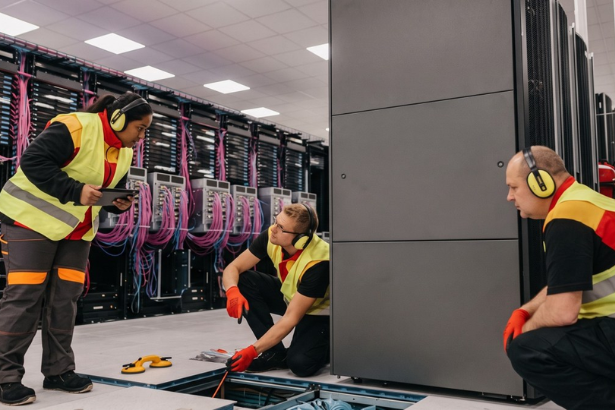
Server racks can be heavy, fragile, expensive, and sensitive to handling conditions. A delivery may need to be synchronized with construction schedules, power availability, cooling infrastructure, and installation teams.
Logistics providers that can coordinate the entire process may have an advantage over companies offering transportation alone.
3. U.S. freight companies are investing in specialized capabilities
FedEx has identified data center and IT equipment transportation as an addressable market worth billions of dollars. The company’s commercial leadership has described growing opportunities across the AI infrastructure supply chain.
FreightWaves also reports that FedEx has seen strong growth in AI-related business and that C.H. Robinson recorded nearly 60% growth in semiconductor and AI-related air freight volumes moving from Asia to the United States over the previous year.
These are company-specific figures reported by FreightWaves, rather than measures of growth across the entire logistics industry.
Nevertheless, they illustrate why major freight providers are developing specialized sales teams, dedicated services, and more flexible transportation options for technology customers.
4. Air freight is gaining importance for high-value shipments
Speed is particularly important when data center construction schedules are tight.
Air freight can move expensive semiconductor equipment, replacement parts, and critical networking components much faster than ocean shipping. The higher transportation cost may be justified when a delay could hold up a much larger infrastructure investment.
Some shipments, however, are better suited to ocean freight or a combination of sea and air transportation. Construction materials, certain server racks, and less time-sensitive equipment may not require the same urgency as advanced chips or critical replacement components.
The challenge for logistics providers is to select the right transportation method for each shipment while maintaining security and delivery reliability.
Expert Analysis: Why AI in Logistics Is Different From Traditional Freight
The biggest change is not simply that more products need to be shipped. It is that the value, complexity, and time sensitivity of some shipments are increasing.
Traditional freight operations often focus on controlling transportation costs, maximizing truck utilization, and maintaining predictable delivery schedules.
AI infrastructure introduces additional requirements.
A logistics provider may need to move a high-value server shipment across multiple countries, coordinate customs documentation, maintain chain-of-custody records, store equipment securely, and deliver it to a construction site during a narrow installation window.
That calls for a combination of transportation expertise, technology, security, and project management.
High-value cargo changes the economics
FreightWaves reports that modern AI servers can cost approximately $1 million to $3 million, depending on the configuration.
Such figures should not be interpreted as the price of every server. They illustrate the potential value concentration in advanced AI computing equipment.
When cargo values are this high, the cost of transportation is only one part of the equation. Insurance, security, specialized handling, and the financial consequences of delayed delivery can become equally important.
A provider that offers dependable execution may be able to command a premium compared with a carrier competing primarily on price.
Shipment visibility is becoming a competitive advantage
Technology companies need to know where critical components are, whether they have cleared customs, and when they will reach their destination.
That information helps project managers coordinate installation crews, warehouse capacity, equipment testing, and commissioning.
Digital tracking, shipment alerts, exception management, and integrated logistics platforms can reduce uncertainty. However, visibility tools are only useful when the underlying shipment data is accurate and updated quickly.
For AI infrastructure projects, logistics visibility must connect operational teams across suppliers, carriers, customs brokers, warehouse operators, and data center construction contractors.
Resilience is replacing the assumption that every shipment can arrive just in time
Just-in-time logistics can reduce inventory costs, but it leaves little room for disruption.
When a critical component is delayed, the consequences can extend beyond one shipment. An installation crew may be left waiting, other equipment may sit idle, and a data center’s launch schedule may slip.
FreightWaves describes how technology companies are increasingly considering inventory buffers, alternative suppliers, and more flexible sourcing arrangements.
The goal is not to abandon efficiency. It is to balance lean operations with enough resilience to manage unexpected delays.
For logistics providers, that creates demand for secure storage, alternative routing, rapid international shipping, and better coordination between transport modes.
Broader Implications: What the AI Logistics Boom Means for the United States
More opportunities for U.S. logistics companies
The expansion of AI infrastructure creates opportunities for freight forwarders, air cargo operators, trucking companies, customs brokers, warehouse operators, and specialist installation providers.
Companies that can combine international freight with secure storage and final-mile delivery may be particularly well positioned.
The market also creates opportunities for smaller specialist providers serving semiconductor manufacturers, equipment suppliers, and data center contractors.
However, growth will not be distributed evenly. Companies need the right facilities, trained personnel, insurance arrangements, and technology to handle high-value equipment safely.
Pressure on air cargo capacity
AI-related shipments compete for transportation capacity with pharmaceuticals, industrial machinery, electronics, and other high-value goods.
When demand grows faster than available capacity, shippers can face higher rates, limited space, and more complicated routing decisions.
FreightWaves reports that logistics providers have seen strong demand on trans-Pacific air routes. If this continues, companies may need to reserve capacity earlier, diversify carrier relationships, or use ocean and sea-air solutions for less urgent cargo.
For U.S. importers, transportation planning is becoming an increasingly important part of data center project management.
New demands on ports, airports, and warehouses
High-value technology cargo needs more than transportation capacity. It also needs secure facilities, suitable loading equipment, trained staff, reliable power where required, and processes for managing sensitive equipment.
Warehouses serving data center customers may need to provide configuration services, staging areas, and carefully coordinated delivery appointments.
These requirements could encourage investment in specialized logistics facilities near major transportation hubs and data center construction markets.
The resulting demand may benefit industrial real estate and logistics infrastructure, although the scale of local gains will depend on where new facilities are built.
Geopolitical risk remains part of the equation
Semiconductor supply chains are globally distributed, with important manufacturing and logistics hubs in Taiwan, South Korea, Japan, China, and Southeast Asia.
Changes in tariffs, export controls, customs requirements, or regional security conditions can affect the movement of these goods.
The DHL and NYU Stern research indicates that trade patterns are adapting to geopolitical pressure rather than simply disappearing. Companies continue to rely on international suppliers while exploring additional markets and sourcing options.
For U.S. logistics businesses, this means planning for alternative routes, maintaining documentation accuracy, and monitoring regulatory changes.
The most resilient networks will be those capable of adapting without losing control over shipment visibility, cost, and delivery schedules.
For more reporting on logistics technology, industrial investment, and changing business models, see The Tech Marketer’s technology and business coverage.
Related History: From E-Commerce Logistics to AI Infrastructure Shipping
The current boom follows earlier changes in the freight industry.
E-commerce growth increased demand for parcel networks, automated fulfillment centers, last-mile delivery, and real-time shipment tracking. Businesses learned to manage large volumes of smaller shipments while meeting increasingly demanding delivery expectations.
The pandemic exposed weaknesses in global supply chains and accelerated interest in inventory buffers, supplier diversification, and better disruption planning.
AI infrastructure is adding another layer of complexity.
Instead of focusing mainly on moving large numbers of consumer packages, logistics providers increasingly need to coordinate expensive equipment across manufacturing, testing, assembly, and installation locations.
The products are different, but the underlying lesson is familiar: logistics systems must evolve as the goods and industries they serve change.
The difference now is the concentration of value in specialized technology shipments and the urgency associated with deploying infrastructure that businesses expect to monetize quickly.
What Happens Next? Three Trends to Watch
1. Specialized data center logistics will attract more investment
As AI infrastructure projects expand, logistics providers are likely to keep developing dedicated warehouse capacity, installation support, and secure transportation services.
DHL has already announced investments in dedicated data center logistics facilities in North America and Asia-Pacific. Its June 2026 announcement describes additional capacity designed to support the region’s expanding data center market.
The key question is whether demand continues growing fast enough to justify these investments over the full infrastructure cycle.
2. Freight planning will become more closely connected to construction schedules
AI data centers require coordination between hardware deliveries, electrical systems, cooling equipment, network infrastructure, and installation crews.
Logistics providers that can integrate shipment data with project schedules may help reduce costly delays.
That could encourage closer partnerships between freight companies, equipment manufacturers, construction contractors, and data center operators.
3. Capacity and cost will determine who captures the opportunity
Strong demand does not guarantee strong profits.
Carriers must manage fuel expenses, aircraft and truck availability, warehouse costs, insurance, labor, and equipment utilization. Building specialized infrastructure also requires capital and carries the risk of underused facilities if market conditions change.
The companies most likely to benefit will be those that can secure suitable capacity, deliver reliably, and maintain pricing discipline.
For shippers, the challenge will be balancing speed against cost while keeping supply chains flexible enough to handle disruptions.
Conclusion: AI in Logistics Is Becoming a Critical Part of the AI Economy
The artificial intelligence boom depends on far more than software and computing power. It also depends on the ability to move semiconductors, servers, networking equipment, cooling systems, and other infrastructure across international supply chains.
The latest FreightWaves reporting shows how this demand is creating opportunities for U.S. freight companies and logistics providers serving trans-Pacific trade.
The market’s growth is reflected in the expansion of specialized data center logistics, stronger demand for high-value air freight, and greater emphasis on shipment visibility and resilience.
But the opportunity comes with challenges. Capacity constraints, geopolitical uncertainty, high equipment values, and complex delivery requirements make this a demanding business.
For logistics companies, the next phase of AI growth will reward more than transportation capacity alone. It will reward the ability to coordinate complicated shipments, protect expensive cargo, and deliver critical equipment when infrastructure projects need it.
AI may be built in data centers, but its physical expansion depends on logistics. The companies that understand this connection could find some of their most valuable growth opportunities in the supply chains behind the technology revolution.
Frequently Asked Questions
1. What is AI in logistics?
AI in logistics refers to the use of artificial intelligence to improve planning, routing, forecasting, warehouse operations, shipment visibility, and other transportation processes. In the current data center boom, the term also describes the growing logistics market created by transporting AI hardware.
2. Why is AI increasing demand for U.S. freight transportation?
AI infrastructure requires semiconductors, servers, networking equipment, cooling systems, and other specialized components. Many are manufactured in Asia and shipped to U.S. data centers, increasing demand for international freight, customs clearance, warehousing, and final delivery.
3. How big is the data center logistics market?
DHL estimated the market at approximately $23 billion in 2025 and projects it could reach at least $35 billion by 2030. These are industry estimates, not audited figures for the entire logistics sector.
4. Why is air freight important for AI infrastructure?
Air freight can move high-value semiconductors, server components, and urgent replacement equipment quickly. It can help data center operators avoid costly installation delays, although ocean freight may be more economical for less time-sensitive shipments.
5. Which logistics companies are benefiting from AI infrastructure demand?
FreightWaves identifies companies including FedEx, DHL, Kuehne+Nagel, C.H. Robinson, and Expeditors as participants in the expanding market for AI-related transportation and data center logistics.
6. What are the main supply chain risks for AI hardware?
Key risks include transportation capacity constraints, geopolitical tensions, tariff changes, export controls, customs delays, supplier concentration, cargo damage, and limited inventory of critical components.
7. Will AI in logistics reduce shipping costs?
It can help reduce inefficiencies through improved forecasting, route planning, and inventory management. However, growing demand for specialized equipment transportation can also increase freight rates and capacity pressure. The overall effect depends on the route, shipment, and market conditions.
8. What should U.S. logistics companies do to benefit from the AI boom?
Companies should evaluate specialized cargo capabilities, secure handling procedures, shipment tracking, customs expertise, flexible transportation options, and partnerships with data center operators. Investments should be based on customer demand and realistic capacity forecasts rather than AI enthusiasm alone.
Sources & References
- FreightWaves: AI Gold Rush Transforms Trans-Pacific Trade and Logistics. Eric Kulisch, October 8, 2026.
- NYU Stern School of Business: Tech Beats Tariffs: Global Trade Growth Accelerates and Globalization Sets New Record. October 7, 2026.
- DHL Group: DHL Expands Asia Pacific Data Center Logistics Capabilities to Support Growing Regional Demand. June 9, 2026.
- DHL: Data Center Logistics and AI Infrastructure. Industry overview of the data center logistics market and end-to-end handling requirements.
- FreightWaves: Global Supply Chain News and Updates. Ongoing coverage of international trade, logistics, and freight market developments.