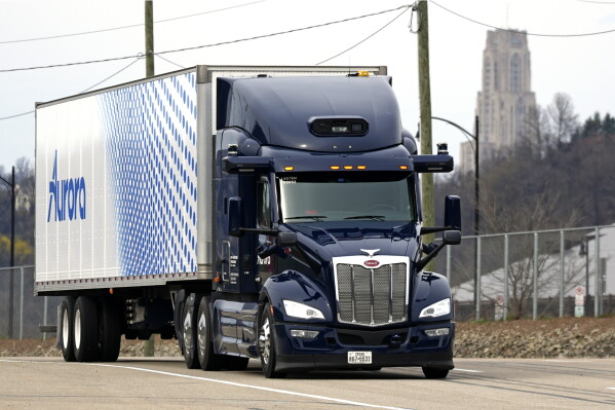
A five-year federal exemption lets Aurora and other qualifying autonomous trucking operators replace roadside warning devices with cab-mounted beacons. The seemingly narrow rule change could remove one more obstacle to scaling driverless freight across the United States.
Introduction
Autonomous trucks just received a significant regulatory boost in the United States.
The U.S. Department of Transportation has approved a five-year exemption allowing Aurora and other qualifying self-driving trucking companies to use high-visibility, cab-mounted warning beacons instead of placing traditional reflective warning devices around a stopped truck. Reuters reports that the decision removes a practical regulatory obstacle for commercial deployment of driverless trucks. Reuters
The change may sound technical. It is. But it also exposes one of the biggest challenges facing autonomous freight: regulations written around the assumption that a human driver is sitting inside the vehicle.
A conventional truck can pull over, and a driver can walk outside to place warning triangles around the vehicle. A Level 4 autonomous truck operating without anyone in the cab cannot perform that task in the same way.
The new exemption addresses precisely that mismatch.
And it arrives as Aurora is preparing for a much larger expansion of its driverless fleet.
Background and Context
The U.S. commercial trucking system was designed around human-operated vehicles.
That assumption appears throughout the federal motor carrier safety rules. Among the requirements are provisions governing what operators must do when a commercial motor vehicle stops on or near a roadway.
Traditional trucks carry warning devices that can be placed around a stopped vehicle to alert approaching motorists.
For an autonomous truck, the problem is obvious.
If there is no driver, there may be nobody available to leave the cab, walk a safe distance from the truck and deploy those warning devices.
Aurora and Alphabet’s Waymo raised that issue with federal regulators in 2023 when they jointly sought a five-year exemption from several warning-device requirements. The application covered Level 4 automated driving system-equipped commercial vehicles and proposed cab-mounted warning beacons as an alternative. FMCSA
The Federal Motor Carrier Safety Administration later granted temporary waivers while the longer-term exemption process moved forward.
In July 2026, FMCSA issued Aurora a limited waiver allowing the company to use cab-mounted warning beacons instead of the devices normally required under federal rules. That waiver was initially effective through October 9, 2026. FMCSA
The new five-year exemption therefore represents a transition from a temporary regulatory workaround toward a longer operating framework.
Latest Update: Autonomous Trucks Receive a Five-Year Exemption
The latest decision is broader than simply giving Aurora permission to operate a particular truck configuration.
According to Reuters, the U.S. Transportation Department approved a five-year exemption for Aurora and other self-driving trucking companies from rules requiring drivers to place warning devices around stopped trucks. Instead, qualifying autonomous trucking companies can use warning beacons mounted directly on the truck cab. Reuters
Read the Reuters report on Aurora’s autonomous-truck exemption
The underlying regulatory request was specifically designed around Level 4 automated driving systems.
FMCSA’s published application describes the proposed technology as flashing amber beacons mounted high on each side of the truck cab. The agency’s earlier application documents also show that the requested exemption was intended to cover other motor carriers operating Level 4 autonomous trucks, provided they notify FMCSA before operating under the exemption. Public Inspection
The distinction between Level 4 and other autonomous-driving systems matters.
A Level 4 system is designed to perform the driving task within its defined operating conditions without requiring a human driver to take over. That makes traditional procedures designed around an onboard driver particularly difficult to apply.
Why the warning beacon matters
The beacon solves a surprisingly practical problem.
Imagine a driverless tractor-trailer experiencing a mechanical problem on a highway shoulder.
A human driver could stop, exit the truck and deploy reflective warning devices.
An autonomous truck without a driver cannot simply send a human outside to perform the same task.
A roof- or cab-mounted warning system keeps the safety signal attached to the vehicle itself.
FMCSA’s regulatory materials describe the beacons as flashing amber lights designed to meet specified photometric performance requirements. Public Inspection
That does not mean the federal government has removed safety requirements.
The exemption establishes a different method for providing the warning signal.
The exemption is not just for Aurora
One of the most important details is that the framework is not limited exclusively to Aurora.
FMCSA’s earlier application documentation described a class-based approach covering other motor carriers operating qualifying Level 4 autonomous commercial vehicles, provided they notify the agency as required. Department of Transportation
That potentially makes the decision more significant for the wider autonomous trucking industry.
Instead of every operator having to solve the same regulatory problem independently, the exemption establishes a path that other qualifying carriers can potentially use.
Aurora Is Already Planning a Much Larger Driverless Fleet
The regulatory decision arrives at an important moment for Aurora.
The company is no longer describing autonomous trucking purely as a technology demonstration.
Aurora said in September that it expects to exit 2026 with 200 driverless trucks operating through its transportation-as-a-service business. The company also said it expects more than 1,000 driverless trucks in 2027 and is targeting more than 30,000 by 2030. Aurora Innovation, Inc.
That is an enormous proposed expansion.
Aurora says its autonomous trucks have already accumulated more than 500,000 driverless miles since commercial launch. It also says its trucks serving customers including McLane and Werner are averaging an annualized utilization rate above 225,000 miles per truck. Aurora Innovation, Inc.
Those figures are company-reported targets and operating metrics, rather than independent forecasts.
Still, they demonstrate why seemingly narrow regulatory questions are becoming increasingly important.
At 20 trucks, a special procedure may be manageable.
At 200, 1,000 or eventually tens of thousands of trucks, regulatory friction becomes an operational scaling problem.
Expert Insights and Analysis
The most interesting part of this development is not the beacon itself.
It is the precedent created by adapting a rule designed for human drivers to an autonomous operating model.
For decades, trucking regulations could reasonably assume that someone was sitting behind the wheel. Autonomous vehicles break that assumption.
That creates two possible regulatory responses.
One approach is to require autonomous trucks to replicate every action a human driver would take.
The other is to ask whether the underlying safety objective can be achieved through a different technology.
The new exemption represents the second approach.
The objective of roadside warning devices is to alert approaching motorists to a stopped commercial vehicle.
The autonomous truck does not necessarily need to perform the exact same human procedure if another system can provide an equivalent safety function.
That is the regulatory logic behind the beacon.
FMCSA’s original application specifically framed the exemption around achieving a level of safety equivalent to or greater than the existing requirements. FMCSA
Why this matters for logistics operators
For freight companies, autonomous trucks are ultimately an operating model, not simply an AI experiment.
The economic proposition depends on vehicles being able to move freight reliably, continuously and at scale.
Every exception that requires human intervention can undermine that proposition.
If an autonomous truck needs a person to accompany it simply because of a regulation written for conventional trucks, the company loses some of the operational advantage it is trying to create.
The warning-device exemption therefore removes one small but concrete example of human-dependent infrastructure from the autonomous trucking workflow.
It does not solve every regulatory challenge.
It does remove one.
Broader Implications
The implications extend beyond Aurora.
1. Autonomous freight is moving from pilot projects toward infrastructure
The industry is increasingly dealing with questions that only become important once autonomous trucks operate commercially.
How should disabled vehicles signal other motorists?
How should roadside inspections work?
How should law enforcement interact with a driverless truck?
What happens during severe weather?
How are vehicles recovered after mechanical failures?
Who is responsible for a stopped autonomous vehicle?
These are operational questions rather than purely technical ones.
The beacon exemption is an example of the regulatory system beginning to answer one of them.
2. Fleets could become easier to scale
Aurora’s 2030 plan calls for more than 30,000 driverless trucks. The company expects its driver-as-a-service model to become an important part of that expansion. Aurora Innovation, Inc.
If autonomous freight reaches that scale, standardized regulatory procedures will become increasingly important.
A carrier operating thousands of autonomous trucks cannot rely on bespoke regulatory arrangements for every state, vehicle configuration or roadside event.
Federal exemptions that establish repeatable operating rules could therefore become an important part of the industry’s infrastructure.
3. Truck manufacturers are becoming part of the autonomy equation
Aurora’s scaling plans also involve several major truck platforms.
The company currently integrates its technology with International LT trucks and Volvo VNL Autonomous vehicles. Aurora has also described collaboration with PACCAR on a future autonomy-enabled platform. Aurora Innovation, Inc.
That points toward a future where autonomy is increasingly integrated into the truck manufacturing process rather than added as a small aftermarket technology package.
4. Regulation may become a competitive factor
The autonomous trucking race is not just about which company develops the best perception system.
It is also about which companies can operate efficiently inside the regulatory framework.
A technology that works technically but requires extensive human intervention may have a harder time scaling than one designed around the full operational environment.
That makes regulatory engineering almost as important as software engineering.
For additional coverage of logistics technology, automation and the future of freight, an internal link to The Tech Marketer would fit naturally here.
Related History and Comparable Technologies
Autonomous trucking has spent years moving through the same basic progression seen in other emerging transportation technologies.
Early development focused heavily on whether autonomous systems could perceive roads, identify vehicles and control a truck.
As the technology matured, attention shifted toward commercial deployment.
That brought a new category of problems.
A truck can drive itself, but who services it?
A vehicle can navigate a highway, but who responds when it breaks down?
A fleet can operate without drivers, but what happens at a depot?
The warning-device issue belongs to this second generation of questions.
It is less glamorous than artificial intelligence or autonomous perception, but arguably more important for commercial deployment.
Aurora’s current strategy illustrates that transition. The company says its second-generation commercial hardware has been designed for a one-million-mile operating lifespan, while its production partners are preparing for higher-volume vehicle integration. Aurora Innovation, Inc.
The company has also said its second-generation commercial hardware is already being deployed on International LT trucks. Aurora
The broader trend is clear: autonomous trucking is becoming a systems-integration problem involving software, hardware, manufacturing, freight customers and regulators.
What Happens Next
The next stage will be less about whether autonomous trucks can drive and more about whether the industry can scale them economically and safely.
Aurora says it expects to finish 2026 with approximately 200 driverless trucks and move beyond 1,000 in 2027. Its longer-term target is more than 30,000 trucks by 2030. Aurora Innovation, Inc.
Those targets will put pressure on several parts of the ecosystem.
Regulatory expansion
The warning-beacon exemption could become a template for resolving other regulations that assume a human driver.
Fleet economics
Aurora expects its driver-as-a-service model to help accelerate deployment by shifting more of the vehicle ownership and operating model toward customers. Its investor presentation projects more than $5 billion in annual revenue by 2030. SEC
Those are company projections, not guaranteed outcomes.
Manufacturing capacity
Scaling from hundreds to thousands of autonomous trucks requires a substantial increase in vehicle production and autonomy-system integration.
Aurora says Roush is targeting production of 20 upfitted trucks per week during October 2026. Aurora Innovation, Inc.
Safety data
Perhaps most importantly, regulators and freight customers will continue to watch real-world safety performance.
A five-year exemption is valuable only if operators can demonstrate that the alternative safety system works as intended.
Reuters reports that the new exemption includes requirements for operators to notify FMCSA and report crashes involving beacon-equipped trucks, while the agency retains authority to revoke the exemption if safety concerns arise. Reuters
That creates an important feedback loop between deployment and regulation.
Conclusion
The latest autonomous trucks decision is easy to underestimate because it concerns a very specific piece of trucking equipment.
But the larger story is about something much bigger: rewriting transportation rules for vehicles that no longer have a driver inside them.
The U.S. Transportation Department’s five-year exemption allows Aurora and other qualifying Level 4 autonomous trucking operators to use cab-mounted warning beacons instead of traditional warning devices placed around stopped trucks. Reuters
For Aurora, the timing is significant.
The company says it expects to reach 200 driverless trucks by the end of 2026, more than 1,000 in 2027 and more than 30,000 by 2030. Aurora Innovation, Inc.
Whether those targets are ultimately achieved will depend on technology, manufacturing, freight demand, economics and regulation.
But the direction is increasingly clear.
The autonomous trucking industry is moving beyond the question of “Can the truck drive itself?”
The harder question now is “Can the entire logistics system operate around a truck that has no driver?”
This exemption is one small answer to that much larger question.
FAQ
What are autonomous trucks?
Autonomous trucks are commercial vehicles equipped with automated driving systems capable of performing some or all driving functions without continuous human control. The latest U.S. exemption specifically concerns Level 4 automated driving system-equipped commercial motor vehicles. Department of Transportation
What did the new autonomous trucks exemption change?
The five-year exemption allows qualifying autonomous trucking operators to use cab-mounted warning beacons instead of placing traditional warning devices around a stopped truck. Reuters
Does the exemption apply only to Aurora?
No. The regulatory framework was designed to cover Aurora and other motor carriers operating qualifying Level 4 autonomous commercial vehicles, subject to required notification and other conditions. Department of Transportation
Why do driverless trucks need special warning beacons?
Traditional regulations assume a human driver can exit a stopped truck and place warning devices around it. A fully driverless truck does not have that capability. A cab-mounted beacon provides a visible warning while remaining attached to the vehicle.
How many autonomous trucks does Aurora currently operate?
Reuters reports that Aurora was operating about 20 autonomous trucks at the time of its October 2026 report. Aurora separately says it expects to exit 2026 with approximately 200 driverless trucks in operation. Reuters
How many autonomous trucks does Aurora plan to operate?
Aurora has announced a target of more than 30,000 driverless trucks by 2030. The company expects to have more than 1,000 in operation by the end of 2027. Aurora Innovation, Inc.
Does this mean driverless trucks are now fully approved across the United States?
No. The exemption addresses a specific set of federal warning-device requirements. Autonomous trucking remains subject to other federal, state and operational requirements.
Will the exemption make autonomous trucking cheaper?
Potentially, by removing one operational requirement that would otherwise require a human intervention. However, the exemption itself does not establish the overall economics of driverless trucking. Those depend on vehicle costs, autonomy hardware, software, insurance, maintenance, utilization, freight rates and regulatory requirements.
Sources & References
- Reuters, “US grants Aurora exemption for self-driving trucks safety feature”
Read Reuters - Federal Motor Carrier Safety Administration, “Parts and Accessories Necessary for Safe Operation; Application for Exemption From Aurora Operations, Inc.”
Read FMCSA regulatory document - Aurora Innovation, “Aurora Outlines 2030 Vision to Scale to 30,000 Driverless Trucks at Analyst and Investor Day”
Read Aurora’s announcement - Federal Motor Carrier Safety Administration, “Cover Letter to Aurora Operations Inc. Waiver of Warning Device Requirements”
Read FMCSA waiver document - TechCrunch, “Aurora CFO says 30,000 driverless trucks by 2030 isn’t as far-fetched as it sounds”
Read TechCrunch analysis