Introduction
The autonomous trucks US market is approaching an important regulatory moment.
A Federal Motor Carrier Safety Administration waiver allowing certain Level 4 autonomous trucks to use cab-mounted flashing warning beacons instead of traditional roadside warning devices is scheduled to expire at 11:59 p.m. on October 9, 2026. FMCSA
The deadline would normally be a technical regulatory matter. Instead, it has become part of a larger legal dispute over how federal regulators should authorize autonomous commercial vehicles.
According to recent reporting from FreightWaves, an Illinois cargo-van operator is asking the 7th U.S. Circuit Court of Appeals to block the current waiver and prevent FMCSA from repeatedly renewing it. FreightWaves
The outcome matters beyond a flashing light on a truck. It could help shape how regulators, carriers and autonomous trucking companies handle the transition from human-driven freight to vehicles capable of operating without a driver behind the wheel.
Background and Context
Traditional commercial trucks stopped on the traveled portion or shoulder of a highway are generally required to use warning devices placed around the vehicle.
For a conventional truck, that procedure assumes someone is physically available to leave the cab and place warning devices on the roadway.
A driverless truck creates a different problem.
If there is no driver in the cab, asking someone to exit the vehicle and place reflective triangles or other warning equipment defeats one of the basic operational advantages of autonomous trucking.
Aurora and Waymo previously sought a five-year exemption that would allow Level 4 automated commercial vehicles to use cab-mounted warning beacons instead of the warning devices required by federal rules. FMCSA denied that exemption in December 2024. FMCSA
FMCSA later adopted a temporary waiver framework.
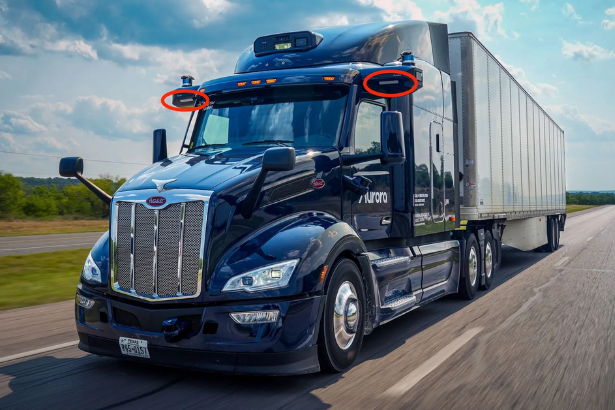
The current waiver permits Aurora and other qualifying carriers operating Level 4 automated trucks to use cab-mounted beacons under specified conditions. The July 2026 waiver runs from July 10 through October 9. FMCSA
The beacon itself is designed to provide an external warning without requiring a human operator to place equipment on the road.
Aurora describes the system as an alternative to reflective triangles for a stopped autonomous truck. Aurora
Latest Update: Autonomous Trucks US Hit a Regulatory Deadline
The immediate issue is what happens after October 9.
The July waiver says that after its expiration, it will be reissued unless there has been a violation of the terms, a safety notification from a carrier or an FMCSA determination of a safety deficiency. FMCSA
That language has become central to the legal challenge.
FreightWaves reports that FMCSA has issued four three-month waivers to Aurora since October 2025, with each subsequent waiver taking effect after the previous one expired. FreightWaves
An Illinois cargo-van operator, Kostas Giannoulias, is challenging that cycle in the 7th Circuit.
He is asking the court to stay the current waiver and prevent a successor waiver while his case proceeds. The Justice Department, representing FMCSA, has argued that the operator has not demonstrated the kind of imminent harm necessary for the requested relief. FreightWaves
As of the latest FreightWaves report published October 2, the court had not ruled on the motion. FreightWaves
That leaves the regulatory picture unusually fluid just days before the deadline.
Why the Beacon Rule Matters for Driverless Freight
It is tempting to dismiss the issue as a narrow technicality.
It is not.
The entire operational model of autonomous trucking depends on designing vehicles and procedures around the assumption that there may be no human driver available to perform traditional roadside tasks.
That includes what happens when a truck:
- Breaks down
- Stops on the shoulder
- Experiences a mechanical problem
- Needs roadside assistance
- Encounters an unexpected obstruction
- Becomes disabled after an incident
For a human-driven truck, these situations are already integrated into standard trucking procedures.
For a driverless truck, the safety system must account for the absence of a driver.
That is why the warning-beacon question is part of a much larger discussion about how federal commercial vehicle rules should evolve for Level 4 autonomous systems.
What FMCSA’s Waiver Actually Allows
The current waiver is not a blanket permission for autonomous trucks to ignore federal safety requirements.
It is specifically focused on certain warning-device requirements.
FMCSA says the waiver provides relief from requirements covering warning-device placement, steady-burning lamps and the types and number of warning devices required under federal regulations. It permits qualifying operators to use cab-mounted warning beacons instead. FMCSA
The conditions also matter.
The beacons must activate as soon as possible, and no later than 10 minutes, when a covered truck stops on the traveled portion or shoulder for reasons other than a necessary traffic stop. They must remain active for the duration of the stop. FMCSA
The waiver also requires other compliance measures and reporting.
So the regulatory debate is not simply about whether autonomous trucks should be allowed to operate without warning equipment.
It is about whether a different warning system can provide a sufficiently equivalent safety outcome.
The Legal Challenge Adds a New Layer of Uncertainty
The legal dispute focuses partly on whether FMCSA can continue issuing successive temporary waivers rather than resolving the issue through a longer-term exemption or another formal regulatory pathway.
According to FreightWaves, Giannoulias argues that the waiver exceeds FMCSA’s statutory authority and should have gone through the exemption or pilot-program process, both of which involve public notice and comment. FreightWaves
FMCSA’s position is different.
Justice Department lawyers argued that the agency’s authority does not prohibit consecutive waivers and pointed to previous instances in which temporary FMCSA waivers were renewed repeatedly. FreightWaves
That disagreement creates an important regulatory question:
Can temporary regulatory flexibility become a long-term operating framework through repeated renewals?
The answer could influence more than this particular beacon system.
The Numbers Show Why the Issue Is Getting More Important
The current fleet operating under the waiver remains small compared with America’s overall trucking population.
The Justice Department told the court that, counting Aurora and Kodiak, approximately 45 self-driving trucks were operating under the waiver at the time of its response. FreightWaves
But the companies involved expect that number to grow.
Aurora told FMCSA in its five-year exemption request that it had 109 Class 8 vehicles and expected more than 200 Level 4 trucks by the end of 2026. Public Inspection Federal Register
Aurora’s own second-quarter shareholder letter said it was fully allocated to exit 2026 with 200 driverless trucks in operation. Aurora Innovation, Inc.
That difference between today’s fleet and tomorrow’s fleet is important.
A rule affecting dozens of vehicles today could affect hundreds or thousands as autonomous freight scales.
Aurora Is Already Moving Toward Commercial Scale
The regulatory debate is happening while Aurora is expanding its actual trucking operations.
In July, Aurora said its second-generation driverless trucks were operating without a person behind the wheel. The company described the launch as the foundation for higher-volume commercial operations. Aurora
Aurora’s second-quarter shareholder letter also said the company had agreements involving freight corridors including Dallas to Laredo and Fort Worth to Phoenix. Aurora Innovation, Inc.
The company has positioned the Sun Belt as an important early operating region.
That geography is significant for freight.
Texas in particular combines major interstate corridors, large distribution markets, cross-border trade and long-haul trucking demand.
For autonomous trucking developers, that creates a natural environment for testing and commercializing driverless freight.
Expert Insights and Analysis
The central issue is not whether autonomous trucks are technologically possible.
They are already operating on public roads.
The more difficult question is whether the regulatory infrastructure can scale at the same pace as the technology.
A three-month waiver can work as a bridge.
It becomes more complicated when a company is building a commercial fleet around it.
That creates a planning problem for carriers and investors.
If a company expects to operate hundreds of autonomous trucks, it needs confidence that the regulatory framework supporting those operations will still exist months and years later.
This is particularly important because autonomous trucks are not just software products.
They are physical assets with manufacturing schedules, insurance requirements, maintenance networks, freight contracts and capital costs.
Regulatory uncertainty therefore has the potential to affect investment decisions.
Safety is the other side of the equation
Regulators also face a legitimate safety question.
If a driverless truck becomes disabled, road users need to recognize it quickly.
The government has argued that the beacon system can provide an appropriate warning and cited agency findings regarding driver response to beacons versus traditional warning triangles. FreightWaves reported that the government’s court filing said differences in response at straight locations in Aurora’s study were less than four-tenths of one percent. FreightWaves
But the legal challenger has questioned whether that evidence establishes equivalence in the way FMCSA claims.
That distinction matters.
A safety regulator has to evaluate not just whether a technology works in a controlled or studied environment, but whether it remains reliable across the unpredictable conditions of real-world trucking.
A Reported Crash Has Become Part of the Debate
The legal challenge has also raised questions about a July crash involving an Aurora truck near Aledo, Texas.
According to FreightWaves, the truck collided with a pickup that ran a red light at the intersection of Farm-to-Market Road 1187 and an Interstate 20 service road.
Aurora’s report to NHTSA listed the automated driving system as “Verified Engaged,” but Aurora’s narrative said the truck was in manual mode and that the operator had disengaged autonomy approximately 12 seconds before the collision. The Texas crash report cited the pickup driver’s disregard of the traffic signal as a contributing factor. No injuries were reported. FreightWaves
The incident is relevant to the legal dispute because the challenger questioned whether the beacon requirements were followed after the truck stopped.
However, it is important not to overstate what the crash demonstrates.
The available reporting does not establish that the autonomous system caused the collision.
It also does not establish that the beacon system failed.
Those are separate questions from the broader regulatory dispute.
Broader Implications for the U.S. Freight Industry
The autonomous trucks US debate is ultimately about much more than Aurora.
The industry needs predictable rules
Truck manufacturers, autonomous technology developers and freight carriers need regulatory certainty before committing significant capital to large-scale deployment.
A patchwork of temporary exemptions can make early deployment possible, but long-term commercial planning requires clearer rules.
Safety procedures will have to change
Driverless trucks cannot simply copy every procedure designed for human drivers.
Roadside assistance, emergency response, inspections, fueling, maintenance and breakdown management all have to be redesigned around autonomous vehicles.
Aurora has already been testing automated navigation around truck stops and third-party fueling as part of its scaling strategy. Aurora Innovation, Inc.
That suggests the regulatory question extends into almost every part of the freight operating model.
Autonomous trucking could reshape freight capacity
If driverless trucks can operate more continuously on appropriate long-haul routes, carriers could potentially use autonomous vehicles to supplement human drivers and increase capacity.
Aurora has said its technology could add flexible capacity on long-haul corridors while allowing human drivers to focus on other portions of freight networks. Aurora Innovation, Inc.
The real economic impact will depend on utilization, safety, maintenance, insurance, vehicle costs, regulatory requirements and shipper adoption.
For more analysis of how automation is reshaping transportation and supply chains, see The Tech Marketer.
Related History and Comparable Technologies
The warning-beacon dispute fits into a longer history of transportation rules adapting to new technology.
Commercial vehicle regulations were generally written around a world in which a human driver was physically present.
Autonomous trucks challenge that assumption.
The same pattern has appeared in other areas of transportation technology.
Advanced driver-assistance systems forced regulators to distinguish between automated functions and human responsibility.
Electric trucks introduced new questions around charging infrastructure, vehicle weight and emergency response.
Connected vehicles introduced new questions around cybersecurity and data.
Autonomous trucking brings all of those questions together while adding a particularly difficult issue: what happens when the vehicle is operating without a person inside who can respond to a roadside event?
The beacon controversy is therefore a useful early case study in how existing transportation regulations may need to evolve.
What Happens Next?
The immediate date to watch is October 9, 2026.
The current FMCSA waiver is scheduled to expire at 11:59 p.m. that day. FMCSA
Several outcomes are possible.
FMCSA reissues the waiver
This would preserve the existing operating framework and allow qualifying autonomous trucks to continue using cab-mounted beacons.
The court intervenes
The 7th Circuit could potentially alter the situation if it grants the challenger’s requested relief.
As of the latest available reporting, the court had not ruled on the motion. FreightWaves
The longer-term exemption advances
Aurora has a separate five-year exemption request pending with FMCSA. The agency published the request in April 2026, and the public comment period closed May 15. FMCSA
A longer-term exemption could provide greater certainty than repeated three-month waivers.
Congress could establish a broader framework
Aurora has pointed to federal legislative efforts that could establish a more unified national framework for autonomous trucking. The company said the BUILD America 250 Act passed the House Transportation and Infrastructure Committee and includes provisions addressing cab-mounted warning beacons. Aurora Innovation, Inc.
Whether and when such legislation becomes law remains a separate question.
Conclusion
The autonomous trucks US market is reaching a point where technology is no longer the only barrier to scale.
The trucks exist. Commercial freight operations are beginning. Companies are investing in production and customer networks.
Now the regulatory system has to catch up.
The October 9 beacon-waiver deadline is a relatively small event compared with the broader autonomous trucking revolution, but it highlights a fundamental challenge.
Driverless vehicles cannot simply operate under rules designed for vehicles with drivers.
The industry needs a framework that addresses the realities of autonomous freight while maintaining a clear safety standard for everyone sharing the road.
For Aurora and other autonomous trucking companies, the next few days could therefore provide an important signal about how quickly the United States is prepared to move from temporary regulatory accommodations to a durable framework for driverless freight.
FAQ
1. What is the autonomous trucks US beacon waiver?
It is an FMCSA waiver allowing qualifying Level 4 autonomous commercial vehicles to use cab-mounted warning beacons instead of certain traditional roadside warning devices when stopped under specified conditions. FMCSA
2. When does the autonomous trucks US beacon waiver expire?
The current waiver is scheduled to expire at 11:59 p.m. on October 9, 2026. FMCSA
3. Why do autonomous trucks need special warning beacons?
A driverless truck does not have a human driver available to exit the vehicle and place traditional warning devices on the roadway. The cab-mounted beacon provides an alternative warning signal.
4. Who is challenging the FMCSA waiver?
An Illinois cargo-van operator, Kostas Giannoulias, has asked the 7th U.S. Circuit Court of Appeals to stay the current waiver and prevent successor waivers while his case proceeds. FreightWaves
5. Which companies can operate under the waiver?
The waiver covers Aurora and other carriers operating qualifying Level 4 automated trucks that notify FMCSA and certify compliance with the waiver’s conditions. FreightWaves reported that Kodiak Robotics, Waabi Logistics and Stack AV had opted in alongside Aurora. FreightWaves
6. How many autonomous trucks are expected to operate under the system?
Aurora told FMCSA it expected to have more than 200 Level 4 trucks by the end of 2026. Aurora separately said it was fully allocated to exit 2026 with 200 driverless trucks in operation. Public Inspection Federal Register
7. Is the beacon waiver the same as permission for autonomous trucks to operate?
No. The waiver specifically addresses certain warning-device requirements. Autonomous truck deployment also involves federal and state regulatory requirements, vehicle safety rules and operational conditions.
8. Why is the dispute important for logistics?
If autonomous trucks are eventually deployed at scale, regulations covering roadside safety, maintenance, fueling, inspections and emergency response will need to work without assuming a human driver is always present.
Sources & References
- “Autonomous truck beacon waiver moves closer to October renewal amid legal challenge”
FreightWaves - “Waiver of Warning Device Requirements Terms and Conditions (July 9, 2026)”
Federal Motor Carrier Safety Administration - “Cover Letter to Aurora Operations Inc. Waiver of Warning Device Requirements (July 9, 2026)”
Federal Motor Carrier Safety Administration - “Parts and Accessories Necessary for Safe Operation; Application for Exemption From Aurora Operations, Inc.”
Federal Motor Carrier Safety Administration / Federal Register - “Second Quarter 2026 Shareholder Letter”
Aurora Innovation