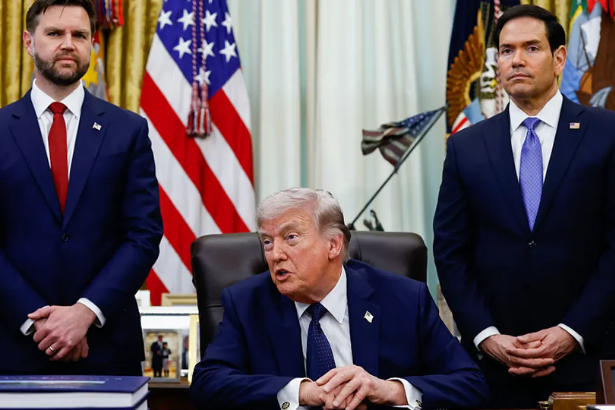
The Trump 2028 presidential ticket conversation just went from private dinner speculation to public applause test. Speaking at a Rose Garden dinner during National Police Week on Monday, May 12, President Donald Trump turned a law enforcement celebration into an impromptu political primary, asking the assembled crowd to weigh in on who they wanted to see on the 2028 Republican ticket. Vice President J.D. Vance got more applause than Secretary of State Marco Rubio. Trump called both of them a “dream team.” Then he told the room that did not constitute an endorsement. Here is everything you need to know about where the 2028 race actually stands, who is running, who is not, and what the wildcards could change.
Editorial Note: This article presents political analysis across party lines and does not reflect an editorial endorsement of any candidate, party, or political position.
What Trump Actually Said at the White House Dinner
President Trump took a poll, by applause, during a dinner in the White House Rose Garden on Monday night, asking the crowd who they want to see on the 2028 Republican presidential ticket. Speaking at an event marking the start of National Police Week, the president veered off course and spoke for several minutes about the next presidential election. Fortune
“Who’s it going to be? Is it gonna be J.D. [Vance]? Is it gonna be somebody else? I don’t know,” Trump said. He then proceeded to pit Vice President Vance and Secretary of State Marco Rubio against one another, asking the crowd to show their support for who they liked. “Who likes J.D. Vance?” he queried. “Who likes Marco Rubio?” he continued, adding that the names together “sound like a good ticket.” TechCrunch
“By the way, I do believe that’s a dream team, but these are minor details,” the President said, notably stopping short of endorsing either member of his Administration. TechCrunch
Vance received a stronger reaction than Rubio from the crowd. “But you know it’s perfect, there was a big, and then a very nice,” Trump said of the applause. “I think it sounds like presidential candidate and vice presidential candidate.” Fortune
This Is Not the First Time: The “Marco or JD?” Pattern
President Trump has begun high-level discussions with senior advisors regarding the future of the Republican Party and the potential GOP nominee for the 2028 presidential election. Sources indicate that Trump has been frequently polling his inner circle, asking friends and aides, “JD or Marco?” BudgetFitter
Back in March, he hosted a gathering at his Mar-a-Lago resort in Palm Beach, Florida, where he posed a pressing question to donors and top administration officials: “Marco or JD?” The responses from that room were mixed, with some attendees favoring Rubio, while others felt the room was split. BudgetFitter
According to reports, Trump has previously polled the possibility of Vance and Rubio appearing together on a 2028 Republican ticket during private dinners and meetings with guests at the White House. TechCrunch
Georgetown University government professor Hans Noel offered context for why Trump keeps running this exercise publicly rather than privately. “President Trump has changed things,” Noel told TIME. “He is very much about showmanship and, by making it into an applause-meter kind of event, Trump wants to not only make this more entertaining, but put himself in the middle of it.” TechCrunch
JD Vance: The Front-Runner With a National Polling Problem
Based on every available data point — internal Republican polling, prediction markets, and the applause test at the Rose Garden dinner — J.D. Vance enters 2026 as the nominal front-runner for the 2028 Republican presidential nomination.
Prediction markets currently give Vance roughly a 37% chance of winning the 2028 Republican nomination, compared to approximately 27% for Rubio, though the gap has narrowed in recent months amid the ongoing conflict in Iran. The Texas Tribune
In an interview in November 2025, Vance acknowledged that he thought about running for president in 2028 and planned to speak with President Trump about it after the midterms, but said he wants to focus on winning the midterms first. In May of 2026, Vance traveled to early primary state Iowa to support representative Zach Nunn, fueling speculation that he was laying groundwork for a presidential run. Engineering News-Record
The Iowa trip is not a casual visit. Iowa’s position in the early primary calendar makes it one of the most consequential states for any Republican seeking the nomination. A sitting Vice President appearing in Iowa in May 2026 — nearly two and a half years before the 2028 election — is a well-understood signal about political ambitions. Polling suggests GOP voters may prefer Vance over Rubio, and that they recognize him more. But like Trump, whose disapproval rating has consistently sat below 40 percent in recent weeks, Vance’s popularity with the American public could be a weak spot for a potential candidacy. Fortune
Marco Rubio: The Running Mate Who Might Actually Be Running
Marco Rubio’s position in the 2028 conversation is unusually complicated. He is simultaneously a potential presidential candidate, a potential vice presidential candidate, and a man who has publicly positioned himself as willing to defer to Vance.
Rubio indicated in a March 2026 interview on CBS News Sunday Morning that he was “considering” a run for president in 2028, saying it was a fifty-fifty chance he would run. He stated in a December 2025 ABC News interview that he did not view Vice President JD Vance as Trump’s “heir apparent.” Engineering News-Record
Other sources report Rubio acknowledging Vance as the clear front-runner for the nomination, and that he “will do anything he can just to support the vice president in that effort.” According to Vanity Fair, Rubio has said that he will not enter the race if JD Vance enters. Engineering News-Record
Both Vance and Rubio have recently been tested by high-profile diplomatic assignments. Vance traveled to Hungary in April to support long-time Trump ally Viktor Orbán ahead of the Hungarian election. Orbán ultimately lost to opposition leader Péter Magyar in a landslide defeat that ended his 16-year rule. TechCrunch
That Hungary trip result is a minor but notable data point. Vance put his name behind Orbán’s reelection effort. Orbán lost decisively to a democratic opposition candidate. The outcome will not define Vance’s political future, but it is a foreign policy stumble that his eventual opponents are likely to reference.
The Third Term Question: What the 22nd Amendment Says
No accounting of the Trump 2028 presidential ticket conversation is complete without addressing the parallel track: Trump’s own repeated suggestions that he might seek a third term.
Trump himself has repeatedly teased the idea of seeking a third term, despite the 22nd Amendment of the U.S. Constitution. His remarks gained further traction when the Trump Store started selling “Trump 2028” merchandise. He later went a step further, telling a crowd that “we actually already served three,” repeating his false claims that the 2020 election — won by President Joe Biden — was stolen. TechCrunch
The 22nd Amendment prohibits any person from being elected president more than twice. Legal scholars across the political spectrum are unanimous that Trump is constitutionally ineligible to run again in 2028. Whether the applause test, the merchandise, and the repeated public teasing represent genuine intent or strategic maintenance of his grip on the Republican Party’s attention is a question that political analysts continue to debate.
The Tucker Carlson Wildcard
The 2028 Republican field extends well beyond Vance and Rubio. Among the names generating the most discussion in Republican circles, Tucker Carlson represents the most unpredictable variable.
Tucker Carlson has positioned himself on the isolationist, “America First” wing of the Republican Party, clashing with President Donald Trump over U.S. military action in Iran, which he described as “absolutely disgusting and evil.” Following that rift, former U.S. Representative Marjorie Taylor Greene publicly urged Carlson to seek the presidency. In a March 2026 interview on Piers Morgan Uncensored, when pressed on a possible presidential run, Carlson did not rule one out, saying “As for Ted Cruz, he says he’s running against me for president. I almost want to run for president just to debate Ted Cruz.” Engineering News-Record
Carlson’s potential candidacy is the one that most disrupts the Vance-Rubio binary. His break with Trump over Iran gives him ideological space to run as a distinct alternative to a Vance who is closely tied to Trump’s foreign policy decisions. His 22 million YouTube subscribers give him a media infrastructure that no traditional politician can replicate without decades of establishment building.
The Democratic Side: Harris, Newsom, and a Party in Flux
On the other side of the aisle, Kamala Harris, who lost to Trump in 2024, has said she is thinking about another presidential run. Gavin Newsom, who has reached his term limit in California, has put himself on the national stage, often going head-to-head with Trump. In a Harvard/Harris poll conducted in April, 50 percent of Democratic voters said they would want to see Harris on the 2028 presidential ticket, with Newsom coming in second at 22 percent. Fortune
Harris’s 50% support among Democratic primary voters is a surprisingly strong number for a candidate who lost the general election less than two years ago. It reflects both name recognition and the absence of a dominant alternative — not necessarily an indicator of where the Democratic primary will actually land in 2027 and 2028 as the field develops.
Broader Implications: What the Trump 2028 Presidential Ticket Talk Actually Signals
The Trump 2028 presidential ticket conversation, conducted by applause meter at a law enforcement dinner, is a study in how Trump uses public spectacle to maintain political leverage even as he formally holds power. By publicly elevating Vance and Rubio without formally endorsing either, he keeps both men competitive with each other and both competing for his approval. By naming a “dream team” without calling it an endorsement, he signals preferred outcomes while preserving maximum flexibility.
The practical effect for both Vance and Rubio is that they are now running in a primary they have not officially entered, for a party whose leader has not officially stepped aside, two and a half years before Election Day. The applause test in the Rose Garden is less a political poll than a reminder of who still controls the Republican Party’s attention — and it is not either of them. For more on the biggest stories in politics and technology, visit The Tech Marketer.
Latest Updates
The Trump 2028 presidential ticket discussion intensified following Monday night’s Rose Garden dinner. Here is where to follow the full story:
- WIRED has the full analysis of Trump’s inner circle and the 2028 presidential ticket dynamics, including who the key figures are and what the race looks like this far out. Read more at WIRED
- TIME has complete coverage of the White House applause test, the Georgetown University analysis of Trump’s showmanship strategy, and the diplomatic context of both Vance’s and Rubio’s recent international assignments. Read more at TIME
- The Boston Globe has the full account of the Rose Garden dinner poll, the Harvard/Harris Democratic polling on Harris and Newsom, and the prediction market odds for both Vance and Rubio. Read more at The Boston Globe
FAQ: Trump 2028 Presidential Ticket
1. What did Trump say about the 2028 presidential ticket at the White House dinner? At a Rose Garden dinner during National Police Week on May 12, 2026, Trump polled the crowd by applause on whether they preferred J.D. Vance or Marco Rubio. Vance got a stronger response. Trump called them a “dream team” but explicitly said his comments did not constitute an endorsement of either man.
2. Who are the leading Republican contenders for the 2028 presidential nomination? Prediction markets give J.D. Vance approximately 37% odds of winning the 2028 Republican nomination and Marco Rubio approximately 27%. Tucker Carlson has emerged as a wildcard after breaking with Trump over Iran policy. Other names discussed include Tom Cotton, Ted Cruz, Tulsi Gabbard, and Josh Hawley.
3. Can Donald Trump run for president again in 2028? No. The 22nd Amendment to the US Constitution prohibits any person from being elected president more than twice. Trump is constitutionally ineligible to run for president in 2028, despite repeatedly teasing the idea publicly and selling “Trump 2028” merchandise.
4. Who is the leading Democratic contender for 2028? A Harvard/Harris poll from April 2026 found that 50% of Democratic voters want to see Kamala Harris on the 2028 ticket, with California Governor Gavin Newsom second at 22%. Neither has officially announced a campaign.
5. Has Marco Rubio said he will run in 2028? Rubio said in March 2026 that a presidential run was a “fifty-fifty” chance. He has also said he will not enter the race if J.D. Vance enters and has publicly described Vance as the clear front-runner for the Republican nomination, saying he would do anything to support Vance’s effort.