


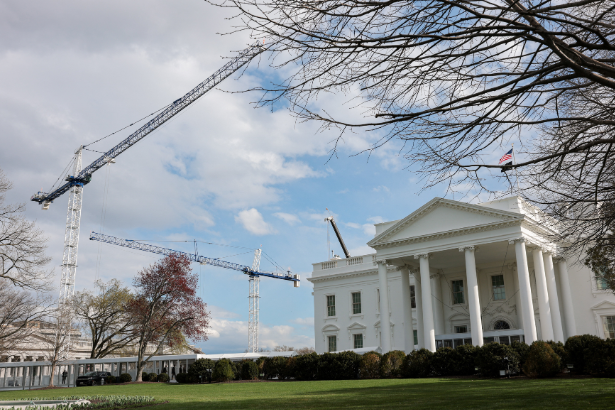
The White House ballroom construction lawsuit 2026 is one of the most complex intersections of executive power, congressional authority, historic preservation law, and national security in recent memory. President Trump’s plan to build a 90,000-square-foot ballroom on the site of the demolished White House East Wing — privately financed at approximately $400 million — has been blocked above ground by a federal judge, stalled in Congress by a Senate parliamentarian ruling, complicated by a shooting at the White House perimeter, and simultaneously defended by the Justice Department as essential to presidential security. An appellate court has allowed construction to continue until at least early June. The next hearing before a three-judge panel will determine what, if anything, can proceed.
What Trump Is Building: The East Wing Ballroom
The White House ballroom construction lawsuit 2026 centers on one of the most ambitious and controversial presidential construction projects in American history. The East Wing of the White House — originally constructed during Franklin D. Roosevelt’s administration — was demolished in late 2025 to make way for Trump’s proposed ballroom. The project is designed at 90,000 square feet with an adjacent 9,000-square-foot ballroom structure.
Trump has described the project as a gift to America and has held a rendering of it on Air Force One. The administration argues the ballroom is intended to be ready by January 2029. The cost — approximately $400 million — is meant to be covered by donations from businesses and private donors, not direct appropriations. Trump told reporters the funds included in the reconciliation bill were specifically for security features, not the ballroom structure itself.
The ballroom’s security specifications are extraordinary. Court filings by Attorney General Todd Blanche describe features including heavy steel construction, drone-proof roof, missile-resistant and drone-proof columns, bullet-, ballistic-, and blast-proof glass, military-grade ventilation, bomb shelters, a state-of-the-art hospital and medical facility, top-secret military installations, sniper stations, a drone port, and hermetic sealing to prevent air contamination.
Judge Leon’s Core Ruling: The President Is Not the Owner
The White House ballroom construction lawsuit 2026 produced one of the most quoted judicial lines of the year. U.S. District Judge Richard Leon — appointed by President George W. Bush — issued an injunction on March 31 blocking construction, writing: “The President of the United States is the steward of the White House for future generations of First Families. He is not, however, the owner.”
Leon said construction “must stop” because no law “comes close” to giving Trump authority to demolish and reconstruct at the White House at this scale without congressional authorization. He cited the $400 million scope as categorically different from the routine presidential renovations the administration cited as precedent: “It’s not $400 million worth of destruction and construction.” He rejected the administration’s argument that an existing federal statute authorizing presidential expenditures for White House improvements covered a project of this magnitude, saying that law applies to “very small-sized projects like air conditioning systems and lights.”
The National Trust for Historic Preservation — the plaintiff in the lawsuit — argued that no president is legally permitted to demolish portions of the White House without review and that the project required both environmental assessment and congressional authorization. Leon agreed on the congressional authorization question, though he twice previously declined to block the project in earlier proceedings.
The Appellate Court Complication
The White House ballroom construction lawsuit 2026 took a significant procedural turn after Leon’s March 31 ruling. The Trump administration immediately appealed to the U.S. Circuit Court of Appeals for the District of Columbia Circuit. In April, the appeals court told Leon to clarify his order — specifically to address the national security implications of blocking construction.
Leon’s April 16 clarification drew a distinction that satisfied neither side completely. He allowed below-ground construction to continue — specifically the bunker and other underground national security facilities. But he maintained the above-ground block on the ballroom structure itself, writing that “national security is not a blank check to proceed with otherwise unlawful activity.” The administration argued its entire project, “from tip to tail,” was a national security facility and therefore exempt from the injunction. Leon explicitly rejected that reading: “That is neither a reasonable nor a correct reading of my Order!”
Trump called Leon a “Trump Hating” judge on social media, despite the fact that Leon is a Bush appointee. The appellate court subsequently allowed construction to continue pending a fuller hearing, which is scheduled for early June.
The Congressional Blockade: Senate Parliamentarian and the Reconciliation Bill
The White House ballroom construction lawsuit 2026 created a parallel political obstacle when Senate Republicans attempted to fund the project’s security features through the reconciliation bill. The Senate parliamentarian ruled that the $1 billion for ballroom security could not be included through the reconciliation process — a procedural determination that removed the legislative path Trump’s team had been pursuing.
Congress then left for recess the following week without reaching an agreement on the measure. That departure matters legally because Judge Leon’s injunction specifically requires congressional authorization before above-ground construction can proceed. Congress leaving for recess without providing that authorization — whether through reconciliation or regular legislation — means the legal basis for resuming above-ground work does not currently exist.
Trump publicly acknowledged the congressional authorization requirement while pushing back against it: “If Congress wouldn’t sign off on the funding, the White House ‘won’t be a very secure place.'”
The Security Argument: White House Shootings and AG Blanche’s Emergency Filing
The White House ballroom construction lawsuit 2026 acquired new urgency on the evening of May 24, when a gunman was killed after allegedly opening fire on a U.S. Secret Service checkpoint near the White House. Secret Service officers returned fire, hitting the suspect, who later died at a hospital. A bystander was also wounded.
Acting Attorney General Todd Blanche filed an emergency court request the following day — May 25 — citing the shooting as evidence that the ballroom’s security features were urgently needed. “This second attack on the President this month underscores the critical need for top level, state of the art security at the White House, including the Ballroom,” Blanche wrote in the filing. He argued the ballroom was “vital for National Security” and that without it, “the President cannot safely conduct the business of the United States.”
The filing also referenced a previous shooting at the White House Correspondents’ Dinner earlier in May — the phrase “second attack this month” reflecting an unusually active period of security incidents at or near the White House complex. Blanche described the ballroom as a “SAFE HAVEN” and specifically contrasted it with “the current tented structures that are used for state dinners” as insufficiently secure.
The UFC Fight: A Separate Security Question
The HuffPost reporting that surfaced the same week raised a related but distinct security question: if the White House South Lawn is secure enough to host a UFC fight — a large, ticket-selling public event with thousands of attendees — the argument that a lack of ballroom makes security impossible becomes harder to sustain in court. The administration has not directly addressed this tension, and it does not affect the legal merits of the ballroom dispute directly. But it has been noted by critics of the administration’s security framing.
The Legal Landscape Heading Into June
The White House ballroom construction lawsuit 2026 will reach another critical moment in early June when the appellate court panel hears the full case. The current status: above-ground ballroom construction is blocked by Judge Leon’s injunction, with the appellate court allowing limited work to continue pending that June hearing. The Senate parliamentarian has blocked the reconciliation funding path. Congress is in recess without having authorized the project.
The AG’s emergency filing citing the May 24 shooting asks the court to allow full construction to resume before the June hearing. Whether the appellate panel grants that request — or waits for its scheduled argument — will determine whether steel rises above the White House grounds before Congress returns and takes up the authorization question.
Broader Implications: Executive Power, Congressional Authorization, and the White House
The White House ballroom construction lawsuit 2026 is ultimately a test of where executive power ends when it comes to the physical fabric of the nation’s most symbolic building. Judge Leon framed it as simply as possible: the president is the steward of the White House, not the owner. The administration’s counterargument — that national security requirements can override the normal constraints on executive action at the White House — has found some acceptance in the appellate court’s willingness to allow limited work to continue, while not fully prevailing against Leon’s core holding. How the D.C. Circuit resolves the tension between those two principles in June will define the legal rules for executive branch construction at the White House for decades. For more on the biggest stories in politics, law, and government, visit The Tech Marketer.
Latest Updates
The White House ballroom construction lawsuit is currently before the D.C. Circuit pending a June hearing. Here is where to follow the full coverage:
- Washington Post has the complete analysis of how courts and Congress have so far created barriers to Trump’s ballroom — including the full legal timeline, Judge Leon’s opinions, the appellate court’s limited authorization, and what the path forward looks like after the Senate parliamentarian’s ruling. Read more at Washington Post
- HuffPost has the full report on the security contradiction raised by the UFC fight on the South Lawn alongside the administration’s argument that the White House is too insecure without the ballroom — and what that tension means for the legal case. Read more at HuffPost
- CBS News has the complete AG Todd Blanche emergency filing report — including Blanche’s full language describing the ballroom as a “SAFE HAVEN,” the May 24 White House checkpoint shooting context, the security specifications for the project, and Judge Leon’s prior reservations about the $400 million private financing arrangement. Read more at CBS News
FAQ: White House Ballroom Construction Lawsuit 2026
1. Why is the White House ballroom construction blocked? U.S. District Judge Richard Leon blocked above-ground construction on March 31, 2026, ruling that no law “comes close” to giving President Trump authority to build a 90,000-square-foot, $400 million ballroom at the White House without express congressional authorization. Leon wrote that “the President of the United States is the steward of the White House for future generations. He is not, however, the owner.” An appellate court has allowed limited construction to continue pending a full hearing scheduled for early June.
2. What is the White House ballroom project? The ballroom is a planned 90,000-square-foot facility on the site of the demolished White House East Wing — the historic wing constructed under President Franklin D. Roosevelt. The project is approximately $400 million and is intended to be privately financed through donations. Trump wants it completed by January 2029. Security features described in court filings include blast-proof glass, missile-resistant columns, a drone-proof roof with sniper stations and drone port, bomb shelters, and a hospital.
3. What role has Congress played in the ballroom dispute? The Senate parliamentarian ruled that $1 billion for ballroom security funding could not be included in the reconciliation bill — removing the legislative path the administration had been pursuing. Congress then left for recess without reaching an agreement on the measure. Judge Leon’s injunction specifically requires congressional authorization before above-ground construction can proceed, meaning the legal path to resuming full construction currently runs through Congress.
4. Why did AG Blanche file an emergency request to resume construction? Acting Attorney General Todd Blanche filed an emergency court request on May 25, 2026, citing a shooting the previous day in which a gunman was killed at a White House Secret Service checkpoint. Blanche argued the incident was the “second attack on the President this month” and underscored the need for the ballroom’s security features. He described the ballroom as a “SAFE HAVEN” essential to the president’s ability to “safely conduct the business of the United States.”
5. Who filed the lawsuit against the White House ballroom? The National Trust for Historic Preservation — the United States’ leading nonprofit preservation organization — filed the lawsuit challenging the ballroom project. The Trust argued that no president is legally permitted to demolish historic White House structures without environmental review, public input, and congressional authorization, and that the Trump administration violated the Administrative Procedures Act, the National Environmental Policy Act, and exceeded its constitutional authority in proceeding without congressional approval.