Introduction
A powerful solar flare erupted from the Sun on August 25, producing an M6.9 event and launching coronal mass ejections, or CMEs, toward Earth. The eruption has now triggered a NOAA forecast for increased geomagnetic activity on August 27 and 28, raising the possibility of enhanced northern lights across parts of the northern United States and Europe.
The timing has made the event particularly interesting for skywatchers.
NOAA’s Space Weather Prediction Center has issued a G1 minor geomagnetic storm watch for August 27 and a G2 moderate geomagnetic storm watch for August 28. The agency says the first watch is associated with a fast solar-wind stream from a coronal hole, while the second is tied to CMEs that left the Sun on August 25.
In other words, Earth may be heading into a couple of unusually active nights.
Background and Context
The Sun is not a quiet ball of gas.
Its magnetic field is constantly shifting, twisting and reconnecting. When magnetic energy is suddenly released, the result can be a solar flare, an intense burst of electromagnetic radiation.
Solar flares are classified by strength using letters A, B, C, M and X. Each category represents a tenfold increase in peak X-ray intensity.
An M6.9 solar flare is therefore a significant event, although it is below the most powerful X-class category.
The August 25 eruption came from sunspot region 4513, according to Space.com. The flare produced an R2, or moderate, radio blackout across portions of the sunlit side of Earth, affecting high-frequency radio communications over parts of Africa, Europe and the Arctic.
But the flare itself is only part of the story.
The bigger concern for aurora watchers is what came afterward.
Latest Update: Solar Flare Sends CMEs Toward Earth
The August 25 event involved more than one eruption.
Several CMEs left the Sun that day, and NOAA expects some of that material to reach Earth around August 28. At the same time, a high-speed solar-wind stream from a coronal hole is expected to arrive earlier, contributing to the G1 watch for August 27.
NOAA’s official geomagnetic storm watch
The distinction between a flare and a CME is important.
A flare is primarily a burst of radiation.
A CME is an enormous cloud of magnetized plasma launched into space.
If a CME is directed toward Earth and its magnetic field interacts strongly with Earth’s magnetosphere, the resulting disturbance can produce a geomagnetic storm.
That storm can enhance auroral displays.
NOAA Forecasts G1 and G2 Conditions
NOAA’s current forecast calls for:
- August 27: G1 minor geomagnetic storm watch
- August 28: G2 moderate geomagnetic storm watch
- Primary drivers: A coronal-hole high-speed stream followed by CMEs from August 25
- Potential result: Increased auroral activity, particularly at higher latitudes
NOAA’s G2 classification means the anticipated disturbance is stronger than a typical minor geomagnetic storm. It does not guarantee a spectacular aurora in every location, however. The eventual strength and orientation of the CME’s magnetic field will determine how much energy couples into Earth’s magnetosphere.
FOX Weather similarly reports that the M6.9 event could contribute to a notable northern lights display by Friday, although the exact arrival and impact of the CME remain uncertain.
FOX Weather’s solar flare and aurora coverage
Why This Solar Flare Could Produce Northern Lights
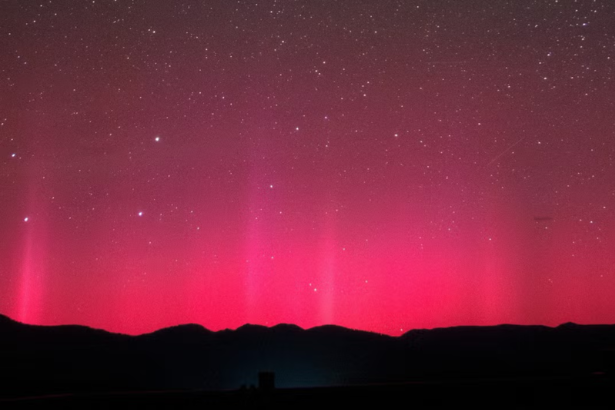
The aurora is essentially the visible result of space weather interacting with Earth’s magnetic environment.
When energetic particles associated with solar activity reach Earth, Earth’s magnetosphere redirects much of that energy toward the polar regions.
Those particles then interact with gases in the upper atmosphere.
The resulting emissions create the shimmering colors associated with the northern and southern lights.
Oxygen can produce green and red emissions, while nitrogen contributes blue and purple hues.
During stronger geomagnetic storms, the auroral oval can expand toward lower latitudes.
That is why a storm classified as G2 can potentially make the northern lights visible farther south than normal.
Space.com reports that the anticipated G2 conditions could push auroral visibility into parts of the northern United States and northern Europe.
What Makes the August Event Different?
The interesting part of this event is the combination of several space-weather drivers.
It is not simply one isolated flare.
There was the M6.9 flare.
There were multiple CMEs.
And there is also a high-speed solar-wind stream originating from a coronal hole.
That creates several opportunities for Earth’s magnetic field to become disturbed over a relatively short period.
The first impact could come from the high-speed solar wind stream on August 27.
The CME activity could then increase geomagnetic conditions on August 28.
That is why NOAA has issued watches across consecutive days rather than a single isolated alert.
Expert Insights or Analysis
The Flare Is Not the Same Thing as the Storm
One of the easiest mistakes in solar-weather coverage is treating a large flare as an automatic guarantee of an aurora.
It is not.
A flare can produce radiation that reaches Earth very quickly, potentially causing radio-blackout effects on the sunlit side.
A CME takes much longer to travel from the Sun to Earth.
And even if a CME reaches Earth, its effectiveness at producing a strong geomagnetic storm depends heavily on its magnetic-field orientation.
This is why forecasts can change as the CME gets closer.
The solar eruption can be observed.
Its trajectory can be modeled.
But the precise magnetic conditions encountered at Earth become much clearer only as spacecraft near the Sun-Earth L1 region measure the incoming solar wind.
Radio Communications Can Be Affected
The August 25 flare already produced an R2 radio blackout, according to Space.com. The impact was reported across parts of Africa, Europe and the Arctic.
That illustrates why space weather is more than an astronomy story.
Strong solar activity can interfere with high-frequency radio communication.
It can also affect satellite operations, navigation systems and, during sufficiently powerful storms, electrical infrastructure.
NOAA’s Space Weather Prediction Center specifically monitors space-weather impacts involving aviation, electric power, GPS, radio communications and satellites.
Broader Implications
Space Weather Is Becoming an Infrastructure Story
The most visually appealing part of a geomagnetic storm is the aurora.
The most important part may be everything happening behind the scenes.
Modern civilization depends on technologies that operate above Earth’s surface or rely on radio signals passing through the atmosphere.
Satellites provide communications and navigation.
GPS supports transportation, agriculture and timing systems.
High-frequency radio remains important for aviation and other communications.
Electric grids can also experience disturbances during sufficiently strong geomagnetic storms.
That means monitoring the Sun is increasingly comparable to monitoring terrestrial weather.
The forecast may be beautiful.
The underlying science is operational.
Satellites Are Particularly Important
A CME can temporarily alter the space environment around Earth.
Increased radiation and changes in the upper atmosphere can affect spacecraft.
One consequence of strong solar activity is increased atmospheric density at satellite altitudes. That can increase drag on low-Earth-orbit spacecraft and alter their trajectories.
This is one reason agencies track solar activity even when no major storm is expected.
The same Sun that creates an extraordinary aurora can also create an engineering problem for spacecraft operators.
Internal Link Suggestion
Suggested internal link anchor: “how solar storms affect satellites and GPS”
This article would also work well as part of a broader The Tech Marketer space-weather explainer series.
Related History or Comparable Solar Storms
The modern era has experienced several significant solar storms.
One of the most famous was the 1859 Carrington Event, an exceptionally powerful geomagnetic storm that disrupted telegraph systems and produced auroras at unusually low latitudes.
More recently, the May 2024 geomagnetic storm produced spectacular auroras across large portions of the world.
Those events provide useful perspective.
The current forecast is for a G2 moderate storm, not a repeat of the Carrington Event.
That distinction matters.
A G2 watch means forecasters expect a measurable disturbance, not a civilization-ending catastrophe.
For most people, the immediate consequence may simply be the opportunity to see an unusual night sky.
What Happens Next
The next 48 hours will be about observation.
Scientists will monitor the solar wind and incoming CME material to determine how closely reality matches the forecast.
The key variables include:
- CME arrival time
- Solar-wind speed
- Magnetic-field strength
- Magnetic-field orientation
- Duration of the disturbance
- Location of the auroral oval
If the incoming magnetic field couples strongly with Earth’s magnetic field, auroral activity could intensify.
If the orientation is less favorable, the visual display may be weaker even if the CME itself is substantial.
Space.com notes that the incoming CME activity, combined with the high-speed solar-wind stream, could produce G1 to G2 conditions across August 27 and 28.
How to Watch the Northern Lights
For people hoping to see the result, location and timing will matter.
The best conditions generally include:
- Dark skies away from city lights
- A clear view toward the northern horizon
- Minimal cloud cover
- A location away from artificial light
- Patience, because auroral activity can fluctuate quickly
Photographers should also remember that cameras can capture aurora that is difficult to see clearly with the naked eye.
For the strongest chance, skywatchers should monitor official NOAA space-weather updates rather than relying solely on a generic aurora forecast.
Conclusion
The latest solar flare activity has turned the Sun into the center of attention for skywatchers and space-weather scientists alike.
An M6.9 flare erupted from sunspot region 4513 on August 25, followed by several CMEs. NOAA has now issued a G1 geomagnetic storm watch for August 27 and a G2 watch for August 28.
That combination could produce a stronger-than-usual northern lights display across parts of the northern United States and Europe.
But the spectacle is only half the story.
The same solar activity that paints the atmosphere with green and red light can also disrupt radio communications and create challenges for satellites and other technology.
The next few days will show how closely the incoming CMEs match current forecasts.
For aurora hunters, that means one thing: keep watching the sky.
FAQ
1. What is a solar flare?
A solar flare is a sudden release of magnetic energy from the Sun that produces intense electromagnetic radiation. Flares are classified from A through X according to their strength.
2. What was the strength of the latest solar flare?
The August 25 eruption was classified as an M6.9 solar flare, originating from sunspot region 4513. It also produced an R2 moderate radio blackout across portions of the sunlit side of Earth.
3. Will this solar flare cause the northern lights?
The flare itself is not the primary reason for the anticipated aurora. Multiple CMEs launched around the same period are expected to reach Earth, potentially producing G1 to G2 geomagnetic storm conditions.
4. When could the northern lights be visible?
NOAA has issued a G1 watch for August 27 and a G2 watch for August 28. The strongest auroral opportunities could occur around the arrival of the incoming CME material, although exact timing can change.
5. What is a CME?
A coronal mass ejection, or CME, is a large cloud of magnetized plasma expelled from the Sun. When a CME reaches Earth and interacts with the magnetosphere, it can produce a geomagnetic storm.
6. What is a G2 geomagnetic storm?
G2 is NOAA’s classification for a moderate geomagnetic storm. Storms at this level can produce stronger auroras and may create some impacts to satellite operations, radio communications or power systems.
7. Can solar flares affect GPS?
Strong space-weather events can affect navigation and satellite systems. The severity depends on the characteristics of the solar event and how Earth’s space environment responds.
8. Is this the same as the Carrington Event?
No. The current forecast is for G1 and G2 geomagnetic storm conditions. The 1859 Carrington Event was an exceptionally powerful historical geomagnetic storm and is not an appropriate direct comparison in terms of expected intensity.
Sources & References
- NOAA / Space Weather Prediction Center, “Geomagnetic Storm WATCHES AUG 27-28”
Read NOAA’s official storm watch - FOX Weather, “Powerful solar flare erupts from the sun, raising chances for dazzling Northern Lights display by Friday”
Read the FOX Weather report - Space.com, “NOAA issues geomagnetic storm watch as CMEs head toward Earth, northern lights possible Aug. 27-28”
Read the Space.com analysis