


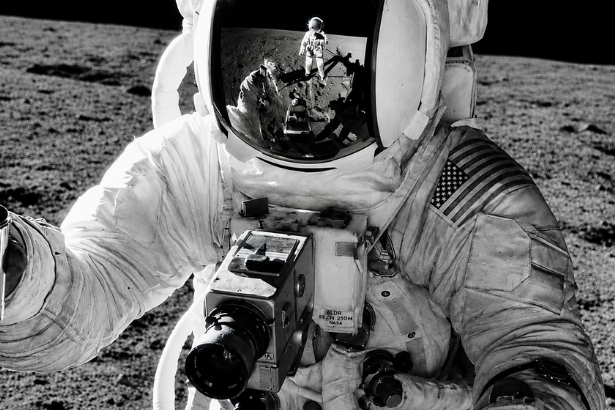
A nearly forgotten 1969 hardware failure is suddenly trending again. During Apollo 12, astronaut Alan Bean accidentally pointed a color television camera at the Sun, permanently damaging its image sensor and cutting short live television coverage from the lunar surface.
The Apollo 12 camera was supposed to give the world something it had not seen during Apollo 11: a better color view of astronauts working on the Moon.
Instead, the ambitious experiment lasted only minutes.
In November 1969, lunar module pilot Alan Bean was positioning the new Westinghouse color television camera on the lunar surface when the camera was inadvertently pointed directly toward the Sun. The intense light permanently damaged the camera’s imaging tube, ending usable live television coverage from the Moon during the mission.
The story has resurfaced online in August 2026. The supplied Google Trends screenshot shows a noticeable surge in searches for “Apollo 12”, with news results focusing on the bizarre but consequential camera failure.
It is a reminder that some of the most important lessons in space technology come from seemingly tiny mistakes.
Background and Context
Apollo 12 launched from Kennedy Space Center on November 14, 1969, just four months after Apollo 11’s historic first crewed Moon landing.
The mission had a different objective from simply repeating Apollo 11.
Commander Pete Conrad and lunar module pilot Alan Bean were tasked with making a precision landing near the Surveyor 3 spacecraft, deploying scientific instruments and collecting lunar samples. Command module pilot Richard Gordon remained in lunar orbit.
The mission also carried an important upgrade for television.
Apollo 11’s lunar-surface television images had been broadcast in black and white. Apollo 12 carried the first color television camera intended for use on the lunar surface, manufactured by Westinghouse.
That camera was technologically ambitious for its time.
It was designed to be lightweight enough for an astronaut to carry and operate on the Moon while transmitting television signals across the enormous distance back to Earth.
Millions of viewers were expecting a more vivid window onto the lunar surface.
Then the camera looked at the Sun.
Latest Update: Why Apollo 12 Is Trending Again
The current search spike is not the result of a new Apollo mission or a newly discovered NASA event.
Instead, the 1969 incident has resurfaced as a trending historical technology story.
A recent Times of India report revisited the episode, explaining how Bean’s camera briefly passed across the Sun while he was setting it up on the lunar surface. The intense sunlight damaged the camera’s sensitive vidicon tube and effectively ended the live color broadcast.
The supplied Google Trends screenshot shows searches for “Apollo 12” climbing sharply during the past 24 hours.
That renewed interest is understandable. The story combines an extraordinary setting, an easily understood technological failure and a surprisingly modern lesson about the fragility of imaging hardware.
What Actually Happened to the Apollo 12 Camera?
During the first lunar excursion, Bean was assigned to move the television camera from its mounting position and place it on a tripod.
NASA’s historical account states that the camera was inadvertently pointed into the Sun while Bean was mounting it, after which it ceased functioning.
A detailed NASA history of Apollo television explains that the camera began directly imaging the Sun at approximately 115 hours and 58 minutes into the mission. The resulting damage left the camera unable to provide a usable picture.
The failure was not simply a temporary exposure problem.
The camera’s imaging sensor had suffered permanent damage from excessive light.
The Technology Behind the Failure
The Apollo 12 camera used a highly sensitive imaging tube known as a vidicon-type tube.
That sensitivity was useful because the camera had to work in the challenging lighting conditions of the lunar environment.
But sensitivity came with a vulnerability.
A NASA technical report explains that the camera’s design depended on a highly sensitive tube and that excessive light intensity could permanently damage its sensor. The crew had been briefed about the danger, but the camera was nevertheless inadvertently pointed at the Sun during deployment.
In other words, the problem was not that the camera was poorly designed in some simple sense.
It was a consequence of trying to build a lightweight, sensitive television system capable of transmitting usable images from the Moon.
The technology was operating close to the edge of what was practical at the time.
The Sun Was a Much Bigger Problem on the Moon
The lunar environment made the problem particularly unforgiving.
There is no atmosphere on the Moon to scatter sunlight in the same way it does on Earth. Bright sunlight and deep shadow exist side by side, creating difficult visual conditions for astronauts and equipment.
A NASA presentation on Apollo mission experience notes that the low Sun angle during Apollo 12’s first EVA affected task performance, with the crew repeatedly commenting on how bright the Sun was. It specifically identifies the color camera’s accidental exposure to the Sun as an operational failure.
That detail is important.
The camera failure was not an isolated technical curiosity. Apollo 12’s astronauts were working in an environment where controlling light exposure was a genuine operational challenge.
The Crew Tried to Save the Camera
Once the television picture failed, the astronauts and Mission Control did not immediately know exactly what had happened.
The crew attempted to troubleshoot the equipment.
Historical records show that Bean even struck the camera while trying to get it working again. Contemporary UPI reporting said engineers at Westinghouse believed there might be a chance of recovering some sort of vague image, but the damage ultimately proved too severe.
The camera was brought back to Earth for examination.
NASA later concluded that the failure was consistent with partial burnout of the camera’s vidicon tube caused by the accidental exposure to the Sun.
So the mission did not simply lose a camera.
It lost one of its most anticipated public-facing technologies.
What the World Lost
The Apollo 12 crew continued its mission successfully despite the television failure.
Conrad and Bean collected lunar samples, deployed the Apollo Lunar Surface Experiment Package and visited Surveyor 3, recovering components from the robotic spacecraft.
But television audiences lost the ability to watch much of that activity live in color.
That is why Apollo 12 has an unusual place in the history of space broadcasting.
The mission was scientifically successful, but its planned visual record was dramatically curtailed.
The astronauts still took thousands of photographs, and a 16mm film camera continued to record portions of their work. The loss was therefore primarily the loss of live television rather than the complete loss of visual documentation.
NASA Turned the Failure Into a Design Lesson
Perhaps the most interesting part of the story is what happened afterward.
NASA and its contractors did not simply accept the failure as bad luck.
The incident led to changes in how lunar television cameras were handled.
The Times of India reports that later Apollo missions incorporated additional protections, including a lens cap and stricter procedures for moving and positioning the camera. From Apollo 15 onward, control of the color television camera was transferred to Mission Control rather than leaving astronauts to operate it entirely themselves.
That is classic engineering feedback.
A failure happens.
Investigators determine why.
The procedure changes.
The next system becomes harder to break in the same way.
Expert Insights and Analysis
Apollo 12 Was an Early Lesson in Human-Machine Interaction
The camera did not fail because an astronaut ignored a known danger deliberately.
It failed during a routine physical task in an extremely unfamiliar environment.
Bean was trying to place the camera correctly. The camera passed across the Sun. The sensor was damaged before the crew could react.
That distinction matters in engineering.
Spacecraft systems are designed around assumptions about how humans will interact with hardware. When those assumptions meet a new environment, seemingly small actions can produce unexpected results.
Modern spacecraft designers still confront the same problem.
Astronauts have to manipulate equipment while wearing bulky suits, dealing with restricted visibility, intense lighting contrasts and limited dexterity.
The Apollo 12 camera became an early demonstration of why human factors engineering is just as important as raw hardware capability.
The Camera Was Sensitive Because It Had to Be
It is tempting to look back at the incident and ask why NASA did not simply build a camera that could tolerate direct sunlight.
The answer is that engineering is about tradeoffs.
The Apollo color television camera had to be lightweight, compact, power-efficient and sensitive enough to produce useful images under difficult lunar conditions.
Increasing protection against extreme light exposure could introduce other constraints.
NASA’s historical documentation confirms that the camera’s sensitivity was central to its design and that excessive light could cause permanent damage.
The Apollo 12 failure therefore illustrates a broader engineering principle:
The most sensitive component in a system can also become its most vulnerable component.
Broader Implications
Space Hardware Is Designed Around Failure
The Apollo program is often remembered for spectacular successes.
But its engineering legacy also comes from failures and near failures.
Apollo 12 itself was struck by lightning twice shortly after launch. The crew and Mission Control successfully dealt with the resulting instrumentation problems and continued toward the Moon.
The camera failure was much less dangerous to the astronauts, but it offered another type of lesson.
Not every failure needs to threaten a mission to change how engineers design the next system.
Sometimes losing a camera is enough.
The Incident Shows Why Redundancy Matters
Apollo 12 still had other ways to document the mission.
Still cameras continued working. A 16mm camera provided moving images. Mission Control maintained communications with the astronauts even though the color television feed was lost.
That redundancy meant the mission did not become undocumented.
Modern spacecraft take this principle much further.
Critical systems frequently have backup computers, communications channels, sensors and power systems.
The Apollo era helped establish the culture of designing spacecraft around the possibility that individual components will fail.
A Tiny Hardware Mistake Can Change the Historical Record
There is also a cultural consequence.
When people picture humans walking on the Moon, they often remember the television images as much as the scientific achievements.
Apollo 11 created an extraordinary visual archive.
Apollo 12 was supposed to expand that archive with live color television.
Instead, one accidental exposure to the Sun permanently changed what audiences could see.
That means the camera failure became part of the historical record itself.
For a technology publication, that is perhaps the most fascinating lesson: hardware decisions can determine what future generations remember.
For more stories about the technology behind major scientific breakthroughs, readers can explore The Tech Marketer.
Related History and Comparable Technologies
Apollo 12 was not NASA’s first experience with the challenges of transmitting television from space.
The Apollo television system had already evolved between missions.
NASA documentation shows that earlier cameras and transmission systems involved substantial bandwidth and signal-management challenges. The Apollo 12 color camera represented another step forward, but its improved capability also introduced new operational risks.
The evolution continued after Apollo 12.
Later missions used improved procedures and camera-control arrangements to reduce the likelihood of another accidental exposure.
This pattern can be seen throughout spaceflight history.
Technology is introduced.
Astronauts discover how it behaves in the real environment.
Engineers revise the design.
The revised system flies again.
Apollo’s camera story is therefore part of a much larger cycle of learning through flight experience.
What Happens Next
Nothing new is happening to the Apollo 12 spacecraft or camera in 2026.
The mission ended more than five decades ago.
What is happening now is a renewed public interest in the story, driven by social media and search algorithms resurfacing an unusual piece of spaceflight history.
The supplied Google Trends chart shows that interest in “Apollo 12” has risen sharply before settling at an elevated level.
That makes this a useful example of how the internet can revive historical technology stories long after the original event.
The underlying facts are not new.
The audience is.
And that audience is discovering a lesson NASA learned in 1969: even the most carefully engineered technology can fail because of a tiny interaction between hardware, environment and human movement.
Why “Apollo 12” Is Trending on Google
The supplied Google Trends screenshot shows “Apollo 12” experiencing a sharp increase in search interest over the past 24 hours.
The news results visible in the screenshot focus on one particular story:
- Alan Bean accidentally pointed the camera at the Sun.
- The camera’s sensor was damaged.
- Live color television from the lunar surface ended.
- NASA later changed camera-handling procedures.
- Apollo 12 continued its scientific mission despite the failure.
The search trend is therefore less about a new spaceflight event and more about a 1969 technology failure being rediscovered by a modern audience.
That distinction is important for anyone reporting on the trend.
The event happened during Apollo 12’s first lunar EVA in November 1969. The current news cycle is simply bringing the story back into public view.
Conclusion
The Apollo 12 camera was supposed to be one of the mission’s most important upgrades.
Instead, it became one of NASA’s most memorable examples of how quickly sensitive technology can fail in an unforgiving environment.
Alan Bean did not intentionally destroy the camera. While positioning it on the Moon, he inadvertently pointed it toward the Sun. The resulting exposure damaged the camera’s vidicon tube and ended usable live television coverage from the lunar surface.
Apollo 12 continued successfully.
The astronauts landed precisely, collected samples, deployed scientific instruments and visited Surveyor 3.
But the camera never recovered.
NASA then did what good engineering organizations do: it investigated the failure and changed procedures and equipment to reduce the chance of repeating it.
More than 50 years later, that small moment is trending again.
And the lesson remains surprisingly modern.
Space technology does not have to fail spectacularly to teach engineers something important. Sometimes all it takes is a camera, a tripod and the Sun.
FAQ
What happened to the Apollo 12 camera?
The Apollo 12 camera was accidentally pointed directly at the Sun while Alan Bean was positioning it on a tripod on the lunar surface. The intense light damaged its imaging tube, making the camera unable to produce a usable television picture.
Who damaged the Apollo 12 camera?
Astronaut Alan Bean inadvertently pointed the camera toward the Sun while setting it up during Apollo 12’s first lunar EVA. NASA’s historical record describes the incident as accidental.
Why did the Apollo 12 camera fail when it saw the Sun?
The camera used a highly sensitive imaging tube. Excessive light intensity caused permanent damage to the sensor. NASA technical documentation specifically identifies the accidental exposure to the Sun as the cause of the failure.
Was Apollo 12 still successful after the camera failure?
Yes. Apollo 12 successfully landed near Surveyor 3, collected lunar samples, deployed scientific instruments and retrieved parts from the earlier robotic lander.
Did Apollo 12 have any other cameras?
Yes. Although the live color television camera failed, the astronauts continued taking still photographs, and a 16mm camera recorded moving images during portions of the mission.
Did NASA fix the camera problem for later Apollo missions?
NASA changed procedures and added protective measures for subsequent missions. Later Apollo missions also moved toward greater control of the television camera from Mission Control.
Why is Apollo 12 trending now?
The supplied Google Trends screenshot shows a recent spike in searches for Apollo 12. Current reports have resurfaced the historical story of Alan Bean accidentally damaging the mission’s color television camera by pointing it at the Sun.
Did the Apollo 12 camera failure end the entire mission?
No. It ended usable live television coverage from the lunar surface, but the Apollo 12 mission itself continued successfully and achieved its primary scientific and exploration objectives.
Sources & References
- NASA: “Apollo 12: The Pinpoint Mission”
- NASA: “Apollo Television” historical technical record
- NASA: “50 Years Ago: Apollo 12 Astronauts Leave Quarantine”
- Times of India: “In 1969, an astronaut pointed Apollo 12’s camera at the sun and accidentally killed the live moon broadcast”
- Economic Times: “In 1969, Apollo 12 began broadcasting from the Moon, but Alan Bean accidentally aimed its camera at the Sun”