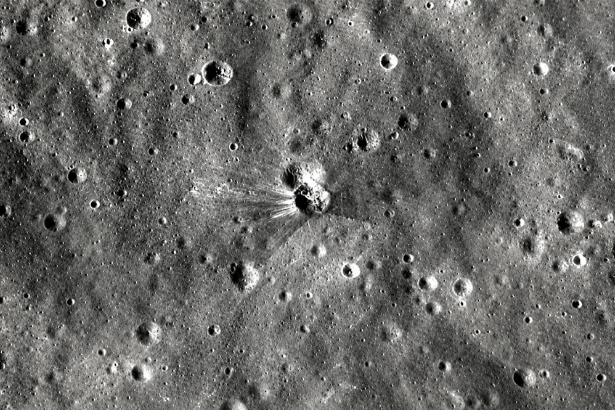
NASA’s Lunar Reconnaissance Orbiter has photographed the fresh crater left by a discarded Falcon 9 upper stage, giving scientists their clearest look yet at the aftermath of an accidental lunar impact.
The SpaceX upper stage Moon impact has left behind a surprisingly small but scientifically valuable scar. NASA’s Lunar Reconnaissance Orbiter, or LRO, captured a series of images between August 11 and 12 showing the crater created when a Falcon 9 upper stage struck the Moon on August 5. NASA says the crater is about 60 feet wide and less than 10 feet deep
Background and Context
The rocket stage came from a January 15, 2025 Falcon 9 launch that sent Firefly Aerospace’s Blue Ghost 1 lunar lander toward the Moon under NASA’s Commercial Lunar Payload Services program. After completing its role in the mission, the upper stage remained in space rather than returning to Earth. NASA later tracked its trajectory as solar activity and gravitational forces altered its path toward the Moon.
NASA had warned ahead of the event that the impact was expected near the Einstein and Bell crater region and posed no danger to Earth. The agency planned to use ground based telescopes and spacecraft to gather scientific observations.
The impact occurred on August 5.
What scientists could not immediately see from Earth was the crater itself.
That changed when lunar orbiters began looking for the fresh scar.
Latest Update: NASA Images the SpaceX Upper Stage Moon Impact
NASA’s LRO photographed the impact site six days after the collision.
That sounds straightforward, but targeting a specific location on the Moon from orbit is anything but simple.
The LRO passes roughly 60 miles above the lunar surface while traveling at about 1 mile per second. Engineers had to tilt the spacecraft so its camera could point toward the newly created crater during the correct orbital pass. NASA says the location took six days to come into view.
Timing was equally critical.
If the camera had taken the picture just 10 seconds too early or too late, NASA says the target could have moved about 10 miles relative to the spacecraft’s viewing geometry.
The resulting images give scientists multiple perspectives of the crater under different lighting conditions.
That helped reveal its dimensions.
NASA measured the crater at approximately 60 feet across and determined that it is less than 10 feet deep based on the length of its shadow.
The LRO’s Narrow Angle Camera was capable of resolving features as small as roughly three feet wide, making it well suited to the task.
The Images Reveal More Than a Hole
The new imagery is valuable because it shows how material was excavated from beneath the lunar surface.
NASA identified both bright and dark rays extending from the crater.
The darker material consists of older lunar surface dust and rocks that have been altered by solar wind, galactic cosmic rays and micrometeorite impacts. The impact excavated some of that weathered material from roughly 1.5 feet below the surface.
The brighter material is different.
It comes from deeper beneath the surface and has been freshly exposed by the collision.
That distinction gives planetary scientists a natural before and after experiment.
Instead of simply seeing a crater, researchers can compare the surrounding lunar landscape with material that was recently excavated from underground.
How NASA Found the Exact Impact Site
The location of the crater was not discovered by NASA alone.
Independent astronomers initially tracked the rocket’s trajectory using publicly available data. NASA’s Center for Near Earth Object Studies then refined the calculations and supplied an estimated impact region to South Korea’s Danuri lunar orbiter team.
Danuri used its high resolution Lunar Terrain Imager to photograph the region only hours after the impact.
NASA says the predicted location was accurate to about 0.6 miles.
Those Danuri observations then helped NASA’s LRO team refine the coordinates for its own imaging sequence.
NASA has now updated the crater’s center coordinates to approximately 19.4759 degrees north, 266.7138 degrees east, at an elevation of 511 meters.
It is a striking example of modern lunar exploration becoming a distributed network rather than a single spacecraft mission.
What Actually Happened to the Falcon 9 Stage?
The Falcon 9 upper stage was never designed to deliberately crash into the Moon.
Before the collision, NASA and SpaceX tracked the object as its trajectory evolved.
NASA said solar activity and gravitational forces contributed to the stage’s unplanned return toward the lunar surface.
Independent observations later confirmed that the impact occurred.
The European Southern Observatory’s Very Large Telescope detected sodium and lithium spectral signatures in a plume lasting roughly five to 10 minutes. Sodium was likely released from lunar soil, while lithium may have originated from the rocket.
The stage hit the Moon at roughly 5,400 miles per hour.
No spacecraft directly recorded the collision in real time, but the combination of trajectory calculations, telescope observations and orbital imagery made the impact increasingly certain.
Expert Insights and Analysis
The scientific value of the SpaceX upper stage Moon impact comes from one unusual advantage: scientists knew a great deal about the object that created the crater.
Natural lunar impacts happen constantly, but researchers generally do not know the exact mass, shape and velocity of the incoming object before it strikes.
Here, they had a tracked spacecraft component with a known origin and trajectory.
That makes the resulting crater a useful calibration point for impact models.
Researchers can compare the predicted impact behavior with the crater’s actual size and the distribution of material around it.
The event also demonstrates why the Moon is such a valuable laboratory for planetary science. Unlike Earth, the lunar surface has no atmosphere, liquid water or active plate tectonics continually reshaping its terrain. Ancient impacts can remain preserved for extraordinarily long periods. NASA describes the Moon’s crater record as an important window into the impact history of the solar system.
Broader Implications
The Moon Is Becoming a Busier Operating Environment
The most important story may not be the crater itself.
It may be what happens as lunar traffic increases.
NASA, commercial companies and international space agencies are preparing for a much more active lunar environment. More spacecraft mean more hardware operating around the Moon, more orbital trajectories to monitor and more opportunities for objects to become uncontrolled.
A spent rocket stage hitting the Moon is not an immediate threat to Earth.
But future lunar infrastructure could be different.
Permanent habitats, scientific instruments, power systems and communications networks would be far more vulnerable to unexpected high velocity impacts.
Recent analysis has already highlighted the operational risks that lunar debris could pose as missions become more frequent.
Lunar Space Debris Could Become a Policy Issue
Earth has spent decades developing rules and technologies around orbital debris.
The Moon is only beginning to face the same conversation.
If lunar activity accelerates, operators will have to think about where spacecraft go after completing their missions.
Controlled disposal.
Trajectory coordination.
Impact avoidance.
Designated disposal zones.
Those ideas could eventually become part of the basic infrastructure of lunar exploration.
The broader conversation around space technology, satellite infrastructure and emerging space markets is likely to become increasingly important as commercial activity expands beyond Earth orbit.
A New Kind of Lunar Environmental Record
There is also a scientific heritage issue.
Every human-made object that reaches the lunar surface changes it in some way.
For decades, those changes were mostly limited to deliberate spacecraft landings and scientific experiments.
Now, accidental impacts are becoming part of the record.
That makes precise mapping important.
Scientists need to know which marks are natural and which are human-made.
The LRO imagery provides exactly that kind of documentation.
Related History and Comparable Technologies
Human-made objects have struck the Moon before.
NASA deliberately used spacecraft impacts as scientific experiments, including the 2009 LCROSS mission, which sent a spent rocket stage into a permanently shadowed lunar crater to study material ejected from the surface.
The difference here is intent.
The Falcon 9 impact was not a planned scientific experiment.
That makes the event unusual, but it also creates a useful comparison. In both cases, scientists can study material excavated from beneath the lunar surface.
The Moon’s natural impact history is far older and much more dramatic.
NASA notes that lunar craters preserve evidence of impacts that occurred billions of years ago, providing scientists with a record that is far better preserved than Earth’s heavily eroded impact history.
The new Falcon 9 crater is tiny by lunar standards.
Scientifically, however, it is a precisely documented modern impact.
What Happens Next?
The next stage is analysis.
NASA now has before and after imagery, detailed crater measurements and refined coordinates.
Scientists can use those observations to study the relationship between the rocket’s properties, impact energy and the resulting excavation pattern.
The LRO will also continue operating as NASA builds a more detailed understanding of the Moon’s surface.
The new imagery could prove particularly useful because the crater was photographed under different lighting conditions. That allows researchers to distinguish fresh ejecta from older, weathered material.
The broader question is what future lunar missions will learn from this accident.
As spacecraft become more numerous, tracking systems will need to account for increasingly complicated trajectories around the Moon.
The Falcon 9 stage provided an unexpected test case.
Future missions may not be so forgiving.
Conclusion
The SpaceX upper stage Moon impact has gone from a predicted collision to a documented piece of lunar history.
NASA’s Lunar Reconnaissance Orbiter has now photographed the crater, measuring it at roughly 60 feet wide and less than 10 feet deep. The images show fresh material excavated from beneath the lunar surface and provide scientists with a detailed record of a human-made impact.
The significance extends beyond SpaceX.
The Moon is entering a new era of activity, with governments and private companies preparing more spacecraft, landers and infrastructure for lunar operations.
That makes tracking, disposal and impact management increasingly important.
For now, the Falcon 9 crater is a scientific curiosity.
It could also be an early warning of the logistical problems that come with turning the Moon into a much busier destination.
FAQ
What happened during the SpaceX upper stage Moon impact?
A spent Falcon 9 upper stage struck the Moon on August 5, 2026 after its trajectory was altered by gravitational and solar forces. NASA later photographed the resulting crater using the Lunar Reconnaissance Orbiter.
How big is the crater from the SpaceX rocket impact?
NASA measured the new crater at approximately 60 feet wide and less than 10 feet deep.
When did the Falcon 9 upper stage hit the Moon?
The impact occurred on August 5, 2026. NASA’s LRO photographed the crater between August 11 and 12.
Did NASA see the rocket hit the Moon?
No spacecraft directly captured the collision itself in real time. Scientists used trajectory calculations and observations from telescopes and lunar orbiters to confirm the impact, followed by NASA’s LRO imagery of the crater.
Where did the Falcon 9 hit the Moon?
The impact occurred near the Einstein and Bell crater region on the Moon’s western side. NASA later refined the crater’s center coordinates to 19.4759 degrees north and 266.7138 degrees east.
Why is the Moon impact scientifically useful?
Scientists know important characteristics of the rocket stage and its trajectory, allowing them to compare the observed crater and ejecta with impact models. That makes the event a useful real-world test of lunar impact science.
Was the SpaceX Moon impact dangerous to Earth?
NASA said the expected impact posed no danger to Earth.
Why is SpaceX upper stage Moon impact trending?
The Google Trends screenshot supplied for this article shows a sharp rise in searches for the topic following the release of NASA’s new LRO images. Related searches center on the SpaceX rocket, the Moon crater and NASA’s imagery.
Sources & References
- NASA Science, “NASA’s LRO Images Falcon 9 Crater on Moon, Learns New Details”
NASA Science article - NASA, “NASA Will Attempt to Observe Rocket Part’s Lunar Impact”
NASA impact observation briefing - Reuters, “Defunct SpaceX rocket crashes into moon”
Reuters coverage - CNN, “New images reveal what happened when a SpaceX rocket slammed into the moon”
CNN coverage - WFLA, “NASA images show crater carved by SpaceX rocket that slammed into moon”
WFLA coverage