Introduction
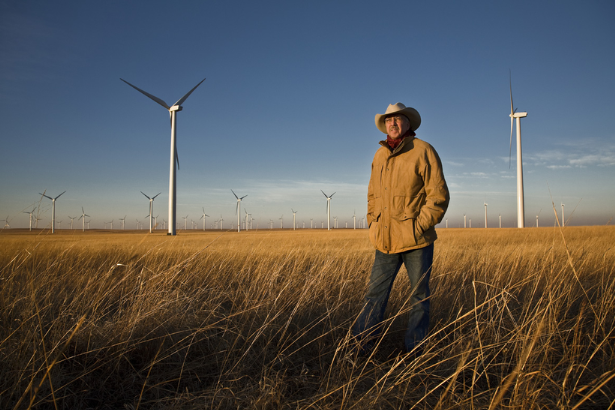
The Pete Ferrell Kansas wind ranch story begins with a simple contradiction: the same land that supports cattle can also produce electricity. On Ferrell’s roughly 7,000-acre family ranch near Beaumont, Kansas, 50 industrial wind turbines now operate alongside cattle grazing across the Flint Hills prairie. The turbines are part of the 100-turbine, 150-megawatt Elk River Wind Project, which began commercial operation in 2005.
For Ferrell, the important transformation was not becoming an electricity producer in the traditional sense. The power flows into the regional grid, while his ranch receives income from leasing land to the wind project.
That distinction is central to the story.
The cattle did not disappear. The ranch did not become an industrial site. Instead, wind became a second revenue stream, one that could continue generating income when drought, grass conditions or cattle markets made ranching less predictable.
Today, Ferrell’s experience offers an unusually tangible example of how renewable energy can change the economics of agricultural land.
Background and Context
The Ferrell family has been tied to the Kansas property since 1888. But the family’s relationship with wind power predates today’s giant turbines by decades.
In 1923, Ferrell’s great-grandfather installed a Jacobs Windjammer wind turbine paired with a Delco glass battery. It provided electricity to the ranch house before the electrical grid reached the property. The technology was small by today’s standards, but the basic idea was already there: use the wind available on the prairie to create something valuable.
Nearly three-quarters of a century later, the scale of the opportunity changed dramatically.
A commercial wind developer approached Ferrell in the 1990s about putting turbines on the ranch. His first reaction was resistance. He worried about the landscape and what large machines might do to a working cattle operation.
A visit to California’s Altamont Pass eventually changed his mind. Ferrell saw ranchers continuing to manage their land around operating turbines, giving him a different perspective on what wind development could look like on agricultural property.
The path to construction was not immediate. An initial development agreement eventually collapsed after the developer concluded the project was not economical. Ferrell then sought another partner and received multiple offers before ultimately working with Greenlight Energy Resources.
The result was the Elk River Wind Project.
Latest Update or News Breakdown
The current attention around the Pete Ferrell Kansas wind ranch comes from a broader conversation about how renewable energy is changing the economics of rural America.
The latest coverage describes Ferrell’s 7,000-acre ranch as home to 50 turbines, representing half of the Elk River project. The full project contains 100 GE 1.5-megawatt turbines for a total capacity of 150 megawatts.
Times of India: Pete Ferrell’s Kansas wind ranch story
The project was originally expected to generate roughly 550,000 megawatt-hours of electricity annually. Contemporary estimates put that output at the equivalent of electricity consumption for tens of thousands of homes, although actual generation varies with wind conditions.
That last point matters.
The turbines do not send electricity directly from Ferrell’s pasture to individual households. The power enters the broader regional electricity system. Ferrell’s economic benefit comes primarily from the land lease arrangement.
The 50 Turbines Do Not Mean 7,000 Acres of Industrial Infrastructure
One of the most interesting details in the story is how little land is actually removed from ranching use.
Ferrell has said that roughly 50 acres became unavailable for grazing because of turbine foundations, roads and related infrastructure. On a ranch covering approximately 7,000 acres, that represents a relatively small portion of the property.
The result is a hybrid landscape.
Cattle continue to graze.
Grass continues to grow.
Turbines generate electricity.
And the landowner receives lease revenue.
That coexistence is arguably more important than the turbines themselves.
Expert Insights or Analysis
Wind Became an Insurance Policy Against Agricultural Volatility
Ranching is inherently exposed to variables that landowners cannot control.
Rainfall affects grass.
Grass affects cattle capacity.
Cattle prices affect revenue.
Drought can turn a productive year into a financial headache.
Wind introduces a different kind of economic exposure.
Ferrell has described wind as his “best cash crop” because it can continue producing revenue during drought. The Environmental Defense Fund reports that wind royalties have accounted for roughly half of Ferrell’s income since the Elk River project began operating.
That does not mean wind has made the ranch risk-free.
It means the ranch has diversified.
Instead of relying entirely on cattle, Ferrell has effectively created two economic engines on the same landscape.
The Model Is Bigger Than One Ranch
The Pete Ferrell Kansas wind ranch is particularly interesting because Kansas itself has become a major wind-energy state.
The U.S. Energy Information Administration reports that wind accounted for 52% of Kansas’s electricity net generation in 2024, the third-highest wind share of any state after Iowa and South Dakota.
That makes Ferrell’s ranch part of a much larger transformation.
Kansas has the land.
It has strong wind resources.
And it has large agricultural areas where energy infrastructure can sometimes coexist with existing land uses.
The economics therefore extend beyond individual landowners.
Wind projects can also generate local tax revenue, construction activity, maintenance jobs and payments to participating landowners.
But those benefits do not eliminate legitimate concerns.
Wind projects can raise questions about viewsheds, roads, wildlife, transmission infrastructure, noise and the character of rural landscapes. Those debates become especially complicated in environmentally significant areas such as the Flint Hills.
Ferrell’s experience demonstrates that coexistence is possible.
It does not demonstrate that every property is appropriate for turbines.
Broader Implications
A New Definition of a Working Ranch
The traditional image of a cattle ranch is straightforward: grass goes in, cattle graze, livestock eventually go to market.
Ferrell’s property adds another layer.
The prairie now produces beef and electricity.
That changes the way the economic value of land can be understood.
A wind turbine does not necessarily require the land beneath it to stop functioning as agricultural land. Much of the surrounding acreage can remain productive.
This is why land-use efficiency is one of the most interesting parts of the story.
A ranch can potentially retain its primary agricultural activity while adding another revenue source above it.
Wind Can Help With Generational Succession
The financial stability created by the turbines has another consequence.
Ferrell has said that wind income has helped keep the ranch intact and positioned it for future generations. The Environmental Defense Fund reports that he has two adult children and four grandchildren and believes the wind project has helped make it possible to pass the property forward without the same financial burden.
That makes renewable energy a land-preservation story as well as an energy story.
A ranch that produces enough diversified income to remain financially viable is less likely to face pressure to sell or subdivide the property.
In that sense, the turbines are not simply producing electricity.
They are helping produce time.
Internal Link Suggestion
For The Tech Marketer, this story would work well with an internal explainer on renewable energy, rural technology or the economics of clean energy.
Suggested internal link anchor: “how renewable energy is changing rural economies”
Related History or Comparable Technologies
Ferrell’s story has an unusual historical arc.
In 1923, the family’s wind turbine was essentially an off-grid household technology. Its job was to provide electricity where utility infrastructure had not yet arrived.
The modern turbines serve a completely different purpose.
They are utility-scale machines connected to a regional electricity system.
Yet the underlying concept is remarkably similar.
The wind is a local resource.
Technology captures it.
Energy becomes useful.
The scale is what changed.
The family’s early turbine generated electricity for a single ranch household. Today’s turbines form part of a 150-megawatt commercial wind project serving the wider power system.
There is another historical comparison worth noting.
Before wind became the ranch’s major supplemental energy story, oil leases had also provided income during difficult periods. Yale Climate Connections reported that Ferrell’s grandfather used oil leases to help the ranch survive years when drought reduced agricultural income.
The technology changed.
The economic strategy did not.
The family has repeatedly looked for ways to make a volatile ranching business more resilient by monetizing resources available on the property.
What Happens Next
The most important question is not whether Ferrell’s turbines will continue turning.
They have been operating since 2005.
The larger question is whether the Ferrell model becomes more common elsewhere.
Kansas already demonstrates how significant wind can become within a state’s energy system. With wind supplying 52% of Kansas electricity generation in 2024, the state has moved well beyond the experimental stage of renewable deployment.
For landowners considering similar projects, several issues will remain critical:
- How much land is actually removed from agricultural use?
- How are lease payments structured?
- Who pays for roads and infrastructure?
- How are wildlife and environmental concerns addressed?
- What happens when turbines reach the end of their operating lives?
- How does the project affect neighboring landowners?
- Can renewable income genuinely help keep family farms and ranches intact?
Those questions will shape the next generation of rural energy development.
The Ferrell Ranch provides one long-running case study.
Conclusion
The Pete Ferrell Kansas wind ranch is compelling because it is not really a story about replacing one industry with another.
It is a story about adding another layer to an existing business.
Cattle still graze across the prairie.
The ranch remains a family operation.
But 50 turbines now turn Kansas wind into a dependable source of lease income.
The project’s history also stretches across generations. A small wind turbine once provided electricity to the Ferrell ranch house before the grid arrived. More than 100 years later, commercial turbines are helping support the economics of the same family property.
That is the larger lesson.
Renewable energy does not always arrive as a giant replacement for what was already there.
Sometimes it arrives as an additional crop.
And on the Kansas prairie, that crop happens to blow through the grass every day.
FAQ
1. Who is Pete Ferrell?
Pete Ferrell is a fourth-generation Kansas rancher whose family has operated land near Beaumont since 1888. His ranch now hosts 50 turbines belonging to the Elk River Wind Project.
2. How many wind turbines are on Pete Ferrell’s Kansas ranch?
The Pete Ferrell Kansas wind ranch hosts 50 wind turbines. They represent half of the 100 turbines in the Elk River Wind Project.
3. How large is the Ferrell Ranch?
The ranch is approximately 7,000 acres of tallgrass prairie in the Flint Hills near Beaumont, Kansas.
4. Does cattle ranching continue around the turbines?
Yes. Cattle continue to graze across much of the ranch. Ferrell has reported that approximately 50 acres were no longer available for grazing because of turbine foundations, roads and associated infrastructure.
5. How much of Ferrell’s income comes from wind?
The Environmental Defense Fund reports that roughly half of Ferrell’s income has come from wind royalties since the Elk River project began operating in 2005.
6. When did the Elk River Wind Project begin operating?
The Elk River Wind Project began commercial operation in 2005. It consists of 100 turbines with a combined capacity of 150 megawatts.
7. Does Pete Ferrell sell electricity directly to households?
No. The electricity generated by the project enters the regional power system. Ferrell’s income comes from leasing his land to the wind project rather than directly selling electricity to individual households.
8. How important is wind power to Kansas?
Wind is extremely important to Kansas’s electricity system. According to the U.S. Energy Information Administration, wind accounted for 52% of the state’s electricity net generation in 2024.
Sources & References
- Times of India, “A Kansas cowboy put 50 wind turbines on his 7,000-acre ranch and turned the wind into his most reliable cash crop, selling electricity to thousands of homes”
Read the Times of India report - Environmental Defense Fund, “Wind energy offers a lifeline for this Kansas rancher”
Read the Environmental Defense Fund report - U.S. Energy Information Administration, “Kansas State Energy Profile”
Read the EIA Kansas energy profile - Canary Media / Yale Climate Connections, “Wind power helps this Kansas cattle ranch survive”
Read the Canary Media report - Yahoo Finance, “50 Wind Turbines on a 7,000-Acre Ranch: Meet the Kansas Cowboy Whose Best Cash Crop Is Wind”
Read the Yahoo Finance report