Introduction
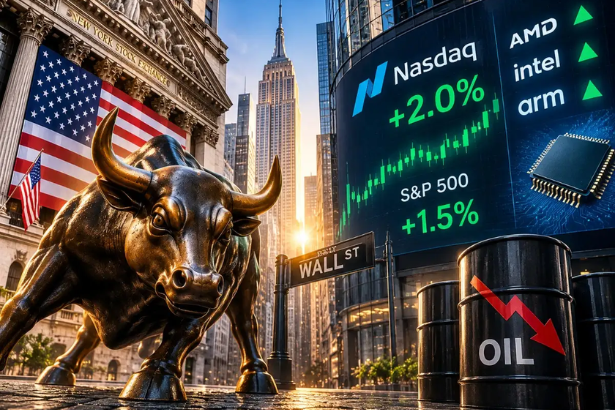
Nasdaq today is one of the biggest market searches as investors digest a powerful technology-led rally, falling crude prices and another record close for the tech-heavy index. On Monday, September 21, the Nasdaq Composite gained 2.26% to close at 27,122.09, while the S&P 500 rose 1.49% and the Dow Jones Industrial Average added 0.71%.
The rally came as artificial intelligence stocks regained momentum and oil prices retreated sharply. The combination matters because lower energy prices can ease inflation pressure, while falling Treasury yields can improve the backdrop for growth-oriented technology stocks.
But Tuesday’s session is starting from a different position. U.S. stock futures were relatively subdued after Monday’s surge, leaving investors watching whether the AI-led momentum can extend beyond the record Nasdaq close.
Background and Context
Monday’s market move was unusually concentrated around technology and AI.
The Nasdaq Composite climbed nearly 600 points, reaching 27,122.09 at the close. The S&P 500 finished at 7,764.70, while the Dow ended at 52,048.83.
The Nasdaq’s latest record came after a difficult stretch in which investors had been dealing with elevated oil prices, higher Treasury yields and uncertainty surrounding inflation and monetary policy.
The change in energy markets has been particularly important.
Brent crude had recently traded close to $110 a barrel before falling to around $100.34 on Monday. West Texas Intermediate fell 4.5% to $95.78.
That decline gave investors another reason to reconsider the inflation outlook.
At the same time, AI-related stocks delivered some of the strongest gains. Semiconductor companies were among the major beneficiaries, reinforcing the market’s continuing focus on artificial intelligence infrastructure and spending.
Latest Update or News Breakdown
Nasdaq reaches another record
The most important data point for Nasdaq today is Monday’s record close.
The Nasdaq Composite rose 599.54 points, or 2.26%, to 27,122.09. The move followed gains across chipmakers and other companies linked to the AI investment cycle.
The index is now up about 15.5% since the beginning of 2026 through the September 21 close, according to historical market data.
That performance helps explain the surge in public interest shown in the Google Trends screenshot supplied with this article.
Searches for terms including “Nasdaq today,” “Dow Jones today,” “Nasdaq futures,” “S&P 500,” and “oil prices today” are all appearing around the current market story.
AI stocks remain the central market engine
Artificial intelligence continues to be one of the strongest themes driving technology stocks.
Monday’s rally included a major move in Advanced Micro Devices, which rose 9.9% and moved above a $1 trillion market valuation, according to The Wall Street Journal. Nvidia also gained following news involving Swedish autonomous trucking company Einride.
The broader semiconductor sector also participated in the rally.
This is significant because investors are increasingly treating AI spending as a major driver of demand across chips, cloud infrastructure, data centers and software.
The market response suggests that AI remains an important factor in how investors assess technology companies, although daily price movements do not by themselves establish how sustainable those valuations or earnings expectations will be.
Oil falls below $100
Oil is the other major part of the story.
Crude prices fell sharply on Monday amid reports of improved prospects for oil flows through the Strait of Hormuz and renewed diplomatic activity involving the United States and Iran.
Brent crude settled at $100.34, down 3.4%, while WTI fell to $95.78.
By Tuesday, reports continued to point to oil prices remaining below the $100 threshold, although prices were moving during the session as traders assessed the geopolitical situation.
For equity markets, the importance of oil extends beyond energy companies.
Higher crude prices can feed into transportation, manufacturing and consumer costs. Lower prices can reduce some of that pressure, although the overall inflation effect depends on many other factors.
Treasury yields are another piece of the puzzle
Falling oil prices have also coincided with lower Treasury yields.
That matters for growth stocks because investors frequently compare the expected future cash flows of technology companies against prevailing interest rates.
When yields decline, the relative valuation pressure on long-duration growth companies can ease.
The recent combination of lower oil prices, softer yields and renewed AI enthusiasm has therefore created a supportive backdrop for technology shares. The Wall Street Journal reported that the Nasdaq led Monday’s advance as chipmakers and other AI-linked stocks rallied.
Tuesday starts with a more cautious tone
The big question for Nasdaq today is whether Monday’s momentum can continue.
Early Tuesday trading pointed to a much quieter start. Nasdaq-100 futures moved around the flatline, while S&P 500 and Dow futures were also relatively subdued.
That does not necessarily reverse Monday’s move. It simply means investors are reassessing prices after a substantial one-day rally.
The market is also watching oil, Treasury yields, developments around U.S.-Iran relations and the technology sector.
Expert Insights or Analysis
The current market setup can be understood through three interconnected forces: AI investment, energy prices and interest rates.
AI is providing the growth narrative.
Companies involved in semiconductors, data centers, cloud computing and AI software remain central to the investment cycle. Strong moves in chip stocks can have an outsized effect on the Nasdaq because technology companies represent a large share of the index.
Oil is providing the inflation narrative.
A sustained decline in crude prices could reduce some of the cost pressure affecting businesses and consumers. It could also reduce concern that higher energy prices will force central banks to keep monetary policy tighter for longer.
Interest rates provide the valuation link.
Lower Treasury yields can change how investors value future corporate earnings, particularly for technology companies whose expected cash flows extend further into the future.
None of these factors operates independently. A renewed geopolitical shock could push oil higher again. A stronger inflation reading could put upward pressure on yields. And a change in expectations around AI spending could quickly alter sentiment toward semiconductor and software stocks.
That makes the current market environment particularly sensitive to new information.
Broader Implications
The Nasdaq today story is ultimately about more than one index.
Technology has become increasingly connected to the broader U.S. economy through data centers, semiconductor manufacturing, cloud infrastructure and AI investment.
The latest rally shows how quickly capital can move toward technology when investors see a combination of strong growth expectations and improving macroeconomic conditions.
It also highlights a potential tension.
The more markets depend on a relatively narrow group of AI-related companies to drive index performance, the more closely investors may watch earnings, capital expenditure and evidence of actual AI demand.
For technology companies, the next stage of the AI cycle will therefore involve more than announcing new models or infrastructure projects. Investors will increasingly look for measurable revenue growth, customer adoption and returns on enormous infrastructure investments.
For more coverage of how AI investment is reshaping technology markets, see The Tech Marketer.
Related History or Comparable Technologies
The current AI-driven Nasdaq rally has similarities to previous periods when new technologies reshaped investor expectations.
The internet boom of the late 1990s created a similar concentration of market attention around technology companies. Later, smartphones and cloud computing created new investment cycles centered on hardware, software and infrastructure.
The AI cycle is different in important ways because today’s technology companies already operate at enormous commercial scale.
Nvidia, Microsoft, Alphabet, Amazon, Meta and other major technology companies have substantial existing businesses that can finance AI investment.
That makes today’s AI trade different from an earlier technology cycle dominated by companies that had little revenue or established infrastructure.
Still, the market is asking a familiar question: how much future growth is already reflected in today’s prices?
The answer will depend increasingly on earnings, capital spending and actual adoption rather than enthusiasm alone.
What Happens Next
Several indicators will matter as the week progresses.
Oil prices will remain one of the most immediate market signals. Investors will watch whether crude can remain below recent highs or whether geopolitical developments push prices higher again.
Treasury yields will also remain important. Any sharp move in bond yields could affect technology valuations and the broader equity market.
AI and semiconductor stocks will remain closely watched after Monday’s strong rally.
U.S. economic data will provide additional information about inflation, employment and growth.
And finally, investors will continue watching developments involving U.S.-China relations and technology policy, particularly because AI has become an increasingly important economic and strategic issue.
The result is a market where several narratives are moving simultaneously rather than one single catalyst determining direction.
Conclusion
The Nasdaq today story begins with a record close but does not end there.
The Nasdaq Composite climbed 2.26% to 27,122.09 on Monday, powered by AI and semiconductor stocks. The S&P 500 gained 1.49%, while the Dow added 0.71%.
At the same time, oil prices fell sharply, with WTI settling below $100 and Brent moving toward the $100 level.
Those developments created a favorable backdrop for technology stocks, but Tuesday’s quieter futures trading shows that investors are now assessing whether the rally can continue.
For the rest of the week, the key variables are likely to remain the same: AI earnings and investment, oil prices, Treasury yields, inflation expectations and geopolitical developments.
The Nasdaq has reached another record. The next question is what the market needs to see to keep pushing higher.
FAQ
What is happening with the Nasdaq today?
The Nasdaq Composite closed at a record 27,122.09 on September 21 after gaining 2.26%. Early Tuesday trading was comparatively subdued after the previous day’s strong rally.
Why is the Nasdaq rising?
The recent rally has been driven largely by AI-related technology and semiconductor stocks, alongside easing oil prices and lower Treasury yields.
Why are oil prices important for the Nasdaq?
Oil prices can influence inflation expectations and operating costs across the economy. A decline in crude prices can reduce some inflation pressure, which can affect expectations for interest rates and, in turn, technology stock valuations.
What happened to the Dow Jones?
The Dow Jones Industrial Average rose 366.19 points, or 0.71%, on September 21 to close at 52,048.83.
What happened to the S&P 500?
The S&P 500 gained 1.49% on September 21 and closed at 7,764.70.
Are AI stocks driving the current market?
AI-related stocks were a major driver of Monday’s rally. Semiconductor companies led parts of the advance, with AMD among the notable gainers.
Sources & References
- “Stock Market Today: Live Updates,” CNBC, September 21, 2026
CNBC market coverage - “Stocks Supported as Crude Oil Prices Ease,” Barchart, September 22, 2026
Barchart market coverage - “Stock Market Today: Oil Sinks Below $100, Lifting Tech Stocks,” The Wall Street Journal, September 22, 2026
WSJ market report - “Stock Market Today: Oil Sinks Below $100, Lifting Tech Stocks,” The Wall Street Journal live coverage, September 22, 2026
WSJ live market coverage - Nasdaq Composite historical market data, September 2026