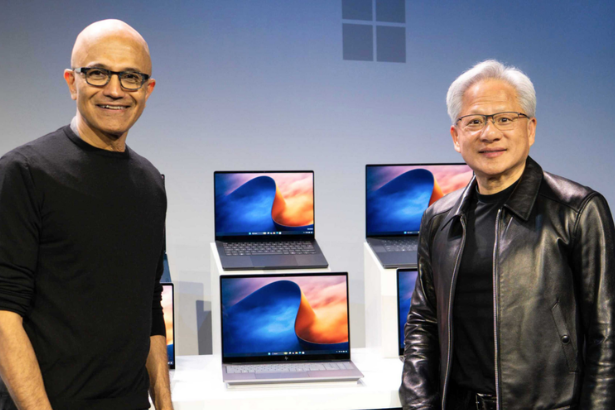
The Microsoft Windows AI event on October 7, 2026, marked a new step in the company’s effort to make artificial intelligence a more central part of everyday computing. Microsoft and NVIDIA presented a vision built around hybrid intelligence, combining local AI processing on a user’s device with cloud computing when additional capability is needed.
The announcements included new Windows AI features, NVIDIA RTX Spark-powered PCs, the Surface Laptop Ultra, and security tools designed to control how AI agents access files and perform actions. Microsoft also outlined a broader approach to running AI workloads across laptops, mini desktop PCs and powerful deskside systems.
The central idea is straightforward: not every AI task needs to run in a remote data center. Some work can happen directly on a PC, potentially improving responsiveness and giving users more control over sensitive information. More demanding tasks can still use cloud resources when necessary.
Microsoft’s Windows Experience Blog announcement describes this strategy as hybrid intelligence. NVIDIA’s event recap explains how the companies are working together on hardware and software to support AI agents on Windows devices.
Background and Context: Why Microsoft Wants More AI to Run on PCs
For much of the recent AI boom, many of the most demanding models have relied on cloud infrastructure. Users submit a prompt, remote servers process it and the results return over the internet. This approach gives applications access to large amounts of computing power without requiring every user to own expensive hardware.
But cloud-based AI also creates trade-offs. Internet connectivity can affect responsiveness, usage can generate ongoing costs, and organizations may have restrictions on sending sensitive information to external services.
Running AI locally offers a different set of possibilities. A capable PC can process certain tasks on-device, potentially reducing latency and limiting how much information needs to leave the computer. The trade-off is that local models are constrained by available processing power, memory, storage and energy.
Microsoft’s hybrid approach is designed to combine the two. A local model can handle suitable tasks, while more complex work can be routed to the cloud. The intended benefit is flexibility rather than a complete replacement for cloud AI.
This strategy also gives Microsoft a reason to work closely with chipmakers and PC manufacturers. Software features alone cannot deliver advanced local AI if a device lacks the memory, processing capacity and thermal design to support demanding workloads.
The October 7 event therefore focused on an ecosystem of Windows software, new hardware and tools for developers and businesses.
Latest Update: What Microsoft and NVIDIA Announced
1. Windows is moving toward hybrid intelligence
Microsoft’s vision for Windows places AI agents at the center of the operating system’s next phase. Agents can perform multi-step tasks, use tools and interact with files or applications, which makes them more capable than a traditional assistant that only responds to individual prompts.
Microsoft says Windows will allow suitable work to run locally, connect to cloud models when needed, and operate within security and management controls. The company also said Copilot will gain the ability, with user permission, to use local context from the PC and take actions on the user’s behalf.
The goal is to make AI more useful without forcing every task through the same computing path.
Microsoft also described new ways to take action from Windows Search on the taskbar, alongside enhancements to everyday Windows experiences. The specific availability of features may vary by device and rollout schedule.
Read the company’s full announcement, Building Windows for hybrid intelligence.
2. Microsoft and NVIDIA introduce a new generation of AI PCs
One of the event’s headline products was the Surface Laptop Ultra, a premium Windows laptop built around NVIDIA’s RTX Spark platform. Microsoft says the device is designed for creators, developers and people who want to run demanding AI workloads locally.
According to Microsoft’s announcement, the Surface Laptop Ultra features a 15-inch touchscreen and configurations with up to 128 GB of unified memory. The company said the device was available for preorder on October 7, with availability beginning October 16, 2026.
Microsoft also announced RTX Spark-powered Windows PCs from partners including ASUS, Dell, HP, Lenovo and MSI. These systems are intended to bring more local AI capability to a broader range of professional workflows.
The announcement extends beyond laptops. Microsoft and NVIDIA also previewed the NVIDIA DGX Station for Windows, a deskside AI supercomputer intended for demanding development, research and enterprise workloads.
NVIDIA’s official event recap provides additional details about RTX Spark, the Windows hardware ecosystem and the companies’ collaboration.
3. Local AI performance is a major selling point
Microsoft and NVIDIA highlighted performance gains for selected local AI workloads on RTX Spark-powered Windows PCs compared with an Apple MacBook Pro 16-inch with M5 Pro.
Microsoft reported up to 2.1 times faster time to first token, 4.3 times faster AI image generation and 6.2 times faster AI video generation in its stated comparisons. These figures are vendor-provided results, not independent benchmarks that should be assumed to apply to every application or configuration.
The distinction matters because AI performance depends on the model, software implementation, memory configuration, power settings and the exact task being measured.
For buyers, the practical question is whether a new device accelerates the workflows they actually use. Developers may care about model inference and coding, while creative professionals may prioritize image generation, video tools and the ability to run multiple applications without excessive delays.
4. Microsoft Execution Containers aim to control AI agents
AI agents can do more than produce text. Depending on their permissions, they may read files, run code, use tools and interact with applications. Those capabilities introduce security questions that do not always arise with conventional software.
Microsoft highlighted Microsoft Execution Containers, or MXC, as a way to contain agent activity and restrict access. The company said MXC was generally available for Windows, with integration into Microsoft Agent 365.
The broader Windows security approach combines containment, identity and management. In practical terms, these controls are intended to help organizations determine what an agent can access, identify which agent performed an action, and apply policies across managed devices.
These safeguards are important because local execution does not automatically make an AI system safe. An agent that can access local files or take actions still needs clear permissions, monitoring and boundaries.
Microsoft’s announcement describes the intended security model, but businesses should assess the actual controls, supported applications and configuration requirements before relying on them for sensitive workloads.
5. Copilot is moving toward a cloud and local model
Microsoft’s hybrid intelligence vision also changes how Copilot could work. With user permission, the assistant is expected to use more local context and local models, while retaining access to cloud capabilities when a task requires them.
The approach could make some interactions faster or reduce the amount of information sent to remote services. It could also allow the system to select different computing resources depending on the task.
However, local processing is not a blanket guarantee of privacy. The actual data flow depends on the feature, model, permissions and application. Users and organizations will still need to understand what information is processed locally, what is sent to the cloud and how settings are managed.
Microsoft said Copilot features powered by hybrid intelligence were expected to begin rolling out over the coming months on Copilot+ PCs. Availability should therefore be checked against the relevant device and software release.
Expert Analysis: What Hybrid Intelligence Could Mean for Users
The Microsoft Windows AI event points toward a future in which AI capability becomes part of the PC platform itself, rather than being limited to individual websites or cloud applications.
Three developments are worth watching.
Local AI could change how people work
Running models on a capable device can make some tasks available even when connectivity is limited. It may also reduce the delay involved in sending a request to a remote service and waiting for a response.
For developers, that could mean faster experimentation with models and coding tools. For creative professionals, it could enable local image or video workflows. For businesses, it may offer more options for working with sensitive information, subject to the specific model and application.
The limitations are equally important. Large models can demand substantial memory and computing resources, and local models may not match the capabilities of the largest cloud-based systems. Hybrid computing is an attempt to choose the appropriate environment rather than insist that every task run locally.
Security becomes an operating-system responsibility
As agents gain access to tools and data, security cannot be treated as an optional feature added by each application. The operating system needs ways to manage identity, permissions and execution boundaries.
Microsoft’s focus on containment and management reflects that challenge. If businesses deploy agents across many devices, IT teams need visibility into which agents are running, what they can access and what actions they have taken.
The effectiveness of these controls will depend on implementation, integration and how well organizations configure them. A security feature is only useful when the relevant applications and workflows are covered.
Hardware specifications will matter more
Local AI can put pressure on memory, processors, graphics hardware and cooling systems. That helps explain the emphasis on high-memory PCs and specialized AI systems at the event.
But not everyone needs a premium AI workstation. Basic assistance, transcription and image features may work well on existing supported devices, while larger local models and development workloads can require substantially more resources.
The best buying decision depends on the workload, the software that supports it and whether local processing offers a real advantage over cloud services.
Broader Implications: Microsoft Is Competing for the Next PC Platform
Microsoft’s strategy is not simply about adding another Copilot button. It is an effort to position Windows as a platform where AI agents can operate across applications, devices and computing environments.
That approach has implications for several parts of the technology industry.
For PC manufacturers, local AI creates a reason to differentiate devices through memory, processing performance and integrated software features. For chipmakers, it expands the importance of hardware designed for AI workloads. For developers, it creates new opportunities to build applications that combine local models, cloud services and agent-based workflows.
The strategy also raises questions about cost. Powerful hardware can reduce reliance on some cloud processing, but premium devices cost more upfront and may consume more power under heavy workloads. Organizations will need to compare those costs with cloud usage, maintenance, software licensing and security requirements.
There is also a trust question. Users need to know when an AI agent is accessing local information, which actions it can take and whether data is being sent to an external service. Clear permissions and transparent controls will be central to whether people are comfortable allowing agents to act on their behalf.
For more coverage of AI platforms, Windows updates and the business of technology, visit The Tech Marketer.
Related History: From Cloud AI to On-Device Intelligence
The move toward local AI builds on earlier efforts to bring more computing tasks onto personal devices. Smartphones already use on-device machine learning for features such as image processing, speech recognition and predictive functions. Modern PCs are extending that approach to more demanding generative AI tasks.
Microsoft’s Copilot+ PC initiative also reflects a broader shift toward hardware designed to accelerate AI features locally. Hybrid intelligence extends the concept by emphasizing how local and cloud processing can work together, including for agents that perform multi-step tasks.
The industry is not moving toward one universal architecture. Some workloads will remain better suited to large cloud systems, especially when they require extensive compute or access to centrally managed models. Other tasks may benefit from local execution because they are latency-sensitive, repetitive or involve information that an organization prefers to keep within its own environment.
The emerging model is a combination of local devices, cloud infrastructure and policy controls that determine where a task should run.
What Happens Next?
The next phase will be measured by product availability, software rollout and real-world performance rather than event demonstrations alone.
Several developments deserve attention:
- Device availability: Microsoft said Surface Laptop Ultra would begin availability on October 16, 2026, while the Surface RTX Spark Dev Box was expected to ship to U.S. customers in November.
- Copilot rollout: Hybrid intelligence features are expected to begin reaching Copilot+ PCs over the coming months.
- Agent security: Businesses will need to evaluate MXC, identity controls and management integrations in their own environments.
- Independent performance testing: Real-world benchmarks will help establish how local AI performance compares across workloads and hardware configurations.
- Developer adoption: The usefulness of the platform will depend partly on whether applications and agents take advantage of local models and Windows security features.
These milestones will show whether hybrid intelligence becomes a routine part of Windows computing or remains a feature primarily used by developers and other people with demanding AI workloads.
Conclusion
The Microsoft Windows AI event on October 7, 2026, presented a broad vision for the next generation of personal computing. Microsoft is combining local AI, cloud services, agent security and new hardware in an effort to make Windows a more capable platform for AI-assisted work.
The Surface Laptop Ultra and RTX Spark-powered PCs illustrate the hardware side of that plan, while Microsoft Execution Containers and hybrid Copilot capabilities address software and security. The larger opportunity is to let users run suitable AI tasks locally without giving up the scale of cloud services.
The challenge now is execution. Device prices, application support, independent performance results and the practical strength of security controls will determine how useful these announcements become. Hybrid intelligence is a clear strategic direction, but its long-term impact will depend on how well the technology works in everyday use.
FAQ
1. What was announced at the Microsoft Windows AI event?
Microsoft and NVIDIA announced a hybrid intelligence strategy for Windows, RTX Spark-powered AI PCs, the Surface Laptop Ultra, a preview of DGX Station for Windows and security features for AI agents.
2. What is Windows hybrid intelligence?
It is Microsoft’s approach to combining local AI processing on a PC with cloud AI services. The system can use the environment best suited to a particular task, depending on the available capabilities and configuration.
3. What is the Surface Laptop Ultra?
The Surface Laptop Ultra is a premium Windows laptop built around NVIDIA’s RTX Spark platform. Microsoft announced configurations with up to 128 GB of unified memory and said availability would begin October 16, 2026.
4. What is NVIDIA RTX Spark?
RTX Spark is the hardware platform Microsoft and NVIDIA are using to support a new generation of Windows PCs designed for demanding local AI workloads, including development and creative applications.
5. What are Microsoft Execution Containers?
Microsoft Execution Containers, or MXC, are designed to contain AI agent activity and help restrict access to resources. Microsoft says the technology is generally available for Windows, with integration into Microsoft Agent 365.
6. Will Windows Copilot run AI locally?
Microsoft says hybrid intelligence will allow Copilot to use local models and local context with user permission, while also drawing on cloud capabilities when appropriate. The rollout is expected to begin over the coming months on Copilot+ PCs.
7. Does local AI guarantee better privacy?
No. Local processing can reduce the need to send certain information to cloud services, but privacy depends on the application, settings, permissions and actual data flows. Users should review the controls and policies for each feature.
8. When will the new AI PCs be available?
Microsoft said the Surface Laptop Ultra and RTX Spark-powered Windows PCs would begin shipping October 16, 2026. The Surface RTX Spark Dev Box was expected to ship to U.S. customers in November. Availability may vary by device and market.
Sources & References
- Microsoft Windows Experience Blog: Building Windows for hybrid intelligence
- NVIDIA Blog: NVIDIA, Microsoft Kick Off a New Beginning for Windows PCs with RTX Spark and AI Agents
- Reuters: Microsoft brings more AI to PCs as it challenges Apple
- The Verge: Windows and Surface live blog: On the ground at Microsoft’s event
- Microsoft News: Building Windows for hybrid intelligence