Introduction
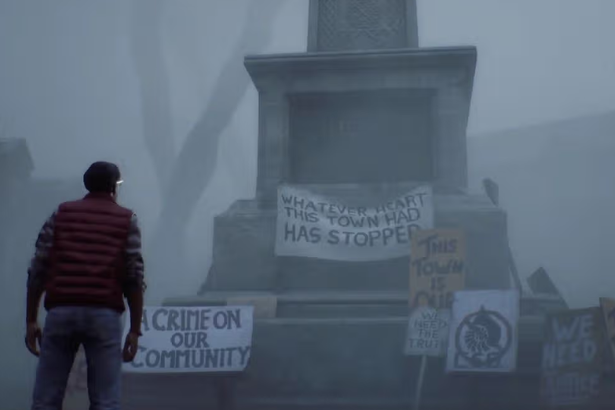
Silent Hill Townfall is taking one of gaming’s most recognizable horror franchises somewhere it has never gone before: a fictional island off the Scottish coast. Developed by Glasgow-based Screen Burn, the game places players in the abandoned fishing town of St. Amelia in 1996, where protagonist Simon Ordell must uncover what happened to the community and why he has been called back.
The timing is deliberate. Townfall arrives September 24, just as interest in the game is surging. The Google Trends screenshot supplied with this article shows a sharp spike in searches for “silent hill townfall,” with recent coverage focusing on its Scottish setting, reviews and its unusual first-person approach.
The game is also attempting something structurally different. Rather than placing players behind a traditional third-person camera, Townfall is the first full-length Silent Hill experience played entirely from a first-person perspective.
Background and Context
The Silent Hill franchise has spent decades building its identity around psychological horror, oppressive atmosphere and environments that blur the line between physical reality and the protagonist’s inner world.
Townfall keeps those foundations while changing the geography.
Instead of returning to the series’ familiar American town, the game is set in St. Amelia, a fictional fishing community inspired by Scotland’s East Neuk of Fife. The developers extensively photographed Scottish coastal towns while building the game’s environments.
The result is a distinctly British version of Silent Hill.
The streets are lined with small stone houses, seaside businesses, old telephone boxes and 1990s technology. The town feels ordinary before the horror begins to distort it.
That period setting is not simply visual decoration. Screen Burn has built parts of the gameplay around the technology and routines of the era, including old PCs, prepaid electricity meters and a handheld CRT television.
Konami describes the game as a self-contained psychological horror experience set against the isolated Scottish landscape of 1996. It is developed by Screen Burn and co-published by Konami and Annapurna Interactive.
Latest Update or News Breakdown
Silent Hill Townfall arrives September 24
The immediate reason for the search spike is simple: Silent Hill Townfall launches September 24, 2026.
Konami has confirmed releases for PlayStation 5, Steam and the Epic Games Store. The company says the broader Silent Hill franchise had sold more than 17.1 million copies worldwide as of the end of March 2026, based on its internal tracking.
That puts Townfall inside a particularly active period for the franchise, following the successful revival of interest around recent Silent Hill projects.
The game moves Silent Hill to Scotland
The biggest creative departure is the setting.
St. Amelia is not simply a renamed version of the original Silent Hill. It is a Scottish coastal community designed around local architecture, weather and 1990s British life.
The Guardian’s earlier preview described the town as being inspired by St Monans and other coastal communities in East Neuk of Fife. Developers visited and photographed locations to create the game’s environment.
That gives Townfall a different visual language.
Instead of the iconic American streets and industrial spaces associated with earlier games, players encounter lobster cages, weathered stone buildings, seaside shops, abandoned homes and a landscape shaped by coastal fog.
The real-world Scottish influence has become part of the game’s marketing story as well, with recent coverage exploring the locations and visual references that inspired St. Amelia.
First-person perspective changes the horror formula
The most important gameplay change is the camera.
For the first time in a full-length Silent Hill game, players experience the entire story from a first-person perspective. PlayStation’s official breakdown identifies this as one of the game’s central design changes.
The difference is more significant than simply moving the camera closer.
In third-person horror games, players can often see their character and scan the surrounding environment from a relatively safe perspective. First-person removes that buffer.
Enemies can approach from outside the player’s field of view. Doors become more threatening. Looking through a drawer or reading a computer screen can mean temporarily losing awareness of everything happening around you.
PlayStation says the game also uses a 2.35:1 aspect ratio, narrowing the vertical field of view and reinforcing the cinematic presentation.
The CRTV replaces Silent Hill’s traditional radio
One of the franchise’s recognizable gameplay devices has also been reworked.
Instead of relying on a traditional radio for warning signals, Townfall gives Simon a handheld CRTV, essentially a portable television that can be tuned to different frequencies.
The device can reveal information about nearby enemies and assist with exploration and puzzles. It also provides haptic feedback through the DualSense controller when danger approaches.
That creates an unusual combination of horror and technology.
The CRTV is simultaneously a tool for understanding the environment and a reminder that something may be hiding just outside normal vision.
Stealth becomes as important as combat
Townfall does not treat every encounter as a conventional fight.
Players can hide, duck behind environmental objects and peek around corners. PlayStation’s breakdown says players can lean around cover to check enemy positions and use cabinets, closets and lockers as hiding places.
Combat remains part of the game, but the design frequently asks players to decide whether fighting is actually the safest option.
That fits the broader direction of the first-person perspective. The player is not simply controlling a character who enters a dangerous room. The player is physically looking into that room.
The 1990s setting becomes a gameplay mechanic
The Guardian’s preview highlighted how extensively the developers have incorporated period technology into puzzles.
One early sequence involves restoring electricity using a prepaid card so Simon can access a computer and investigate emails. Other sections use old computers and analogue equipment as part of environmental storytelling.
The CRTV is an extension of the same idea.
It is a piece of technology that feels specific to the game’s time period while also serving a supernatural purpose.
That approach is particularly fitting for Screen Burn, whose previous projects Stories Untold and Observation also leaned heavily into tactile technology and environmental storytelling.
Expert Insights or Analysis
The most interesting aspect of Townfall is not simply that Silent Hill has moved to Scotland.
It is that the developers are treating Silent Hill as a phenomenon rather than a fixed geographical location.
In a previous Guardian interview, series producer Motoi Okamoto explained that the team wanted to avoid repeating the same locations and gameplay patterns. The developers instead wanted to interpret Silent Hill as a state of mind that could exist somewhere else.
That philosophy gives Townfall considerable freedom.
The game can preserve the franchise’s central ideas while changing the architecture, culture and social history surrounding them.
The first-person perspective reinforces the same philosophy from a gameplay standpoint.
The horror becomes less about watching a character navigate an environment and more about forcing the player to experience uncertainty directly.
A door can be dangerous because the player cannot see around it.
A computer can be dangerous because reading the screen requires attention.
A map can become dangerous because opening it takes the player’s eyes away from the surrounding environment.
PlayStation specifically highlights this divided attention as one of the consequences of the first-person design.
That makes ordinary actions part of the horror system.
Broader Implications
Silent Hill Townfall is arriving during a broader revival of classic horror franchises.
Publishers have increasingly returned to established horror properties through remakes, new interpretations and spin-offs. The strategy gives developers recognizable worlds while still allowing them to experiment with setting, mechanics and tone.
Townfall takes that approach further by changing both where Silent Hill exists and how players experience it.
The Scottish setting also gives the series a different cultural texture.
The Guardian’s preview describes an abandoned coastal community affected by a corporation called CEG, with the story touching on the relationship between individuals, communities and industrial exploitation.
That means the game’s horror is not confined to monsters.
The environment itself carries a history.
For The Tech Marketer, this also creates a useful internal-link opportunity: Read more gaming and interactive technology coverage on The Tech Marketer.
Related History or Comparable Technologies
The move to first-person is unusual for Silent Hill, but it is not completely unprecedented.
The series has experimented with first-person perspectives before. PlayStation notes that Silent Hill 4: The Room and Silent Hill: The Short Message included first-person gameplay elements. Townfall is the first full-length Silent Hill game to make first-person the central perspective for the entire experience.
The approach also connects Townfall to a larger tradition of first-person psychological horror.
Games such as Resident Evil 7, Amnesia: The Dark Descent and Alien: Isolation have demonstrated how first-person perspective can make environmental uncertainty central to horror.
Screen Burn has its own connection to that tradition. The studio’s earlier work includes Stories Untold and Observation, while director and writer Jon McKellan previously worked on Alien: Isolation.
That history helps explain why Townfall puts so much emphasis on analogue interfaces, limited visibility and environmental clues.
What Happens Next
The immediate milestone is the September 24 launch.
That will allow players to test whether the game’s first-person design works across a complete Silent Hill campaign rather than a preview segment.
Reviews already suggest a generally strong response to the atmosphere and setting, although some critics have pointed to puzzle difficulty as a potential frustration.
The Guardian’s review praised the game’s psychological and environmental storytelling while noting that some puzzles can become obscure.
PC Gamer similarly highlighted the game’s worldbuilding, environmental exploration and CRTV mechanic.
The larger question will be whether the Scottish setting and first-person structure become meaningful additions to the Silent Hill formula rather than simply surface-level changes.
Players will also discover how the game’s multiple character perspectives fit together.
The story follows Simon, Zoe and Richard, with each character connected to the wider tragedy surrounding St. Amelia.
That gives the game another layer beyond the immediate survival-horror mechanics.
Conclusion
Silent Hill Townfall is arriving with a surprisingly large set of changes for one of gaming’s most established horror franchises.
It moves the action from the familiar Silent Hill setting to a fictional Scottish fishing community. It shifts the entire experience into first person. It replaces the traditional radio mechanic with a handheld CRTV. And it uses the technology and social atmosphere of 1996 as part of the gameplay itself.
The result is a game that appears designed to preserve the psychological core of Silent Hill while changing the machinery surrounding it.
The search spike shown in Google Trends reflects the timing. With the September 24 release approaching, attention is now shifting from what Townfall looks like to whether its Scottish setting, first-person camera and analogue horror systems can deliver a genuinely different Silent Hill experience.
The fog is moving again. This time, it is rolling in from Scotland.
FAQ
What is Silent Hill Townfall?
Silent Hill Townfall is a full-length psychological horror game developed by Screen Burn and co-published by Konami and Annapurna Interactive. It is set on the fictional Scottish island of St. Amelia in 1996.
When does Silent Hill Townfall release?
Silent Hill Townfall releases on September 24, 2026, for PlayStation 5, Steam and Epic Games.
Is Silent Hill Townfall a first-person game?
Yes. It is the first full-length Silent Hill game presented entirely from a first-person perspective.
Where is Silent Hill Townfall set?
The game takes place in St. Amelia, a fictional fishing community on an isolated Scottish island. The environment was inspired by coastal towns in Scotland’s East Neuk of Fife.
What is the CRTV in Silent Hill Townfall?
The CRTV is a handheld television-like device that Simon can tune to different frequencies. It can help reveal nearby enemies and provide information used for puzzles and exploration.
Who developed Silent Hill Townfall?
The game was developed by Screen Burn, the Glasgow-based studio previously known as No Code, whose credits include Stories Untold and Observation.
Is Silent Hill Townfall connected to the original Silent Hill games?
It is a self-contained psychological horror game within the Silent Hill franchise. Its Scottish setting and new characters give it a distinct story while retaining the series’ focus on psychological horror and environmental storytelling.
Sources & References
- “Silent Hill: Townfall review: shame and suffering on the Scottish coast,” The Guardian, September 21, 2026
Read the Guardian review - “Silent Hill: Townfall: 9 ways first-person changes the iconic horror formula,” PlayStation.Blog, September 21, 2026
Read the PlayStation analysis - “The Next Phase of Psychological Horror Begins, SILENT HILL: Townfall Releases September 24,” Konami, June 3, 2026
Read Konami’s announcement - “Silent Hill Townfall: the series is coming to Scotland, but what fresh horrors will it bring?” The Guardian, July 29, 2026
Read the Scottish setting preview - “SILENT HILL: Townfall,” Annapurna Interactive
View the official game page - “I Visited the Real-Life Silent Hill Village in Scotland,” CNET
View the supplied CNET report