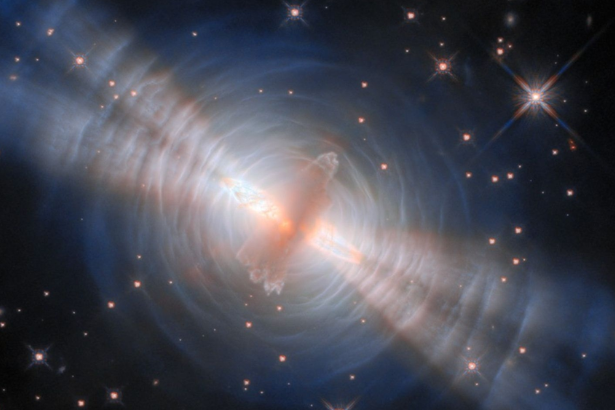
NASA and ESA reveal new details inside the iconic Egg Nebula
Introduction
Hubble Egg Nebula image searches surged after NASA and ESA released breathtaking new observations showing the dramatic structure of a dying star in unprecedented clarity. The latest imagery from the Hubble Space Telescope reveals intricate dust lanes, expanding shells of gas, and beams of light piercing through a dense stellar cocoon.
The Egg Nebula, formally known as CRL 2688, offers scientists a rare look at a short-lived phase of stellar evolution that precedes the formation of a planetary nebula.
Background and Context
Located roughly 3,000 light-years from Earth in the constellation Cygnus, the Egg Nebula is classified as a protoplanetary nebula. This stage occurs when a Sun-like star exhausts its nuclear fuel and begins shedding its outer layers.
Unlike a fully developed planetary nebula, the central star remains partially hidden behind thick clouds of dust and gas. These layers scatter and reflect starlight, creating the glowing lobes and concentric arcs visible in the new Hubble Egg Nebula image.
Astronomers consider this phase fleeting in cosmic terms, lasting only a few thousand years before ultraviolet radiation from the exposed stellar core ionizes the surrounding material.
Latest Update: What the New Hubble Egg Nebula Image Shows
According to reporting from Space.com and official releases from NASA and ESA, the updated Hubble observations highlight several key features:
1. Bipolar Outflows
The nebula displays symmetrical lobes extending outward from the hidden central star. These structures are sculpted by high-speed stellar winds interacting with previously expelled material.
2. Concentric Shells
Faint, layered arcs surround the core, indicating periodic mass ejections during the star’s late evolutionary stages.
3. Light Beams Through Dust
One of the most striking elements in the Hubble Egg Nebula image is the appearance of light shafts piercing dense dust clouds. These beams create a dramatic, lantern-like effect.
4. Complex Dust Structure
The nebula’s dust lanes reveal turbulent shaping forces, likely driven by magnetic fields or companion star interactions.
The enhanced image quality demonstrates how the Hubble Space Telescope continues to deliver groundbreaking science decades after launch.
Expert Insights and Scientific Analysis
Astronomers describe the Egg Nebula as a laboratory for understanding stellar death.
When stars similar in mass to our Sun approach the end of their life cycle, they expand into red giants before ejecting their outer layers. The newly released Hubble Egg Nebula image provides visual confirmation of how uneven and dynamic that process can be.
The structured arcs suggest rhythmic pulses of mass loss rather than a single dramatic expulsion. This supports models proposing that late-stage stars undergo repeated convective instability cycles.
Scientists are particularly interested in how bipolar jets form. One leading hypothesis involves gravitational influence from an unseen companion star, shaping the ejected gas into opposing lobes.
Broader Implications
For Stellar Evolution Research
The Egg Nebula offers direct observational evidence of how Sun-like stars evolve. By studying objects like this, astronomers can predict the eventual fate of our own Sun, which is expected to enter a similar phase in about five billion years.
For Imaging Technology
The clarity of the new Hubble Egg Nebula image underscores the continued scientific relevance of Hubble, even as newer telescopes like the James Webb Space Telescope expand infrared capabilities.
For Public Engagement
Images of dying stars often resonate with the public because they transform abstract astrophysics into tangible cosmic art. The Egg Nebula’s structure resembles butterfly wings or glowing lanterns, making it one of the most visually compelling protoplanetary nebulae ever observed.
Related History and Comparable Discoveries
Hubble has previously captured dramatic stellar death sequences, including detailed imagery of planetary nebulae and supernova remnants.
However, protoplanetary nebulae are relatively rare observational targets due to the short timescale of this transitional phase. Each high-resolution image adds critical data for refining stellar evolution models.
The Egg Nebula remains one of the clearest examples of bipolar shaping in action.
What Happens Next
Astronomers will continue analyzing spectral data to determine the composition and velocity of the expelled material. Future observations may reveal:
- Evidence of a binary companion
- More precise measurements of dust grain composition
- Improved modeling of stellar wind dynamics
As telescope technology advances, multi-wavelength observations will provide an even deeper look into the transformation from red giant to planetary nebula.
Conclusion
The latest Hubble Egg Nebula image provides a dramatic snapshot of stellar transformation. Far from a quiet fade-out, the death of a Sun-like star is chaotic, luminous, and structurally complex.
Through detailed observation, astronomers gain insights not only into distant cosmic objects but also into the long-term future of our own solar system. The Egg Nebula stands as both a scientific treasure and a reminder of the dynamic processes shaping the universe.
FAQ
What is the Egg Nebula? The Egg Nebula is a protoplanetary nebula located about 3,000 light-years away, representing a transitional stage in stellar evolution.
Why is the Hubble Egg Nebula image important? It reveals structural details about how dying stars shed their outer layers before becoming planetary nebulae.
Is the Egg Nebula a supernova? No. It involves a Sun-like star gradually shedding material, not an explosive supernova event.
Will our Sun form something like the Egg Nebula? Yes. In about five billion years, the Sun is expected to enter a similar red giant and protoplanetary nebula phase.
How far away is the Egg Nebula? Approximately 3,000 light-years from Earth.
Sources and References
Space.com: Hubble Space Telescope captures the final breaths of a dying star
NASA Science: Exploring the Structure of the Egg Nebula
ESA/Hubble: Hubble captures light show around rapidly dying star