Introduction
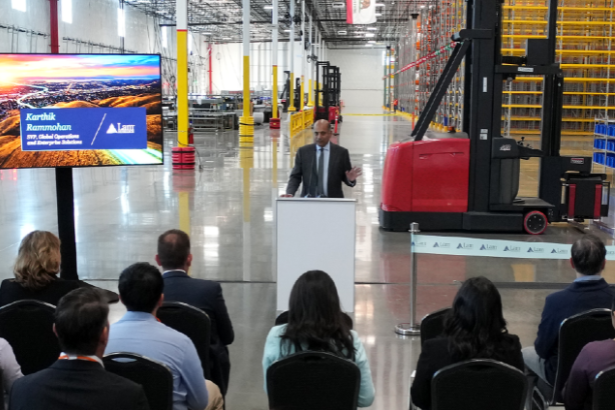
The new U.S. logistics hub opened by Lam Research in Livermore, California, is designed around a simple idea: semiconductor supply chains need to move faster as AI accelerates demand for advanced chips.
The 470,000-square-foot facility is Lam Research’s largest U.S. warehouse. The site consolidates California logistics operations and uses a large automated storage and retrieval system to move parts through the facility faster. According to reporting based on Lam Research’s announcement, the system uses 15 robots, about 150,000 storage bins and can accommodate more than 500,000 unique part numbers.
The opening comes as semiconductor equipment investment continues to expand. SEMI reported that global semiconductor equipment billings reached $40.53 billion in the second quarter of 2026, up 23% from a year earlier, with AI infrastructure investment helping drive demand.
For logistics operators, the story is bigger than one warehouse. It shows how automation is becoming part of the physical infrastructure supporting the AI economy.
Background and Context
Lam Research supplies equipment used in semiconductor manufacturing, including technologies associated with etch, deposition and advanced packaging.
That puts the company in a strategically important position within the chip supply chain. When semiconductor manufacturers expand production, equipment suppliers must be able to deliver complex machines, modules, replacement parts and components on increasingly demanding schedules.
The logistics challenge is particularly complicated because semiconductor equipment is not ordinary warehouse inventory.
A facility can need to manage:
- Large and small components
- High-value equipment parts
- Thousands of individual SKUs
- Manufacturing components
- Service and replacement inventory
- Pilot-development materials
- Time-sensitive shipments
- Inventory supporting multiple manufacturing locations
Lam has previously described automation as an important part of its effort to build more resilient operations. Its March 2026 discussion of semiconductor manufacturing logistics said its newer warehouse facilities use automated guided vehicles, autonomous mobile robots and automated storage and retrieval systems. The company said those technologies had helped increase warehouse productivity by more than six times across its operations.
The Livermore facility takes that approach into a much larger U.S. logistics operation.
Latest Update: Lam Research Opens Its Largest U.S. Logistics Hub
Lam Research opened the new facility in Livermore on September 28, according to reporting on the company’s announcement.
The site covers approximately 470,000 square feet across more than 10 acres and brings multiple California logistics operations together under one roof.
That consolidation is one of the most important elements of the project.
Instead of managing multiple regional facilities separately, Lam can centralize inventory and coordinate the movement of parts from a single major logistics location.
Automation sits at the center
The facility’s automated storage and retrieval system covers approximately 40,000 square feet.
It uses 15 robots and roughly 150,000 storage bins, with capacity for more than 500,000 unique part numbers. According to the reported facility specifications, retrieving a part can take less than 30 seconds, compared with approximately six minutes under the previous process.
That represents a significant change in warehouse workflow.
A traditional warehouse can require employees to travel between storage locations, locate an item and manually retrieve it.
An automated storage system changes the sequence:
Inventory request → automated retrieval → part presented to operator → order fulfillment
The objective is not simply fewer manual movements. It is faster and more predictable inventory access.
The facility connects logistics with manufacturing
The Livermore hub is positioned close to Lam’s high-volume manufacturing operation in the same city.
The facility also supports pilot product development at Lam’s Fremont headquarters. An adjacent metrology laboratory adds another capability to the site and is intended to support faster outbound delivery and regional research and development activity.
That geographic arrangement matters.
The closer logistics, manufacturing and development operations are to one another, the fewer unnecessary transportation steps may be required between them.
Why the U.S. Logistics Hub Matters for AI
The connection between a warehouse in California and AI may not be obvious at first.
AI models run on data-center infrastructure that depends on advanced processors, memory and increasingly sophisticated packaging technologies.
Those chips require complex manufacturing processes.
And those manufacturing processes require semiconductor equipment.
Lam sits further upstream in that chain.
SEMI’s latest market data shows why that upstream equipment market is expanding. Global semiconductor equipment billings rose 23% year over year in Q2 2026, reaching a second consecutive record quarter. SEMI attributed the continued investment partly to AI infrastructure and demand for advanced manufacturing capacity.
SEMI’s mid-year forecast also projects total semiconductor manufacturing equipment sales to reach $165.9 billion in 2026, up 23.2% from 2025. The organization expects investment in wafer fabrication equipment to rise to $143.9 billion in 2026.
The implication for logistics is straightforward.
More semiconductor manufacturing investment means more equipment, components and spare parts have to move through the supply chain.
That puts pressure on warehouses to become faster, more accurate and more responsive.
Expert Insights and Analysis
1. The warehouse is becoming part of the manufacturing system
The traditional view of logistics treats a warehouse as a place where inventory waits.
That model is changing.
For high-value manufacturing, warehouse performance can influence production responsiveness.
If a critical component is sitting in the wrong location, the problem is no longer simply a warehouse delay. It can become a manufacturing delay.
Lam’s facility is designed to reduce that friction by centralizing inventory and automating retrieval.
The company’s broader logistics strategy reflects the same idea. Lam says its automation efforts include autonomous mobile robots and automated storage and retrieval systems as part of its resilience strategy.
2. AI demand is increasing the importance of speed
AI semiconductor development is moving quickly.
Lam said in August that it plans to invest more than $3 billion over five years to expand its global R&D laboratory network, with the goal of increasing experimentation capacity by more than 50%. The company said its global lab network supports more than one million experiments annually.
That investment is happening alongside logistics expansion.
The combination tells an important story.
R&D acceleration + manufacturing expansion + logistics automation
These are increasingly connected pieces of the same semiconductor operating model.
3. Inventory visibility becomes more important as networks grow
Centralization can also improve visibility.
With hundreds of thousands of potential part numbers in one facility, companies need accurate information about what is available, where it is stored and how quickly it can be dispatched.
Automation can help connect physical inventory with digital inventory records.
That creates opportunities for:
- Better inventory accuracy
- Faster order processing
- More predictable fulfillment
- Reduced manual handling
- Better demand response
- Improved warehouse utilization
The value is particularly relevant when semiconductor demand changes quickly.
Broader Implications for U.S. Logistics
Lam’s new facility reflects a broader transformation taking place across American logistics.
Warehouses are increasingly becoming technology platforms rather than simple storage buildings.
Robotics, warehouse management systems, machine vision, sensors and analytics are becoming more tightly integrated.
The semiconductor sector is particularly suited to this transformation because its inventory can be expensive, technically complex and highly time-sensitive.
The same approach is now spreading across other industries.
Automotive manufacturers are using automated material movement.
Retailers are expanding robotic fulfillment.
Pharmaceutical companies are investing in controlled and highly traceable distribution.
Industrial manufacturers are increasingly connecting warehouses directly with production systems.
For The Tech Marketer, an internal linking opportunity would be: U.S. Logistics and Supply Chain Technology.
Related History and Comparable Technologies
Warehouse automation is not new.
Automated storage and retrieval systems have been used for decades in manufacturing and distribution.
What has changed is the combination of robotics, software and data.
Earlier automated warehouses often focused on repetitive movement.
Modern systems can combine:
- Autonomous robots
- Automated storage
- Inventory-management software
- Sensors
- Machine learning
- Digital twins
- Real-time inventory tracking
- Automated picking and retrieval
Lam’s own technology strategy illustrates this evolution.
The company has discussed Equipment Intelligence, which combines sensors, data, algorithms, artificial intelligence and robotics to make semiconductor manufacturing equipment more autonomous and productive.
The logistics facility extends that broader philosophy beyond the manufacturing tool itself and into the physical movement of components.
What Happens Next?
The most important question is how quickly semiconductor logistics networks can scale alongside AI-related demand.
More warehouse automation
The Livermore project provides a model for how large semiconductor equipment suppliers can centralize inventory and automate retrieval.
If demand continues to expand, similar facilities could become more common.
Greater integration between warehouses and factories
The boundary between logistics and manufacturing is likely to become less distinct.
Real-time inventory information can increasingly connect directly with production planning.
More regionalized semiconductor networks
The U.S. semiconductor industry is also expanding its manufacturing footprint.
Reuters reported on September 30 that TSMC is considering a potential Texas investment to expand its U.S. chip production capabilities, although the plans had not been finalized. Reuters noted that this would add to the company’s major Arizona expansion.
More U.S. semiconductor manufacturing could create additional demand for nearby equipment, parts, logistics and service infrastructure.
Automation will not eliminate every logistics challenge
Robotics can accelerate warehouse operations, but it does not remove the need for transportation networks, suppliers, skilled workers, inventory planning and reliable infrastructure.
The strongest logistics networks will likely combine automation with human decision-making rather than treating robotics as a standalone solution.
Conclusion
Lam Research’s new U.S. logistics hub in Livermore is more than a large warehouse.
The 470,000-square-foot facility brings California logistics operations together, introduces a 40,000-square-foot automated storage and retrieval system and uses 15 robots to manage a huge inventory of semiconductor parts. Reported retrieval times fall from roughly six minutes to less than 30 seconds.
The timing is significant.
AI is driving investment across the semiconductor industry, and SEMI reported record semiconductor equipment billings in the second quarter of 2026.
As chip manufacturing becomes more complex, the logistics systems supporting it are becoming more sophisticated too.
The warehouse of the AI era is not simply a place to store parts. It is increasingly becoming an active component of the manufacturing network.
FAQ
1. What is Lam Research’s new U.S. logistics hub?
Lam Research’s new U.S. logistics hub is a 470,000-square-foot facility in Livermore, California, designed to centralize logistics operations and support the company’s semiconductor equipment supply chain.
2. How large is the Lam Research logistics hub?
The facility covers approximately 470,000 square feet across more than 10 acres and is Lam Research’s largest U.S. warehouse.
3. How many robots are used at the facility?
The automated storage and retrieval system uses 15 robots and approximately 150,000 storage bins.
4. How does the facility support AI chip demand?
Lam Research supplies equipment used in semiconductor manufacturing. As AI increases demand for advanced chips and manufacturing capacity, faster movement of semiconductor equipment parts can help support production and development operations.
5. Where is Lam Research’s new logistics hub located?
The facility is located in Livermore, California, near Lam’s existing high-volume manufacturing operation.
6. Why is warehouse automation important for semiconductor logistics?
Semiconductor manufacturing involves complex equipment and large inventories of specialized components. Automated storage and retrieval can reduce manual movement, speed up part retrieval and improve inventory handling.
Sources & References
- Lam Research: New Logistics Hub Built for Velocity, Resilience, and AI-Era Growth
Lam Research Newsroom and company blog - Lam Research Announces Plans to Invest More than $3B to Expand Global Lab Network, Increase Innovation Velocity in the AI Era
Lam Research Investor Relations - Global Semiconductor Equipment Billings Increased 23% Year-Over-Year in Q2 2026, SEMI Reports
SEMI report - Global Semiconductor Equipment Sales Forecast to Reach a Record $229 Billion in 2028, SEMI Reports
SEMI forecast - Lam Research Focused on Adding AI to Chipmaking Tools as It Eyes U.S. Expansion, CEO Says
Reuters report