Google has quietly refreshed its canonicalization documentation, giving SEO professionals and site owners clearer guidance on duplicate URLs, canonical signals and what to do when Google chooses a different canonical page.
Google canonicalization documentation has received a series of small but important updates, bringing clearer explanations to one of the more confusing parts of technical SEO.
The changes do not appear to introduce a new canonicalization algorithm or fundamentally alter how Google selects canonical URLs. Instead, Google has reorganized and clarified its guidance around what canonicalization means, how site owners can indicate their preferred URL and how to troubleshoot cases where Google selects something else.
The timing is notable because canonicalization remains one of the most misunderstood areas of Google Search.
A site can have several URLs pointing to substantially identical content. Google groups those pages, evaluates a range of signals and chooses what it considers the representative URL.
The important catch is that a site’s preferred canonical is a hint, not a command.
Google’s refreshed documentation makes that point particularly clear.
Background and Context
Canonicalization is essentially Google’s system for deciding which URL should represent a piece of content when multiple URLs contain the same or very similar material.
That can happen for perfectly legitimate reasons.
An ecommerce site might generate different URLs for sorting products. A publisher might have separate mobile and desktop URLs. International websites can create regional variations. Tracking parameters can also create multiple addresses for substantially the same page.
Google says canonicalization helps it avoid showing multiple versions of essentially duplicate content in search results. It also reduces unnecessary crawling of duplicate URLs.
The concept is not new.
What has changed is how Google is explaining it.
The updated documentation now presents canonicalization as a clearer three-part topic: understanding what canonicalization is, specifying a preferred canonical URL and fixing canonicalization problems. Google’s documentation change history says the canonicalization material was refreshed and split into distinct sections to make it easier for site owners to understand.
That structure matters because canonicalization problems are rarely solved by simply adding a rel="canonical" tag.
There can be conflicts between redirects, internal links, sitemaps, page content and canonical annotations.
Google’s systems consider those signals together.
Latest Update: Google Refreshes Canonicalization Help Docs
Search industry publication Search Engine Roundtable reported that Google made minor updates to its canonicalization help documentation, specifically the pages covering what canonicalization is and how to fix canonicalization issues. The publication characterized the changes as making the explanations easier to understand rather than introducing a fundamental change to Google’s search behavior.
Search Engine Roundtable’s report on Google’s canonicalization documentation update
Google’s own documentation now explains canonicalization in more direct terms.
When Google encounters multiple pages that appear to contain the same primary content, it can cluster those URLs together. It then chooses the URL it considers the most representative based on the signals available to its indexing systems.
Those signals include:
- HTTPS versus HTTP
- Redirects
- URLs included in sitemaps
rel="canonical"annotations- The content and overall quality of the pages
- Other technical and indexing signals
The key takeaway is that Google can disagree with the canonical URL a site owner specifies.
Google explicitly describes a canonical preference as a hint rather than a rule.
That distinction is one of the most important parts of the refreshed guidance.
What Is a Canonical URL?
A canonical URL is Google’s selected representative URL for a group of duplicate or substantially similar pages.
Imagine a website has these three addresses:
example.com/article
example.com/article?utm_source=newsletter
example.com/article?sort=latest
If Google determines that the pages contain essentially the same primary content, it can group them together and select one URL as canonical.
The canonical version becomes the primary URL Google associates with that content.
This does not necessarily mean the other URLs disappear from the internet.
They can remain accessible.
But Google generally wants to consolidate the indexing signals around the representative version.
Google’s documentation says the canonical page is normally the URL used as the main source for evaluating content and quality, while duplicate URLs are generally crawled less frequently.
Google Search Central’s updated canonicalization documentation
Why the Update Matters for SEO
Canonicalization sits underneath several important SEO processes.
If it is configured correctly, multiple URLs can effectively consolidate their signals around one preferred page.
If it is configured badly, a site can end up with Google selecting a different URL than the publisher intended.
That can create confusing situations in Google Search Console.
A publisher might believe that /article/ is the primary page while Google has selected /article?source=homepage or another URL as the canonical.
The refreshed documentation makes troubleshooting such problems more systematic.
Google recommends first checking which URL it actually considers canonical using the URL Inspection tool. Site owners can then investigate technical signals and determine whether the clustered pages are sufficiently different to warrant being treated separately.
The Biggest Lesson: rel="canonical" Is Not a Force Field
One of the easiest SEO mistakes is assuming that adding this HTML element:
<link rel="canonical" href="https://example.com/preferred-page">automatically tells Google what to index.
It does not.
Google can choose a different canonical URL.
The refreshed documentation reinforces this.
Google considers canonical annotations alongside other signals rather than treating them as absolute instructions.
That means a website should make its signals consistent.
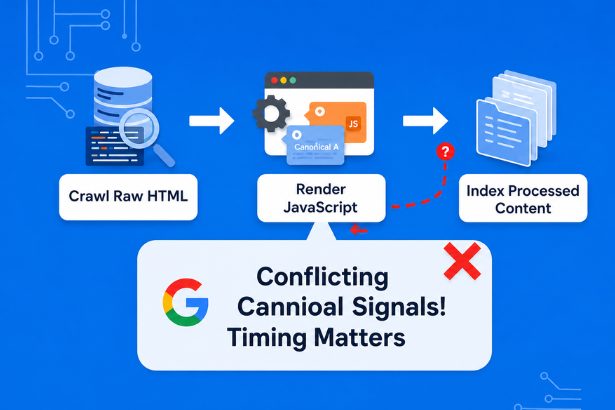
If the canonical tag points to URL A, the sitemap lists URL B, internal links overwhelmingly point to URL C and redirects send users somewhere else, the site is effectively sending Google mixed instructions.
A clean canonical strategy attempts to eliminate that ambiguity.
How Google Chooses a Canonical URL
Google’s process begins by identifying the primary content of a page.
If it discovers other pages with identical or highly similar primary content, it can group those URLs into a duplicate cluster.
It then selects the URL it considers the best representative.
Google says the decision can involve several technical signals, including:
HTTPS
If equivalent pages exist over HTTP and HTTPS, the HTTPS version can be an important canonical signal.
Redirects
Redirects can communicate that one URL should effectively replace another.
Sitemaps
Including a URL in a sitemap can reinforce the publisher’s preferred version.
rel="canonical"
A canonical link annotation tells Google which URL the publisher prefers.
Content Quality and Completeness
This is particularly important.
Google’s refreshed documentation says its systems can select a different canonical based on the quality or usefulness of the pages involved.
That means canonicalization is not purely a technical exercise.
Content itself matters.
Google’s New Troubleshooting Guidance
The updated “Fix canonicalization issues” documentation provides a practical workflow.
Google recommends starting with the URL Inspection tool to determine which page Google has actually selected as canonical.
That first step is critical.
There is little value in guessing what Google thinks.
The Search Console data can reveal the difference between the site’s preferred canonical and Google’s selected canonical.
From there, Google recommends looking for technical problems.
These can include:
- Incorrect
rel="canonical"elements - Server configuration problems
- Unexpected redirects
- Localization problems
- Duplicate pages that are too similar
- Other signals pointing toward another URL
Google also advises making sure pages within the same duplicate cluster are sufficiently different when they are supposed to be indexed independently.
Canonicalization Problems Can Take Time to Resolve
There is another important detail in Google’s updated guidance.
Fixing a canonicalization issue does not necessarily produce an immediate change.
Google says that after content issues are corrected, pages can remain in a duplicate cluster for up to two weeks while Google’s systems reevaluate them.
That is useful operational information for SEO teams.
A developer might fix the canonical tag on Monday, inspect Search Console on Tuesday and conclude that nothing worked.
That conclusion could be premature.
Google recommends requesting reindexing through Search Console after significant fixes, while noting that the feature has quotas and should therefore be reserved for important URLs.
Canonicalization and Duplicate Content Are Not the Same Thing as Spam
Another useful clarification is that duplicate content itself is not automatically a violation of Google’s spam policies.
Duplicate URLs are often a normal consequence of how websites work.
Sorting parameters, tracking URLs, device versions and regional variations can all produce multiple URLs for essentially the same content.
The problem is primarily one of organization and search-engine efficiency.
If hundreds or thousands of URLs expose the same content, Google has to determine which version deserves to represent the cluster.
That can make crawling and performance analysis more complicated.
Canonicalization helps consolidate those signals.
Expert Insights and Analysis
The Update Is More About Clarity Than a New Ranking System
The most important thing to understand about the latest documentation change is what it doesn’t appear to be.
There is no indication from Google’s updated documentation that the company has launched a new canonicalization ranking system.
Instead, Google is improving the documentation around an existing process.
Search Engine Roundtable likewise described the changes as minor and focused on making the documentation easier to understand.
For SEO professionals, that distinction matters.
A documentation refresh should not automatically be interpreted as an algorithm update.
Google’s Canonical Decision Is Becoming Easier to Explain
The bigger win is operational.
Canonicalization can become extremely complicated on large websites.
News publishers can have multiple URL structures.
Ecommerce sites can create thousands of filtered combinations.
International businesses can operate regional versions.
JavaScript applications can alter URLs dynamically.
In all of these environments, SEO teams need a consistent way to reason about canonical signals.
The updated documentation provides a clearer framework.
Choose the preferred URL. Make your technical signals consistent. Check what Google actually selected. Then fix the underlying reason if Google disagrees.
That is much more actionable than simply telling publishers to add canonical tags.
Broader Implications
SEO Teams Should Audit Signals, Not Just Tags
A canonical audit should go beyond checking whether a page contains:
rel="canonical"SEO teams should also examine:
- The canonical URL in the HTML.
- Internal links.
- XML sitemaps.
- Redirect chains.
- HTTP versus HTTPS versions.
- Duplicate content.
- International versions and
hreflang. - Google-selected canonical URLs in Search Console.
If those signals disagree, the site may be making Google’s decision unnecessarily difficult.
Large Websites Have More to Lose
Canonicalization becomes especially important at scale.
A small blog might have a handful of duplicate URLs.
A large ecommerce platform can potentially generate millions of URL combinations through filtering, sorting, search parameters and session-related functionality.
The larger the URL footprint, the more important it becomes to make the site’s preferred URL structure obvious.
It Also Matters for AI Search
Modern search is increasingly dependent on systems that need to identify the most representative version of a piece of content.
Canonicalization is therefore relevant beyond traditional blue-link rankings.
A clean canonical architecture can help establish which URL represents a publisher’s primary version of a page.
That does not guarantee visibility in AI-generated search features, but it is an important part of making a site’s content architecture understandable to search systems.
For more coverage of Google Search, AI and the technology reshaping digital marketing, readers can explore The Tech Marketer.
Related History and Comparable Technologies
Canonicalization has been part of SEO for years, but Google’s documentation around it has continued to evolve.
Google’s documentation history shows previous clarification around canonicalization, including guidance on JavaScript and the extraction of rel="canonical" annotations. Google has also emphasized that canonicalization can happen before and after rendering, making consistency between the original HTML and rendered page important.
This reflects a broader shift in web architecture.
Modern websites are increasingly dynamic.
Content may be rendered through JavaScript, personalized through frameworks and delivered through complex URL structures.
Search engines therefore need to interpret not just HTML tags but the complete set of signals surrounding a page.
Canonicalization is one part of that larger indexing system.
What Happens Next
The immediate impact of the update is likely to be practical rather than dramatic.
SEO teams will have a clearer reference when diagnosing cases where Google selects an unexpected canonical URL.
Developers will have more explicit guidance on technical problems.
Publishers will have a better explanation of why a canonical tag does not always produce the desired result.
The bigger question is whether Google will continue refreshing other technical SEO documentation in the same way.
The company’s documentation update history shows an ongoing effort to clarify search guidance rather than leaving older explanations untouched.
For website owners, the takeaway is simple.
Do not treat Google’s documentation refresh as a reason to change every canonical tag on the site.
Instead, use it as an opportunity to audit whether the site’s preferred URLs are supported consistently across its technical architecture.
Why “Docs” Is Trending on Google
The supplied Google Trends screenshot shows “docs” experiencing a sharp late-period increase in search interest.
However, the trend is broader than Google’s canonicalization update.
The screenshot’s news results include:
- Google’s canonicalization documentation changes
- A court-related story involving former Phoenix officers
- Another report about the same Phoenix case
That means the Google Trends term “docs” should not be interpreted as evidence that Google’s canonicalization update alone caused the entire search spike.
For this article, the technology-specific news result is the relevant signal.
The Google documentation update itself is timely, with Google’s canonicalization pages showing recent updates in August 2026.
Conclusion
Google’s latest canonicalization documentation update is not a flashy algorithm launch.
It may be more useful than one.
By clarifying how canonical URLs are selected and how publishers should troubleshoot unexpected canonicalization, Google is giving SEO teams a better framework for solving one of technical SEO’s most persistent problems.
The central message is worth remembering:
A canonical URL is a preference, not a command.
Google considers redirects, sitemaps, HTTPS, canonical annotations and the actual content of pages when deciding which URL best represents a duplicate cluster.
If Google chooses a different URL, the answer is not necessarily to add another canonical tag.
The answer is to find out why.
That means checking Search Console, auditing technical signals and making sure the pages within a cluster are genuinely differentiated when they are intended to rank independently.
For publishers and SEO teams, the refreshed documentation turns that process into a much clearer playbook.
FAQ
What is Google canonicalization?
Google canonicalization is the process Google uses to select the representative URL from a group of duplicate or substantially similar pages. The selected URL is known as the canonical URL.
What changed in Google’s canonicalization documentation?
Google made minor updates to its canonicalization help pages, including clearer explanations of what canonicalization is and how to troubleshoot cases where Google selects a different canonical URL. Search Engine Roundtable reported the changes as documentation improvements rather than a fundamental algorithm change.
Does rel="canonical" force Google to index a specific URL?
No. Google describes a canonical annotation as a hint rather than a rule. Google can select a different canonical URL when other signals or the content itself indicate that another page is more representative.
How can I check which canonical URL Google selected?
Use Google’s URL Inspection tool in Search Console. Google’s updated troubleshooting guidance specifically recommends checking which URL Google considers canonical before investigating potential technical problems.
How long does a canonicalization fix take?
Google says pages can remain in a duplicate cluster for up to two weeks after content issues are fixed while its systems reevaluate the pages.
What can cause Google to select the wrong canonical URL?
Potential causes include incorrect canonical tags, redirects, server configuration problems, localization issues and pages that are too similar to one another. Conflicting signals across a site’s technical architecture can also make the preferred URL less clear.
Is duplicate content a Google spam violation?
Not automatically. Google says some duplicate content is normal and does not itself violate its spam policies. Canonicalization primarily helps Google consolidate duplicate URLs and identify the most representative version.
Should every page have a canonical tag?
A canonical strategy should be deliberate rather than based on blindly adding tags everywhere. Site owners should ensure their preferred URLs are consistent with other signals such as redirects, internal links and sitemaps.