Introduction
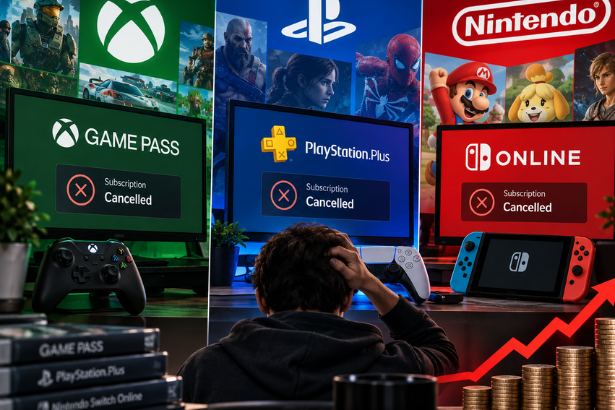
Xbox Game Pass subscription cancellations are drawing attention after new Circana survey data showed that rising costs are becoming a stronger reason for players to leave major gaming services.
More than 40% of U.S. players who recently canceled Xbox Game Pass Essential, PlayStation Plus Essential, or Nintendo Switch Online cited cost as a primary reason, according to figures shared by Circana senior director and video game analyst Mat Piscatella.
The finding arrives as Microsoft, Sony, and Nintendo face growing pressure to justify subscription prices in an increasingly expensive gaming market.
For players, the appeal of paying one recurring fee for access to games remains strong. But when subscription prices rise, the value proposition becomes harder to defend, particularly for people who do not use the service regularly.
The latest data suggests that the issue is not necessarily that gamers dislike these services. Many may simply feel that the monthly or annual cost no longer fits their budgets.
Background and Context
The rise of gaming subscriptions
Gaming subscriptions have transformed how players access video games.
Instead of purchasing individual titles at full price, subscribers can access game libraries, online multiplayer features, discounts, and other benefits through recurring payments.
Xbox Game Pass, PlayStation Plus, and Nintendo Switch Online have become central parts of their respective platforms’ ecosystems.
The model offers flexibility for players who want to try different games without making a separate purchase every time.
For platform holders, subscriptions provide recurring revenue and a way to keep users engaged over longer periods.
However, the model depends on a delicate balance between price, content, and perceived value.
When any one of those factors changes, subscribers may reconsider whether the service deserves a place in their budgets.
Why subscription fatigue is becoming a bigger issue
Consumers are increasingly managing multiple recurring payments across entertainment, software, and digital services.
A gaming subscription may compete with streaming platforms, music services, mobile apps, and other household expenses.
Even when a player enjoys a service, the subscription can become an easy expense to cut if it is not used frequently.
That dynamic is especially important for gaming companies because users can often return later when a major release or attractive promotion gives them a reason to resubscribe.
Latest Update: More Than 40% of Recent Cancellers Cite Cost
What the Circana data shows
The latest survey data from Circana’s Future of Insights for Video Games Consumer Survey points to a growing role for cost in subscription cancellations.
According to the findings shared by Mat Piscatella, 40% of recent Xbox Game Pass Essential and PlayStation Plus Essential cancellers cited cost as a primary reason for leaving.
That figure was up from 37% in the first quarter of 2026.
Nintendo Switch Online recorded a sharper increase. The share of recent cancellers citing cost rose from 40% in the first quarter to 50% in the more recent survey period.
The findings were highlighted in GamesIndustry.biz’s coverage of the survey.
The numbers do not prove that overall cancellations increased
One important distinction deserves attention.
The survey measures why people who already canceled their subscriptions decided to leave. It does not establish that the total number of cancellations across the gaming industry has increased.
That means the data should not be interpreted as proof of a mass exodus from Xbox Game Pass, PlayStation Plus, or Nintendo Switch Online.
Instead, it shows that among the people who are canceling, cost is becoming a more common explanation.
That distinction matters for both investors and platform executives trying to understand customer behavior.
Nintendo Switch Online sees the biggest shift
Nintendo Switch Online stands out because the proportion of recent cancellers citing cost rose by 10 percentage points.
That is a larger increase than the three-point rise recorded for Xbox Game Pass Essential and PlayStation Plus Essential.
The result is notable because Nintendo’s service has traditionally been positioned as a relatively inexpensive way to access online multiplayer and classic game libraries.
Even a low-cost subscription can become difficult to justify when household budgets are under pressure.
The data suggests that affordability is not only a concern for premium services.
Xbox Game Pass Subscription Cancellations and Microsoft’s Pricing Strategy
Game Pass has undergone major changes
Microsoft’s Game Pass strategy has evolved as the company has expanded its gaming business.
The service has offered access to large game libraries, cloud gaming, online multiplayer, and other benefits across different subscription tiers.
However, changes to pricing and content availability have made the value proposition more complicated.
The latest reporting around Xbox Game Pass subscription cancellations comes after a period of pricing adjustments and changes to how major releases are included in the service.
Players are now evaluating not only how much Game Pass costs, but also which games they receive and how frequently they use the subscription.
Price changes can alter customer expectations
A subscription price increase can be difficult for users to absorb when they believe the service is already expensive.
The issue becomes more complicated when features or benefits change at the same time.
For example, a player may accept a higher price if the service delivers a steady stream of highly anticipated games.
But if major benefits are reduced, the same price can feel less attractive.
That makes pricing decisions particularly important for Microsoft as it tries to balance revenue growth with subscriber retention.
PlayStation Plus Faces Similar Pressure
Sony’s PlayStation Plus service faces the same broader challenge.
Players use the service for online multiplayer, monthly games, discounts, and access to different game catalogs depending on their subscription tier.
The survey indicates that 40% of recent PlayStation Plus Essential cancellers cited cost as a primary reason for leaving, up from 37% in the first quarter.
That increase suggests that price sensitivity is not limited to Xbox users.
Players across competing platforms are making similar decisions about whether recurring gaming expenses are worth maintaining.
The value question is becoming more important
The subscription model works best when users feel they are receiving more value than they would by purchasing games individually.
But not every player uses a subscription enough to reach that point.
Someone who plays only one or two games per month may prefer buying those titles outright.
Others may subscribe temporarily for a major release, then cancel once they finish playing.
This creates a challenge for Sony and Microsoft: maintaining a large subscriber base requires more than adding content. It requires keeping the service relevant to users’ changing habits.
Nintendo Switch Online and the Cost Problem
Why the increase matters
The Nintendo Switch Online results are particularly interesting because the service is generally cheaper than many competing subscription offerings.
The fact that half of recent cancellers cited cost suggests that consumers are evaluating subscriptions against their total household budgets, not simply comparing one service with another.
A lower price does not guarantee retention if users feel they are not getting enough value.
Nintendo’s different subscription model
Nintendo Switch Online has a distinct value proposition built around online multiplayer, access to classic games, and additional features.
Unlike some Game Pass offerings, it is not primarily marketed as a large catalog of newly released premium games.
That means subscribers may evaluate the service differently.
For some users, access to classic titles and online features may be enough to justify the fee. For others, the service may be less essential, particularly if they play infrequently.
Expert Insights and Analysis
Cost is becoming a stronger driver of churn
The survey findings indicate that price is becoming more important in the decision to cancel gaming subscriptions.
This is significant because subscription businesses typically rely on customers maintaining payments over long periods.
When users begin to see a service as optional rather than essential, the risk of cancellation increases.
The challenge for platform holders is to keep the perceived value of their services ahead of the price consumers are willing to pay.
Subscription fatigue is not unique to gaming
Gaming subscriptions are part of a broader digital economy built around recurring payments.
Consumers increasingly face decisions about which services to keep, pause, or cancel.
The gaming industry is competing for the same limited household spending as video streaming, music, cloud storage, and other digital services.
As more subscriptions accumulate, users may become more selective about the services they maintain.
The most important metric is not just subscriber count
A large subscriber base can look impressive, but it does not necessarily reveal how healthy a subscription business is.
Companies also need to understand engagement, retention, average revenue per user, and the reasons customers leave.
The Circana findings offer a useful signal because they reveal what recent cancellers say about their decisions.
However, the data does not provide a complete picture of overall churn or platform profitability.
Broader Implications
Gaming companies may need more flexible pricing
The findings could encourage platform holders to explore more flexible subscription options.
Possible approaches include lower-cost tiers, temporary pauses, annual discounts, and targeted promotions.
These strategies may help companies retain users who are interested in the service but cannot justify the full recurring price.
Content strategy becomes more important
Price and content are closely connected.
A subscription can feel expensive when users do not see enough new or appealing games.
Platform holders may therefore need to pay closer attention to release schedules, catalog quality, and how frequently subscribers engage with the service.
A strong content pipeline can help justify recurring payments, while a slow period may encourage cancellations.
Cloud gaming adds another layer of cost pressure
Microsoft is also changing how cloud gaming is included in Game Pass.
According to Xbox Wire, monthly cloud gaming limits are scheduled to begin in November 2026.
The announced allowances are:
- Game Pass Ultimate: 15 hours per month.
- Game Pass Premium: 10 hours per month.
- Game Pass Essential: 5 hours per month.
Xbox says the change is expected to affect approximately 4% of Game Pass subscribers.
The company also says additional cloud playtime will be available for purchase through the Xbox Store, with further pricing details to be announced.
Although the cloud gaming changes are separate from the Circana cancellation survey, they contribute to the broader conversation about what subscribers receive for their money.
The subscription model may become more segmented
The future of gaming subscriptions may involve more differentiated tiers.
Some players want access to large libraries. Others primarily need online multiplayer. Some want cloud gaming, while others prefer downloading games to their consoles.
A single subscription structure may not serve all of those needs equally well.
More specialized plans could help platform holders offer different levels of value at different prices.
Related History and Comparable Technologies
The Netflix comparison
Gaming subscriptions have often been compared with Netflix and other streaming services.
The comparison is useful because both models rely on recurring payments and ongoing content value.
However, gaming is different in several important ways.
Games can require dozens of hours to complete, and players may focus intensely on a small number of titles.
That means a user may not need continuous access to a large catalog.
A streaming subscriber may watch something every day, while a gamer may spend weeks on a single title and then take a break.
The rise of free-to-play gaming
Free-to-play games have also changed how players think about subscriptions.
Many popular multiplayer titles can be played without a paid console subscription, depending on the platform and game.
This reduces the need for some players to maintain a subscription solely for online gaming.
As a result, subscription services must offer additional benefits that users consider worthwhile.
What Happens Next
Platform holders will watch retention closely
Microsoft, Sony, and Nintendo will likely continue monitoring how pricing changes affect customer behavior.
The key question is whether cost-driven cancellations translate into a broader decline in subscriber numbers or remain concentrated among a smaller group of users.
Discounts may become more common
Targeted promotions and temporary discounts could become useful tools for winning back former subscribers.
Microsoft has reportedly experimented with targeted Game Pass discounts for some users who have canceled, according to TechRadar’s coverage.
Such strategies may help reduce churn, although they can also create questions about fairness when different users receive different prices.
Cloud gaming changes will be watched
The November cloud gaming changes will provide another test of how subscribers respond to adjustments in service benefits.
Xbox says the new limits will affect a minority of Game Pass users, but the reaction among frequent cloud players could be important.
Consumers will continue to prioritize value
The broader trend is clear: gamers are increasingly weighing subscription costs against actual usage.
Players who use a service regularly may continue to see strong value in it.
Those who play less frequently may choose to pause or cancel and return when a more appealing lineup of games becomes available.
Conclusion
Xbox Game Pass subscription cancellations are becoming part of a larger conversation about the sustainability of gaming subscriptions.
Circana’s latest data shows that cost is a growing reason for recent cancellations across Xbox Game Pass Essential, PlayStation Plus Essential, and Nintendo Switch Online.
The most important finding is not that the entire subscription market is collapsing. It is that users who do cancel are increasingly pointing to affordability as a key factor.
For Microsoft, Sony, and Nintendo, the challenge is to make recurring payments feel worthwhile in a market where consumers have more entertainment options and tighter budgets.
The future of gaming subscriptions will depend on pricing, content, flexibility, and the ability to keep users engaged.
Frequently Asked Questions
1. Why are Xbox Game Pass subscription cancellations increasing?
Rising costs are becoming a stronger reason for people who cancel Xbox Game Pass Essential subscriptions, according to Circana survey data. The findings do not establish that overall cancellation numbers have increased.
2. What percentage of Xbox Game Pass Essential cancellers cite cost?
The latest survey figures indicate that 40% of recent Xbox Game Pass Essential cancellers cited cost as a primary reason, up from 37% in the first quarter of 2026.
3. Is PlayStation Plus facing the same problem?
Yes. The survey indicates that 40% of recent PlayStation Plus Essential cancellers cited cost, compared with 37% in the first quarter.
4. Why are Nintendo Switch Online cancellations notable?
Nintendo Switch Online recorded the largest increase in the share of recent cancellers citing cost, rising from 40% to 50%.
5. Does the survey prove that more gamers are canceling subscriptions?
No. The data measures the reasons given by people who have already canceled. It does not establish that the total number of cancellations has increased.
6. How can gaming companies reduce subscription cancellations?
Platform holders can explore flexible pricing, stronger content lineups, targeted promotions, and subscription tiers that better match different players’ needs.
7. Are Xbox Game Pass cloud gaming limits related to the cancellation trend?
The cloud gaming changes are a separate development. Xbox has announced monthly cloud gaming allowances beginning in November 2026, while the Circana survey focuses on reasons for subscription cancellations.
Sources & References
- GamesIndustry.biz: More than 40% of people cancelling Xbox Game Pass, PlayStation Plus and Nintendo Switch Online subscriptions blame rising costs
- DualShockers: Xbox Game Pass and PS Plus Face Cancellation Surge as Fans Reject Price Hikes
- Nintendojo: More Than 40 Percent of Those Who Cancel Nintendo Switch Online Attribute the Reason to High Costs
- Xbox Wire: Upcoming Changes to Xbox Cloud Gaming
- TechRadar: Xbox Game Pass Discounts for Some Users