Introduction
The NVIDIA RTX 5090 is facing renewed supply concerns after reports emerged that at least one graphics-card manufacturing partner can no longer order the GPU and memory packages required to build the flagship graphics card. The reported restriction has reignited speculation about production cuts, retail shortages, and the future of NVIDIA’s most powerful GeForce gaming GPU.
The issue goes beyond whether a particular RTX 5090 model is temporarily out of stock. According to reporting based on information shared by German hardware enthusiast Roman Hartung, better known as der8auer, an unnamed board partner can no longer order NVIDIA’s GB202 graphics processor bundled with 32GB of GDDR7 memory. The partner reportedly cannot place backorders either.
However, there is an important distinction between restricted component orders and an official product discontinuation. NVIDIA has reportedly told Hartung that the RTX 5090 has not been discontinued and that shipments will continue despite production-capacity constraints.
That leaves GPU buyers with an uncomfortable question: if NVIDIA says the RTX 5090 is still shipping, why are reports suggesting that manufacturers cannot obtain the components needed to build more cards?
The answer may involve supply allocation, memory availability, and changing production priorities. The precise cause and scope of the reported restrictions remain unclear, however, and the available evidence does not establish a complete manufacturing shutdown.
For gamers, PC builders, and hardware enthusiasts, the practical concern is straightforward. If fewer cards reach retailers while demand remains strong, finding an RTX 5090 at a reasonable price could become increasingly difficult.
Background and Context: Why the RTX 5090 Matters
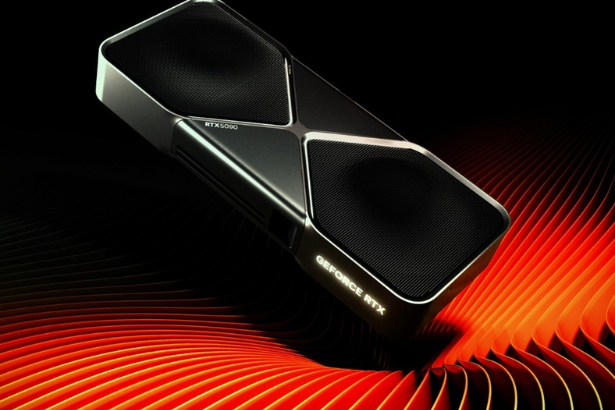
NVIDIA introduced the GeForce RTX 5090 as its flagship Blackwell-generation consumer graphics card.
The card combines 21,760 CUDA cores with 32GB of GDDR7 memory and a 512-bit memory interface. It supports NVIDIA’s DLSS 4 technology, including Multi Frame Generation, alongside hardware-accelerated ray tracing and other features intended for demanding gaming and creative workloads.
Those specifications make the RTX 5090 a premium option for enthusiasts who want high-resolution gaming, advanced ray tracing, 3D rendering, video production, and other GPU-intensive workloads.
Its position at the top of NVIDIA’s consumer lineup also makes it a useful indicator of broader GPU-market conditions.
Unlike a mainstream graphics card, the RTX 5090 uses a large amount of high-speed memory and a powerful GPU package. Producing and supplying those components at scale requires coordination among chip manufacturing, memory suppliers, board partners, and cooling-system manufacturers.
When any part of that supply chain becomes constrained, the effects can reach the retail market.
The RTX 5090 is also part of a wider market in which advanced GPUs are valuable for both gaming and professional computing. Graphics processors and related technologies play a major role in AI development, scientific computing, and data-center workloads, although the available reports do not establish that NVIDIA’s reported RTX 5090 order restrictions were caused by a specific reallocation to AI products.
That distinction matters. Industry-wide competition for computing components provides context, but it does not independently prove why NVIDIA is restricting orders for a particular consumer GPU.
Latest Update: NVIDIA RTX 5090 Orders Face New Restrictions
The latest reports point to three developments that deserve attention.
1. A board partner reportedly cannot order new GPU-memory packages
According to reporting published by TechPowerUp, Mezha, and other hardware outlets, der8auer contacted an NVIDIA board partner that said it could no longer order the GB202 GPU and 32GB GDDR7 memory package used to build the RTX 5090.
The manufacturer reportedly said it had not received an official end-of-life notification for the graphics card. It also could not confirm whether NVIDIA would resume accepting orders in the future.
One detail makes the situation particularly noteworthy: the partner reportedly said that during earlier shortages, it could still place backorders and wait for inventory to become available. That option is reportedly unavailable this time.
However, the identity of the board partner has not been publicly established in the reports cited here. It is also unclear whether the restriction applies to every NVIDIA partner or only to particular manufacturers or allocations.
The distinction prevents a broader conclusion that all RTX 5090 production has stopped.
2. NVIDIA reportedly says the RTX 5090 has not been discontinued
NVIDIA’s reported response provides an important counterpoint to the supply concerns.
According to Mezha and Notebookcheck, the company said the RTX 5090 had not been discontinued and that shipments would continue despite constrained production capacity. The statement echoes earlier comments attributed to NVIDIA GeForce executive Jeff Fisher.
That statement does not necessarily mean the market will receive a steady supply of new cards.
A product can remain officially available while manufacturers face restrictions on new component orders. Existing inventory can also continue moving through distribution channels after new allocations become limited.
Consequently, the reported NVIDIA statement and the board partner’s account are not necessarily contradictory. One concerns the product’s official status and continued shipments; the other concerns a manufacturer’s ability to order components.
3. Cooling-system suppliers report weaker future orders
A separate account from a supplier of graphics-card cooling systems adds another reason to watch the situation.
According to the reports, the supplier said two board partners had substantially reduced their projected RTX 5090 cooler orders for the first quarter of 2027 compared with the third quarter of 2026. It reportedly had not received RTX 5090 cooler orders for the second quarter of 2027.
These forecasts could indicate that some manufacturers expect to build fewer cards in the coming quarters.
But forecasts are not the same as completed production figures. Orders can change, suppliers can receive new requests, and manufacturers may adjust their plans as component availability evolves.
The information therefore strengthens the case for monitoring supply without proving that NVIDIA has permanently ended RTX 5090 production.
For the original reporting, see TechPowerUp’s article, “NVIDIA Allegedly Stops Accepting RTX 5090 Orders,” alongside the reports from Mezha and Overclock3D listed in the references below.
Expert Analysis: Five Things RTX 5090 Buyers Should Understand
1. An order restriction is not the same as a discontinuation
The most important distinction in this story is the difference between a supply restriction and a product end-of-life decision.
A graphics-card manufacturer needs access to the GPU, memory, circuit board components, cooling hardware, and other materials before it can produce a finished card.
If NVIDIA stops accepting new orders for a particular component package, the manufacturer may be unable to build additional units even if the product has not been officially discontinued.
An official end-of-life decision would be a separate development. The available reporting does not establish that NVIDIA has announced one.
For consumers, the immediate outcome could look similar in either situation: fewer cards available to purchase. But the long-term implications differ.
A temporary supply restriction may ease when components become available. A permanent discontinuation would make existing inventory and the secondary market increasingly important.
Until NVIDIA provides more detailed information, buyers should distinguish what has been reported from what remains speculation.
2. Retail availability may deteriorate before production status becomes clear
Consumers often judge a product’s availability through retailer listings.
An item marked out of stock may return when the retailer receives another shipment. A product marked “Not Carried” may no longer be part of a retailer’s active catalog.
Earlier reporting from Tom’s Hardware noted that the RTX 5090 had disappeared from NVIDIA’s US Marketplace and that Micro Center had listed it as “Not Carried.” Those observations suggested tighter availability but did not establish a worldwide production decision.
The distinction is especially important for expensive graphics cards.
A retailer may have no units available even while other stores or distributors have limited stock. Different regions may also have different inventory positions.
A product listing, therefore, is one indicator of availability, not a complete measure of global production.
3. Memory availability could be part of the supply problem
The RTX 5090 uses 32GB of GDDR7 memory, making memory supply an important part of its manufacturing requirements.
Reports have linked current RTX 5090 supply concerns to constraints involving memory and other components. NVIDIA’s reported response acknowledges constrained production capacity but does not establish the precise contribution of each component or supplier.
Memory shortages can affect more than one product category. High-performance graphics cards, professional computing hardware, and other devices may compete for manufacturing capacity or related components.
However, it would be premature to conclude that memory availability is the sole reason for the reported order restrictions.
A more complete explanation would require additional information from NVIDIA and its manufacturing partners.
4. AI demand is relevant, but its role should not be overstated
The growth of AI computing has increased the importance of advanced processors and high-bandwidth memory across the technology industry.
NVIDIA supplies products for gaming, professional visualization, and data-center computing. That makes allocation decisions across product categories an important subject for investors and hardware enthusiasts.
Some reports have speculated that NVIDIA may be prioritizing professional or AI-oriented products over consumer RTX 5090 graphics cards.
Yet the available evidence does not confirm that this is the definitive reason for the current order restrictions.
It is reasonable to examine AI demand as part of the broader market context. It is not reasonable to present an unverified allocation decision as an established fact.
The stronger analysis is that the RTX 5090 depends on a complex component supply chain, and any reduction in available GPU-memory packages could affect the number of consumer cards manufacturers can produce.
5. Higher prices are possible, but not guaranteed
When supply becomes tighter and demand remains strong, retail prices can rise.
That risk is particularly relevant to a flagship graphics card whose buyers may already be willing to pay a premium for top-tier performance.
If retailers receive fewer units, consumers may encounter higher prices, limited model choices, or bundled offers that cost substantially more than the manufacturer’s original suggested price.
However, a shortage does not automatically produce the same price movement in every region.
Local demand, import costs, currency fluctuations, taxes, retailer inventory, and competition between sellers all affect the final price.
Buyers should compare actual listings and verify warranty coverage rather than assuming that every high price reflects NVIDIA’s official pricing policy.
Broader Implications: Why NVIDIA RTX Searches Are Rising
The supplied Google Trends screenshot shows a sharp increase in searches for “NVIDIA RTX,” with related news headlines focusing on RTX 5090 order restrictions and uncertainty about future availability.
The graph suggests concentrated interest in the story, but it does not reveal exact search volumes or prove that the reported supply issue is the only reason for the increase.
The timing of the news nevertheless creates several important questions for the wider PC hardware market.
The premium GPU market could become harder to navigate
The RTX 5090 occupies the high end of NVIDIA’s consumer graphics lineup.
If supply tightens, enthusiasts may face a choice between waiting for additional inventory, paying more for a card already in stock, or selecting a less expensive alternative.
For gaming, the right decision depends on the resolution, refresh rate, software, and performance targets involved.
For creative professionals, the relevant factors may include rendering performance, memory capacity, application compatibility, and how much time the GPU saves in a working day.
A shortage does not make every alternative equally suitable, but it does increase the importance of evaluating the entire system rather than focusing exclusively on the flagship model.
PC builders may need to reconsider upgrade plans
Graphics cards are often among the most expensive components in a high-performance PC.
When the desired model becomes difficult to obtain, buyers may be tempted to make a rushed purchase or pay an inflated price.
A more measured approach is to establish a budget, compare performance requirements, and check availability across multiple authorized sellers.
For users with an existing high-end GPU, waiting for supply conditions to become clearer may be more sensible than replacing a working card immediately.
For users who need a new system now, a different GPU may deliver better overall value than paying a substantial premium for a hard-to-find flagship.
The story highlights the complexity of semiconductor supply
A finished graphics card is the result of multiple manufacturing and logistics processes.
The GPU itself is only one part of the system. Memory, power delivery, circuit boards, cooling components, packaging, and distribution all influence how many units can reach consumers.
The reports about both GPU-memory packages and cooling-system orders illustrate why supply-chain problems can appear at different stages of manufacturing.
For more coverage of graphics cards, semiconductor markets, AI infrastructure, and PC hardware, readers can explore The Tech Marketer.
Related History: How GPU Shortages Affect Gamers
Graphics-card shortages are not new.
During previous periods of unusually high demand, consumers encountered limited availability and prices that exceeded manufacturers’ suggested retail prices.
The causes varied. Cryptocurrency mining, pandemic-era manufacturing disruptions, logistics problems, and strong gaming demand have all affected GPU availability at different times.
The current RTX 5090 situation has its own specific circumstances, and it should not automatically be treated as a repeat of any previous shortage.
Nevertheless, earlier episodes demonstrate a consistent principle: when supply cannot keep pace with demand, retail pricing can become disconnected from the original launch price.
They also show why consumers should distinguish between a product’s official status, the manufacturer’s component allocations, and the stock actually available at retailers.
The RTX 5090 remains a particularly important case because it sits at the premium end of the gaming market and uses high-performance components that are also relevant to other computing workloads.
What Happens Next?
Several developments will help clarify the RTX 5090’s future.
NVIDIA’s next supply update
The most important development would be a more detailed statement from NVIDIA about component allocations, production capacity, and expected shipments.
Its reported assurance that the card has not been discontinued provides useful context, but it does not establish how many units will reach manufacturers or when supply may improve.
Board-partner orders
Additional information from graphics-card manufacturers could establish whether the reported restriction affects one partner, several partners, or the wider manufacturing network.
The identity and geographic scope of the restriction remain unclear in the available reports.
Retail inventory and pricing
Retail availability will provide another practical signal.
Buyers should watch for changes in stock levels, listed prices, delivery estimates, and whether sellers offer individual cards or only bundled systems.
These observations can help consumers understand local availability, although they cannot independently establish NVIDIA’s production decisions.
Alternative graphics cards
If the RTX 5090 remains difficult to find, buyers may compare other graphics cards based on performance, memory capacity, power consumption, and price.
The best alternative depends on the intended workload. A gaming-focused buyer and a professional creator may have very different requirements.
Consumers should compare independently tested performance and total system cost rather than assuming that the next model down will be the right choice for every use case.
Conclusion
The NVIDIA RTX 5090 is facing renewed supply concerns after a board partner reportedly said it could no longer order the GPU and memory packages needed to manufacture the flagship graphics card.
The reports also point to weaker future cooling-system orders and limited retail availability. Together, those developments suggest that supply could remain constrained.
But the available evidence does not establish that NVIDIA has officially discontinued the RTX 5090.
The company has reportedly said the card will continue shipping, even as production capacity remains constrained. The scope of the order restrictions, the timing of any improvement, and the number of cards likely to reach retailers remain uncertain.
For buyers, the immediate lesson is to avoid treating rumors as confirmed product announcements. Check actual inventory, compare prices, and evaluate alternatives based on real performance needs.
For the wider GPU market, the story highlights how component availability and manufacturing decisions can affect even the most expensive consumer graphics cards.
The next meaningful development will be clearer information about supply and allocations. Until then, the RTX 5090 shortage story is best understood as a serious availability concern, not proof of an official discontinuation.
Frequently Asked Questions
1. Has NVIDIA discontinued the RTX 5090?
The available reports do not establish an official discontinuation. NVIDIA has reportedly said the RTX 5090 has not been discontinued and that shipments will continue despite constrained production capacity.
2. Why is NVIDIA reportedly stopping RTX 5090 orders?
An unnamed board partner reportedly said it could no longer order the GB202 GPU bundled with 32GB of GDDR7 memory and could not place backorders. The exact reason for the restriction and its scope remain unclear.
3. Will the RTX 5090 become more expensive?
It could become more expensive if supply tightens while demand remains strong. However, actual prices will depend on regional availability, retailer inventory, taxes, and competition among sellers.
4. Is the RTX 5090 shortage related to AI demand?
AI demand is relevant to the broader market for advanced computing components, and some reports have speculated about production priorities. The available evidence does not conclusively establish that AI demand is the cause of the reported RTX 5090 order restrictions.
5. Can consumers still buy an RTX 5090?
Availability varies by retailer and region. The reports indicate tight supply, but they do not establish that every RTX 5090 model is unavailable everywhere.
6. What specifications does the RTX 5090 offer?
NVIDIA lists 21,760 CUDA cores, 32GB of GDDR7 memory, a 512-bit memory interface, and support for DLSS 4 technologies. Actual gaming performance depends on the application, settings, and overall system configuration.
7. Should I buy an RTX 5090 now or wait?
That depends on your performance requirements, budget, and local availability. Compare prices from authorized retailers, avoid rushing into heavily inflated offers, and consider alternatives if you need a GPU immediately.
8. When will RTX 5090 supply improve?
No confirmed date for a return to normal supply is established by the reports discussed here. Buyers should monitor official NVIDIA communications and retailer inventory rather than relying on speculative restocking dates.
Sources & References
- TechPowerUp, “NVIDIA Allegedly Stops Accepting RTX 5090 Orders.”
- Mezha, “RTX 5090 Isn’t Officially Discontinued, but a Board Partner Says It Can’t Order New GPUs.”
- Overclock3D, “GeForce Partners ‘Cannot Purchase’ RTX 5090 GPUs From NVIDIA.”
- Notebookcheck, “Nvidia Cuts Off RTX 5090 GPU Supply, Board Partner Says.”
- NVIDIA, “GeForce RTX 5090 Graphics Cards.”