Introduction
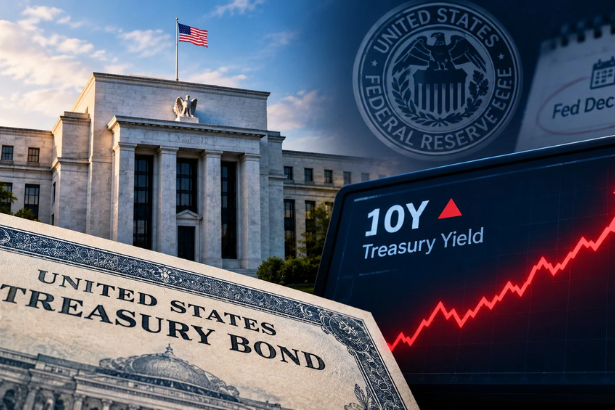
The stock market today is facing renewed pressure as the 10-year Treasury yield moves above 5%, oil prices climb, and investors reassess the outlook for inflation and interest rates.
The latest market coverage from The Wall Street Journal describes a global bond selloff that has pushed the 10-year Treasury yield to its highest level since 2007. Brent crude is also trading near $108 a barrel, adding to concerns that higher energy costs could make inflation more difficult to control.
The combination is creating a difficult environment for stocks. Higher bond yields can make equities less attractive, while rising oil prices can increase costs for businesses and households.
Still, a sharp market move is not the same as a confirmed crash. Investors are watching whether the latest pressure reflects a temporary repricing of interest-rate expectations or a deeper deterioration in the economic outlook.
Background and Context
Why Treasury yields matter to stocks
U.S. Treasury bonds are widely used as a benchmark for borrowing costs and investment returns.
The 10-year Treasury yield influences mortgage rates, corporate borrowing costs, and the valuation of financial assets.
When yields rise, investors may demand a higher expected return from stocks to compensate for the additional return available from relatively lower-risk government debt.
That can put pressure on stock valuations, especially companies whose expected earnings are far into the future.
Technology and growth stocks are particularly sensitive to changes in interest-rate expectations because their valuations often depend heavily on projected future cash flows.
The bond market’s unusual position
The current selloff comes after a period in which Treasury yields have already remained elevated compared with the years before the pandemic.
Morningstar’s analysis, Don’t Panic About a US Bond Market Selloff, argues that the rise in yields should be examined across different time periods rather than automatically interpreted as evidence of an imminent debt crisis.
The distinction matters because yields can rise for several reasons, including stronger economic expectations, higher inflation expectations, and increased compensation demanded by investors for holding longer-term debt.
Latest Update: Stock Market Today Faces Pressure as Yields Rise
The 10-year Treasury yield moves above 5%
The Wall Street Journal’s September 15 market coverage reports that the 10-year Treasury yield rose as high as 5.033% in early trading, reaching its highest level since 2007.
The report also notes that Japan’s 10-year government bond yield moved above 3%, reaching a 30-year high.
The simultaneous movement in major bond markets is an important part of the story. It suggests that investors are reassessing interest rates and economic risks across multiple countries, rather than reacting only to a single U.S. stock market development.
Oil prices add to inflation concerns
Brent crude futures were trading just below $108 a barrel in the same market update.
The rise in oil prices is significant because energy costs can affect transportation, manufacturing, household budgets, and the prices of other goods and services.
Higher oil prices can create a difficult policy problem for central banks. Inflation may become more persistent even as higher energy costs weigh on economic activity.
The Wall Street Journal reports that the latest moves have increased pressure on the Federal Reserve ahead of its interest-rate decision. https://www.wsj.com/livecoverage/stock-market-today-dow-sp-500-nasdaq-09-15-2026
Stock futures move lower
U.S. stock futures were lower in the report, with Dow contracts leading the declines.
European and Asian indexes were also under pressure.
The weakness indicates that investors are responding to a broader repricing of risk across markets.
However, futures movements do not determine where stocks will finish the trading session. Actual market performance can change as investors respond to economic data, corporate announcements, and developments in energy prices.
Federal Reserve expectations shift
The Wall Street Journal reported that investors were pricing in a 92% chance of a quarter-percentage-point rate hike at the upcoming Federal Reserve decision, compared with 59% a week earlier.
That change illustrates how quickly market expectations can move when inflation risks and energy prices become more prominent.
Higher expected policy rates can push Treasury yields higher and make financing more expensive for businesses and consumers.
Why the Bond Selloff Matters for Investors
Higher yields change the investment landscape
When Treasury yields rise, investors have more reason to compare the potential return from stocks with the income available from government bonds.
That does not mean stocks must fall every time yields rise. But it can change how investors value companies, especially those trading at high earnings multiples.
The effect is often most visible in growth-oriented sectors, where a higher discount rate can reduce the present value of expected future earnings.
Borrowing costs can increase
Higher interest rates can affect companies that rely on debt financing.
Businesses may face higher costs when refinancing loans or issuing new debt.
For consumers, higher rates can affect mortgages, credit cards, and other forms of borrowing.
If financial conditions remain tight, companies may become more cautious about hiring, expansion, and capital spending.
Energy prices create another layer of uncertainty
Oil prices influence more than the energy sector.
Higher fuel costs can affect airlines, transportation companies, manufacturers, retailers, and consumers.
If those costs remain elevated, companies may need to decide whether to absorb the increase or pass it on to customers.
Either choice can affect profitability and demand.
Expert Insights and Analysis
Morningstar: The bond selloff needs context
Morningstar economist Preston Caldwell argues that the recent rise in Treasury yields should not automatically be interpreted as a sign of an approaching debt crisis.
The analysis distinguishes between yields rising because of stronger economic expectations and yields rising because investors demand greater compensation for perceived risk.
Those scenarios have different implications.
If yields rise because the economy is stronger than expected, the outlook for corporate earnings may remain relatively resilient.
If yields rise because investors are increasingly concerned about government debt, inflation, or market stability, the consequences could be more difficult for both bonds and stocks.
The Federal Reserve remains central
Interest-rate expectations are a major driver of financial markets.
When investors anticipate tighter monetary policy, Treasury yields can rise and equity valuations can come under pressure.
The Federal Reserve’s response will depend on its assessment of inflation, economic growth, and labor-market conditions.
Investors are therefore watching both the immediate rate decision and the language used by policymakers to describe the economic outlook.
The debt question is more complicated than a headline
Morningstar’s analysis notes that long-term Treasury yields can reflect increased bond supply and changes in demand, not just fears of a government debt crisis.
That distinction is important because the U.S. government debt outlook is a long-term concern, but a rise in yields does not prove that investors believe a default is imminent.
Financial markets often incorporate several factors at once.
A single headline about rising yields may therefore obscure the more complicated forces driving the move.
Broader Implications
Could higher yields hurt technology stocks?
Technology stocks can be sensitive to rising yields because investors often value them based on earnings expected years into the future.
When discount rates increase, those future earnings may be worth less in today’s dollars.
That can lead investors to reconsider valuations, particularly when companies are trading at high multiples.
Still, the effect varies from company to company. Businesses with strong cash flow, durable demand, and manageable debt may be better positioned than companies dependent on cheap financing.
Could the market enter a crash?
A market crash is not inevitable simply because Treasury yields rise above 5%.
A sustained stock market decline would depend on a broader combination of factors, such as weakening corporate earnings, deteriorating economic conditions, financial instability, or a sharp loss of investor confidence.
The latest market coverage establishes that stocks and bonds are under pressure. It does not, by itself, establish that a crash is imminent.
Investors should distinguish between market volatility and a confirmed systemic crisis.
Higher oil prices could complicate inflation
If energy prices remain elevated, inflation could prove more persistent than policymakers would prefer.
That could make it harder for the Federal Reserve to lower interest rates quickly.
For households, the consequences may appear in fuel costs, transportation expenses, and the prices of goods that depend on energy-intensive production.
For companies, the effect may appear through higher operating costs.
The dollar and global markets remain important
The Treasury market is closely connected to global financial conditions.
Changes in U.S. yields can affect currency markets, international bond prices, and the relative attractiveness of investments in other countries.
The movement in Japan’s government bond market shows that the latest developments are not isolated to the United States.
Related History and Comparable Market Episodes
The 2022 bond market selloff
The sharp rise in interest rates during 2022 demonstrated how quickly higher yields can affect both bonds and stocks.
As central banks tightened monetary policy to fight inflation, investors faced a difficult adjustment in asset valuations.
The episode remains a useful reminder that bond market volatility can influence the wider financial system.
The 2007 to 2008 financial crisis
The current Treasury yield level is drawing attention partly because it has not been seen since the years before the financial crisis.
However, a similar yield level does not mean the economic circumstances are identical.
Market structure, banking regulation, household debt, corporate balance sheets, and monetary policy can all differ substantially across periods.
Historical comparisons are useful, but they should not be treated as predictions.
What Happens Next
The Federal Reserve decision
The next Federal Reserve interest-rate decision will be closely watched by investors.
The key issue is how policymakers balance inflation concerns against economic growth and financial conditions.
Any change in rate expectations could influence Treasury yields and stock prices.
Oil market developments
Investors will also monitor whether oil prices remain elevated.
A sustained rise in energy costs could increase inflation concerns and put additional pressure on businesses and consumers.
If oil prices stabilize or fall, some of that pressure could ease.
Corporate earnings and market breadth
The performance of corporate earnings will help determine whether the stock market can absorb higher borrowing costs.
Investors will be watching whether market weakness is concentrated in a few sectors or spreads across a broader range of companies.
A wider decline could indicate that concerns are becoming more deeply embedded in investor sentiment.
Economic data
Inflation reports, labor-market data, and consumer spending figures will remain important.
The data will help investors assess whether the economy is slowing, remaining resilient, or facing a combination of inflation and weaker growth.
Conclusion
The stock market today is facing a difficult combination of rising Treasury yields, higher oil prices, and changing expectations for Federal Reserve policy.
The 10-year Treasury yield’s move above 5% has intensified concerns about borrowing costs and stock valuations. Meanwhile, elevated energy prices could make inflation more persistent.
But the latest developments do not automatically signal a stock market crash.
Morningstar’s analysis emphasizes the importance of understanding why yields are rising, while The Wall Street Journal’s market coverage highlights the immediate pressure on stocks and bonds.
For investors, the most important next steps are to watch the Federal Reserve’s decision, oil prices, and incoming economic data.
The market’s direction will depend on whether these pressures ease or develop into a broader deterioration in economic and financial conditions.
Frequently Asked Questions
1. What is happening in the stock market today?
Stocks are under pressure as Treasury yields rise above 5%, oil prices climb, and investors reassess inflation and interest-rate expectations.
2. Why is the 10-year Treasury yield above 5%?
The rise reflects a combination of changing Federal Reserve rate expectations, inflation concerns, and broader shifts in bond market demand and risk pricing.
3. Does a higher Treasury yield mean a stock market crash is coming?
Not necessarily. Higher yields can pressure stock valuations, but a crash would require a broader deterioration in economic or financial conditions.
4. How do oil prices affect the stock market?
Higher oil prices can increase operating costs for businesses, raise household expenses, and contribute to inflation. Those effects can influence corporate earnings and interest-rate expectations.
5. Why are technology stocks sensitive to Treasury yields?
Technology and growth stocks often depend on expected future earnings. Higher discount rates can reduce the present value of those earnings and pressure valuations.
6. What should investors watch next?
Key indicators include the Federal Reserve’s interest-rate decision, inflation data, oil prices, Treasury yields, and corporate earnings.
7. Where can investors follow official market information?
The U.S. Securities and Exchange Commission, Federal Reserve, and U.S. Treasury provide official financial and economic information.