Walmart is investing heavily in warehouse robotics to move merchandise faster and improve inventory accuracy. But aging buildings, unreliable machines, awkward packaging, and expensive retrofits show why automating a massive supply chain is harder than installing robots.
Supply chain automation is becoming one of the biggest competitive battlegrounds in American retail. Walmart, the country’s largest retailer by revenue, is investing billions of dollars to modernize its distribution network, replace repetitive warehouse tasks with robotics, and move products from suppliers to store shelves more efficiently.
But the transformation is proving far more complicated than the technology industry’s promises might suggest.
A report published by The Wall Street Journal on October 8, 2026, describes Walmart’s multiyear effort to automate its warehouses while keeping those facilities operational. The company has encountered malfunctioning robots, packaging that does not fit automated equipment, products that are difficult to handle mechanically, and buildings that were never designed for today’s robotics systems. Read the original WSJ report. <Cite refs={[“turn860425news23″,”turn860425search0”]}/>
The scale of the challenge matters. Walmart has a vast distribution network serving stores and online customers across the United States. Even a relatively small operational problem can ripple through inventory availability, delivery schedules, labor planning, and customer experience.
Yet the retailer is not abandoning automation. By August 2026, more than 65% of its stores were receiving some freight from automated warehouses, and more than 50% of its e-commerce inventory volume was moving through automated systems, according to the WSJ report.
The story offers an important lesson for retailers and logistics operators: successful supply chain automation depends on redesigning the entire operation, not simply purchasing more robots.
Background and Context: Why Walmart Is Betting on Supply Chain Automation
Walmart’s distribution network has historically depended on large teams of warehouse workers. Employees unload trucks, move pallets, retrieve merchandise from storage, sort individual products, and prepare shipments for stores and homes.
Many of these tasks are physically demanding and repetitive. They also need to be completed at enormous scale, with inventory moving through distribution facilities throughout the day.
Automation offers several potential advantages:
- Faster movement of merchandise through distribution centers.
- More consistent inventory handling and tracking.
- Better organization of pallets for store deliveries.
- Reduced dependence on repetitive manual handling.
- More predictable replenishment and warehouse scheduling.
For a retailer operating thousands of stores and serving customers through both physical locations and e-commerce, small improvements in distribution efficiency can have significant effects.
Walmart is also responding to competitive pressure. Amazon has invested heavily in warehouse automation, robotics, and fulfillment technology, raising expectations for how quickly retailers can process orders and deliver merchandise.
The WSJ report describes automation as a long-term strategic investment for Walmart, even as the company works through technical and financial obstacles.
The goal is not simply to reduce the number of employees moving boxes. It is to build a supply chain that can process more merchandise, improve inventory accuracy, and deliver products to stores in a more organized and predictable way.
Latest Update: Walmart’s Warehouse Automation Hits Technical Roadblocks
The October 8 WSJ report, For Walmart, Replacing Humans With Robots Is a Multibillion-Dollar Struggle, identifies several challenges that explain why large-scale warehouse automation is taking longer than expected. <Cite refs={[“turn860425search0”]}/>
1. Existing warehouses were not designed for robots
One of Walmart’s biggest challenges is upgrading buildings that were constructed for conventional warehouse operations.
Older distribution centers were designed around human workers, forklifts, pallets, and established material-handling processes. Introducing robotic storage, retrieval, and sorting systems requires changes to equipment, electrical infrastructure, software, and the physical movement of goods.
The company must make these changes while continuing to fulfill orders.
Closing a warehouse for an extended modernization project could disrupt store replenishment and force the company to redirect merchandise through other facilities. Keeping the building open makes the transition more complicated because construction, testing, and daily operations must coexist.
This is a central lesson for businesses planning their own automation projects: existing infrastructure can be as important as the technology itself.
2. Robots struggle with real-world merchandise
Robotics systems perform best when products have predictable dimensions, packaging, weight, and handling characteristics.
Retail inventory does not always cooperate.
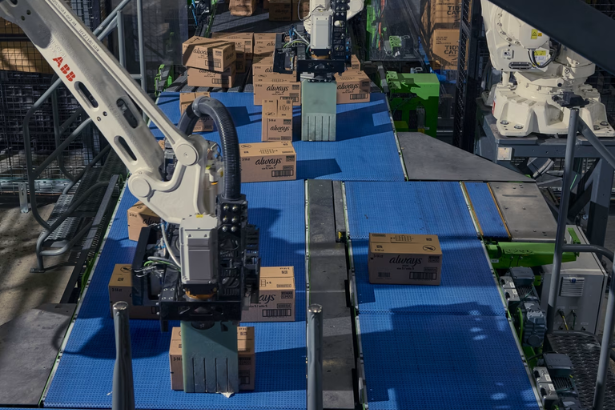
The WSJ report describes problems involving oversized products, including large bags of dog food, as well as cardboard boxes that do not fit automated systems. In one example, robotic arms struggled to handle large frozen turkeys because the shipping boxes were not sufficiently suited to the equipment.
These issues may appear minor, but they can create significant operational problems when thousands of different products pass through a distribution network.
A robot that handles standard boxes reliably may still struggle with irregular shapes, unstable packages, fragile products, or items that vary significantly in size.
Walmart has responded in part by working with suppliers to identify packaging problems and make adjustments.
This shows that supply chain automation extends beyond the warehouse. Suppliers, packaging designers, equipment manufacturers, and retailers all need to coordinate their processes.
3. Robot maintenance affects throughput
Automation depends on machines being available when the warehouse needs them.
According to the WSJ report, Walmart’s robotic systems have experienced breakdowns and maintenance problems, with dust accumulation among the issues affecting performance.
Symbotic, a robotics provider working with Walmart, told the Journal that the proportion of its robots being repaired at any given time had fallen from below 10% to approximately 5% in recent months.
That improvement is encouraging, but even a small percentage of unavailable machines can affect a tightly coordinated operation.
If a robot stops working, merchandise may wait for retrieval, sorting can slow down, and downstream equipment may have less inventory to process. The effects depend on the system’s design and the availability of backup procedures.
For retailers, reliability is therefore just as important as a robot’s theoretical speed.
4. Automation can increase operating expenses before it delivers savings
Robotics requires investment in equipment, software, electrical infrastructure, maintenance, and specialized personnel.
The WSJ report describes monthly electricity bills at Walmart’s automated grocery facilities reaching $800,000 or more during peak heating or cooling months, compared with approximately $250,000 a month when operations were more manual.
The figures illustrate the potential operating-cost trade-off, although they should not be treated as a like-for-like measure of the total cost of automation across every warehouse.
Automation also creates demand for mechanical and electrical engineers who can maintain complex systems. These roles may cost more than conventional warehouse labor positions.
Walmart expects long-term efficiency gains, but those gains must eventually outweigh the additional capital and operating expenses.
Expert Analysis: What Makes Supply Chain Automation So Difficult?
Walmart’s experience highlights three questions that every large retailer should ask before committing to a major automation program.
Can the technology handle the actual product mix?
A demonstration in a controlled environment is not the same as operating a warehouse containing thousands of products with different shapes, weights, packaging materials, and handling requirements.
The most difficult items may account for a small percentage of inventory but still require manual intervention.
That matters because a warehouse is only as automated as its most persistent bottlenecks allow it to be.
Walmart’s Brooksville facility provides an example. According to the WSJ report, the company describes the warehouse as nearly fully automated, with about 80% of inventory movements handled through automation. The remaining 20% includes more difficult items that still need human assistance.
The figures show why automation rates need context. A high percentage of automated inventory movements does not mean that every product, task, or exception has been automated.
Can the warehouse remain productive during the transition?
Replacing an existing distribution system is a major operational undertaking.
A retailer cannot simply pause replenishment while engineers rebuild storage systems and install robotics. Stores still need merchandise, customers still place online orders, and suppliers continue delivering products.
Walmart’s approach requires equipment installation, testing, troubleshooting, and ongoing fulfillment to happen in parallel.
This can make the transition longer and more expensive than a greenfield project, where a company designs a new warehouse around automation from the beginning.
Businesses considering retrofits should account for temporary capacity losses, installation risks, training requirements, and the possibility that older processes may need to remain in place longer than planned.
Will the investment deliver measurable financial returns?
Automation should ultimately be judged on business results rather than the number of robots installed.
Relevant measures include:
- Cost per case or unit handled.
- Orders processed per labor hour.
- Equipment uptime and maintenance costs.
- Inventory accuracy and product availability.
- On-time store replenishment.
- Capital expenditure and payback period.
These measures help businesses determine whether a system is improving the operation as a whole.
An automated warehouse may process merchandise faster but consume substantially more electricity. It may reduce manual handling but require expensive technical maintenance. It may improve inventory accuracy while creating new constraints around unusual products.
The business case depends on how these effects balance out over time.
Broader Implications: What Walmart’s Automation Push Means for Retail and Logistics
Warehouse jobs will change, not simply disappear
Automation raises legitimate questions about the future of warehouse employment.
The WSJ report says Walmart executives expect to need fewer warehouse workers for some manual tasks, while creating a greater need for employees who operate, maintain, and repair automated equipment.
Company executives also said high employee turnover and continued sales growth mean automation would not necessarily result in broad layoffs.
Those statements describe Walmart’s expectations, not a guarantee about future employment outcomes.
The likely operational shift is toward a different mix of skills. Traditional material-handling work may decline in some areas, while demand grows for technicians, equipment specialists, controls engineers, and employees capable of troubleshooting automated systems.
For workers and employers, training and job redesign will become increasingly important.
Suppliers may need to redesign packaging
Walmart’s experience with oversized and difficult-to-handle packages shows that retailers cannot automate in isolation.
Suppliers may need to standardize package dimensions, reinforce cartons, improve labeling, or adjust how products are grouped for shipment.
Such changes can improve compatibility with automated equipment, but they may also create additional costs for packaging redesign, testing, and production changes.
The long-term benefit is a more consistent flow of goods through the supply chain. The challenge is distributing the cost of achieving that consistency among retailers, suppliers, and logistics partners.
Retailers without sufficient capital could fall behind
Large automation programs require substantial financial resources and patience.
Walmart can invest across a large network and absorb the cost of learning from early installations. Smaller retailers may have less flexibility to fund expensive retrofits, particularly when returns take years to materialize.
The risks are not hypothetical. The WSJ report notes that Kroger announced a $2.6 billion charge last year related to closing three automated e-commerce fulfillment centers that had not met financial expectations.
Kroger’s experience is a warning against assuming that more automation automatically produces a better business model.
Retailers need to match the technology to their order volumes, product mix, facility layouts, labor market, and customer requirements.
For some businesses, targeted automation may be more effective than trying to automate an entire fulfillment network at once.
Automation could improve store availability and customer service
Walmart’s long-term objective includes building more consistently organized pallets and improving the timing of store deliveries.
If successful, automated distribution could make replenishment more predictable, reduce handling errors, and help stores keep products in stock.
Those improvements could benefit customers indirectly by reducing out-of-stock situations and supporting more reliable online order fulfillment.
However, warehouse automation is only one part of the equation. Demand forecasting, supplier performance, inventory allocation, transportation, and store operations must also work effectively.
The benefits depend on the performance of the whole supply chain, not just the warehouse equipment.
For more coverage of retail technology and industrial operations, visit The Tech Marketer’s technology and business coverage.
Related History: From Warehouse Conveyors to Intelligent Robotics
Warehouse automation has evolved through several stages.
Early systems focused on conveyors, fixed sorting equipment, barcode scanning, and mechanical pallet handling. These technologies improved throughput in operations where merchandise followed relatively predictable paths.
More recent systems combine robotics, warehouse management software, sensors, and automated storage and retrieval equipment.
These tools can handle a wider variety of tasks, but greater flexibility introduces complexity. Systems must coordinate multiple machines, interpret product information, avoid collisions, recover from errors, and respond to changing inventory conditions.
Walmart’s partnership with Symbotic reflects this shift toward integrated warehouse systems.
The retailer is attempting to automate not only individual tasks but also the flow of merchandise from receiving to storage, retrieval, sorting, and dispatch.
This is a more ambitious goal than installing a few robotic arms or conveyor belts. It requires coordination among hardware, software, packaging standards, facility design, and human workers.
The historical lesson is clear: automation becomes more powerful as systems become integrated, but integration also creates more dependencies and potential failure points.
What Happens Next? Four Things to Watch
1. Whether Walmart meets its automation targets
Walmart expected spending on store remodeling and supply chain automation to peak in 2026 and 2027, according to the WSJ report.
The important question is whether the company can translate those investments into higher throughput, better inventory accuracy, and lower long-term fulfillment costs.
Future disclosures about automation coverage, operational efficiency, and capital spending will help investors and suppliers assess progress.
2. Whether robotic reliability continues improving
Equipment uptime will be a critical measure of success.
Lower maintenance requirements can improve throughput and reduce the need for manual intervention. But performance must hold up across different facilities, products, and seasonal demand patterns.
The next phase will require Walmart and its technology partners to show that systems can operate reliably at scale, not just in selected warehouses.
3. How quickly suppliers adapt
Packaging compatibility may become an increasingly important part of supplier relationships.
Walmart has already started notifying suppliers about packaging that creates problems for automated systems, according to the Journal’s report.
As automation expands, suppliers may face greater pressure to standardize packaging and coordinate product handling with retailer requirements.
That could lead to changes in packaging design, distribution practices, and supplier contracts.
4. Whether automation can improve e-commerce fulfillment inside stores
Automating online orders assembled inside existing stores remains a particularly difficult challenge.
Store layouts were designed primarily for customers shopping in person, leaving limited room for dedicated automated fulfillment systems. Reliability problems can also affect customers waiting for pickup or delivery.
The WSJ report says Walmart has invested nearly $1 billion since 2016 in efforts to automate in-store e-commerce fulfillment. A workable broader model remains a challenge.
The next breakthrough may depend on finding solutions that fit within existing store layouts without disrupting the shopping experience.
Conclusion: Walmart’s Warehouse Automation Is a Long-Term Test of Execution
Walmart’s automation program demonstrates both the promise and the limitations of modern warehouse robotics.
Automation can help retailers move merchandise faster, improve inventory handling, and make replenishment more predictable. But these benefits require reliable machines, compatible packaging, suitable facilities, trained workers, and careful financial planning.
The company’s experience also shows why retrofitting an existing network is so demanding. Warehouse systems must be modernized while products continue moving through the supply chain, and even seemingly simple tasks can become complicated when robots encounter real-world inventory.
For retailers, the lesson is not to avoid automation. It is to approach it as an end-to-end operational transformation, with clear performance measures and realistic expectations about costs, reliability, and implementation timelines.
Walmart has made substantial progress, but the remaining work will determine whether the investment delivers the long-term efficiencies the company expects.
The future of supply chain automation will not be decided by which retailer installs the most robots. It will be decided by which retailer can make automation work reliably, economically, and at scale.
Frequently Asked Questions
1. What is supply chain automation?
Supply chain automation uses robotics, software, sensors, and connected systems to reduce manual work across warehousing, inventory handling, sorting, transportation coordination, and order fulfillment.
2. Why is Walmart automating its warehouses?
Walmart wants to process merchandise faster, improve inventory accuracy, reduce repetitive manual handling, and make store replenishment more predictable while competing with increasingly automated retail operations.
3. What challenges is Walmart facing with warehouse automation?
The reported challenges include robot breakdowns, maintenance requirements, oversized merchandise, incompatible packaging, expensive facility retrofits, higher electricity consumption, and the difficulty of maintaining operations during installation.
4. How much of Walmart’s supply chain is automated?
The WSJ reported that, by August 2026, more than 65% of Walmart’s stores received some freight from automated warehouses, and over 50% of its e-commerce inventory volume moved through automated systems. These figures measure different aspects of automation and do not mean every task is automated.
5. Is Walmart replacing warehouse workers with robots?
Automation is expected to reduce the need for some manual tasks and increase demand for technical maintenance and equipment-management skills. Walmart executives told the WSJ that high turnover and sales growth could limit the need for layoffs, but actual employment effects will depend on implementation and future business needs.
6. What role does Symbotic play in Walmart’s automation strategy?
Symbotic provides warehouse automation technology used to move, store, retrieve, and organize merchandise. Walmart’s work with Symbotic illustrates the complexity of integrating robotics into a large existing distribution network.
7. Can small retailers afford supply chain automation?
Some can, particularly when they automate selected processes rather than an entire warehouse. The right investment depends on order volume, labor costs, product mix, available space, system reliability, and expected payback.
8. What is the future of supply chain automation?
The industry is likely to combine robotics with better warehouse software, sensors, inventory visibility, and human technical expertise. The strongest results will come from systems that work reliably with real merchandise and produce measurable operational and financial improvements.
Sources & References
- The Wall Street Journal: For Walmart, Replacing Humans With Robots Is a Multibillion-Dollar Struggle. Sarah Nassauer, October 8, 2026.
- Walmart Corporate: Walmart Enhances Supply Chain to Bring Customers What They Need, When They Need It. Company overview of distribution efficiency and inbound freight initiatives.
- Reuters: Walmart Investors Reject AI Workplace Report as Automation Expands in the U.S.. June 4, 2026.
- Symbotic: Company Website. Information about warehouse automation systems and robotic material handling.
- The Conveyor: Walmart Is Rebuilding Its Regional Distribution Centers Around Automation. June 18, 2026.