Introduction
The U.S. rare earth supply chain is entering a critical phase as Washington invests heavily in domestic mining and processing while China continues to control a large share of the global refining and separation industry. Reuters reports that the United States is expected to remain dependent on China for rare earth processing well into the 2030s, even as American production capacity expands.
The issue is particularly important for manufacturers of electric vehicles, motors, electronics, aerospace equipment, defense systems and renewable-energy technologies. Rare earth elements are not necessarily scarce in the Earth’s crust. The harder challenge is turning ore into the separated materials and high-performance magnets that manufacturers actually need.
That processing gap is now becoming one of the most closely watched vulnerabilities in global supply chains.
Background and Context
Rare earth elements are a group of 17 metallic elements used in a wide range of industrial products.
Some are particularly important for permanent magnets. Neodymium, praseodymium, dysprosium and terbium, for example, can be used in high-performance magnets found in electric motors and other advanced equipment.
The supply chain has several distinct stages:
- Mining extracts rare earth-bearing ore.
- Concentration increases the amount of rare earth material.
- Separation and refining turn mixed material into individual rare earth compounds or metals.
- Metal and alloy production prepares materials for industrial use.
- Magnet manufacturing converts selected rare earth materials into finished permanent magnets.
- Component manufacturing incorporates those magnets into motors, electronics and other products.
The United States has made progress in the first stages, but China remains particularly influential further downstream.
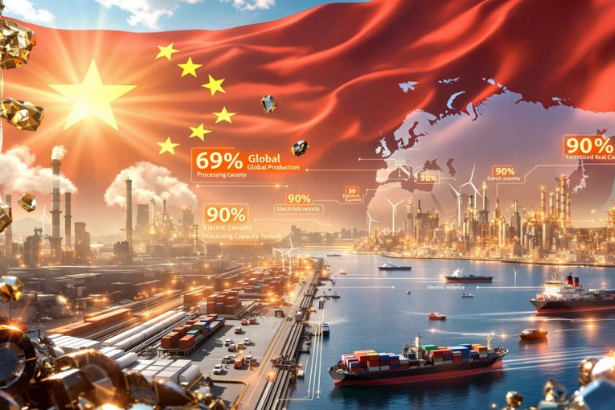
According to the U.S. Geological Survey, China accounted for more than 70% of global rare earth extraction and 87% of processing in the data cited by the agency. China also accounted for all of the reported heavy rare earth production involving dysprosium and terbium in that dataset.
That distinction between mining and processing is central to the current supply-chain debate.
Latest Update or News Breakdown
China Still Holds the Processing Advantage
China’s position in rare earths is not simply the result of having large mineral deposits.
The country has spent decades developing the infrastructure needed to separate, refine, alloy and manufacture rare earth materials at industrial scale.
Reuters reported this month that China continues to dominate rare earth processing even as the United States and other countries invest in alternative capacity. Reuters cited China’s share of global rare earth refining at around 85% in 2025, down from more than 90% in 2023.
That decline is significant, but it does not eliminate the underlying supply-chain concentration.
A country can have access to its own mined ore and still depend on overseas facilities to transform that material into the precise inputs required by manufacturers.
That is the challenge facing the United States.
The U.S. Is Expanding Domestic Capacity
Washington has responded with a series of investments intended to build more domestic capability.
The U.S. Department of Energy announced $134 million in June 2026 for two projects designed to strengthen domestic rare earth supply chains. The projects focus on recovering and refining rare earth elements from unconventional feedstocks including mine tailings, electronic waste and other waste materials.
The Energy Department also announced $162 million in August for nine projects focused on recovering critical minerals and other valuable materials from industrial feedstocks. Those projects include work involving rare earth elements.
And in September, DOE announced another $73 million for four projects aimed at advancing domestic mining technologies and establishing real-world testing grounds for new extraction methods.
The individual investments vary in purpose, but together they show that the U.S. strategy is increasingly focused on the entire supply chain rather than simply extracting more ore.
Domestic Mining Alone Does Not Solve the Problem
This is where the rare earth story becomes more complicated.
The United States already produces rare earth material domestically. USGS estimates that the country produced approximately 51,000 metric tons of rare-earth-oxide equivalent in mineral concentrates during 2025.
Mountain Pass in California remains the country’s major rare earth mining operation.
But mining concentrate is not the same thing as producing finished rare earth magnets.
The material has to move through multiple additional processing stages before it can become a component for an electric motor, industrial machine or electronic device.
That means increasing U.S. mining output without simultaneously expanding separation, refining, metalmaking and magnet manufacturing would leave a major part of the supply chain exposed.
Why the Processing Stage Matters So Much
Processing is one of the hardest parts of the rare earth supply chain to rebuild.
The process can require specialized chemical facilities, significant capital investment, technical expertise and environmental controls.
China’s established industrial ecosystem provides another advantage. Processing facilities exist alongside manufacturers that consume the resulting materials, creating an integrated supply chain.
For American manufacturers, building an alternative system means creating several connected industries rather than simply opening another mine.
This is why the current U.S. strategy increasingly includes recycling, unconventional feedstocks, processing technology and manufacturing.
Expert Insights or Analysis
The key issue for supply-chain managers is concentration risk.
A company can have multiple suppliers on paper while still depending on the same upstream processing network.
For example, an automaker might purchase components from suppliers in different countries, but if those suppliers ultimately rely on rare earth magnets processed through the same Chinese ecosystem, the apparent diversification is smaller than it looks.
This is particularly important for manufacturers using permanent magnets.
An electric motor can require a relatively small quantity of rare earth material compared with the total weight of a vehicle or machine, but the material can be difficult to substitute without changing the motor’s design or performance characteristics.
That creates an unusual supply-chain problem.
The bottleneck does not necessarily have to be a huge physical quantity of material. It can be a highly specialized processing capability that is difficult to replace quickly.
The U.S. Is Building a More Diverse Supply Chain
The American response is therefore moving in several directions.
Domestic companies and government-backed projects are working on:
- New mining capacity
- Rare earth separation
- Refining
- Magnet production
- Recycling
- Recovery from industrial waste
- Alternative feedstocks
- Processing technology
- Supply agreements with foreign partners
The Energy Department says its 2026 programs are designed to strengthen domestic critical-material supply chains and reduce reliance on foreign sources.
The challenge is timing.
New mines and processing plants can take years to develop, qualify and scale. Manufacturers also need confidence that alternative suppliers will be able to deliver consistent volumes and quality before they redesign products around them.
Broader Implications
The U.S. rare earth supply chain affects considerably more than the mining industry.
Automotive Manufacturing
Electric vehicles use permanent-magnet motors in many applications, creating demand for rare earth materials.
Automakers therefore have an interest in securing long-term supplies of neodymium, praseodymium and other magnet-related materials.
Supply disruptions can affect vehicle production even when the rare earth component represents only a small percentage of the vehicle’s overall cost.
Defense Manufacturing
Rare earth magnets and materials are also used in advanced defense equipment.
That makes supply-chain resilience a national-security concern in addition to a commercial one.
Reuters has reported that China’s control over rare earth minerals has become an important factor in U.S.-China economic relations, particularly because the materials are important to technology and defense industries.
Electronics and Industrial Equipment
Rare earth materials appear in numerous industrial and electronic applications, including motors, sensors, magnets and specialized components.
As factories become more automated, demand for high-performance motors and other magnet-based equipment can increase.
Renewable Energy
Wind turbines and other clean-energy technologies can also use rare earth magnets, depending on their design.
That means a supply-chain bottleneck can potentially affect several industries simultaneously.
For more reporting on industrial technology, manufacturing and supply-chain transformation, visit The Tech Marketer.
Related History or Comparable Technologies
The rare earth supply chain resembles other strategic-material markets where processing capacity becomes more concentrated than mining.
Lithium provides one comparison.
Countries can have lithium resources underground while relying on processing facilities elsewhere to convert those resources into battery-grade materials.
Cobalt presents another example. Mining and refining are geographically separated, creating different types of supply-chain exposure.
Rare earths are unusual because the supply chain extends beyond refining into highly specialized magnet manufacturing.
A manufacturer therefore has to consider several layers of dependency.
This is one reason governments and companies are increasingly discussing supply-chain resilience rather than simply domestic resource production.
The objective is not necessarily to produce every kilogram of material inside one country. Instead, companies can seek multiple sources across mining, processing, refining and manufacturing so that a disruption at one point does not halt the entire system.
What Happens Next
The next stage of the U.S. rare earth strategy will be measured less by announcements and more by actual production.
Several developments will matter.
1. New Processing Plants Must Reach Commercial Scale
Government funding can help projects get started, but manufacturers ultimately need reliable commercial production.
The industry will be watching whether newly supported U.S. facilities can produce rare earth materials at consistent quality and competitive cost.
2. Magnet Manufacturing Will Become More Important
A domestic supply chain that stops at refined rare earth material still leaves manufacturers exposed further downstream.
Building U.S. magnet capacity will therefore be an important part of reducing reliance on overseas supply.
3. Recycling Could Become a Larger Feedstock
The Energy Department is supporting projects that recover rare earths from electronic waste and other unconventional sources.
If those technologies reach commercial scale, recycling could provide another source of material without requiring every additional unit of supply to come from a new mine.
4. Manufacturers Will Continue Diversifying Suppliers
Automakers, electronics companies and industrial manufacturers are likely to continue evaluating alternative suppliers and longer-term contracts.
The objective is to reduce the risk associated with sudden restrictions or shortages.
5. China Will Remain Central to the Market
Even with significant U.S. investment, China is unlikely to disappear from the global rare earth supply chain in the near term.
Reuters’ current reporting indicates that the U.S. will remain reliant on Chinese processing capacity into the 2030s.
That makes diversification a long-term industrial process rather than a quick replacement project.
Conclusion
The U.S. rare earth supply chain is being rebuilt, but the biggest challenge is not simply finding more rare earths.
It is developing the processing and manufacturing infrastructure needed to turn those minerals into materials that American factories can actually use.
The United States is expanding mining, refining, recycling and critical-mineral technology projects, with the Department of Energy announcing hundreds of millions of dollars in new support during 2026.
China, meanwhile, continues to hold a dominant position in global rare earth processing. USGS data cited by the agency put China’s share of global processing at 87%, while Reuters reports that its share of refining remained around 85% in 2025.
For American manufacturers, the implication is straightforward: domestic mining is only the beginning.
The real test will be whether the United States can build a commercially viable chain from ore to refined material to magnet to finished product without creating a new bottleneck somewhere else.
That process is likely to take years, which explains why China’s processing advantage remains an important supply-chain issue well into the next decade.
FAQ
What is the U.S. rare earth supply chain?
The U.S. rare earth supply chain covers the extraction, concentration, separation, refining, metal production, magnet manufacturing and eventual use of rare earth elements in American products.
Why does the U.S. depend on China for rare earths?
China has developed substantial capacity across mining, separation, refining and downstream manufacturing. USGS data cited by the agency show China accounting for more than 70% of global rare earth extraction and 87% of processing.
Does the United States mine rare earth elements?
Yes. USGS estimates that the United States produced approximately 51,000 metric tons of rare-earth-oxide equivalent in mineral concentrates during 2025.
Why is rare earth processing more important than mining?
Mining produces raw or concentrated material, but manufacturers generally require separated and refined rare earth materials, alloys or magnets. Processing is therefore a critical link between the mine and the finished product.
What industries depend on rare earth elements?
Rare earths are used in applications including permanent magnets, electric motors, electronics, industrial equipment, defense technologies and some renewable-energy systems.
Is the U.S. building new rare earth processing capacity?
Yes. The Department of Energy announced multiple 2026 funding programs supporting rare earth recovery, refining, mining technology and broader critical-mineral processing.
When could the U.S. become independent of Chinese rare earth processing?
There is no verified date for complete independence. Current Reuters reporting indicates that U.S. dependence on Chinese processing is expected to continue into the 2030s, even as domestic capacity expands.
Trend Tags / Keywords
U.S. rare earth supply chain · rare earths · rare earth processing · China rare earths · critical minerals · rare earth magnets · U.S. critical minerals · rare earth refining · China processing