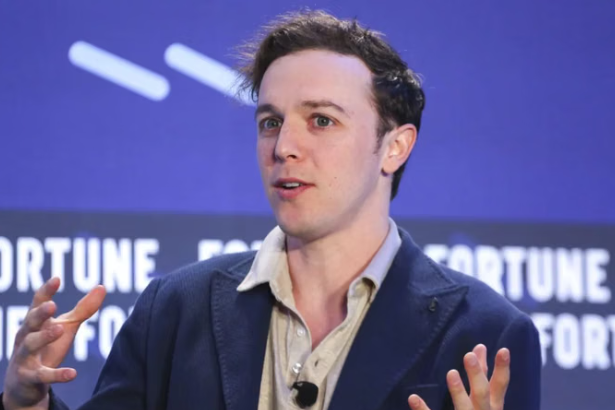
Ryan Breslow Bolt HR layoffs 2026 became the most-discussed workplace story of the week after the 31-year-old CEO made a candid admission at Fortune’s Workforce Innovation Summit on Tuesday, May 19. Speaking with Fortune editorial director Kristin Stoller, Breslow defended the decision to eliminate Bolt’s entire HR department — and described the outcome in three words that instantly went viral: “Those problems disappeared.” The statement arrived in the same conversation where Breslow also defended a recent 30% workforce reduction, described a culture of employee “entitlement” that he said festered during Bolt’s boom years, and explained why a company that once employed thousands now operates with roughly 100 people in what he calls “wartime” startup mode.
What Breslow Actually Said — and the Context Around It
The quote that circulated across every major business publication within hours of the summit was delivered without apparent hesitation. “We had an HR team, and that HR team was creating problems that didn’t exist,” Breslow told Fortune’s editorial director Kristin Stoller. “Those problems disappeared when I let them go.”
For most executives, that sentence would provoke intense anxiety. Breslow offered it as evidence of a necessary turnaround. His framing is important: he was not describing a decision made in anger or as a first resort. He was describing it as the culmination of a return to what he called “wartime” — the operational posture of a company that has lost nearly everything and needs to move fast to survive.
Breslow acknowledged on LinkedIn last year that the replacement was not simply “no HR” but a different philosophy entirely. He posted that “HR is the wrong energy, format, and approach. People ops empowers managers, streamlines decision making, and keeps the company moving at lightning speed.” Bolt has since brought on a smaller people operations team to oversee required training and serve as a resource for employees. The distinction Breslow draws between the two is operational: HR, in his characterization, was reactive, bureaucratic, and problem-generating. People ops, as he defines it, is lean, manager-empowering, and speed-oriented.
The Bolt Valuation Collapse That Made the Turnaround Necessary
The Ryan Breslow Bolt HR layoffs 2026 story cannot be understood without the company’s extraordinary rise and fall. Bolt was founded by Breslow in 2014 in his Stanford dorm room as a one-click checkout fintech platform. By 2022, the company had soared to an $11 billion valuation and employed thousands of workers. Breslow stepped down as CEO the same year amid a variety of controversies, and by 2024, the company’s valuation had reportedly fallen to roughly $300 million — a decline of nearly 97%. Multiple rounds of layoffs dramatically reduced headcount from its peak.
Breslow attributed the downturn bluntly to “poor decision-making and overspending.” He returned as CEO in 2025 in what he describes as wartime mode. His first major actions included a layoff affecting roughly 30% of remaining employees. The HR team elimination followed as part of a broader structural reset that eventually removed nearly the entire leadership team he had inherited.
The “Entitlement” Culture Breslow Says He Had to Destroy
Beyond the HR decision, Breslow’s most provocative characterization at the Fortune summit was his description of the employee culture he encountered when he returned.
“There’s a sense of entitlement that had festered across the company, and people who felt empowered, felt entitled — but weren’t actually working hard. And this is the number one thing that I had to battle,” Breslow said. “Ultimately, most of those people just had to be let go.” When he returned as CEO, he gave employees who had been hired under the prior leadership structure 60 days to adapt to a leaner, startup-style culture. The result was that “99%” could not adapt.
“They had gotten used to working at a company where they didn’t have to get their hands dirty, and could spend a lot of money, and we just didn’t have that money to spend anymore, and we didn’t have that luxury,” he said. The reset also required Breslow to abandon some of the leadership ideals he had previously championed publicly — including eliminating the four-day workweek and unlimited PTO that had been prominent features of Bolt’s culture during his first tenure.
“As someone who was a pioneer of conscious leadership,” he acknowledged, “I had to bring a company back to a very gritty place.”
The Unpaid Contractors Rumors: Breslow’s Denial
The Ryan Breslow Bolt HR layoffs 2026 coverage comes amid a complicated reputational backdrop. In recent months, Bolt has been plagued by rumors that it was taking back employees’ paychecks and that some contractors went unpaid. At the Fortune summit on Tuesday, Breslow directly denied those allegations. He stated that Bolt did not withhold funds from staff.
The denial came in the same session where he was defending the layoffs and HR elimination — a combination that means no part of his public appearance on Tuesday was straightforward reputation management. He was simultaneously defending controversial decisions and refuting specific allegations, in a high-profile media format, in real time.
What Bolt Is Now: 100 Employees, One SuperApp
The endpoint of the Ryan Breslow Bolt HR layoffs story is a company that looks almost nothing like the $11 billion unicorn it was three years ago.
Bolt currently markets itself as the “One SuperApp to rule them all” — a one-stop shop for sending money, earning rewards, and trading cryptocurrency. It has slimmed down to roughly 100 employees. Breslow argues this is not a diminished company. It is a focused one.
“We have a team a quarter of the size, who are much more junior, who work a lot harder, who have better energy,” he said. “And our customers are telling us, ‘We haven’t had this type of attention in four years.'” The company is moving without what Breslow described as “big credentialed, pedigreed professionals” — a deliberate inversion of the hiring philosophy that characterized Bolt’s growth years.
The SuperApp pivot is a significant strategic departure from Bolt’s origins as a one-click checkout platform for e-commerce. Whether the pivot succeeds will depend on whether Bolt can acquire users in a market that already has established players across every product category it is now targeting — money transfers, crypto, rewards — with 100 people and a $300 million valuation.
The HR vs. People Ops Debate: What Experts Are Saying
Breslow’s decision has reopened a long-running debate in startup culture about what human resources departments actually do — and whether the function as traditionally structured serves the company, the employees, or primarily itself.
The argument Breslow is making is not entirely novel in startup circles. Y Combinator alumni and Silicon Valley founder networks have long debated whether traditional HR departments — with their compliance orientation, conflict mediation roles, and procedural frameworks — create bureaucratic drag in fast-moving early-stage companies. The counterargument, advanced by employment law practitioners and organizational behavior researchers, is that HR functions prevent far more expensive problems than they create: lawsuits, discrimination claims, regulatory violations, and the institutional memory loss that comes from treating people as interchangeable labor units.
The specific framing that Bolt’s HR team was “creating problems that didn’t exist” is the most legally and organizationally contested element of Breslow’s public statement. Problems that an HR department identifies and documents are not problems the HR team created — they are problems that existed in the organization that the HR team made visible. Whether those problems disappear when the function is eliminated, or simply become invisible and therefore unaddressed, is the question that will be answered not at a Fortune summit but in Bolt’s employment practices over the next several years.
Broader Implications: The Startup “Wartime CEO” Playbook and Its Limits
The Ryan Breslow Bolt HR layoffs 2026 story is the most public recent example of the “wartime CEO” archetype that Ben Horowitz of Andreessen Horowitz first described in a widely-read 2011 essay. The wartime CEO breaks rules, makes uncomfortable decisions, and prioritizes survival over harmony. Peacetime CEOs build systems, invest in people, and create culture. Breslow explicitly describes himself as operating in wartime.
The wartime CEO playbook works when the situation actually requires it — when a company genuinely faces extinction and the alternative to radical action is dissolution. Whether Bolt’s situation warranted the specific form of radical action Breslow chose — eliminating HR rather than restructuring it, characterizing employees who could not adapt as “entitled” rather than as people hired for a different kind of company — is a question that employees, regulators, and the labor market will eventually answer more clearly than any conference panel can. For more on the biggest stories in business leadership and workplace culture, visit The Tech Marketer.
Latest Updates
Ryan Breslow’s statements at the Fortune Workforce Innovation Summit on May 19, 2026 are generating significant reaction. Here is where to follow the full story:
- Fortune has the complete account of Ryan Breslow’s statements at the Workforce Innovation Summit including all direct quotes, the Bolt valuation history, the 30% layoff context, the unpaid contractors denial, and the full description of Bolt’s current 100-employee SuperApp model. Read more at Fortune
- NDTV has the full international coverage of Ryan Breslow’s defense of firing the entire Bolt HR team, including analysis of the viral “problems disappeared” quote and the broader workplace culture debate it has ignited. Read more at NDTV
- Hindustan Times has the full trending story on the CEO of a $300 million company whose statement about problems disappearing after firing the HR team has gone viral globally, with international reader reactions and workplace culture analysis. Read more at Hindustan Times
FAQ: Ryan Breslow Bolt HR Layoffs 2026
1. What did Ryan Breslow say about Bolt’s HR team at the Fortune summit? Speaking at Fortune’s Workforce Innovation Summit on May 19, 2026, Bolt CEO Ryan Breslow said: “We had an HR team, and that HR team was creating problems that didn’t exist. Those problems disappeared when I let them go.” He defended the decision as a necessary step in Bolt’s turnaround from a $11 billion valuation collapse to a lean 100-employee startup operating in what he called “wartime” mode.
2. Why did Bolt fire its entire HR team? Breslow framed the HR elimination as part of a broader cultural reset after returning as CEO in 2025. He said Bolt’s culture had developed a sense of “entitlement” during its boom years, with employees who “felt empowered, felt entitled — but weren’t actually working hard.” He described giving employees 60 days to adapt to a leaner startup culture, with 99% unable to make the transition.
3. What happened to Bolt’s valuation between 2022 and 2026? Bolt soared to an $11 billion valuation in 2022, making it one of fintech’s most prominent unicorns. By 2024, the valuation had reportedly fallen to approximately $300 million — a decline of nearly 97%. Breslow attributed the collapse to poor decision-making and overspending, and stepped down as CEO in 2022 before returning in 2025 to lead the turnaround.
4. Does Bolt have any HR function at all after the elimination? Yes. Breslow acknowledged that Bolt has replaced its HR department with a smaller “people operations” team that handles required training and serves as a resource for employees. He has previously written on LinkedIn that “HR is the wrong energy, format, and approach” while “people ops empowers managers, streamlines decision making, and keeps the company moving at lightning speed.”
5. What is Bolt doing now after the layoffs and restructuring? Bolt currently operates with approximately 100 employees and is pivoting its business model toward what it calls the “One SuperApp to rule them all” — a platform for sending money, earning rewards, and trading cryptocurrency. Breslow says the current team, though smaller and more junior than in Bolt’s peak years, is delivering better customer attention than the company had provided in four years.
Sources and References
- Fortune: Bolt CEO Says He Let Go of His Entire HR Team for Creating Problems That Didn’t Exist: ‘Those Problems Disappeared When I Let Them Go’
- NDTV: ‘Problems Disappeared’: Bolt CEO Ryan Breslow Defends Firing Entire HR Team
- Hindustan Times: CEO of $300 Million Company Says ‘Problems Disappeared’ After Firing HR Team