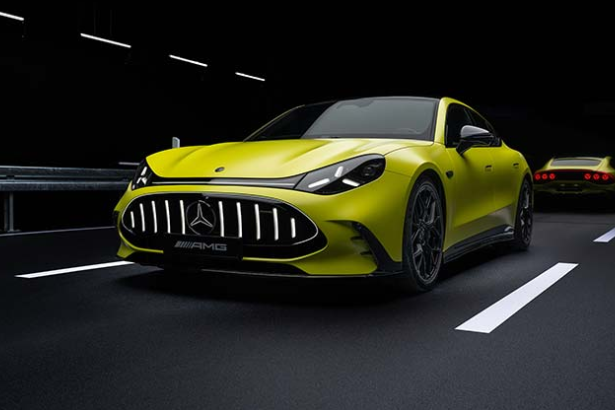
The Mercedes-AMG GT four-door coupe EV 2026 is here — and it is the most technically ambitious electric performance car any German manufacturer has ever built. The all-new AMG GT 4-Door Coupe makes its full debut today, replacing the V8-powered predecessor with a purpose-built electric platform that produces 860 kW — 1,169 horsepower — during AMG Launch Control in its flagship GT 63 configuration. The car does 0-100 km/h in 2.1 seconds, reaches 200 km/h in 6.4 seconds, and tops out at 300 km/h. It charges at up to 600 kW — 10% to 80% in 11 minutes. And for the AMG faithful who cannot imagine their car without a V8 soundtrack, it plays one — reconstructed from over 1,600 sound files — with a haptic gear-shift simulation built into the steering paddles. Production begins this summer at the Sindelfingen factory.
The Two Variants: GT 63 and GT 55
Mercedes-AMG customers will initially be able to choose between two variants of the Mercedes-AMG GT four-door coupe EV 2026. The flagship GT 63 4-Door Coupe delivers 860 kW (1,169 hp) during AMG Launch Control, with continuous output of 721 hp available repeatedly for circuit driving. The GT 55 4-Door Coupe produces 600 kW (816 hp). Both variants use three axial flux motors — two at the rear axle and one at the front — on the new AMG.EA 800-volt dedicated high-performance electric platform.
The architecture is technically capable of supporting even higher outputs of over 1,000 kW, AMG states. That framing — announcing a 860 kW production car while acknowledging the platform supports 1,000 kW — signals that a higher-tier variant is coming. The GT 63 and GT 55 are the opening chapter of what AMG is positioning as a multi-model electric performance family.
The Axial Flux Motors: A World First for Series Production
No series-production electric car has used axial flux motors before the AMG GT 4-Door Coupe EV 2026. That fact deserves to be understood technically rather than simply listed as a spec.
In a conventional radial motor, electromagnetic flux runs perpendicular to the axis of rotation. In an axial flux design, it runs parallel. The practical result is a dramatically more compact form factor that delivers higher power density in a package slim enough to fit where a conventional motor cannot. At the rear axle, two motors sit in a shared High Performance Electric Drive Unit housing barely eight centimeters wide each. The front motor is even slimmer at nine centimeters. The motors spin at over 13,000 rpm at the rear and more than 15,000 rpm at the front axle.
AMG co-developed these motors with YASA, the British electric motor specialist Mercedes-Benz acquired in 2021. More than 30 patent applications were generated during the development of the new manufacturing processes for these motors, which will be produced at the Berlin-Marienfelde facility. The front motor functions primarily as a booster unit, disconnecting automatically during low-load driving to improve efficiency and reduce drag losses — a sophisticated energy management strategy that balances peak performance with everyday range.
The Battery: F1-Inspired, Oil-Cooled, Built for Track Use
The battery system in the Mercedes-AMG GT four-door coupe EV 2026 is engineered on Formula 1 principles — not as a marketing claim but as a specific technical approach to thermal management.
The 800V underfloor pack contains 2,660 cylindrical cells bathed in electrically non-conductive oil — a direct-cooling arrangement that allows the car to deliver and absorb charge at rates previously unimaginable in a production road car. The small diameter of the cylindrical cells minimizes the distance from the cell core to the surface, enabling rapid heat dissipation under load. Each individual cell is maintained within its optimal temperature range during repeated hard acceleration runs — the specific failure mode that has traditionally made high-performance EVs frustrating on track.
The laser-welded aluminum cell housing is a new development, lighter than conventional steel casings and offering improved electrical and thermal conductivity. The full-tab cell design, where the cell winding is fully connected electrically and thermally to both poles, further improves heat transfer. The engineering result is a battery that can support sustained performance across a circuit session rather than delivering one hot lap before needing a cooling period.
600 kW Charging: 10-80% in 11 Minutes
The charging performance of the Mercedes-AMG GT four-door coupe EV 2026 is the data point that most clearly illustrates what 800V architecture enables for daily use. Peak charging capacity exceeds 600 kW — meaning a charge from 10% to 80% takes approximately 11 minutes at a compatible ultra-high-power charger.
For context, most current 800V EVs — including the Porsche Taycan and Hyundai Ioniq 6 — peak at 270-350 kW. The AMG GT’s 600 kW charging capability is more than twice that figure. In practical terms, the 11-minute charge time means a driver who stops for coffee while the car charges can realistically complete a 400+ mile charge session before the coffee is finished.
Performance Figures: The Numbers That Matter
The Mercedes-AMG GT four-door coupe EV 2026 performance specifications position it alongside the fastest production vehicles ever built:
0-100 km/h in 2.1 seconds. 0-200 km/h in 6.4 seconds. Top speed of 300 km/h. Continuous output of 721 hp — available repeatedly, not just once. Drag coefficient of 0.22 Cd on a 5.1-meter body. The 0.22 Cd figure is particularly notable. The AMG GT is not a sleek compact crossover — it is a full-size four-door sports coupe nearly 17 feet long. Achieving 0.22 Cd on that body requires intelligent active aerodynamics — the car uses two Venturi plates in the underbody and a rear diffuser, all adapting automatically to driving conditions.
The V8 Sound: 1,600 Files, Mixed in Real Time
The most divisive element of the Mercedes-AMG GT four-door coupe EV 2026 is also its most impressive piece of engineering — and that combination will infuriate purists and delight pragmatists simultaneously.
In AMG FORCE S+ mode, the car plays a V8 soundtrack built from over 1,600 sound files, mixed in real time, based on the AMG GT R’s iconic engine note. Tug the steering paddles and you get haptic gear-shift interruptions that convincingly simulate the brutal shifts of a quick twin-clutch transmission. An adapted central display shows a tachometer, and the soundtrack changes contextually with driving style — whether accelerating hard, burbling on a trailing throttle, or approaching the car to unlock it. AMG’s own engineers have reportedly driven it and believed they were in a V8.
This is far beyond a generic EV whine with a sound button. The 1,600-file library, real-time mixing based on driving inputs, and patent-pending reconstruction of the AMG GT R’s specific engine note represent serious engineering investment in the emotional experience of the car. Whether artificial V8 sound is acceptable in an AMG is a philosophical question this car refuses to answer — it simply makes the most technically sophisticated argument for yes that anyone has ever attempted.
The Chassis: Active Ride Control, Rear-Axle Steering
The suspension system is new from the ground up. AMG’s active ride control system replaces conventional anti-roll bars with semi-active, hydraulically interconnected dampers that link the compression and rebound sides, regulated by a central pump and valves. The system simultaneously improves handling precision and ride quality — the fundamental trade-off that conventional suspension cannot resolve.
Rear-axle steering further enhances both low-speed maneuverability and high-speed stability. The combination of rear-axle steering, active aerodynamics, and AMG’s four-wheel-drive torque distribution makes the GT 4-Door Coupe a genuinely dynamic instrument rather than simply a straight-line performance showcase.
Brad Pitt, Sindelfingen, and the Production Timeline
The Mercedes-AMG GT four-door coupe EV 2026 was first publicly showcased in November 2025 on the sidelines of the Formula 1 race in Las Vegas as a heavily camouflaged prototype, with actor Brad Pitt announced as the face of the model. The car was unveiled in full production form in March 2026 with interior details and drivetrain specifications released progressively thereafter.
Series production begins in summer 2026 at the historic Mercedes-Benz plant in Sindelfingen, Germany — the same facility that has produced AMG’s most important models for decades. The axial flux motors are manufactured at the Berlin-Marienfelde facility, where more than 30 patent applications were filed during the development process.
Broader Implications: What the AMG GT EV Means for Performance Cars
The Mercedes-AMG GT four-door coupe EV 2026 represents the clearest statement yet from a major performance car manufacturer that electric architecture is not a compromise but a platform. The combination of world-first axial flux motors, F1-derived battery technology, 600 kW charging, and a 2.1-second 0-100 km/h time places this car in a category that no purely internal combustion car has entered. The V8 sound system is the acknowledgment that the technology alone is not yet sufficient for every AMG buyer — and the willingness to engineer a 1,600-file audio reconstruction of a V8 is the clearest possible signal of how seriously AMG takes the emotional dimension of performance driving. For more on the biggest stories in automotive and technology, visit The Tech Marketer.
Latest Updates
The Mercedes-AMG GT four-door coupe EV 2026 has been fully revealed. Here is where to follow the complete technical coverage:
- The Verge has the full reveal coverage of the Mercedes-AMG GT four-door coupe EV 2026, including the complete specs breakdown, the YASA axial flux motor technology explanation, and the detailed analysis of AMG FORCE S+ sound system. Read more at The Verge
- Electric Cars Report has the comprehensive technical breakdown of the AMG GT 4-Door Coupe EV including the GT 63 and GT 55 variant specifications, the axial flux motor performance figures, the 600 kW charging capability, and the Sindelfingen production timeline. Read more at Electric Cars Report
- Electrive has the complete engineering deep-dive on the AMG GT 4-Door Coupe EV including the HP.EDU drive unit architecture, the silicon carbide inverters, the oil-cooled motor design, and the active aerodynamic system details. Read more at Electrive
FAQ: Mercedes-AMG GT Four-Door Coupe EV 2026
1. How much horsepower does the Mercedes-AMG GT four-door coupe EV 2026 have? The flagship GT 63 4-Door Coupe produces 860 kW (1,169 hp) during AMG Launch Control, with 721 hp of continuous output available for sustained performance on track. The GT 55 variant produces 600 kW (816 hp). Both use three YASA axial flux motors — two at the rear axle and one at the front — on the AMG.EA 800V platform.
2. How fast is the Mercedes-AMG GT four-door coupe EV 2026? The GT 63 does 0-100 km/h in 2.1 seconds, 0-200 km/h in 6.4 seconds, and reaches a top speed of 300 km/h. The 0.22 Cd aerodynamic coefficient and active Venturi underbody panels contribute to both the top speed capability and high-speed stability.
3. How fast does the Mercedes-AMG GT four-door coupe EV 2026 charge? The car supports peak DC charging at over 600 kW — charging from 10% to 80% in approximately 11 minutes at a compatible ultra-high-power charging station. The 800V AMG.EA architecture and F1-inspired oil-cooled battery system enable charge rates more than twice those of current 800V performance EVs like the Porsche Taycan.
4. What are the YASA axial flux motors in the Mercedes-AMG GT EV? YASA is a British electric motor specialist acquired by Mercedes-Benz in 2021. Their axial flux motors run electromagnetic flux parallel to the axis of rotation — rather than perpendicular as in conventional radial motors — producing a dramatically more compact form factor with higher power density. The AMG GT uses three of these motors in a world first for series production, spinning at over 13,000 rpm at the rear and 15,000 rpm at the front.
5. Does the Mercedes-AMG GT four-door coupe EV 2026 make a V8 sound? Yes. In AMG FORCE S+ mode, the car plays a V8 soundtrack built from over 1,600 sound files, mixed in real time based on driving inputs, reconstructed from the AMG GT R’s iconic engine note. Steering paddle pulls trigger haptic gear-shift interruptions that simulate a twin-clutch transmission, and the central display shows a contextual tachometer. The system is patent-pending and represents AMG’s most technically serious attempt to preserve the emotional experience of a combustion engine AMG.
Sources and References
- The Verge: Mercedes-AMG GT Four-Door Coupe EV Specs Revealed
- Electric Cars Report: Mercedes-AMG GT 4-Door Coupe Debuts With 1,169 HP and 600 kW Charging
- Electrive: Electric Powerhouse: Mercedes-AMG Unveils GT 4-Door Coupé