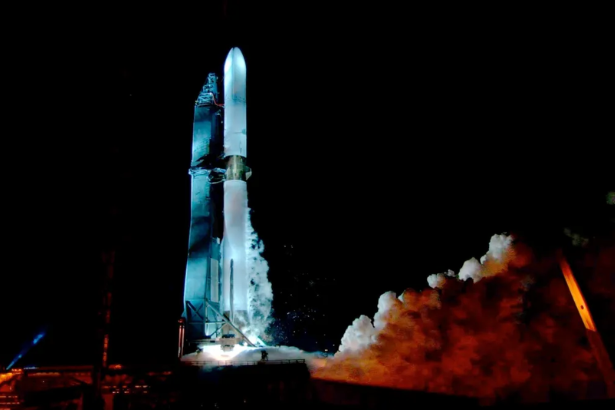
The Blue Origin New Glenn explosion 2026 occurred at approximately 9 PM EDT on Thursday, May 28, at Launch Complex 36 at Cape Canaveral Space Force Station in Florida. Blue Origin’s New Glenn heavy-lift rocket was undergoing a hotfire test — a ground-based static firing of the rocket’s seven methane-fueled BE-4 first-stage engines — in preparation for a launch planned for next week carrying Amazon Leo internet satellites. As the engines appeared to begin firing, something went wrong at the base of the rocket. Fire enveloped the 188-foot first stage. The 86-foot upper stage tilted and began to fall. Then the vehicle exploded in a roiling orange fireball that lit the Florida sky, shook homes in Cape Canaveral and Cocoa Beach, and destroyed the rocket, the transporter erector, and at least one lightning protection tower. No injuries were reported. Jeff Bezos posted on X: “Very rough day, but we’ll rebuild whatever needs rebuilding and get back to flying.”
What Happened: The Hotfire Test and the Anomaly
A hotfire test — also called a static-fire test — is a critical pre-launch procedure in which a rocket’s engines are ignited while the vehicle remains secured to the launch pad. The test verifies that the propulsion system, fuel delivery, ignition sequence, and engine control systems are all functioning correctly before committing to a flight attempt. It is considered one of the safest phases of launch preparation — the rocket is tethered, emergency systems are standing by, and no payload is aboard.
The Blue Origin New Glenn explosion 2026 occurred during exactly this kind of test. Engineers were counting down to a brief firing of the New Glenn’s seven BE-4 first-stage engines at approximately 9 PM EDT. Amazon confirmed to TechCrunch late Thursday that no Leo satellites were aboard for this test — meaning the payload for the planned June launch was not lost. As the engines appeared to begin the firing sequence, the anomaly developed at the base of the rocket with extreme speed. Video captured from multiple angles showed a fire igniting at the engine section, the first stage becoming enveloped in flames, the upper stage beginning to tilt as the structural integrity of the first stage failed, and then a full vehicle explosion as the rocket’s methane fuel and liquid oxygen propellants ignited simultaneously.
The Physical Damage: Pad, Erector, Towers
The immediate physical consequence of the Blue Origin New Glenn explosion 2026 is significant and practically constraining. The rocket itself was destroyed. The transporter erector — the infrastructure that moves the New Glenn from its assembly building to the pad and raises it to the vertical position for launch — was also destroyed or severely damaged. At least one of the lightning protection towers at Launch Complex 36 was damaged. Until a full structural assessment is completed, it is impossible to know precisely how long it will take to resume launch operations from the pad.
The operational constraint created by that damage is severe for a specific reason: Blue Origin has only one New Glenn launch pad — Launch Complex 36 at Cape Canaveral. Unlike SpaceX, which can shift Florida operations between pads at Cape Canaveral and the Kennedy Space Center, Blue Origin’s New Glenn program has a single pad from which to operate. The 2016 SpaceX Falcon 9 explosion at nearby pad 40 — which also occurred during pre-launch test preparations — kept that pad out of action for more than a year. SpaceX was able to maintain launch operations by shifting to pad 39A at Kennedy Space Center and pad 4-East at Vandenberg. Blue Origin does not currently have that flexibility.
Jeff Bezos’ Response: “Worth It”
Bezos communicated directly to the public through X within hours of the explosion. His full statement: “All personnel are accounted for and safe. It’s too early to know the root cause but we’re already working to find it. Very rough day, but we’ll rebuild whatever needs rebuilding and get back to flying. It’s worth it.”
The final two words — “It’s worth it” — are the message that Blue Origin needed its customers, investors, and government partners to receive on Thursday night. The explosion destroys hardware and damages infrastructure. It does not, by itself, end the New Glenn program or Blue Origin’s commercial launch ambitions. What Bezos was communicating is that the organization’s conviction that New Glenn represents a viable, commercially important launch vehicle has not changed as a result of one test failure.
Blue Origin’s official statement confirmed an “anomaly during today’s hotfire test” and that all personnel had been accounted for. The company said it would provide updates as more is learned. The FAA told Spaceflight Now that the static fire test was not within the scope of FAA-licensed activities and would not prompt a new investigation by the agency. However, the FAA confirmed it will verify that Blue Origin implements corrective actions prior to the next licensed New Glenn mission.
The Impact on Amazon Leo Satellites and Blue Origin’s 2026 Plans
The Blue Origin New Glenn explosion 2026 disrupts what had been an ambitious launch schedule for the remainder of the year. Blue Origin had been planning as many as 12 New Glenn launches in 2026 — an aggressive cadence that, if achieved, would have substantially advanced the company’s competitive position against SpaceX.
The rocket that exploded was preparing to carry Amazon Leo internet satellites into orbit next week. Amazon confirmed no satellites were aboard for the hotfire test. However, the United Launch Alliance Atlas V rocket is still scheduled to launch Friday night with a separate batch of Amazon Leo satellites — meaning Amazon’s satellite internet constellation buildout continues even as Blue Origin’s contribution is paused.
One week before the explosion, Amazon publicly touted Blue Origin’s reliability in building the Leo network, calling New Glenn a “reusable, heavy-lift rocket” in marketing materials tied to the planned June launch. That context makes Thursday’s event particularly difficult for the commercial relationship between the two Bezos-connected companies.
NASA’s Artemis Program: Implications Flagged
The Blue Origin New Glenn explosion 2026 has implications beyond commercial satellite launches. NASA Administrator Jared Isaacman — who was notified of the explosion by Congressman Mike Haridopolos (R-FL), the representative for the district where Cape Canaveral is located — issued a statement acknowledging the anomaly and flagging the program-level consequences.
“NASA is aware of the anomaly that occurred tonight at Launch Complex 36 involving Blue Origin’s New Glenn rocket at Cape Canaveral Space Force Station. Spaceflight is unforgiving, and developing new heavy-lift launch capability is extraordinarily difficult. We will work with our partners to support a thorough investigation of this anomaly, assess near-term mission impacts, and get back to launching rockets,” Isaacman said. “We will provide information on any impacts to the Artemis and Moon Base programs as it becomes available.”
NASA had highlighted Blue Origin’s expected role in the Artemis and Moon Base programs earlier the same week. The degree of disruption to those programs depends on the root cause investigation and how quickly Blue Origin can restore Launch Complex 36’s operational capability.
The Historical Comparison: SpaceX Falcon 9, 2016
The Blue Origin New Glenn explosion 2026 is the most serious US commercial launch pad accident since September 1, 2016, when a SpaceX Falcon 9 rocket exploded at nearby Space Launch Complex 40 during preparations for a static-fire test. That explosion destroyed the rocket and the AMOS-6 communications satellite aboard. SpaceX’s Falcon 9 did not return to flight for three and a half months, and the pad was out of action for more than a year.
The structural similarity between the two events is the starting point for assessing the Blue Origin timeline — but the differences matter. SpaceX had multiple pads available in Florida and California to maintain launch cadence during the recovery. Blue Origin has one New Glenn pad. The root cause of the SpaceX 2016 failure was traced to a helium tank rupture inside the upper stage liquid oxygen tank — a specific and identifiable failure mode that engineers could then correct. The root cause of the New Glenn explosion remains unknown.
Elon Musk responded to the New Glenn explosion video on X with characteristic brevity: “Most unfortunate. Rockets are hard.”
What Comes Next: Investigation, Assessment, Return to Flight
The immediate priority for Blue Origin is the root cause investigation — understanding specifically what failed in the engine firing sequence and why the anomaly progressed to a full vehicle explosion rather than being contained by the pad safety systems. That investigation will involve Blue Origin’s engineering team, the US Space Force, and potentially the FAA despite the agency’s statement that the test was outside its licensed scope.
The pad damage assessment will run in parallel. The transporter erector and lightning protection tower damage needs to be quantified before any timeline for pad restoration can be established. If the damage is limited to the erector and tower — which are replaceable — the return-to-launch timeline could be measured in months rather than a year. If the explosion damaged the flame trench, fuel loading systems, or pad structure underneath the launch mount, the timeline extends considerably.
Broader Implications: Blue Origin’s Commercial Future and the New Glenn Program
The Blue Origin New Glenn explosion 2026 is the most significant setback in the program since its development began more than a decade ago. Blue Origin spent approximately a decade and enormous capital developing New Glenn to compete with SpaceX in the commercial and government launch markets. The rocket had completed successful orbital launches and was beginning to establish itself as a viable alternative for customers who wanted options beyond SpaceX.
The return-to-flight timeline will determine how much market position Blue Origin loses in the interim. Launch customers who were planning to use New Glenn for 2026 missions will now face decisions about whether to wait for Blue Origin’s return or shift to other providers. SpaceX, ULA, and Rocket Lab all benefit from any extended New Glenn grounding. The Bezos promise to “rebuild whatever needs rebuilding” reflects the organization’s conviction in the program — the question the commercial space market is now asking is how long that rebuilding will take. For more on the biggest stories in space, technology, and science, visit The Tech Marketer.
Latest Updates
The Blue Origin New Glenn explosion 2026 occurred May 28 at approximately 9 PM EDT. Here is where to follow the full investigation coverage:
- BBC has the complete Blue Origin New Glenn explosion video and initial report — the fireball footage, Blue Origin’s official anomaly statement, and Jeff Bezos’ full X post. Read more at BBC
- Times of Israel has the complete Blue Origin New Glenn explosion watch coverage including the launch pad footage, the Cape Canaveral community reaction, and the technical context for what a hotfire test involves and why this one failed. Read more at Times of Israel
- WESH Orlando has the complete Florida-local coverage of the Blue Origin New Glenn explosion at Cape Canaveral — including the homes-shaking impact, the emergency response, the orange fireball visible from Cocoa Beach, and the Space Force statement. Read more at WESH
FAQ: Blue Origin New Glenn Explosion 2026
1. What caused the Blue Origin New Glenn explosion in 2026? The root cause of the explosion has not been determined. Blue Origin confirmed an “anomaly during today’s hotfire test” and said it is working to find the root cause. The explosion occurred as engineers were conducting a static-fire test of the New Glenn’s seven methane-fueled BE-4 first-stage engines at Launch Complex 36 at Cape Canaveral Space Force Station on May 28, 2026. Jeff Bezos said on X: “It’s too early to know the root cause but we’re already working to find it.”
2. Was anyone hurt in the Blue Origin explosion? No. Blue Origin confirmed all personnel were accounted for and safe. Cape Canaveral Space Force Station officials also confirmed no injuries. The explosion occurred during a ground test with no crew aboard and standard safety protocols in place. Homes in nearby Cape Canaveral and Cocoa Beach were shaken by the blast and the sky was lit orange, but no physical harm was reported.
3. Were Amazon Leo satellites aboard the New Glenn when it exploded? No. Amazon confirmed to TechCrunch that no Leo satellites were aboard for the hotfire test. The satellites planned for the New Glenn’s upcoming June launch were not damaged or destroyed. United Launch Alliance’s Atlas V rocket, which was already scheduled to launch Friday night, will still carry a separate batch of Amazon Leo satellites.
4. How does the New Glenn explosion compare to SpaceX’s 2016 Falcon 9 pad explosion? The SpaceX Falcon 9 exploded at nearby Space Launch Complex 40 on September 1, 2016, during preparations for a static-fire test. That explosion destroyed the rocket and the AMOS-6 communications satellite aboard. SpaceX did not return to flight for three and a half months, and the pad was out of action for more than a year. A key difference: SpaceX had multiple pads in Florida and California to continue operations. Blue Origin has only one New Glenn pad at Cape Canaveral.
5. What does the New Glenn explosion mean for NASA’s Artemis program? NASA Administrator Jared Isaacman confirmed NASA is aware of the anomaly and said the agency will “provide information on any impacts to the Artemis and Moon Base programs as it becomes available.” Blue Origin is a key partner in the Artemis program. The degree of disruption depends on how quickly Blue Origin can restore Launch Complex 36 and return the New Glenn to flight status — a timeline that will not be known until the root cause investigation is complete and the pad damage assessment is finished.