Introduction
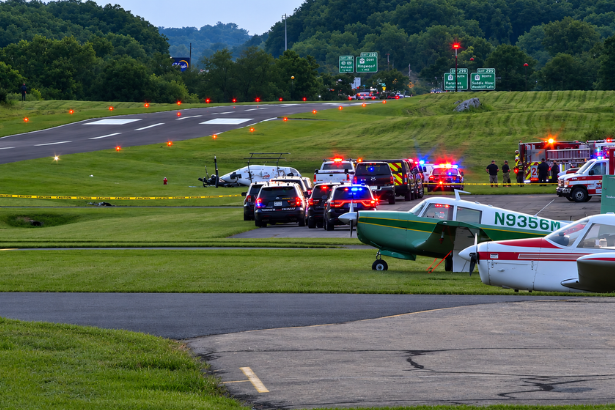
The Carlisle plane crash has triggered a federal aviation investigation after a small Cessna 150 collided with a Pennsylvania State Police Bell 407 helicopter Wednesday evening, killing the plane’s pilot and injuring two troopers aboard the helicopter.
The collision happened at Carlisle Airport in Cumberland County, Pennsylvania. According to Pennsylvania State Police officials cited by NBC Philadelphia, the helicopter was conducting a training exercise when the Cessna veered from its course during landing and struck the rear of the helicopter.
The crash was violent enough to break the Cessna into pieces and overturn the helicopter. The two troopers survived and were hospitalized, while the pilot of the Cessna died.
The Federal Aviation Administration and National Transportation Safety Board are investigating.
Background and Context
Carlisle Airport is a public-use airport in Pennsylvania with a 4,008-foot asphalt runway. The airport operates without a control tower and uses a common traffic advisory frequency for aircraft operating in the area.
That operating environment is relevant because small airports rely heavily on pilots maintaining situational awareness and coordinating their movements.
The crash involved two very different aircraft.
The first was a Cessna 150, a small, two-seat general aviation aircraft commonly associated with flight training and recreational flying.
The second was a Bell 407, a single-engine turbine helicopter operated by Pennsylvania State Police.
According to officials, the State Police helicopter was carrying two troopers and was conducting a training exercise near the airport when the collision occurred.
The incident demonstrates how quickly aviation operations can become dangerous when two aircraft occupy the same low-altitude operating environment.
Latest Update: What Happened in the Carlisle Plane Crash?
The collision occurred Wednesday evening near Carlisle Airport.
NBC Philadelphia reported that the Cessna veered off course while landing and collided with the back of the police helicopter. The impact caused the fixed-wing aircraft to break apart, while the Bell 407 rolled and ultimately stopped on its side.
Pennsylvania State Police Acting Commissioner George L. Bivens said the helicopter was conducting training near the runway when the aircraft collision occurred.
The two troopers were identified as Corporal Bryce Corman and Trooper Jason Mills. Both were initially trapped inside the overturned helicopter. Corman was able to escape and then helped Mills out of the wreckage, according to officials.
The two troopers were taken to a hospital. Officials said one could potentially be released before Thursday morning, while the other was expected to remain overnight for observation.
The identity of the deceased pilot had not initially been released because authorities were waiting to notify next of kin.
Local reporting from NBC Philadelphia, WGAL and ABC27 has focused on the crash scene, the emergency response and the condition of those involved.
What Aviation Technology Can Tell Investigators
The investigation will likely involve more than physical wreckage.
Modern aircraft can produce multiple streams of information that investigators can use to reconstruct an accident.
Depending on the equipment installed and the circumstances, investigators can examine radar data, automatic dependent surveillance broadcast information, radio communications, flight paths, aircraft maintenance records and other available evidence.
That information can help establish where each aircraft was located, what direction it was traveling and how the paths changed immediately before the collision.
But technology does not automatically provide an explanation.
Investigators still need to determine why the Cessna changed course, whether the pilots had visual contact with each other, what instructions or communications were occurring and whether mechanical, environmental or human factors played a role.
The FAA and NTSB are responsible for determining the cause and contributing factors. NBC Philadelphia confirmed that both agencies are investigating.
Expert Analysis: Why the Investigation Matters
The most important unanswered question is why the aircraft ended up on a collision path.
Officials have described the Cessna as veering from its course during landing. That describes what happened, but it does not explain why.
There are several categories investigators typically examine after an aviation accident:
- Pilot decision-making
- Aircraft mechanical condition
- Flight path and altitude
- Weather and visibility
- Radio communications
- Airport procedures
- Training operations
- Traffic awareness
- Human factors
- Possible equipment or navigation issues
At this stage, it would be premature to attribute the crash to any single factor.
The available evidence establishes the collision and its immediate consequences. It does not yet establish the final cause.
That distinction is especially important in a breaking aviation story, where early reports can change as investigators recover additional evidence.
Broader Implications
For Aviation Safety
The Carlisle plane crash will likely become another case study in the challenges of operating multiple aircraft in relatively confined airspace.
Small airports can have a mixture of student pilots, recreational aircraft, helicopters, emergency operations and other traffic.
Each aircraft has different operating characteristics.
A helicopter can hover or maneuver at low speed, while a small fixed-wing aircraft approaching a runway has a very different flight profile.
Managing those interactions requires pilots to maintain constant awareness of surrounding traffic.
For Police Aviation
The accident also highlights the risks faced by law enforcement aviation units.
Police helicopters perform missions that range from training and patrol operations to search and rescue, traffic monitoring and emergency response.
Training exercises are essential, but they also place crews in situations designed to simulate real-world operations.
The Pennsylvania State Police helicopter involved in this crash was conducting training when the collision occurred, according to officials.
For Airport Technology
The incident also raises broader questions about how technology could improve situational awareness at smaller airports.
Modern traffic-awareness systems can provide pilots with information about nearby aircraft, but no technology completely removes the need for pilots to maintain visual and procedural awareness.
Future aviation systems could increasingly combine aircraft transponder information, digital traffic displays, automated alerts and improved airport surveillance.
For aviation technology coverage, this story also fits naturally within an internal The Tech Marketer aviation and emerging technology section.
Related History and Comparable Technologies
Midair collisions remain among the most serious aviation risks because aircraft can have very little time to react once their flight paths converge.
The aviation industry has responded over decades by developing increasingly sophisticated traffic-alert and collision-avoidance technologies.
Transponders allow aircraft to broadcast identification and position information. Traffic alert systems can warn pilots about nearby aircraft. More advanced systems can provide guidance intended to help crews avoid collisions.
But small-aircraft operations can still present challenges.
General aviation aircraft may operate at low altitudes and around airports without control towers. Helicopters can also operate in ways that differ significantly from conventional fixed-wing traffic.
That makes human awareness, communication and predictable operating procedures particularly important.
The investigation into the Carlisle accident will help determine whether any of these factors played a role.
What Happens Next
The FAA and NTSB will continue examining the wreckage and available flight information.
Investigators will likely reconstruct the movements of both aircraft and examine the circumstances immediately before impact.
They may also review:
- Aircraft maintenance histories.
- Pilot qualifications and training records.
- Radio communications.
- Available radar or tracking information.
- Weather conditions.
- Airport operating procedures.
- Witness accounts.
- Physical evidence from both aircraft.
The final investigation could take considerably longer than the initial news cycle.
That is normal for major aviation accidents.
The first reports establish the basic facts. The subsequent investigation attempts to explain them.
For now, officials have confirmed one death and two injuries, while the cause remains under investigation.
Conclusion
The Carlisle plane crash is a tragic reminder of how quickly aviation accidents can unfold.
A Cessna 150 and a Pennsylvania State Police Bell 407 collided near Carlisle Airport, killing the Cessna’s pilot and injuring two state troopers.
The troopers survived and were hospitalized, while federal investigators from the FAA and NTSB work to determine exactly why the aircraft collided.
The most important unanswered question is not simply what happened, but why.
Until investigators complete their work, claims about mechanical failure, pilot error, weather or other possible causes remain speculation.
The coming investigation should provide the technical evidence needed to reconstruct the final moments of both aircraft and determine what lessons can be applied to aviation safety.
FAQ
What happened in the Carlisle plane crash?
A Cessna 150 collided with a Pennsylvania State Police Bell 407 helicopter near Carlisle Airport in Pennsylvania. The Cessna pilot died and two state troopers aboard the helicopter were injured.
Was the aircraft pilot killed in the crash?
Yes. Officials said the pilot of the Cessna 150 was killed. Authorities initially withheld the pilot’s identity pending notification of next of kin.
What happened to the Pennsylvania State Police troopers?
Corporal Bryce Corman and Trooper Jason Mills were aboard the helicopter. Both survived and were hospitalized after the helicopter overturned. Corman was able to escape and helped Mills out of the aircraft.
What type of aircraft were involved?
The collision involved a Cessna 150 airplane and a Pennsylvania State Police Bell 407 helicopter.
Where did the Carlisle plane crash happen?
The accident occurred at or near Carlisle Airport in Cumberland County, Pennsylvania. The airport is a public-use facility located southeast of Carlisle.
What caused the crash?
The final cause has not been determined. Officials said the Cessna veered from its course during landing and collided with the helicopter. The FAA and NTSB are investigating.
Were the troopers conducting police operations?
Officials said the helicopter was conducting a training exercise when the collision occurred.
Is Carlisle Airport closed?
Initial local reporting indicated that the runway was closed while first responders and investigators worked at the scene. Travelers and pilots should rely on official airport and FAA notices for the latest operational status.
Sources & References
- NBC Philadelphia: “Pilot killed, 2 PSP Troopers hurt after aircraft collision, officials say”
Read the NBC Philadelphia report - WGAL: “PA plane, helicopter crash: Pilot dead, troopers injured in Carlisle”
Read the WGAL report - ABC27: “First responders converge on Carlisle Airport, runway closed”
Read the ABC27 report - Associated Press: “Pilot killed in violent collision with Pennsylvania police helicopter”
Read the AP report - Pennsylvania Department of Transportation: Carlisle Airport information
View Pennsylvania’s Carlisle Airport information