


Introduction
The best pool cleaning robots are no longer simple underwater vacuums that wander around until their batteries die. The latest generation combines cordless motors, sensors, smartphone apps, computer vision and increasingly sophisticated navigation to handle one of the least glamorous jobs of pool ownership.
The shift is significant. Traditional pressure-side cleaners relied on pool pumps and long hoses. Corded robotic cleaners removed some of that complexity but still left cables stretched across the pool deck. Today’s battery-powered machines can operate without either. WIRED’s latest testing points to cordless robots as the direction the category is heading, with the Beatbot AquaSense 2 Ultra taking the top overall position.
That does not mean everyone needs a $2,000-plus machine.
A smaller pool, a tighter budget or a lot of floating leaves can change which robot makes sense. A cleaner with an enormous battery might be more useful to a hands-off owner than one with the most advanced navigation. And sometimes the right answer is not a pool-floor robot at all, but a dedicated surface skimmer.
Here is how the current field breaks down.
Background and Context
Pool robots have existed for decades, but the technology has changed dramatically.
Older pressure-side systems were connected to a pool’s circulation system and moved using water pressure. They remain available, but they require hoses and depend on the pool’s existing plumbing and pump setup.
Corded electric robots offered a major improvement because they could operate independently of the pool’s pump. The tradeoff was a long power cable running through the water.
Battery technology has changed that equation.
Modern cordless cleaners can be dropped into the pool, navigate independently and return to the surface or pool edge when their work is complete. The absence of a cable also makes it easier to leave the pool ready for swimming.
The most sophisticated models are now adding another layer: AI-assisted navigation.
Beatbot’s AquaSense 2 Ultra, for example, uses a combination of cameras, infrared and ultrasonic sensors for pool mapping and obstacle detection. The company says its HybridSense system can adapt navigation to different pool shapes and platforms.
That is a long way from a random underwater vacuum bumping into the same wall repeatedly.
Latest Update or News Breakdown
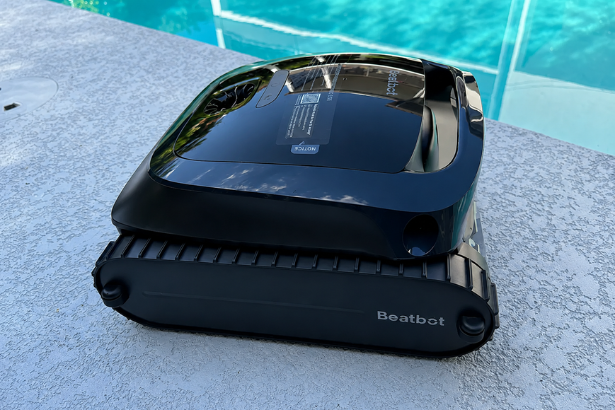
Best Overall: Beatbot AquaSense 2 Ultra
If money is not the primary constraint, the Beatbot AquaSense 2 Ultra is the most complete option in the current field.
WIRED’s testing gave it the top overall position after four years of testing robotic pool cleaners and hundreds of individual test runs. The publication praised its ability to clean floors, walls and waterlines, along with surface-skimming capability, AI debris detection, app control and roughly six hours of underwater battery life in its testing.
The latest official specifications are even more ambitious.
Beatbot lists a 13,400-mAh lithium-ion battery, 5-in-1 cleaning across the floor, walls, waterline and surface, AI mapping, automatic poolside parking and a recommended cleaning area of up to 3,875 square feet.
The official price is currently $2,199, although pricing and promotions can change.
The problem is physical as much as financial.
WIRED puts the robot at about 29 pounds. A machine that powerful is not exactly something you casually toss onto the pool deck.
Best for: Large or complicated pools, hands-off maintenance and buyers willing to pay for the most capable feature set.
Best Battery Life: iGarden M1-AI 90
For homeowners who would rather leave a robot in the pool for days than constantly pull it out and recharge it, the iGarden M1-AI 90 takes a different approach.
Its 12,500-mAh battery provides up to nine hours of floor-mode operation, according to iGarden. The company also gives it AI-assisted debris targeting, a camera system and scheduling features designed for extended maintenance cycles.
WIRED highlighted the same basic advantage. The publication found that the M1-AI 90 can run for long periods and potentially remain in a pool for a week or more between cleanouts, depending on the cleaning schedule.
The current official price is $1,399, down from a listed $2,199.
That makes it significantly less expensive than the AquaSense 2 Ultra while offering a compelling battery advantage.
Best for: Large pools, frequent cleaning and owners who value long autonomous runtimes.
Best Budget Pick: Dreame Z1 Pro
The Dreame Z1 Pro is where the economics become much more interesting.
WIRED selected it as its budget recommendation, noting that it combines onboard sensors, pool mapping and app control while avoiding some of the compromises normally associated with inexpensive robotic cleaners.
The robot is slower than more expensive competitors, and its cleaning performance is not as comprehensive as the premium models. But for casual cleaning, particularly in smaller pools, those limitations may not matter much.
Its magnetic charging system is another practical advantage because it eliminates the need for a conventional exposed charging connection. WIRED also highlighted the included remote control, which can bring the robot back to the surface when it is time to retrieve it.
The current price cited by WIRED is around $499, although retail pricing can change.
Best for: Smaller pools, casual maintenance and shoppers who want smart features without spending thousands.
Best for a More Moderate Budget: Beatbot AquaSense 2
There is a middle ground between the flagship AquaSense 2 Ultra and budget cleaners.
The Beatbot AquaSense 2 strips away some of the premium features but retains the basics that make cordless robots attractive.
WIRED says it can clean floors, walls and waterlines, automatically return toward the pool deck and charge wirelessly. Its 10,000-mAh battery provides roughly four hours of operation.
Beatbot currently lists the AquaSense 2 at $799 on its U.S. website.
For many pool owners, that may be the more sensible purchase than spending more for AI features they may never use.
Best Surface Skimmer: Beatbot iSkim Ultra
There is one important distinction in the robotic pool market: cleaning underwater is not the same as cleaning the surface.
Leaves, pollen and other debris can sit on top of the water long before they reach a conventional pool filter.
That is where the Beatbot iSkim Ultra comes in.
WIRED found it more capable than most robotic skimmers because its sensors help it detect pool walls rather than repeatedly crashing into them. It is solar powered and designed to stay on the surface rather than diving underwater.
Beatbot’s current specifications list a 24-watt solar panel, a 10,000-mAh battery and up to 28 hours of runtime. The company also lists a 9-liter debris basket.
The official price is currently $499 for the newer iSkim configuration, though retailer pricing may differ.
Best for: Pools surrounded by trees, heavy surface debris and owners whose existing skimmer struggles with floating leaves.
Other Robots Worth Considering
The market is getting crowded.
WIRED’s current testing also includes models such as the Beatbot Sora 10, Sora 30, AquaSense 2 Pro and AquaSense X, along with the Bublue Vortex V5, Mammotion Spino E1, Aiper Scuba V3, iGarden Pool Cleaner K Pro, Wybot S2 and Polaris VRX iQ+.
The AquaSense 2 Pro is particularly interesting for large pools because it adds a larger battery and a surface-cleaning mode while sitting below the Ultra in the lineup. WIRED lists five hours of floor-cleaning operation and up to 11 hours of surface-skimming operation for the Pro.
Beatbot’s newer AquaSense X goes in an even more automated direction, pairing the robot with a 42-pound base station for charging and debris handling.
The category is clearly moving toward something bigger than a robotic vacuum.
It is becoming an autonomous pool-maintenance system.
Expert Insights or Analysis
The biggest change in this market is not simply that robots are getting better.
It is that they are becoming less dependent on the homeowner.
AI matters most when the pool is complicated
Marketing around AI can be vague, but navigation is one area where smarter software has a practical purpose.
A rectangular pool with a flat bottom is relatively easy to clean.
A pool with steps, tanning ledges, slopes, curved walls and multiple depths is a different problem.
Beatbot’s latest system uses an AI camera alongside infrared and ultrasonic sensors to build a map and adapt its path. The company says it can identify platforms and optimize cleaning paths around complex pool shapes.
That does not mean every pool owner needs AI.
It means the value of smarter navigation rises as the geometry of the pool becomes more complicated.
Battery capacity may matter more than AI
For some homeowners, however, the killer feature is simply runtime.
A robot that can run for nine hours may be more useful than one that has sophisticated object recognition if the owner wants to automate cleaning over several days.
The iGarden M1-AI 90 illustrates this philosophy. Its 12,500-mAh battery and AI timer are designed around longer maintenance cycles.
That suggests a useful buying rule:
Buy the automation you will actually use, not the technology that looks best on the specification sheet.
Pool size changes the equation
A small pool does not necessarily need a $2,000 machine.
A compact backyard pool can often be maintained by a simpler robot with a shorter battery life.
Large pools are different.
The robot needs enough battery capacity to finish a cleaning cycle, sufficient filter capacity to avoid constant emptying and navigation good enough to cover the entire floor and wall system.
That is why premium machines become easier to justify as pool size increases.
Broader Implications
The smart-home robot market is moving outside the house
Robot vacuums conquered indoor floors.
Robot lawn mowers are moving into yards.
Pool cleaners are now following the same trajectory.
The technology is increasingly built around autonomy rather than simple mechanization.
A modern robot does not just move.
It maps.
It detects.
It schedules.
It communicates with a phone.
And in some cases, it knows when and where it missed debris.
That is a familiar pattern across the smart-home industry.
Pool maintenance could become an autonomous stack
The more interesting future is not one robot doing everything.
It could be multiple specialized devices working together.
One robot handles submerged surfaces.
Another skims floating debris.
A separate system monitors water chemistry.
A smart pump manages circulation.
An app becomes the control layer.
Beatbot’s current lineup already hints at this direction, with underwater cleaning and dedicated surface-skimming products operating as complementary systems.
That is potentially more useful than trying to build one machine that does every task badly.
The economics are still complicated
A robotic cleaner is not automatically cheaper than hiring a pool service.
The purchase price can reach several thousand dollars, and premium robots contain batteries, motors, sensors, filters and electronics that eventually need maintenance or replacement.
The real value proposition is convenience.
If the alternative is repeatedly cleaning the pool yourself, a robot can buy back hours of time.
If the alternative is a reliable pool service that already handles chemicals, filters and repairs, the calculation becomes more complicated.
A robot can clean.
It cannot replace every part of pool ownership.
For more smart-home coverage, The Tech Marketer’s technology section can provide an internal destination for related automation stories.
Related History or Comparable Technologies
The evolution of robotic pool cleaners closely resembles the evolution of robot vacuums.
Early robot vacuums were relatively simple machines that moved around a room, bumped into furniture and gradually covered the floor.
Today’s premium models use cameras, lidar, maps and software to create much more predictable cleaning patterns.
Pool robots are now making the same transition.
The difference is the environment.
Underwater navigation is harder because GPS does not work normally, visibility can be poor and the robot has to deal with changing surfaces, walls, slopes and water resistance.
That makes navigation technology especially important.
The old pool cleaner was essentially a mechanical appliance.
The new generation is increasingly a small autonomous vehicle.
What Happens Next
AI navigation will become more common
Computer vision and sensor fusion are already appearing in premium pool robots.
As those technologies become cheaper, expect them to migrate down the price range.
The distinction between “smart” and “basic” cleaners will probably become less important.
Battery life will keep improving
The iGarden M1-AI 90 already reaches nine hours of floor-mode operation, while other products are pushing longer surface-cleaning runtimes.
Longer runtimes make a different ownership model possible.
Instead of putting a robot away after every cleaning cycle, owners can leave it deployed for longer periods and let scheduling software decide when it works.
Self-maintenance is the next frontier
The biggest remaining inconvenience is often not cleaning the pool.
It is cleaning the cleaner.
Someone still needs to empty the filter basket, rinse the robot and recharge it.
Beatbot’s AquaSense X is notable because it pairs a cleaning robot with a base station designed to automate charging and debris handling.
That could be an important direction for the entire category.
The ultimate pool robot will not simply clean the pool.
It will clean itself.
Pool robots will become part of broader home automation
The next generation of pool systems could connect water chemistry, pumps, filtration, weather forecasts and cleaning robots into a single automated workflow.
That would turn pool maintenance from a collection of individual chores into a coordinated system.
The technology is not quite there yet.
But the pieces are beginning to appear.
Conclusion
The best pool cleaning robots are becoming less like glorified underwater vacuums and more like autonomous machines.
The Beatbot AquaSense 2 Ultra currently stands out as the most comprehensive option in WIRED’s testing, combining floor, wall, waterline and surface cleaning with AI-assisted navigation and automatic retrieval.
The iGarden M1-AI 90 makes a stronger case for battery endurance, while the Dreame Z1 Pro brings mapping and smart features into a much lower price category.
And for pools constantly covered in leaves, a dedicated robotic skimmer may be more useful than another underwater cleaner.
The important thing is not to buy the robot with the longest feature list.
Buy the one that matches the pool.
For a small, uncomplicated pool, a budget cleaner can make more sense. For a large pool with steps and multiple levels, better navigation and battery life become more valuable. And if surface debris is the main headache, buy for that problem specifically.
The pool-cleaning robot market is still evolving.
But one thing is already clear.
The days of dragging a long hose around the pool are starting to look increasingly old-fashioned.
FAQ
What are the best pool cleaning robots in 2026?
WIRED’s current testing places the Beatbot AquaSense 2 Ultra at the top overall, while the iGarden M1-AI 90 stands out for battery life and the Dreame Z1 Pro for value.
Are cordless pool cleaning robots better than corded models?
For most pool owners, cordless models are more convenient because they eliminate long power cables and are easier to deploy. Corded cleaners can still make sense for very large pools that require near-continuous cleaning.
How long do robotic pool cleaners run?
Battery life varies considerably. The iGarden M1-AI 90 is rated for up to nine hours of floor-mode operation, while Beatbot’s AquaSense 2 Ultra is rated for up to five hours of floor cleaning in its current specifications.
Can robotic pool cleaners clean walls?
Yes. Many modern cordless robots can clean floors, walls and waterlines. Premium models increasingly use sensors and specialized navigation to handle steps, slopes and pool ledges.
Do pool-cleaning robots replace a pool service?
Not necessarily. A robotic cleaner can automate physical debris removal, but pool owners may still need to manage chemicals, water chemistry, filters and other equipment.
Are AI pool cleaners worth the extra money?
It depends on the pool. AI-assisted navigation is most useful for complex pools with multiple levels, curves, steps and difficult areas. A simple pool may not benefit enough to justify the premium.
What is the difference between a pool robot and a robotic skimmer?
A pool robot generally works underwater and cleans the floor, walls or waterline. A robotic skimmer stays on the surface and collects floating debris such as leaves and pollen.
How should I choose a robotic pool cleaner?
Start with pool size and shape. Then consider floor and wall coverage, battery life, filter capacity, retrieval method, app features and whether you need surface skimming. Price should come after those requirements.
Sources & References
- WIRED: The Best Robotic Pool Cleaners of 2026: Beatbot, iGarden, Dreame. The primary source reviewed for product testing, rankings and methodology. Read the WIRED buying guide
- Beatbot: AquaSense 2 Ultra AI Robotic Pool Cleaner. Official specifications, features, pricing and warranty information. View the official Beatbot product page
- iGarden: Robotic Pool Cleaner M1-AI 90. Official battery, runtime, navigation and pricing information. View the official iGarden product page
- iGarden: Dual-Vision AI Robotic Pool Cleaner. Product technology and technical specifications. View iGarden’s M1-AI technology page