Introduction
The BD $19 billion manufacturing commitment announced October 6 is one of the clearest examples yet of how U.S. trade policy is being used to encourage domestic industrial investment. Becton, Dickinson and Company, widely known as BD, said it plans to invest $19 billion in the United States over several years, including $3 billion specifically for expanding U.S. manufacturing capacity. BD Newsroom
The agreement focuses on products that rarely attract attention until hospitals face shortages: needles, syringes, IV catheter systems and other essential medical consumables.
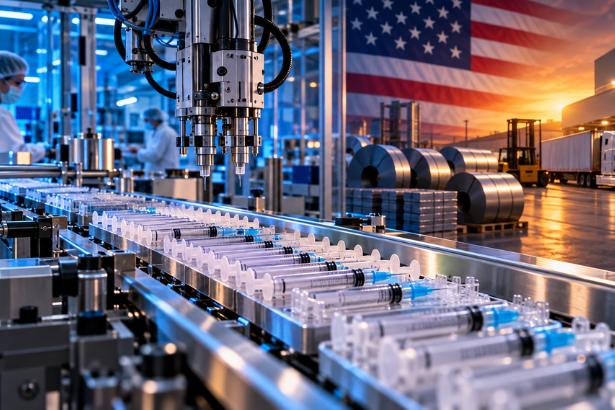
Under the plan, BD expects to add approximately 5 billion essential medical consumables to its annual U.S. production capacity, bringing its share of domestically supplied essential medical consumables to roughly 80%. BD also plans to manufacture all needles used in the United States domestically using American-made steel. Becton, Dickinson and Company
The investment is also tied to future tariff policy. BD says the agreement provides relief from future Section 232 tariffs on covered products and inputs, subject to the final scope and implementation of those measures and the company’s achievement of agreed milestones. BD Newsroom
That makes the announcement more than a factory-expansion story. It is a test of whether tariffs and targeted government agreements can change where critical manufacturing capacity is built.
Background and Context
BD is one of the largest medical technology companies in the United States and has operated for nearly 130 years.
Its products span syringes, needles, infusion systems, catheters and other medical technologies used throughout healthcare. BD says its essential medical consumables are used in approximately 90% of U.S. hospital visits. Becton, Dickinson and Company
The company already maintains a substantial U.S. manufacturing footprint.
Its facilities include production sites in Nebraska, Connecticut, Georgia, Puerto Rico, South Carolina, Texas and Utah. Manufacturing Dive
That is important because the latest announcement is not about creating a U.S. manufacturing operation from scratch.
It is about expanding an existing network.
The company had already announced a $2.5 billion U.S. manufacturing investment over five years earlier in 2026, including $110 million for a Nebraska facility producing prefillable syringes and cannulas. The Washington Post
BD has also made previous investments in U.S. needle, syringe and IV production.
The new $19 billion figure therefore represents a much broader commitment encompassing capital investment, operational improvements and supply-chain initiatives.
Latest Update or News Breakdown
BD is committing $19 billion to U.S. operations
The headline figure is straightforward: BD intends to invest $19 billion in the United States over several years.
But only a portion of that figure is specifically identified as manufacturing expansion.
BD says $3 billion will go toward expanding strategic U.S. manufacturing sites. The broader $19 billion commitment includes capital, operational and supply-chain investments. BD Newsroom
That distinction matters.
The announcement should not be interpreted as $19 billion of new factory construction.
Instead, the company is committing a much larger pool of investment across its U.S. operations, with $3 billion earmarked directly for manufacturing expansion.
Read BD’s official announcement
Five billion more medical consumables every year
The manufacturing target is particularly significant.
BD expects the expanded facilities and production capabilities to add approximately 5 billion essential medical consumables annually to its U.S. production capacity. That would bring roughly 80% of the company’s domestically supplied essential medical consumables under U.S. production. Becton, Dickinson and Company
The products include items such as:
- Needles
- Syringes
- IV catheter systems
- Other essential disposable medical supplies
These products are relatively inexpensive individually, but they are used at enormous scale.
That creates an unusual supply-chain vulnerability.
A shortage of a high-value medical device may affect a specific procedure. A shortage of something as basic as syringes or needles can affect routine healthcare across an entire hospital system.
BD will make U.S.-used needles domestically
One of the most specific commitments involves needles.
BD says it will manufacture 100% of the needles it uses in the United States domestically and use American-made steel in their production. BD Newsroom
This is a particularly direct example of verticalizing a critical supply chain.
Instead of simply assembling a finished product domestically while relying on imported inputs, the company is committing to domestic production and a U.S.-sourced material for the needle component.
That is precisely the kind of supply-chain localization policymakers have been encouraging.
The tariff agreement changes the economics
The other major part of the announcement is the relationship between investment and tariffs.
BD says its agreement provides relief from future Section 232 tariffs on covered products and inputs, provided the company meets agreed milestones. Becton, Dickinson and Company
Section 232 is a U.S. trade mechanism that allows tariffs or other restrictions when imports are determined to threaten national security.
The medical-device industry has already been under scrutiny as the administration considers additional trade measures.
The Washington Post reported that BD’s agreement provides relief from future medical-device tariffs covered by the arrangement, provided the company meets the specified targets. The Washington Post
There is an important caveat.
BD said it cannot yet quantify the financial impact of the agreement because the final tariff rates, product scope and effective timing have not been determined. Becton, Dickinson and Company
So the tariff savings are not yet a fixed dollar amount.
Expert Insights or Analysis
The most interesting aspect of the BD deal is not the size of the investment alone.
It is the mechanism.
The traditional argument for reshoring is that companies will build domestically when supply-chain security, labor availability, automation and market demand make U.S. production economically attractive.
The BD agreement introduces another variable: tariff certainty.
A company deciding where to build a factory has to forecast costs years into the future.
If imported products could face substantially higher tariffs, the economics of overseas manufacturing become less predictable.
A tariff-relief agreement can potentially change that calculation.
BD itself said the arrangement provides greater long-term certainty for manufacturing and supply-chain planning. BD Newsroom
That does not mean tariffs automatically make U.S. manufacturing cheaper.
Domestic production can carry higher labor, energy, construction and regulatory costs than production in lower-cost manufacturing regions.
Instead, the policy is changing the relative risk of the two options.
Why medical consumables are different
Medical consumables have an unusual strategic profile.
They are:
High volume. Hospitals consume enormous quantities.
Low unit value. Individual products can be inexpensive compared with sophisticated medical equipment.
Operationally critical. A shortage can disrupt routine healthcare.
Difficult to substitute quickly. Hospitals cannot necessarily switch suppliers overnight.
Highly regulated. Manufacturing changes must meet strict quality and safety requirements.
That combination makes supply-chain resilience particularly important.
The COVID-19 pandemic demonstrated what happens when global disruptions collide with healthcare demand. BD’s current expansion is not simply about avoiding another pandemic-era shortage, but the experience clearly reinforced the strategic importance of domestic capacity.
Broader Implications
The BD $19 billion manufacturing agreement could become a template for other industries where policymakers consider certain products strategically important.
The logic is relatively straightforward:
Government identifies a supply-chain vulnerability → companies commit to domestic investment → policy provides greater certainty or tariff relief → domestic capacity expands.
Whether that model becomes widespread remains uncertain.
But the BD agreement provides a concrete example of how the pieces can fit together.
Reshoring is becoming more targeted
The U.S. manufacturing debate is increasingly moving away from the idea that every product must be made domestically.
Instead, policymakers and companies are focusing on categories where supply disruption could have disproportionate consequences.
Medical supplies are an obvious example.
Semiconductors, batteries, pharmaceuticals, critical minerals, aerospace components and defense products are other areas where domestic capacity can have strategic importance.
Supply chains may become more regional
For manufacturers, the question is increasingly about diversification rather than simply finding the lowest-cost supplier.
A company might previously have optimized its supply chain primarily around unit cost.
Now it also has to consider:
- Tariffs
- Geopolitical risk
- Shipping disruption
- Supplier concentration
- Inventory requirements
- Domestic production incentives
- Regulatory exposure
- Time to recover from disruption
That creates a more complicated manufacturing equation.
For more coverage of manufacturing, technology and industrial supply chains, visit The Tech Marketer.
Automation will be crucial
There is another issue hiding behind the reshoring narrative: labor.
Building more factories in the United States does not necessarily mean creating traditional factory employment at the same scale seen in previous industrial eras.
Modern medical manufacturing increasingly relies on automation, robotics, machine vision and highly controlled production environments.
For BD, expanding domestic capacity will therefore involve not only physical factories but also advanced production systems.
That could make U.S. manufacturing more competitive without requiring a return to labor-intensive production models.
Related History or Comparable Technologies
BD’s announcement fits into a much broader wave of U.S. industrial investment.
Healthcare manufacturing has already been moving toward greater domestic capacity following pandemic-era supply disruptions.
The Washington Post reported that BD had announced previous investments in U.S. production, including the Nebraska syringe project, while additional investments were made in needle, syringe and IV production during 2024 and 2025. The Washington Post
The new agreement is therefore better understood as an acceleration of an existing trend.
Pharmaceuticals
Drugmakers have also been announcing large U.S. investment commitments tied to trade and policy discussions.
The difference is that BD’s focus is medical devices and consumables rather than pharmaceuticals.
Semiconductors
The semiconductor industry offers another comparison.
Chip manufacturers have invested heavily in U.S. facilities because governments view semiconductor capacity as strategically important.
The underlying principle is similar: the cheapest global supply chain is not necessarily the most resilient supply chain.
Medical device manufacturing
Medical devices add another layer because shortages can directly affect patient care.
A supply chain that fails to deliver syringes, needles or IV components is not merely experiencing a commercial disruption.
It can become a healthcare-system problem.
What Happens Next
The next phase of the BD agreement will be closely tied to implementation.
1. BD must execute the investment
The $19 billion figure is a multi-year commitment.
The key measure will therefore be actual spending, factory expansion and production capacity rather than the headline announcement alone.
2. Manufacturing capacity will need to come online
BD says it intends to increase domestic production by approximately 5 billion essential medical consumables annually.
The timing of those capacity increases will determine how quickly the supply-chain impact becomes visible.
3. Section 232 tariffs remain an important variable
The precise financial value of tariff relief is not yet known.
BD has said final tariff rates, product scope and timing have not been determined. Becton, Dickinson and Company
That means investors and competitors will have to wait for additional details before calculating the full economics of the arrangement.
4. Other manufacturers may respond
This could be the most consequential part of the story.
If BD’s investment demonstrates that tariff relief and domestic manufacturing incentives can produce attractive long-term economics, other medical-device manufacturers may consider similar arrangements.
That could accelerate investment in U.S. production.
5. Supply-chain resilience will become a measurable business goal
Manufacturers are increasingly likely to measure resilience alongside cost.
That means asking not only:
“How cheaply can we produce this component?”
but also:
“How quickly can we recover if our overseas supplier stops shipping?”
That change in thinking could influence factory locations, supplier contracts and inventory strategies for years.
Conclusion
The BD $19 billion manufacturing announcement is significant because it connects three forces that are reshaping American industry: domestic manufacturing, supply-chain resilience and tariff policy.
BD plans to invest $19 billion in the United States over several years, including $3 billion for manufacturing expansion. It expects the program to add approximately 5 billion essential medical consumables to annual U.S. production capacity and lift its domestically supplied share to roughly 80%. BD Newsroom
The company will also make all BD needles used in the United States domestically with American-made steel.
But the bigger story is the policy structure surrounding the investment.
BD receives relief from future Section 232 tariffs on covered products and inputs, subject to agreed milestones and the final details of those tariffs. Becton, Dickinson and Company
That creates a new model for reshoring: government policy provides an economic incentive, while manufacturers provide domestic capacity.
Whether the model becomes widespread will depend on execution, costs and the final shape of U.S. trade policy.
For now, BD has provided one of the clearest examples of what the next generation of American manufacturing could look like: more domestic production, more resilient healthcare supply chains and increasingly strategic decisions about where critical products are made.
FAQ
1. What is BD’s $19 billion manufacturing investment?
BD plans to invest $19 billion in U.S. operations over several years, including $3 billion specifically for expanding domestic manufacturing. The broader investment also includes operational and supply-chain spending. Becton, Dickinson and Company
2. How much of BD’s investment will go directly to manufacturing?
BD says $3 billion of the $19 billion commitment will be directed toward expanding strategic U.S. manufacturing sites. BD Newsroom
3. What will BD manufacture in the United States?
The company plans to increase domestic production of essential medical consumables, including products such as syringes and IV catheter systems. BD also plans to manufacture all needles used in the United States domestically using American-made steel. Becton, Dickinson and Company
4. How many additional medical products will BD produce domestically?
BD expects to expand end-to-end U.S. production by approximately 5 billion essential medical consumables annually, which would bring its share of domestically supplied essential medical consumables to about 80%. Becton, Dickinson and Company
5. Why is BD expanding U.S. manufacturing?
The investment is designed to expand domestic manufacturing and strengthen the resilience of the U.S. healthcare supply chain. The agreement also provides relief from future Section 232 tariffs on covered products and inputs, subject to milestones and final tariff details. BD Newsroom
6. What are Section 232 tariffs?
Section 232 is a U.S. trade authority that allows the government to impose measures on imports when they are determined to threaten national security. In BD’s agreement, tariff relief applies to covered products and inputs subject to the terms of the deal.
7. Will BD’s $19 billion investment create new U.S. jobs?
The announcement describes major manufacturing expansion but does not provide a specific total number of new jobs associated with the full $19 billion commitment. The company has previously announced individual U.S. projects with specific employment expectations, but those should not be added together as a forecast for this new agreement.
8. Could other manufacturers follow BD?
Potentially. The agreement provides a notable example of domestic manufacturing investment being linked to trade-policy treatment. Whether other companies pursue similar arrangements will depend on their production economics, tariff exposure, supply-chain requirements and the final implementation of U.S. trade policy.
Sources & References
- BD, “BD and U.S. Government Launch Landmark Partnership to Expand U.S. Manufacturing and Strengthen America’s Healthcare Resilience,” October 6, 2026.
Read the official BD announcement - Reuters, “Becton Dickinson pledges $19 billion US investment in deal with government,” October 6, 2026.
Read the Reuters report - Manufacturing Dive, “BD strikes supply chain pact with Trump administration,” October 6, 2026.
Read Manufacturing Dive’s report - The Washington Post, “Health Brief: Medical devices join Trump’s tariff bargain,” October 6, 2026.
Read The Washington Post analysis - Fierce Pharma, “BD commits $19B amid US onshoring push, with $3B earmarked for manufacturing growth,” October 6, 2026.
Read Fierce Pharma’s coverage