

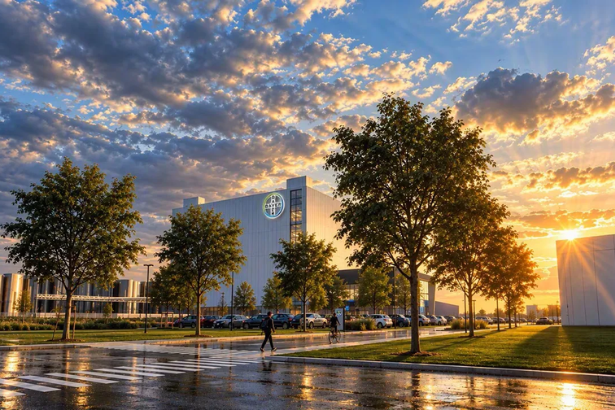
Bayer is putting $2.2 billion into a new pharmaceutical manufacturing campus in New Albany, Ohio. The project will create about 600 permanent high-value jobs, roughly 1,500 construction jobs and a new production hub designed around digital manufacturing and automation.
Introduction
The Bayer Ohio manufacturing plant is one of the largest recent pharmaceutical manufacturing investments in the state, with Bayer committing $2.2 billion to build a new facility in New Albany.
Announced on October 2, the project is expected to create around 600 high-value permanent jobs and approximately 1,500 construction jobs. Bayer says the investment builds on more than $7 billion in U.S. pharmaceutical research, development and manufacturing spending over the previous five years. Bayer Global
The project is bigger than a new factory.
Bayer is designing the site as a flexible, modular manufacturing campus using advanced digital and automation technologies. The facility is expected to produce medicines and drug substances for areas including oncology, cardiovascular disease and renal care. City of New Albany
For the U.S. pharmaceutical industry, the investment arrives at a moment when manufacturers are putting greater emphasis on domestic production, resilient supply chains and proximity to major healthcare markets.
Background and Context
Pharmaceutical manufacturing is unusually dependent on complex international supply chains.
Drug companies source active pharmaceutical ingredients, chemical inputs, specialized equipment and other materials from multiple countries before products eventually reach patients.
That makes manufacturing location strategically important.
Bayer has described the United States as both a major pharmaceutical market and an important manufacturing and innovation base. The company says the new Ohio campus is part of a longer-term effort to expand its U.S. pharmaceutical business rather than simply a one-off factory project. Bayer Global
The location is also significant.
New Albany is part of the Columbus-area life sciences and advanced manufacturing ecosystem. The city says the surrounding region has developed capabilities spanning research and development, logistics, production and manufacturing. City of New Albany
That ecosystem is one reason the Bayer project matters beyond the walls of the facility itself.
A pharmaceutical plant needs more than buildings.
It needs engineers, laboratory specialists, manufacturing technicians, quality professionals, automation experts, logistics providers and a workforce capable of operating highly regulated production systems.
Latest Update: Bayer Commits $2.2 Billion to Ohio
Bayer announced the investment on October 2, 2026, selecting New Albany International Business Park for the new pharmaceutical manufacturing site. Bayer Global
Read Bayer’s official announcement
The company expects the campus to create approximately 600 high-value jobs once operational, while construction is expected to generate about 1,500 jobs. Bayer Global
The project will be built in stages.
Reporting from The Wall Street Journal and Fierce Pharma indicates that the first module, focused on drug-substance manufacturing, is planned for 2031, while a second module for finished drug products is planned for 2034. The Wall Street Journal
That phased approach is important.
Rather than building one enormous facility and waiting years for every component to become operational, Bayer is planning a modular campus that can expand production capabilities over time.
What will the Ohio facility manufacture?
Bayer says the site will support its pharmaceutical portfolio, with the facility designed to serve patients in the United States and globally. Bayer Global
The project is expected to support manufacturing connected to:
- Oncology
- Cardiovascular care
- Renal care
- Small-molecule pharmaceuticals
- Drug substances
- Finished pharmaceutical products
Manufacturing Dive reports that the site will use advanced digital and automation technologies and describes the first phase as targeting completion in 2031. Manufacturing Dive
This makes the project as much about manufacturing technology as physical capacity.
Why New Albany, Ohio?
The choice of Ohio was not simply about available land.
Bayer and local officials highlighted the region’s workforce, research infrastructure and life sciences ecosystem.
The City of New Albany says the project will join an existing cluster that includes companies such as Amgen, Hims & Hers, American Regent and Pharmavite. City of New Albany
The region also sits close to several major research universities.
That creates a potential pipeline between higher education, pharmaceutical research and manufacturing employment.
Ohio Capital Journal reports that Bayer’s new plant is expected to be near seven major research universities, while a state-supported life sciences training center in New Albany is being developed to prepare workers for pharmaceutical biomanufacturing careers. Ohio Capital Journal
This is increasingly important for advanced manufacturing.
Modern pharmaceutical factories do not simply need traditional production-line workers. They need people who can operate automated equipment, manage digital manufacturing systems, maintain highly controlled environments and work within strict quality and regulatory frameworks.
Expert Insights and Analysis
The most interesting part of the Bayer Ohio manufacturing plant is its combination of capital investment, automation and workforce development.
A $2.2 billion factory is expensive to build, but the economics of pharmaceutical manufacturing are not determined only by construction costs.
Companies also have to consider reliability, transportation, access to skilled workers, regulatory requirements and proximity to customers.
Bayer says the new site will strengthen its ability to manufacture medicines in the United States while supporting its broader pharmaceutical strategy. Bayer Global
Reuters describes the investment as part of Bayer’s effort to expand its U.S. pharmaceutical footprint and production capabilities. Reuters
There is also a competitive backdrop.
The U.S. remains the world’s largest pharmaceutical market, making domestic production strategically attractive for global drugmakers.
At the same time, companies are increasingly evaluating how much manufacturing capacity they want physically located near major markets.
The Ohio project fits into that larger calculation.
The automation angle
Bayer and New Albany officials specifically describe the planned campus as incorporating advanced digital and automation technologies. City of New Albany
That matters because the future pharmaceutical factory is increasingly software-defined.
Manufacturing systems can monitor equipment, track production parameters, detect deviations and generate enormous quantities of quality data.
Automation can also make facilities more flexible.
A modular plant can potentially be configured to handle different production requirements without rebuilding the entire operation.
The result is a factory designed less like a traditional industrial building and more like a highly controlled digital production system.
Broader Implications
The Bayer project has implications for three areas: U.S. manufacturing, pharmaceutical supply chains and regional economic development.
1. U.S. pharmaceutical production
The investment adds substantial pharmaceutical manufacturing capacity inside the United States.
Bayer says the project builds on more than $7 billion in U.S. pharmaceutical R&D and manufacturing expenditure over the past five years. Bayer Global
That suggests the Ohio facility is part of a broader U.S. commitment rather than an isolated investment.
2. Pharmaceutical supply-chain resilience
The COVID-19 pandemic exposed vulnerabilities in global medical supply chains.
Drug shortages can have consequences far beyond delayed shipments. Hospitals and pharmacies need predictable access to essential medicines, and manufacturers need reliable supplies of ingredients and production inputs.
A new domestic production site does not eliminate global supply-chain exposure.
It can, however, add another layer of manufacturing capacity within the U.S.
New Albany officials specifically describe the project as strengthening the reliability of America’s medicine supply. City of New Albany
3. Ohio’s manufacturing economy
The employment numbers are significant.
The project is expected to create about 600 permanent high-value jobs and approximately 1,500 construction jobs. Bayer Global
But the potential economic impact does not stop with direct employment.
Large pharmaceutical facilities can generate demand for contractors, maintenance providers, laboratory services, logistics companies, equipment suppliers and specialized professional services.
That creates a wider manufacturing ecosystem around the primary facility.
4. Manufacturing is becoming more regional
The project also illustrates a broader shift toward locating manufacturing close to important research institutions and customer markets.
The old model of manufacturing could prioritize low production costs above almost everything else.
The newer model increasingly considers:
- Supply-chain resilience
- Skilled labor
- Automation
- Infrastructure
- Research access
- Transportation
- Market proximity
- Regulatory reliability
The Bayer project brings many of those factors together in one location.
For additional coverage of manufacturing technology, industrial automation and supply-chain transformation, an internal link to The Tech Marketer would fit naturally here.
Related History and Comparable Technologies
Bayer’s Ohio investment arrives during a broader period of major U.S. pharmaceutical and healthcare manufacturing commitments.
The industry is not simply adding conventional factories.
New projects increasingly incorporate automation, digital production systems, modular architecture and advanced quality-control technologies from the beginning.
That approach is different from taking an older factory and gradually automating individual processes.
A new facility can be designed around digital systems from day one.
Manufacturing Dive describes Bayer’s Ohio project as a flexible, modular campus that will incorporate advanced digital and automation technologies. Manufacturing Dive
That could allow the site to evolve as Bayer’s product portfolio changes.
The pharmaceutical industry also has a useful precedent for this approach in biologics manufacturing, where production environments require sophisticated automation, monitoring and quality-control systems.
Bayer already operates a U.S. biologics manufacturing site in Berkeley, California, according to reporting from The Wall Street Journal. The Wall Street Journal
The Ohio facility will add another major piece to Bayer’s U.S. manufacturing footprint, with a focus on small-molecule production.
What Happens Next
The project is still years away from full operation.
The next major milestone is expected to be construction.
Ohio Capital Journal reports that groundbreaking is expected in 2027, with manufacturing planned to begin in 2031. Ohio Capital Journal
That leaves several important stages ahead.
Construction
The first phase will require major construction and specialized infrastructure capable of supporting pharmaceutical production.
Workforce development
The projected 600 permanent positions will require specialized training.
Ohio is simultaneously developing a life sciences training center in New Albany, creating a potential pipeline for future pharmaceutical manufacturing workers. City of New Albany
Automation deployment
The facility’s digital manufacturing and automation systems will need to be installed, validated and integrated into pharmaceutical production processes.
Drug-substance manufacturing
The first planned manufacturing module is expected to begin operations in 2031, according to industry reporting. The Wall Street Journal
Finished-product manufacturing
A second module is planned for 2034, expanding the campus’s production capabilities. The Wall Street Journal
The long timeline is typical of major pharmaceutical manufacturing projects.
Building the structure is only part of the process. Production systems must also be qualified, validated and brought into compliance before medicines can be manufactured at commercial scale.
Conclusion
The Bayer Ohio manufacturing plant is more than a $2.2 billion construction project.
It represents the convergence of several major trends reshaping U.S. manufacturing: pharmaceutical localization, supply-chain resilience, industrial automation, workforce development and strategic investment in domestic production.
Bayer expects the New Albany campus to create around 600 permanent high-value jobs and roughly 1,500 construction jobs. The company also says the project builds on more than $7 billion in U.S. pharmaceutical R&D and manufacturing spending over the previous five years. Bayer Global
The manufacturing campus is expected to be developed in stages, with drug-substance production targeted for 2031 and finished-product manufacturing planned for 2034. The Wall Street Journal
The bigger question is what happens after Bayer.
If more pharmaceutical companies make similar investments in U.S. production, the impact could extend well beyond individual factories. It could reshape where medicines are manufactured, how supply chains are structured and what skills America’s next generation of manufacturing workers needs.
For Ohio, the immediate story is a $2.2 billion investment.
For U.S. manufacturing, it may be another signal that the pharmaceutical factory of the future will be more automated, more digital and more closely integrated with its regional supply chain.
FAQ
What is the Bayer Ohio manufacturing plant?
The Bayer Ohio manufacturing plant is a planned $2.2 billion pharmaceutical manufacturing campus in New Albany, Ohio. Bayer expects the project to create about 600 high-value permanent jobs and approximately 1,500 construction jobs. Bayer Global
How much is Bayer investing in the Ohio manufacturing plant?
Bayer plans to invest $2.2 billion in the New Albany pharmaceutical manufacturing site. The company says the project builds on more than $7 billion in U.S. pharmaceutical R&D and manufacturing spending over the previous five years. Bayer Global
When will Bayer’s Ohio plant start production?
The first manufacturing module is planned to begin production in 2031, with a second module for finished products planned for 2034, according to industry reporting. The Wall Street Journal
How many jobs will the Bayer Ohio plant create?
Bayer expects the project to create approximately 600 permanent high-value jobs. Construction is expected to generate roughly 1,500 jobs. Bayer Global
What medicines will Bayer manufacture in Ohio?
The planned facility is expected to support Bayer’s pharmaceutical portfolio, including medicines associated with oncology, cardiovascular and renal care. City of New Albany
Why did Bayer choose New Albany, Ohio?
Bayer and local officials point to Ohio’s skilled workforce, research ecosystem, infrastructure and existing life sciences cluster. New Albany is also close to major research universities and other pharmaceutical and life sciences companies. City of New Albany
Will the Bayer facility use automation?
Yes. Bayer and New Albany describe the planned campus as incorporating advanced digital and automation technologies. City of New Albany
How does the project affect the U.S. pharmaceutical supply chain?
The new facility will add pharmaceutical production capacity inside the United States. It does not eliminate international supply-chain dependencies, but additional domestic manufacturing can diversify production locations and potentially strengthen supply resilience.
Sources & References
- Bayer, “Bayer to invest 2.2 billion U.S. dollars in a new manufacturing site in the United States”
Read the official Bayer announcement - Reuters, “Bayer to invest $2.2 billion in new U.S. pharma site”
Read Reuters coverage - Manufacturing Dive, “Bayer to invest $2.2B in Ohio pharmaceutical facility”
Read Manufacturing Dive - City of New Albany, “Bayer Announces $2.2B Life Sciences Investment in the New Albany International Business Park”
Read the New Albany announcement - Ohio Capital Journal, “Bayer will build a $2.2 billion pharmaceutical manufacturing plant in central Ohio”
Read Ohio Capital Journal