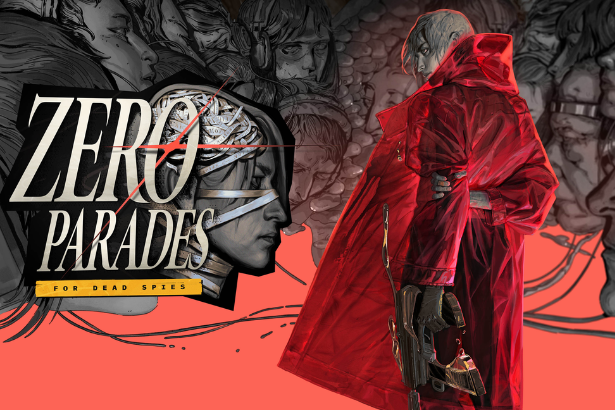
The Zero Parades For Dead Spies review consensus arriving from every major outlet on launch day — May 21, 2026 — lands at roughly the same place: better than it had any right to be, not quite what it could have been, and essential for anyone who cares about where narrative RPGs are going. ZA/UM’s follow-up to Disco Elysium is a spy thriller set in the city of Portofiro, where you play as Hershel “CASCADE” Wilk, a disgraced communist bloc operative on one final desperate mission that immediately goes sideways. It is a game of fatigue, anxiety, and delirium. Of failed skill checks that send your mental state spiraling. Of conspiracies that metastasize the moment you think you understand them. It is, despite everything that happened between Disco Elysium and today, a genuinely great RPG. Here is the full picture.
What Zero Parades For Dead Spies Actually Is
Zero Parades: For Dead Spies is developed and published by ZA/UM. It is the studio’s second game following Disco Elysium, and while it shares many similar concepts in art and gameplay, is neither a sequel nor spiritual successor to Disco Elysium. It released for Windows on May 21, 2026, with a PlayStation 5 version planned later in the year. The player controls Hershel Wilk, a female operative under the code name CASCADE sent to the town of Portofiro on a covert mission. CNN
Zero Parades was inspired primarily by the spy novels of John le Carré, which writer Honey Watson said were more intellectual compared to James Bond, and about a person doing “sneaky, horrible things” as part of their espionage. Additionally, the works of Ursula K. Le Guin and Thomas Pynchon inspired the story. CNN
The John le Carré inspiration is the clearest design signal for anyone who played Disco Elysium. Where Harry DuBois fumbled through a murder investigation with fractured self-awareness and proletarian sympathy, CASCADE navigates a world of deliberate moral compromise — a world where the right thing to do is never available, only the least wrong option. Le Carré’s George Smiley would recognize the terrain immediately.
The Story: Portofiro and the World Behind It
You play as Hershel Wilk (alias: CASCADE), a disgraced spy from the communist bloc whose previous assignment in Portofiro ended in total disaster. Finally redeployed after years in the “Freezer,” her latest mission goes off the rails before she even enters the picture. But when her handler tries to pull the plug, CASCADE decides to press on; more than just staging a comeback, she wants to finally make peace with what happened to those closest to her all those years ago. 9to5Toys
Unlike Disco Elysium’s amnesiac cop Harry DuBois, Hershel still knows who she is. Reality is less easy to grasp, though, and that’s partly because reality is complicated. It’s a messy tangle of international conspiracies, post-industrial fallout, bad faith actors manipulating innocent people, and an ever-widening gap between those who have means and those who don’t. Zero Parades is Disco’s ideological successor and a natural follow-up to that game’s conclusion: that the pursuit of capital and power infects everything, even unions and progressive movements. Zero Parades examines what happens when labor loses the class conflict, when work dries up and the bankers turn your once-thriving urban center into a tourist trap, and when the much-vaunted opportunities of the privileged world turn out to be unavailable for you. It’s the 2000s to Disco Elysium’s 1970s. MacRumors
The thematic extension from Disco Elysium’s politics is the most ambitious thing Zero Parades attempts. Disco asked: what does a man look like when ideology fails him? Zero Parades asks: what does a city look like after ideology has already lost? The answer it provides — Portofiro as a post-industrial tourist trap managed by international bankers — is one of the most credible and depressing settings in recent RPG history.
The Systems: What’s New, What’s Different
Where Harry had morale and health in Disco Elysium, Hershel has fatigue, anxiety, and delusion. These fluctuate based on your choices, circumstances, and certain items you wear or consume. Alcohol has benefits, for example, but increases delusion, while chugging coffee lowers fatigue and spikes anxiety. Alone, these seem inconsequential but conversations can quickly go off the rails and dredge up something from Hershel’s psyche to push her delusion toward dangerous levels. Hershel suffers negative effects once these levels pass certain thresholds and, if they keep rising, loses a skill point in a related area. MacRumors
Zero Parades adds a more punishing twist: three status bars — Fatigue, Anxiety, and Delirium — that give disadvantages if not managed. Thankfully, there’s no ailment a cocktail of cigarettes, coffee, alcohol, and other assorted drugs can’t fix. Slickdeals
The three-bar psychological pressure system is the most meaningful mechanical innovation in Zero Parades. Where Disco Elysium’s skill checks carried consequences primarily in narrative outcomes, Zero Parades’ mental pressure system creates a feedback loop where poor choices degrade your character’s capabilities — which makes subsequent choices harder — which further degrades your mental state. It is a system designed to simulate exactly what a spy running a blown mission would actually feel like: a cascading deterioration of agency that mirrors CASCADE’s own psychological unraveling.
Cold Read seems like it imitates some of Disco Elysium’s observation skills, except getting an accurate read of a stranger often makes a vital difference in how conflicts with them progress. Zero Parades deftly scatters these more action-packed sequences throughout the game without straying too far from its genre roots, and they make good use of another new feature. MacRumors
What the Critics Are Saying
The review consensus for the Zero Parades For Dead Spies review cycle places the game firmly in the “excellent but not transcendent” category.
TechRadar concluded: “Zero Parades: For Dead Spies establishes a strong identity for itself with its deep understanding of human nature and political philosophy, plus plenty of twists on the standard CRPG formula. The story is slow, and some elements don’t quite live up to their potential, but it’s still one of 2026’s essential games.” MacRumors
GameSpot said: “Disco Elysium’s shadow looms large, and while Zero Parades: For Dead Spies stumbles into imitation at times, it’s still an excellent and richly detailed RPG in its own right.” The review noted that the game is “an endlessly captivating narrative that offers myriad ways to maneuver through its fantastic twists and turns. It might not capture the same rarified magic, but it’s well worth venturing into Zero Parades’ clandestine world.” 9to5Toys
The Steam page carries pull quotes from multiple outlets: GamesRadar calls it “a worthy Disco Elysium successor,” IGN calls it “a fascinating RPG,” and Polygon says it is “funny, weird, and full of tabletop RPG depth.” PCWorld
The range from “worthy successor” to “cannot escape imitation” reflects a genuine critical divide that maps to how much a given reviewer weighed the quality of Zero Parades on its own terms versus in comparison to Disco Elysium. Both readings are honest.
Where Zero Parades Stumbles
The criticisms of Zero Parades For Dead Spies are consistent across outlets and worth naming directly.
GameSpot noted: “Your skills form different parts of your mind and will regularly comment on your dialogue choices and the world around you. Unlike in Disco Elysium, however, they don’t feel like defined characters of their own and are largely interchangeable. This is partly due to the game’s writing failing to distinguish among the different parts of Hershel’s psyche, but also because they all share a similar voice.” 9to5Toys
GamesRadar identified the broader structural problem: “As a successor to Disco Elysium, ZA/UM’s spy-fi RPG is a little too fearful to roll the dice on something new. But if the systems and themes are a little too familiar in Zero Parades: For Dead Spies, that does mean some of the old charm persists.” 9to5Toys
The AV Club preview noted that the game’s prose “just doesn’t have the same weight” as Disco Elysium’s, and that the invitation for direct comparison “backfires most notably” in the writing quality. 9to5Toys
The loss of the original writing team — Robert Kurvitz, Helen Hindpere, and the other founding ZA/UM writers who departed after the ownership dispute — is most felt in the game’s internal monologue system. The skill voices in Disco Elysium were not simply functional tools — they were fully realized characters with distinct philosophical stances, vocabularies, and emotional registers. Zero Parades’ skill voices are competent and often interesting. They are not the same.
The ZA/UM Schism: Why It Matters for This Game Specifically
Any Zero Parades For Dead Spies review that ignores the studio’s history is incomplete — not because readers need the drama, but because the game itself insists on the relevance of its own context.
GamesRadar explained the stakes: “ZA/UM notoriously splintered after the release of its debut, in a whirlwind of accusations and lawsuits. This is now one of five potential games, from as many studios, vying for the title of true heir to Disco Elysium’s throne. Zero Parades has the advantage of coming first, and of the right brand name above the door but — check the credits — very few names in common with the previous game. All of this matters more than it might for another studio, another game, because questions of labor and capital were always at the heart of Disco Elysium.” 9to5Toys
The Gamer captured the recursive irony precisely: “I can’t help but feel the writers were being allegorical with Zero Parades: For Dead Spies. There’s perhaps a lack of recognition for those who remain at ZA/UM, talented people who worked on Disco Elysium but avoided the post-release maelstrom. The dead spies given no parades. Zero Parades’ central themes of friendship, betrayal and atonement are as relevant to ZA/UM as they are for our protagonist.” Slickdeals
That reading — the title as self-commentary on the people who stayed, who worked without recognition, whose contributions to both games will never receive the parade afforded to the founders — is the most poignant and honest frame for what Zero Parades For Dead Spies actually is. Not just a video game. A statement about credit, labor, and the institutional memory of creative work.
Broader Implications: What Zero Parades Means for the Future of the Genre
The Zero Parades For Dead Spies review conversation is happening at a moment when the genre it belongs to — the dialogue-first, combat-light, philosophically ambitious CRPG — is more relevant than it has been since Planescape: Torment. ZA/UM was always working in Disco’s shadow, and Zero Parades demonstrates both that the studio can produce excellent work without its founding writers and that the original game’s specific achievement cannot be replicated by institutional continuity alone. 9to5Toys
Four other studios are also developing Disco Elysium successors. Zero Parades ships first. Whatever its limitations relative to its predecessor, it establishes that this kind of game — political, verbose, psychologically punishing, philosophically committed — has a future beyond the specific people who invented it. That is a meaningful achievement, regardless of score. For more on the biggest stories in gaming and culture, visit The Tech Marketer.
Latest Updates
Zero Parades For Dead Spies launched on Windows on May 21, 2026. Here is where to follow the full review coverage:
- The Verge has its full Zero Parades For Dead Spies review covering the Disco Elysium comparison, the political themes, and what ZA/UM’s spy RPG achieves and doesn’t in its attempt to follow one of the greatest games ever made. Read more at The Verge
- TechRadar has the complete review of Zero Parades For Dead Spies, including its verdict as one of 2026’s essential games, the fatigue/anxiety/delusion system breakdown, and the Disco Elysium ideological successor analysis. Read more at TechRadar
- GameSpot has the full Zero Parades For Dead Spies review with character analysis, the skill voice comparison to Disco Elysium, the Portofiro setting deep dive, and a verdict on whether the game earns its 10-hour runtime. Read more at GameSpot
FAQ: Zero Parades For Dead Spies
1. What is Zero Parades For Dead Spies and who made it? Zero Parades: For Dead Spies is a dialogue-first espionage RPG developed and published by ZA/UM, the studio behind Disco Elysium. It released on Windows on May 21, 2026, with a PlayStation 5 version planned for later in the year. You play as Hershel “CASCADE” Wilk, a disgraced communist bloc spy on a final mission in the city of Portofiro.
2. Is Zero Parades For Dead Spies a sequel to Disco Elysium? No. ZA/UM confirmed Zero Parades is neither a sequel nor a spiritual successor to Disco Elysium — it shares no story or setting with the previous game. It is inspired primarily by the spy novels of John le Carré rather than continuing Disco Elysium’s detective fiction. The two games share ZA/UM’s isometric art style and skill-check-based dialogue systems.
3. How does Zero Parades For Dead Spies differ from Disco Elysium mechanically? Zero Parades replaces Disco Elysium’s health and morale system with three psychological pressure bars: Fatigue, Anxiety, and Delirium. These fluctuate based on dialogue choices, actions, and consumables like coffee and alcohol, and create cascading disadvantages if they exceed certain thresholds. The game also introduces Cold Read for NPC analysis and dramatic encounter chains as new systems.
4. Is Zero Parades For Dead Spies as good as Disco Elysium? The critical consensus says it is an excellent RPG that cannot fully match Disco Elysium’s specific achievement. TechRadar calls it “one of 2026’s essential games.” GameSpot and GamesRadar praise its world-building and narrative depth while noting the skill voices lack Disco Elysium’s distinctive character and the prose does not carry the same weight as the original writers’ work.
5. What is the ZA/UM schism and why does it matter for Zero Parades? After Disco Elysium’s release, ZA/UM’s founding creative team — including lead writer Robert Kurvitz — was allegedly pushed out in an ownership dispute. Only approximately 35% of those who worked on Zero Parades contributed to Disco Elysium. Five separate studios founded by former ZA/UM staff are also developing Disco Elysium successors. This context matters because Disco Elysium was explicitly a game about labor, capital, and institutional betrayal — themes Zero Parades continues directly.