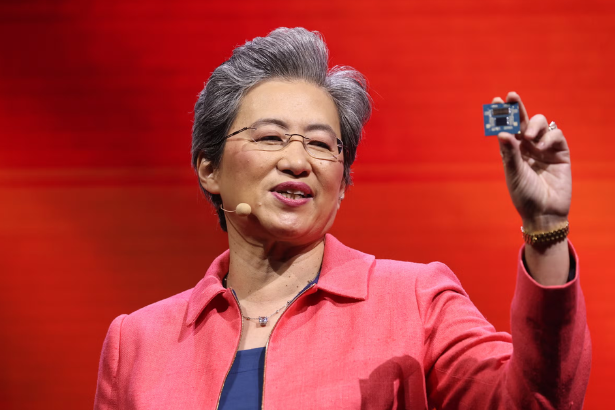
AMD stock 2026 is on a historic run. Advanced Micro Devices (NASDAQ: AMD) has gained more than 100% year-to-date as of mid-May 2026, far outpacing the S&P 500’s roughly 10% return in the same period. Three of Wall Street’s most influential semiconductor analysts have raised their price targets in the past two weeks — Mizuho to $515, Bank of America to $500, and Goldman Sachs in a separate revision. The catalyst is a Q1 2026 earnings report that AMD CEO Lisa Su described as “a clear inflection in our growth trajectory and a structural shift in our business.” Here is everything investors need to know about what AMD reported, what the analysts are saying, and what risks remain.
AMD Q1 2026: The Numbers Behind the “Structural Shift”
AMD reported its Q1 2026 earnings on May 5. Non-GAAP earnings per share grew 43% year over year to $1.37. GAAP net income grew 95% year over year to $1.38 billion. MacRumors
AMD released its results for Q1 2026 with revenues coming at $10.3 billion, gross margin at 53%, operating income at $1.5 billion, and net income at $1.4 billion. Diluted EPS was $0.84. MacRumors
The top-line number of $10.3 billion in quarterly revenue is the largest in AMD’s history and represents a company that has dramatically accelerated its growth rate in a compressed timeframe. The combination of record data center revenue, expanding margins, and tripling free cash flow tells the story of a company that has successfully converted AI infrastructure spending into durable financial results.
Lisa Su said: “Earnings grew more than 40%, and free cash flow more than tripled to a record $2.6 billion, driven by significantly higher sales of EPYC CPUs, Instinct GPUs, and Ryzen processors. These results mark a clear inflection in our growth trajectory and a structural shift in our business.” MacRumors
Data Center: The Engine Driving Everything
The most important segment in AMD’s Q1 2026 report is data center — and the numbers there are extraordinary.
Su said: “Data center revenue increased 57% year-over-year to a record $5.8 billion, led by strong demand for our EPYC CPUs and Instinct GPUs. In server, we delivered our fourth consecutive quarter of record server CPU revenue. Revenue increased more than 50% year-over-year, with sales to both cloud and enterprise customers each growing more than 50%.” MacRumors
Four consecutive quarters of record server CPU revenue means this is not a single-quarter spike driven by one customer’s procurement cycle. It is a sustained trend that has been building across the entirety of 2025 and into 2026. The 50%-plus growth in both cloud and enterprise customers simultaneously is the most bullish detail in the data center segment — it means AMD is not just winning AI hyperscaler business, it is also penetrating the enterprise server CPU market that Intel has historically dominated.
AMD continues to see healthy momentum, with inferencing and agentic AI fueling higher demand for high-performance CPUs and accelerators. MacRumors
Mizuho Raises Price Target to $515: The Agentic AI Thesis
On May 12, Mizuho lifted its price objective on AMD to $515 from $415 and kept an “Outperform” rating on the shares. As per the firm, agentic AI has been fueling server demand. The firm increased the semiconductor estimates after the March quarter earnings season. MacRumors
Mizuho’s $515 target reflects a conviction that the agentic AI infrastructure build-out — AI systems that autonomously complete multi-step tasks and require continuous inference compute — is sustaining server demand growth well beyond what the initial generative AI wave produced. Agentic workloads are more compute-intensive than traditional LLM inference because they involve chains of model calls rather than single queries. Every autonomous AI agent running in production is a continuous drain on data center GPU and CPU capacity.
The $100 price target increase from Mizuho — moving from $415 to $515 — in a single revision reflects both the Q1 upside and a structural upward revision to AMD’s forward revenue estimates for the full year 2026 and into 2027.
Bank of America Raises to $500: The $1.7 Trillion Data Center TAM
In a research note from May 13, Bank of America analyst Vivek Arya and his team raised their 2030 AI data center systems total addressable market outlook to approximately $1.7 trillion from $1.4 trillion. The team also raised their AI accelerator outlook to approximately $1.2 trillion from $1.0 trillion. Analysts raised their data center server CPU outlook to $110 billion from $80 billion, and AI networking outlook to $316 billion from about $240 billion. MacRumors
Arya reiterated a buy rating for AMD stock and raised the target price to $500 from $450, based on a 42x multiple of his 2027 non-GAAP EPS estimate. He believes the price target is justified given the recent increase in CPU industry strength, the July analyst day event (Advancing AI 2026), and AMD’s potential for additional GW data center wins without warrant requirements. MacRumors
The TAM revision from $1.4 trillion to $1.7 trillion for 2030 data center systems is the most important data point in the BofA note. When Bank of America’s top semiconductor analyst raises his estimate of the total market by $300 billion, it signals that he believes AI infrastructure spending is not decelerating — it is accelerating faster than his previous models projected.
Q2 2026 Guidance: $11.2 Billion
The forward guidance AMD provided confirms that Q1 was not a peak — it was a stepping stone.
AMD provided Q2 2026 guidance for revenue of $11.2 billion ± $300 million, and non-GAAP gross margin of approximately 56%. MacRumors
Sequential revenue growth from $10.3 billion in Q1 to $11.2 billion in Q2 represents approximately 9% quarter-over-quarter expansion. At the high end of guidance ($11.5 billion), AMD would be growing its quarterly revenue at a pace that annualizes above $44 billion. For context, AMD’s full-year 2023 revenue was $22.7 billion. The company has roughly doubled its annualized run rate in approximately two years.
What Has Driven the 100%+ YTD Rally
The AMD stock 2026 rally did not happen on a single catalyst — it accumulated across multiple developments throughout the first five months of the year.
Several key news items contributed to the stock’s rally. At the end of February, AMD expanded its partnership with Meta. Bank of America revised its server CPU sales forecasts in April. Intel’s Q1 earnings, reported on April 23, boosted confidence in the semiconductor sector. Following Intel’s earnings, AMD reported its Q1 2026 earnings on May 5, helping sustain the momentum from the ongoing sentiment that the AI boom will drive further growth. MacRumors
The Meta partnership expansion is particularly strategically significant. Meta is one of the world’s largest consumers of AI compute infrastructure. AMD winning deeper penetration into Meta’s AI training and inference infrastructure signals that AMD’s Instinct GPUs are competitive with Nvidia’s offerings for at least some workload types at one of the most demanding customers on the planet.
The Advancing AI 2026 Event: July 22-23
AMD’s flagship global AI event, “Advancing AI 2026,” is set for July 22-23, 2026. MacRumors
The Advancing AI event has historically been where AMD announces its next-generation GPU accelerator roadmap. In the current cycle, the market is watching for any details on the MI400 series — the next generation of Instinct accelerators. Bank of America’s Arya specifically cited the July event as a catalyst for AMD’s price target justification, suggesting he expects product announcements that could expand AMD’s addressable GPU market share.
Downside Risks Every AMD Investor Should Know
Bank of America’s analysts noted these downside risks: execution on the first rack-scale product (MI400 Series); timing and magnitude of Middle East AI projects; the lumpy nature of consumer and enterprise spending, which could create delays in the acceptance and success of new products; high reliance on one outsourced manufacturing partner; and maturity of the current game console cycle. MacRumors
The outsourced manufacturing dependency risk refers to AMD’s reliance on TSMC for its most advanced chip production. Any disruption to TSMC’s manufacturing capacity — geopolitical, natural disaster, or supply chain — would directly impact AMD’s ability to ship its most competitive products.
The Middle East AI projects risk is newer but significant. AMD has won data center contracts in the Gulf region tied to AI investment announced during recent US diplomatic visits. The timing of when those projects translate into shipped hardware and recognized revenue creates potential quarters where results miss expectations.
Broader Implications: AMD’s Place in the AI Semiconductor Race
The AMD stock 2026 story is ultimately a story about the second competitor in the most important market in technology. Nvidia controls approximately 70 to 80 percent of the AI accelerator market through its CUDA ecosystem, customer lock-in, and NVLink interconnect technology. AMD is credibly challenging for the remaining 20 to 30 percent — and in some specific workloads, particularly CPU-intensive agentic AI and EPYC server deployments, it is winning business at Nvidia’s expense.
A company that doubles its free cash flow to $2.6 billion in a single quarter while growing data center revenue 57% year-over-year is not a Nvidia alternative story. It is becoming a Nvidia parallel story — two infrastructure suppliers meeting the same exponential demand from different architectural angles. For more on the biggest stories in technology and investing, visit The Tech Marketer.
Latest Updates
AMD stock 2026 continues to attract major analyst upgrades. Here is where to follow the full story:
- Yahoo Finance via Insider Monkey has the Mizuho price target increase to $515 from $415, the Outperform rating maintenance, and the agentic AI server demand thesis behind the revision alongside AMD’s Q1 2026 financial summary. Read more at Yahoo Finance
- Seeking Alpha has the full deep-dive analysis of why the market may have underpriced what Lisa Su revealed in AMD’s Q1 2026 earnings call, including the “structural shift” interpretation and the Instinct GPU data center trajectory. Read more at Seeking Alpha
- TheStreet has the complete Bank of America research note from analyst Vivek Arya, including the $500 price target raise from $450, the $1.7 trillion 2030 data center TAM revision, and the full breakdown of downside and upside risks for AMD stock. Read more at TheStreet
FAQ: AMD Stock 2026
1. Why has AMD stock gained more than 100% year-to-date in 2026? AMD’s 100%+ YTD gain in 2026 reflects a series of catalysts: the February Meta partnership expansion, Bank of America’s April server CPU forecast revision, Intel’s stronger-than-expected Q1 earnings that boosted sector confidence, and AMD’s own Q1 2026 report showing 57% data center revenue growth to $5.8 billion with GAAP net income up 95%.
2. What did AMD report in Q1 2026 earnings? AMD reported Q1 2026 revenue of $10.3 billion, gross margin of 53%, operating income of $1.5 billion, GAAP net income of $1.4 billion (up 95% year-over-year), non-GAAP EPS of $1.37 (up 43%), and record free cash flow of $2.6 billion. Data center revenue reached a record $5.8 billion, up 57% year-over-year.
3. What are the current analyst price targets for AMD stock in 2026? Mizuho raised its AMD price target to $515 (from $415) on May 12, 2026, with an Outperform rating. Bank of America raised its target to $500 (from $450) on May 13, with a Buy rating. Goldman Sachs separately revised its target following the Q1 earnings report. The consensus reflects broad bullish conviction on AMD’s AI infrastructure positioning.
4. What is AMD’s guidance for Q2 2026? AMD guided for Q2 2026 revenue of approximately $11.2 billion plus or minus $300 million, and non-GAAP gross margin of approximately 56%. This represents sequential growth from Q1’s $10.3 billion revenue and would represent approximately 9% quarter-over-quarter expansion.
5. What are the main risks to AMD stock in 2026? Bank of America’s Vivek Arya identified the following downside risks: execution challenges on the MI400 rack-scale product; timing uncertainty on Middle East AI data center projects; lumpy consumer and enterprise spending patterns; high reliance on TSMC as sole advanced manufacturing partner; and the maturing console game cycle reducing gaming segment revenue contribution.
Sources and References
- Yahoo Finance / Insider Monkey: Mizuho Lifts PT on Advanced Micro Devices (AMD) Stock
- Seeking Alpha: AMD: The Market Mispriced What Lisa Su Just Said
- TheStreet: Bank of America Resets AMD Stock Price Target