


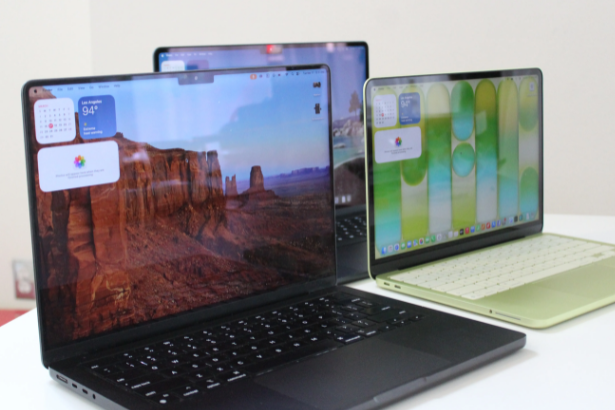
Which MacBook should you buy 2026 is a more interesting question than it has been in years because Apple’s laptop lineup now spans three genuinely distinct tiers rather than just two. The new MacBook Neo, announced March 4 and released March 11, is the first Mac ever powered by an iPhone chip and starts at $699 following a June 25 price increase driven by the global memory shortage. The MacBook Air M5, updated in March 2026 with a starting price of $1,099, remains the best choice for most buyers with its combination of portability, silent fanless operation, and all-day battery. The MacBook Pro M5 and M5 Max, starting at $2,199, exist for professionals who need sustained heavy performance that the Air’s passive cooling cannot maintain. This guide covers the full lineup so you can make the right call.
The 2026 MacBook Lineup at a Glance
Apple now sells three distinct MacBook lines. Here is what each one is, who it is for, and what it costs.
MacBook Neo launched March 11, 2026, at $599 before a $100 price increase on June 25 brought it to $699. Education pricing remains $599. It uses the A18 Pro chip, 8GB of non-upgradable RAM, either 256GB or 512GB of storage, and a 13-inch Liquid Retina display with no notch. Colors: Silver, Blush, Citrus, and Indigo.
MacBook Air M5 launched in March 2026 starting at $1,099 with 16GB of RAM and 512GB of storage in a 13-inch model, with a 15-inch version also available at a higher price. It is Apple’s best-selling laptop and the most popular recommendation for most users.
MacBook Pro M5 and M5 Max starts at $2,199 for the 14-inch model with M5 Pro chip and 1TB of base storage. The 16-inch model and M5 Max configurations carry higher prices. It features active cooling, Thunderbolt 5 ports, HDMI, SDXC card slot, ProMotion 120Hz Liquid Retina XDR display, and up to 128GB of unified memory.
MacBook Neo: The Right Buy for Budget Shoppers and Students
The MacBook Neo is Apple’s most significant product launch in years for one specific reason: it cuts the price of entry into the Mac ecosystem nearly in half compared to the MacBook Air.
The MacBook Neo is Apple’s newest entry-level laptop, officially announced in early March 2026. It is designed to be the most affordable Mac yet, starting at $699, or $599 for students and educators. It features a colorful aluminum chassis available in Silver, Indigo, Blush, and Citrus, and is powered by the A18 Pro chip, the same processor found in the iPhone 16 Pro, making it the first Mac ever to run an iPhone-class chip.
The A18 Pro has a 6-core CPU with two performance cores and four efficiency cores, a 5-core GPU, and a 16-core Neural Engine that runs Apple Intelligence fully on-device. Apple says the chip is up to 50 percent faster at everyday tasks than the bestselling Windows PC with the latest Intel Core Ultra 5, and up to three times faster for on-device AI workloads. In benchmark tests, it outperforms the M1 MacBook Air in single-core performance. The Verge said the MacBook Neo “zips through the light workloads it’s designed for.”
The trade-offs are real and worth understanding before buying. The 8GB of RAM is fixed, which means there is no upgrade path if you find it limiting. The SSD is slower than the one in the MacBook Air. The display uses the sRGB color space rather than the wider P3 gamut on the Air and Pro, which matters for photo and video professionals. There is no Thunderbolt 4, only two USB-C ports running at USB 3 and USB 2 speeds respectively. The base model does not have a keyboard backlight. The MacBook Neo is best for: students, casual browsing, streaming, document work, light creative tasks, and anyone switching from Windows or Chromebook who wants the least expensive entry point to macOS.
MacBook Air M5: The Right Buy for Most People
The MacBook Air M5 is the answer to the question “which MacBook should I buy” for approximately 85 to 90 percent of buyers.
The MacBook Air M5 offers the best mix of portability, battery life, silent operation, and everyday performance. It received a meaningful storage upgrade in its March 2026 refresh, with the base configuration now starting at 512GB rather than 256GB at the same $1,099 price point. It starts with 16GB of unified memory, which is double the Neo’s fixed 8GB and provides significantly more headroom for multitasking.
The M5 chip delivers up to 30 percent efficiency gains over the previous M4 models. Battery life reaches approximately 15 hours of real-world use. The 13-inch model weighs just 2.4 pounds with no fan, no vents, and no moving parts. The display delivers 500 nits of brightness with the wide P3 color gamut. There are two Thunderbolt 4 ports, MagSafe for charging, a headphone jack, and Wi-Fi 7 via Apple’s own N1 wireless chip. The MacBook Air supports up to two external displays, sufficient for most productivity setups.
The MacBook Air is best for: general users, students who want more headroom, office productivity, web development, light to moderate photo and video editing, coding, and anyone who wants a premium all-around laptop without professional workflow demands. The MacBook Air M5 represents the performance of a machine that would have been a high-end professional laptop just five years ago, in a fanless body that fits in any bag.
MacBook Pro M5: The Right Buy for Professionals
The MacBook Pro exists for users whose work creates demands that the MacBook Air cannot sustain over extended sessions.
The MacBook Pro M5 and M5 Max are best for demanding workflows such as 4K and 8K video editing, 3D work, heavy multitasking, large AI model inference, software compilation, animation, and visual effects. The MacBook Pro includes HDMI, SDXC, and three Thunderbolt 5 ports for advanced peripherals and daisy-chaining multiple monitors. The Liquid Retina XDR display reaches 1,600 nits HDR with 120Hz ProMotion adaptive refresh, compared to 500 nits and 60Hz on the Air. The six-speaker spatial audio system with extended bass is meaningfully better than the Air’s four-speaker stereo.
Battery life under real-world professional workloads reaches approximately 22 hours on the MacBook Pro, compared to 15 on the Air. The active cooling system allows the M5 Pro and M5 Max chips to sustain their full performance under continuous load, which the Air’s passive cooling cannot do for extended rendering, compilation, or encoding tasks. The M5 Max supports up to 128GB of unified memory for large-scale creative and AI workloads. All configurations now start with 1TB of base storage.
The MacBook Pro starts at $2,199 for the 14-inch M5 Pro model. For most people, even those who consider themselves power users, the MacBook Air M5 with 16GB of RAM handles daily workloads without hitting a performance ceiling. The Pro becomes the correct answer when your computer directly impacts your productivity or income, when you work with large files daily, or when you need the expanded port selection without adapters.
The RAM Question: How Much Do You Need?
The RAM decision is one of the most consequential choices in any MacBook configuration and is worth addressing directly.
The MacBook Neo is fixed at 8GB with no upgrade option. For casual users doing standard tasks, 8GB on macOS runs smoothly because Apple’s software manages memory more efficiently than Windows at the same RAM level. However, for multiple heavy apps simultaneously, 30 or more browser tabs, or complex video editing, 8GB starts to show limits.
The MacBook Air M5 starts with 16GB, which handles the vast majority of professional and personal workflows without meaningful constraints. A 24GB configuration is available as an upgrade and is worth considering if you routinely run multiple demanding applications simultaneously or work with larger datasets.
The MacBook Pro M5 Pro starts with 24GB and can be configured with 48GB or 96GB. The M5 Max supports up to 128GB. For most professional creative workflows, 24GB is sufficient. The 48GB and above configurations are relevant for large AI model inference, high-resolution 3D rendering, and very large Final Cut Pro or DaVinci Resolve projects.
The June 2026 Price Increase: What It Means for Buyers
An important recent development affects every current MacBook purchase decision.
Apple raised prices for all of its Macs in June 2026 due to a global memory shortage that has driven up component costs. The MacBook Neo’s launch price of $599 increased to $699 on June 25, though the $599 education price remains available. Other MacBook models also received price adjustments. Apple CEO Tim Cook confirmed during earnings that the memory shortage has made price increases “unavoidable,” and Macworld reports that the situation could result in further price adjustments before the end of 2026.
For buyers considering whether to purchase now or wait, the trajectory of component pricing suggests current prices may not represent a floor. The RAM crisis driving these increases is expected to persist through 2027 according to Jefferies analysts, as noted in the Arduino UNO Q Price Increase article covered earlier in this session.
Latest Update: MacBook Lineup as of July 2026
The which MacBook should you buy 2026 question now has a clear three-tier answer following the March launches and June price adjustments.
MacBook Neo at $699 ($599 for students): Best for casual users, students, and budget shoppers switching from Windows or Chromebook. MacBook Air M5 at $1,099: Best for most people, covering the vast majority of use cases with more RAM, faster storage, better display, and more ports. MacBook Pro M5 starting at $2,199: Best for professionals with sustained heavy workloads in video, 3D, audio, coding, or AI.
For full coverage and detailed reviews, follow WIRED, MacRumors, and Macworld.
Broader Implications: What the MacBook Neo Means for Apple’s Market Strategy
The which MacBook should you buy 2026 buying guide exists in a new form this year because the MacBook Neo represents a genuine strategic shift for Apple in the laptop market.
For years, Apple’s laptop strategy was anchored by the MacBook Air as the accessible entry point at approximately $999. The Neo cuts that entry price by 30 percent while still delivering a full aluminum build, Apple Intelligence support, and macOS compatibility. The Verge described it as Apple’s long-awaited “colorful, lower-cost MacBook.” iFixit found the Neo to be Apple’s most repairable laptop in 14 years. It competes directly with Chromebooks and Windows laptops in the $500 to $800 range that Apple had largely ignored.
The competitive pressure from Qualcomm, which unveiled a $300 Snapdragon C chip aimed directly at the Neo after its launch, confirms that the rest of the PC industry took Apple’s move seriously. Whether the Neo sustains its appeal after the June price increase from $599 to $699 will depend on how well Apple manages memory supply constraints through the rest of 2026.
For more Apple product coverage and tech buying guides, visit The Tech Marketer.
What Happens Next
Apple is expected to update the MacBook Pro lineup with OLED displays in a future refresh, with Macworld reporting that an OLED MacBook Pro is part of Apple’s 2026 roadmap. The MacBook Air M5 and MacBook Neo are both recently launched and unlikely to see hardware updates before 2027. The ongoing RAM crisis may produce further price adjustments across the lineup before year end.
FAQ
Which MacBook should you buy in 2026?
For most people, the MacBook Air M5 at $1,099 is the best MacBook to buy in 2026. It offers the strongest balance of portability, battery life, performance, and everyday value. Students and budget-conscious buyers who only need basic tasks should consider the MacBook Neo at $699 ($599 for students). Professionals with demanding workloads in video editing, 3D, AI, or software development should consider the MacBook Pro M5 starting at $2,199.
What is the MacBook Neo and is it worth buying?
The MacBook Neo is Apple’s new entry-level laptop launched March 11, 2026, at an original price of $599 before a June 25 increase to $699. It is powered by the A18 Pro chip from the iPhone 16 Pro, making it the first Mac with an iPhone-class processor. It is worth buying for casual users and students who primarily browse, stream, write documents, and do light creative work. It is not the right choice for professionals or users who need more than 8GB of RAM.
What are the key differences between the MacBook Neo and MacBook Air M5?
The MacBook Air M5 costs $400 more at $1,099 but provides 16GB of RAM versus the Neo’s fixed 8GB, faster SSD storage, the wider P3 color display gamut versus Neo’s sRGB, Thunderbolt 4 ports versus USB 3 and USB 2 on the Neo, Wi-Fi 7 versus Wi-Fi 6E, a more powerful M5 chip, and support for external displays. The Neo is lighter on storage upgrade flexibility and port options but delivers solid everyday performance at a lower entry price.
Is the MacBook Pro worth the extra cost over the MacBook Air in 2026?
For most users, the MacBook Pro is not worth the $1,100 premium over the MacBook Air M5. The Air handles email, browsing, coding, light video editing, and most professional tasks without hitting a performance ceiling. The Pro becomes worth the investment when you regularly do 4K or 8K video editing, 3D rendering, complex audio production, heavy coding compilation, or need more than 24GB of RAM, HDMI, SDXC, or Thunderbolt 5 ports.
Why did Apple raise MacBook prices in June 2026?
Apple raised MacBook prices in June 2026 due to a global memory shortage that has driven up component costs industry-wide. The MacBook Neo’s price increased from $599 to $699 on June 25, with other Mac models also receiving price adjustments. Apple CEO Tim Cook confirmed the memory shortage makes price increases unavoidable. Education pricing of $599 for the MacBook Neo was maintained. Further price adjustments across the lineup remain possible if memory costs continue to rise through 2026.
Sources and References
- WIRED (original submission, blocked): https://www.wired.com/story/which-macbook-should-you-buy/