U.S. manufacturing reshoring 2026 is gaining momentum, as manufacturers reconsider the balance between overseas production and building closer to American customers. A survey published by SupplyChainBrain on October 5 found that 36% of U.S. original equipment manufacturers (OEMs) had brought some production back to the United States or were actively working toward doing so, up from 29% in 2025. Among contract manufacturers, the share rose from 16% to 32%.

SupplyChainBrain
The figures point to a shift in how businesses think about manufacturing location. Cost still matters, but so do delivery speed, exposure to trade restrictions, supplier reliability, and the ability to work closely with product engineering teams.
Artificial intelligence and robotics are adding another dimension to the discussion. Automation could help some U.S. factories offset higher labor costs and improve productivity, but technology cannot eliminate every disadvantage of domestic production. Factories still need skilled technicians, dependable suppliers, reliable energy, and enough demand to justify their investments.
The result is a more complicated reshoring calculation. Bringing production home can reduce certain risks, but it does not automatically make a supply chain cheaper, faster, or more resilient.
Background and Context: What Is Reshoring?
Reshoring is the process of moving manufacturing or sourcing activities back to a company’s home country after previously placing them abroad. For a U.S. manufacturer, that might mean transferring production from an overseas factory to an American facility, moving selected components to domestic suppliers, or expanding an existing U.S. production line.
The term is often used alongside nearshoring and friendshoring, but the strategies are different.
- Reshoring: Moving production or sourcing back to the United States.
- Nearshoring: Moving production closer to the target market, such as from Asia to Mexico or Canada.
- Friendshoring: Prioritizing suppliers in countries considered strategic or politically reliable partners.
- Diversification: Splitting production or sourcing across multiple regions to reduce dependence on a single location.
These approaches can overlap. A manufacturer might bring one critical component home, move another to Mexico, and continue purchasing less-sensitive materials from Asia.
The recent survey from the Reshoring Initiative and Regions Recruiting covered 249 manufacturers, including 118 OEMs and 131 contract manufacturers. Its findings, reported by SupplyChainBrain, show that reshoring is an active consideration for a growing share of respondents. They do not mean that 36% of all U.S. manufacturing has returned from overseas. The figure applies specifically to surveyed OEMs that had reshored some production or were actively engaged in the process.
SupplyChainBrain
That distinction matters. Reshoring is a series of company-level decisions, not a single nationwide factory migration.
Latest Update: U.S. Manufacturing Reshoring Gains Momentum
The 2026 survey identifies both growing interest in domestic production and significant obstacles to making it happen.
2026 USA Reshoring Survey
36%
OEMs reshoring or actively pursuing reshoring in 2026
29%
Comparable OEM figure in 2025
32%
Contract manufacturers taking similar action in 2026
16%
Comparable contract-manufacturer figure in 2025
Source: 2026 USA Reshoring Survey, reported by SupplyChainBrain on October 5, 2026.
SupplyChainBrain
The survey points to several reasons manufacturers are reconsidering their production footprint.
Trade policy and geopolitical risk
For companies that rely on international sourcing, tariffs and trade restrictions can change the economics of a product quickly. A supplier that appears inexpensive under one set of rules may become more expensive when duties change or when new restrictions affect the movement of goods.
According to SupplyChainBrain, 53% of surveyed contract manufacturers said geopolitical turmoil, including tariffs and other trade restrictions, was driving customers to seek domestic suppliers. That was up from 24% in 2025. The report also found that 60% said importers from China or Taiwan had at least discussed reshoring as a way to mitigate risk.
SupplyChainBrain
Those numbers show how uncertainty can influence sourcing discussions. They do not mean every company has committed to move production. A conversation with a domestic supplier is an early step, not evidence that a factory has already relocated.
Faster delivery and closer collaboration
Domestic production can shorten some lead times, especially when manufacturers serve customers in the United States. The same survey found that 70% of OEM respondents cited greater speed to market as a benefit of reshoring, while 65% cited improved fulfillment or on-time delivery and 60% cited logistics savings.
SupplyChainBrain
Proximity can also help engineering teams resolve product issues. When manufacturing and product design teams are closer together, they may be able to evaluate prototypes, identify production problems, and implement changes with fewer coordination delays.
However, proximity alone does not guarantee faster delivery. A U.S. plant that depends on imported components may still face long lead times, and an overseas factory with efficient production and reliable freight connections may remain competitive.
Investment is rising, but commitments take time
Reshoring usually requires more than switching suppliers. Companies may need to build facilities, buy equipment, qualify new vendors, recruit workers, and meet industry-specific quality or regulatory requirements.
The Reshoring Initiative’s 2026 survey announcement also reported that 63% of surveyed OEMs planned U.S. capital investment through 2027. That indicates investment intent among respondents, not a guarantee that every planned project will proceed or that the spending will produce an immediate increase in domestic output.
Reshoring Initiative
For manufacturers, the next question is whether the economics of a proposed domestic operation remain attractive after the full costs of labor, equipment, utilities, materials, and supply chain management are included.
Expert Insights and Analysis: Can AI and Robotics Make U.S. Factories More Competitive?
Reshoring and automation are increasingly discussed together because they address different parts of the same business problem. Reshoring changes where production takes place. AI and robotics can change how efficiently that production runs.
The National Institute of Standards and Technology (NIST) explored this relationship in its 2026 Roadmap on Artificial Intelligence and Machine Learning for Smart Manufacturing. The roadmap identifies applications including industrial data analysis, advanced sensing, autonomous systems, digital twins, robotics, and supply chain optimization. It also emphasizes continuing challenges around data quality, integration with existing equipment, and reliable operation.
NIST
That is an important reality check: AI can create opportunities, but it is not a plug-and-play solution for every factory.
1. Predictive maintenance can reduce unplanned downtime
Manufacturers can use sensors and machine-learning systems to monitor equipment conditions and identify patterns associated with possible failures.
Instead of servicing every machine on a fixed schedule, a factory may use operating data to prioritize maintenance when a component shows signs of deterioration. This can help maintenance teams plan work before a failure interrupts production.
The business value depends on the equipment, the quality of the data, and whether maintenance teams can act on the warnings. Poor sensor coverage or unreliable predictions can create false alarms rather than savings.
2. Robotics can support repetitive and physically demanding work
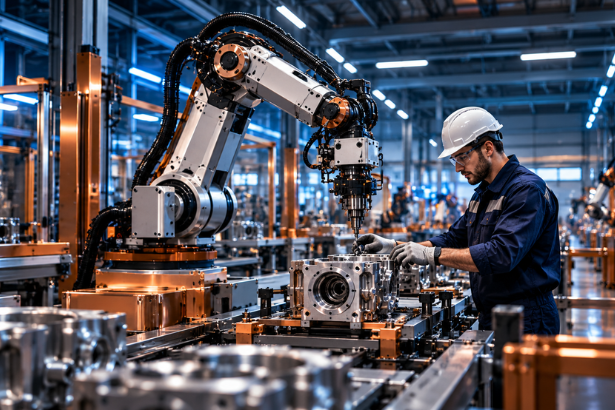
Industrial robots are already used for tasks such as welding, material handling, palletizing, and assembly. More flexible robotic systems can help manufacturers automate work that changes between production runs, although setup and integration remain important considerations.
For U.S. manufacturers facing difficulties hiring technicians and production workers, automation may help increase output without requiring a proportional increase in headcount.
The reshoring survey underscores the labor challenge: 66% of respondents described hiring technicians such as welders, machinists, and electrical or chemical engineers as very difficult or at crisis levels. It also found that 60% cited similar challenges in securing maintenance and repair technicians.
SupplyChainBrain
But a robot does not eliminate the need for people. Automated factories still need workers who can install equipment, troubleshoot faults, maintain machines, interpret production data, and ensure that operations meet safety and quality standards.
3. AI can help detect quality problems earlier
Computer vision and other AI-assisted inspection tools can analyze images, measurements, or sensor readings to identify defects and deviations from specifications.
When properly validated, these systems can help inspectors focus on potential problems and collect consistent quality data across production runs. They can also support root-cause analysis by helping teams identify when and where a defect pattern began.
The limitation is that models need suitable training data, reliable lighting and sensors, and ongoing validation. A system that performs well on one product may not perform equally well on another. Human oversight remains important, particularly in high-consequence manufacturing environments.
4. Digital twins can improve production planning
A digital twin is a digital representation of a physical asset, process, or system. Manufacturers can use these models to explore production scenarios, assess changes to equipment layouts, or test how a new product might move through a factory before committing to expensive physical changes.
For a company planning to build or expand a U.S. facility, simulation can help identify bottlenecks and estimate capacity needs. The results are only as useful as the underlying data and assumptions, however. A digital model cannot compensate for inaccurate information about machine performance, supplier lead times, or workforce availability.
What should manufacturers automate first?
| Manufacturing challenge | Potential technology | Business objective |
|---|---|---|
| Unexpected equipment failures | Predictive maintenance | Reduce unplanned downtime |
| Repetitive material handling | Industrial robots and automated guided vehicles | Improve throughput and consistency |
| Repeated inspection tasks | Machine vision and AI-assisted inspection | Detect defects and improve quality control |
| Complex production scheduling | AI-supported planning tools | Improve resource utilization and scheduling |
| Factory expansion planning | Digital twins and simulation | Identify bottlenecks before major investment |
These are potential applications, not guaranteed results. Manufacturers should evaluate each project against a measurable operational problem rather than adopting AI simply because it is available.
Broader Implications: Does Reshoring Make Supply Chains More Resilient?
A domestic factory can reduce exposure to some overseas shipping delays, trade restrictions, and long international replenishment cycles. It may also improve communication between production teams and U.S. customers.
But resilience is not the same as geography. A company can move production to the United States and remain vulnerable if it relies on a single plant, a single supplier, or imported materials that are difficult to replace.
A more resilient manufacturing strategy considers the entire production network.
The benefits of domestic production
- Shorter replenishment routes: Some products can reach U.S. customers faster when production is closer to demand.
- Closer supplier relationships: Local suppliers may be easier to visit, audit, and coordinate with.
- Reduced exposure to certain trade risks: Domestic production can reduce dependence on specific international routes or import arrangements.
- More direct engineering collaboration: Product and manufacturing teams may be able to resolve design and quality issues more quickly.
- Potentially lower logistics costs: Shorter transport routes can reduce freight expenses in some cases, although the overall economics vary by product.
The risks that remain
Domestic manufacturing can still face high labor costs, equipment delays, energy-price fluctuations, natural disasters, and shortages of specialist components. Concentrating production in one U.S. location can also create a single point of failure.
For that reason, manufacturers should not assume that moving production home automatically improves resilience. The stronger approach may be a hybrid network with domestic capacity for strategically important products, overseas production for cost-sensitive items, and qualified alternative suppliers for critical components.
The 2026 USA Reshoring Survey points to a growing interest in domestic investment while also highlighting workforce and policy challenges. Its findings suggest that manufacturers are considering reshoring as part of a broader sourcing strategy rather than treating location as the only factor.
Reshoring Initiative
+1
Internal link suggestion for The Tech Marketer: Add a related article titled Supply Chain Resilience in 2026: How Manufacturers Can Reduce Supplier Risk. Link the phrase “building a resilient manufacturing supply chain” to that article once the published URL is available.
Related History: From Offshoring to a More Flexible Manufacturing Network
For decades, many companies moved production overseas to take advantage of lower labor costs, supplier clusters, and established manufacturing infrastructure. Global sourcing enabled companies to reach large production networks and scale manufacturing across borders.
Over time, the calculation became more complicated. Long transport routes, geopolitical tensions, pandemic-era disruptions, and changing trade rules made some companies reassess the risks of concentrating production far from their main markets.
Reshoring is one response, but it is not a universal reversal of globalization. Some manufacturers are moving selected products home, some are adding suppliers in neighboring countries, and others are maintaining international production while increasing inventory or qualifying alternative sources.
The 2026 survey reflects this mixed picture. It shows more OEMs and contract manufacturers engaging with reshoring, but also identifies uncertainty over trade policy and labor availability as barriers.
SupplyChainBrain
Automation adds a new variable. If robotics and AI make certain production processes less dependent on large numbers of workers, the cost difference between domestic and overseas production could narrow in some industries. Yet the survey found that manufacturers do not agree on whether automation alone will be enough to close that gap.
SupplyChainBrain
The future is therefore more likely to involve different combinations of domestic production, international suppliers, automation, and inventory buffers than one uniform return to U.S. factories.
What Happens Next?
The next phase of U.S. manufacturing reshoring will depend on whether companies can turn plans into sustainable production operations.
Manufacturers and supply chain leaders should watch several developments:
- Capital investment: Whether announced factory projects proceed and add usable production capacity.
- Workforce availability: Whether employers can recruit and train machinists, welders, engineers, and maintenance technicians.
- Trade-policy predictability: Whether companies can estimate the cost of imported components and long-term domestic investments with greater confidence.
- Automation adoption: Whether AI and robotics projects produce measurable improvements in uptime, quality, throughput, or unit costs.
- Supplier development: Whether U.S. suppliers can scale to meet the volume, quality, and delivery requirements of new domestic manufacturing projects.
- Total cost of ownership: Whether companies compare labor, equipment, tariffs, freight, inventory, and risk instead of choosing a location based on labor costs alone.
For executives, the most useful next step is to evaluate reshoring one product family or production process at a time. A carefully modeled pilot can reveal the costs and operational changes required before a company commits to a much larger facility or network redesign.
A decision that looks attractive in a headline may not work once the company accounts for capital costs, staffing, material sourcing, and realistic production volumes.
Conclusion
U.S. manufacturing reshoring in 2026 is gaining momentum, but the path from interest to investment remains complicated. The latest survey shows more OEMs and contract manufacturers considering or undertaking domestic production, with faster delivery, logistics savings, and geopolitical risk among the factors influencing their decisions.
SupplyChainBrain
AI and robotics could strengthen the business case by improving productivity, supporting quality control, and reducing certain types of downtime. They will not remove the need for skilled workers, stable sourcing, or careful financial planning.
The real question is not whether every factory should return to the United States. It is which products and processes make economic and strategic sense to produce domestically, and how technology can help those operations compete.
Manufacturers that evaluate the full cost of ownership, invest in their workforce, and build flexible supplier networks will be better placed to make that decision with confidence.
Frequently Asked Questions
1. What is U.S. manufacturing reshoring in 2026?
Reshoring means bringing manufacturing or sourcing activity back to the United States after it was previously moved overseas. In 2026, survey findings indicate that more U.S. manufacturers are undertaking or considering this strategy, although the figures apply to surveyed companies rather than the entire manufacturing sector.
SupplyChainBrain
2. How many U.S. manufacturers are reshoring production?
The 2026 USA Reshoring Survey found that 36% of surveyed U.S. OEMs had reshored some production or were actively engaged in reshoring, up from 29% in 2025. Among contract manufacturers, the share rose from 16% to 32%.
SupplyChainBrain
3. Why are manufacturers bringing production back to the United States?
Common reasons include reducing exposure to trade restrictions, shortening delivery times, improving coordination with customers and engineering teams, and reducing some logistics costs. The right decision depends on the product, supplier network, production volume, and total cost of ownership.
4. Can AI and robotics make U.S. manufacturing more competitive?
They can help in selected applications, including predictive maintenance, machine-vision inspection, repetitive material handling, production planning, and simulation. The business case depends on integration costs, data quality, worker training, and measurable operating results.
NIST
+1
5. Does reshoring eliminate supply chain risk?
No. Domestic production can reduce some international transport and trade risks, but companies may still depend on imported components or concentrated suppliers. A resilient network often combines domestic capacity, alternative suppliers, and contingency planning.
6. What are the biggest obstacles to U.S. manufacturing reshoring?
The survey highlights uncertainty over trade policy and the availability of skilled workers. Capital investment, equipment costs, supplier capacity, and operating expenses also influence whether a reshoring project is financially viable.
SupplyChainBrain
7. Is reshoring always cheaper than offshore manufacturing?
No. Domestic production may reduce freight, inventory, and certain risk-related costs, but it can also involve higher wages, facility expenses, and capital requirements. Companies should compare total cost of ownership rather than labor costs alone.
8. What should manufacturers do before moving production to the United States?
They should assess total costs, identify critical suppliers, model realistic demand and capacity, evaluate workforce availability, and test automation where it can solve a defined problem. A pilot project can help validate assumptions before a major investment.
Sources & References
1. “Survey Finds More U.S. Manufacturers Reshoring, But Some High Hurdles Remain” Robert J. Bowman, SupplyChainBrain, October 5, 2026. https://www.supplychainbrain.com/articles/44952-survey-finds-more-us-manufacturers-reshoring-but-some-high-hurdles-remain
2. “New Survey: U.S. Reshoring Momentum Builds Despite Policy and Workforce Challenges” Reshoring Initiative, August 2026. https://www.reshorenow.org/august-30-2026/
3. “2026 Roadmap on Artificial Intelligence and Machine Learning for Smart Manufacturing” National Institute of Standards and Technology (NIST), July 3, 2026. https://www.nist.gov/publications/2026-roadmap-artificial-intelligence-and-machine-learning-smart-manufacturing
4. “The Rise of Artificial Intelligence (AI) in U.S. Manufacturing” National Institute of Standards and Technology, Manufacturing Extension Partnership. https://www.nist.gov/mep/rise-artificial-intelligence-ai-us-manufacturing-text-only
5. “US Manufacturing Output Rises in September” Reuters, October 16, 2026. https://www.reuters.com/business/us-manufacturing-output-rises-september-2026-10-16/