


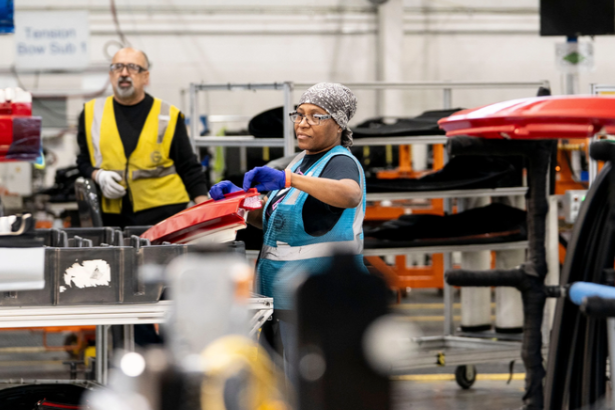
US manufacturing jobs just posted their strongest hiring stretch in half a decade, with factories adding workers at a pace that economists say signals real momentum rather than a one-month blip.
A Five-Year High in Factory Hiring
The headline number came from two separate reports that told largely the same story. S&P Global said manufacturers responded to increasing backlogs by generating jobs at a pace not seen for five-and-a-half years. cbsaustin
On the government side, the data showed clear acceleration too. Hiring in the manufacturing industry continued to trend up, adding 19,000 jobs in October, according to U.S. Bureau of Labor Statistics data, a 311% increase compared to the same time last year, when there were 9,000 job cuts. Adjusted data also showed 13,000 jobs were added in September, revised up from the BLS’s initial report of 9,000 jobs, while August’s numbers were revised again to 21,000 jobs added, a 40% increase from the agency’s first revision of 15,000. manufacturingdive
That manufacturing strength fit into a broader, better-than-expected labor market report. Overall, 165,000 jobs were added across all US industries in October, and Andrew Flowers, chief economist at Appcast, said the US labor market is reaccelerating, noting the October jobs report beat expectations by a massive margin, adding 165,000 jobs, about 100,000 above the consensus forecast. manufacturingdive
What the PMI Numbers Show
Behind the hiring data sits a manufacturing sector that’s been expanding steadily for nearly a year. Economic activity in the manufacturing sector expanded in October for the 10th consecutive month, according to the latest ISM Manufacturing PMI Report, issued by Susan Spence, Chair of the Institute for Supply Management Manufacturing Business Survey Committee. The Manufacturing PMI registered 55.5 percent in October, 1 percentage point above the September figure of 54.5 percent, with the overall economy expanding for the 24th month in a row. textileworldwebull
The breadth of that growth stands out as much as the headline figure. All five subindexes that directly factor into the PMI were in expansion territory, those being new orders, production, employment, supplier deliveries, and inventories, and ISM said five of the six largest manufacturing industries expanded in October. nbcmontana
A separate, private-sector survey largely confirmed the trend, though with a slightly different read on momentum. The S&P Global manufacturing PMI registered 54.9 in October, with S&P Global saying manufacturing growth remained comfortably above trend, though its PMI softened a bit from September’s 52-month high of 55.9. Chris Williamson, chief business economist at S&P Global Market Intelligence, said the US manufacturing sector is having its best growth spell since early 2022. okcfoxweartv
Why Two Reports Tell Slightly Different Stories
Observers familiar with both surveys say the divergence comes down to methodology rather than any real contradiction in the underlying economy. Victoria Bloom, chief economist for the National Association of Manufacturers, said the ISM report showed growth accelerated, while the S&P Global report showed growth softened, which she attributed to differences in who the two firms survey and how they weight different components. wset
Despite that nuance, both organizations landed on the same broad conclusion. Bloom told reporters that both the ISM and S&P Global reports showed continued strength in manufacturing, though both reports broadly told a growth story in American manufacturing despite cost pressures and an increasing concern of price volatility. cbsaustin
That cost pressure shows up clearly in the ISM’s own underlying detail. ISM’s report showed that factories in October once again faced elevated prices for raw materials and longer lead times on supplier deliveries, even as the Manufacturing PMI expanded for the 10th month in a row following 10 months of contraction. staffingindustry
A Sector Still Watching for Soft Spots
Not every reading was uniformly strong. Employment decelerated even as the overall PMI improved, a reminder that factory-level hiring trends can diverge from the broader index even during a period of expansion. And while the headline growth streak looks durable, the report’s own internal contraction metrics show a sector that isn’t universally healthy. Six percent of the sector’s gross domestic product contracted in October, compared to 2 percent in September, and 6 percent of manufacturing GDP was in strong contraction, defined as a composite PMI of 45 percent or lower, compared to 2 percent in September. staffingindustrywebull
What It Means Going Forward
Taken together, the October data paints a picture of a manufacturing sector that’s genuinely reaccelerating after a rough stretch, even if cost pressures and uneven performance across subsectors mean the recovery isn’t universal. For an economy that’s spent much of the past two years hearing about a factory slowdown, five-year-high hiring numbers and a 24-month expansion streak are a meaningful reversal, one that both government data and independent surveys now agree on.
FAQ
1. How many manufacturing jobs were added in October 2026?
US manufacturers added 19,000 jobs in October, a 311% increase compared to the same period last year, according to Bureau of Labor Statistics data.
2. What was the ISM Manufacturing PMI reading for October 2026?
The ISM Manufacturing PMI registered 55.5%, one percentage point above September, marking the 10th straight month of sector expansion.
3. Why do the ISM and S&P Global manufacturing reports differ?
The two surveys reached slightly different conclusions due to differences in who each firm surveys and how they weight different components, though both confirmed continued manufacturing strength.
4. What factors are still pressuring the manufacturing sector?
Factories continue to face elevated raw material prices and longer supplier delivery lead times, even as overall growth accelerates.
5. How strong was the broader October 2026 US jobs report?
The US added 165,000 jobs across all industries in October, about 100,000 above consensus forecasts, which economists described as a reacceleration of the labor market.
SOURCES AND REFERENCES
- Manufacturing Dive: “BLS: Manufacturing Employment Situation, October / JOLTS September 2026”
- CBS Austin: “Factory job growth hits 5-year peak as US manufacturing keeps growing in October”
- Webull: “Manufacturing PMI at 55.5%; October 2026 ISM Manufacturing PMI Report”
- Textile World: “ISM Manufacturing PMI Report, October 2026”
- Staffing Industry Analysts: “US factory activity picks up speed in October”