Introduction
Trump Accounts have become one of the fastest-moving financial policy stories online after the Treasury Department completed automatic enrollment for eligible children on October 1. More than 60 million additional children were added to the system, bringing the potential reach of the program to roughly 70 million children under 18 with valid Social Security numbers. U.S. Department of the Treasury
The Google Trends screenshot accompanying this story shows just how quickly public interest has shifted. Searches around “Susan Dell,” “Michael Dell,” “Trump Accounts,” and related terms are appearing together, reflecting a story that now spans Washington policy, billionaire philanthropy, technology companies and the stock market.
The timing is significant. Parents are being urged to claim accounts that have already been created, while new rules are opening the door for charitable contributions in the form of individual company stock. That has made the program considerably more complicated than the simple child savings initiative introduced earlier this year.
Background and Context
Trump Accounts were created as tax-advantaged investment accounts for children. The program launched in July 2026, with eligibility generally extending to children under 18 who have Social Security numbers.
The federal government’s most prominent contribution is a one-time $1,000 deposit for qualifying U.S. citizen children born between January 1, 2025, and December 31, 2028. Other contributions can come from parents, relatives, employers, governments and qualifying nonprofit organizations. Internal Revenue Service
Before automatic enrollment, parents or guardians generally had to take the initiative to establish an account. That approach limited participation. Treasury said that automatic enrollment created accounts for more than 60 million additional eligible children, dramatically expanding the program’s potential footprint. U.S. Department of the Treasury
The mechanics are important: automatic enrollment does not mean parents have completed the process. A parent or guardian still needs to claim the account to manage it, enable additional contributions and, for eligible children, request the federal $1,000 contribution. U.S. Department of the Treasury
That distinction is one reason the search interest is accelerating now.
Latest Update: Trump Accounts Go From Optional Program to Mass Enrollment
The biggest development came October 1, when the Treasury Department announced that automatic enrollment was complete.
The agency said every eligible child under 18 with a valid Social Security number now has a Trump Account ready to be claimed. Treasury also said parents must claim the accounts to manage them and allow contributions from family members, friends and employers. U.S. Department of the Treasury
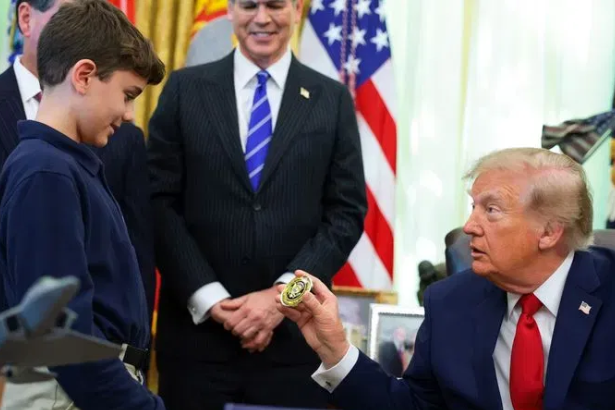
The administration highlighted the scale of the change on October 7, with President Donald Trump promoting the expansion at the White House. The Washington Post reported that the administration was encouraging parents to claim the accounts after automatic enrollment began. The Washington Post
Washington Post: Trump prods parents to claim child investment accounts as auto-enrollment begins
At the same time, another change has pushed the story into technology and investing territory.
New rules allow charities to contribute individual publicly traded stocks to children’s Trump Accounts. Previously, contributions during the growth period were generally constrained to qualifying investments such as low-cost funds tracking primarily U.S. equity indexes. Internal Revenue Service
That change is why Michael and Susan Dell are suddenly appearing so prominently in search results.
Why Michael and Susan Dell Are Trending
Michael and Susan Dell’s Trump Accounts coverage on Yahoo Finance
Michael Dell and his wife, Susan Dell, committed $6.25 billion to support Trump Accounts, with the contribution structured around $250 deposits for millions of qualifying children. Yahoo Finance reported that the Dells’ pledge is now adding $250 to eligible children’s accounts. Yahoo Finance
The Dells’ involvement matters for another reason. The broader program is increasingly connecting philanthropy with investment ownership rather than simply cash savings.
That distinction has triggered debate about whether children’s long-term portfolios should receive individual-company shares and what safeguards should accompany such donations. Yahoo Finance’s October 7 interview with Michael Dell addressed criticism that individual stock donations could concentrate children’s holdings in particular companies. Yahoo Finance
Michael and Susan Dell’s official company connection through Dell Technologies
Expert Insights and Analysis
The central question surrounding Trump Accounts is no longer simply whether children should have investment accounts. It is how those accounts should operate at enormous scale.
Automatic enrollment solves one obvious participation problem. Programs that require families to actively sign up tend to attract people who are already financially engaged. By automatically establishing accounts, the government removes that initial administrative hurdle.
But there is a second hurdle: engagement.
A family may have an account technically established without understanding how contributions work, what investments are available or what claiming the account actually unlocks.
That makes the next phase less about enrollment numbers and more about financial literacy.
The individual-stock rule adds another layer. A diversified index fund spreads exposure across hundreds of companies. A single-company stock does not. If a child’s account receives shares in one business, the value of that portion of the account becomes more closely tied to that company’s performance.
The Treasury and IRS framework still places restrictions on what can generally be held during the growth period. The IRS has described eligible investments as generally mutual funds or ETFs tracking equity indexes made up primarily of U.S. companies, with fee limitations. The newer stock-donation framework creates a separate pathway for qualifying philanthropic transfers. Internal Revenue Service
That distinction is worth emphasizing because “Trump Accounts can hold individual stocks” is an oversimplification. The new provision concerns certain philanthropic stock contributions, not a general invitation for families to turn the accounts into unrestricted brokerage accounts.
Broader Implications
A New Pipeline Into the Stock Market
If millions of children eventually accumulate investment balances, Trump Accounts could create a long-duration pool of household financial assets.
The immediate market impact should not be confused with the longer-term structural effect. A single $1,000 contribution is tiny compared with the size of U.S. equity markets. But repeated contributions over many years could make the program more meaningful as a mechanism for introducing households to investing.
Philanthropy Becomes More Visible
The Dell contribution also highlights a new model for large-scale philanthropy.
Rather than donating exclusively to traditional institutions, wealthy donors can help seed investment accounts belonging directly to children. That could encourage additional corporations, foundations and wealthy individuals to participate.
The Treasury has already framed automatic enrollment as a pathway for philanthropic contributions to reach millions of children. U.S. Department of the Treasury
The Policy Debate Moves to Portfolio Construction
The next argument is likely to be less about whether children should receive investment accounts and more about what those accounts should own.
Index funds offer diversification and relatively simple exposure to the market. Individual shares introduce the possibility of larger gains, but also larger company-specific losses.
For parents, that makes the difference between receiving money and understanding the investment vehicle particularly important.
For policymakers, it raises a broader question: how much investment choice should children have before they reach adulthood?
For the technology sector, there is another intriguing angle. If corporate stock becomes a more visible form of philanthropic contribution, technology companies with large market capitalizations could become particularly prominent participants.
Related History or Comparable Technologies
Trump Accounts sit somewhere between several existing financial products.
A 529 plan is primarily designed around education savings and offers different tax treatment and withdrawal rules.
A custodial brokerage account can provide broader investment flexibility, but it does not operate under the same specialized structure as a Trump Account.
A Roth IRA is designed primarily for retirement and generally requires earned income for contributions.
Trump Accounts are different because they introduce an investment structure specifically for children while combining government seed money, private contributions and philanthropic funding.
The IRS describes the program as having a growth period during which distributions are generally restricted, with specific rules governing eligible investments and contributions. Internal Revenue Service
For readers following the broader technology and markets landscape, this is another example of financial infrastructure increasingly becoming part of the technology story. Digital account management, automated enrollment and low-cost index investing all depend on financial technology operating behind the scenes.
Internal link suggestion: Link this article to The Tech Marketer’s technology and markets coverage and related explainers covering investing platforms, financial technology and technology policy.
What Happens Next
The immediate priority is claiming accounts.
Treasury says parents or guardians need to verify their identity and relationship to the child during the claiming process. Eligible children must also have their accounts claimed to receive the one-time $1,000 Treasury contribution. U.S. Department of the Treasury
The next major storyline will be participation.
Creating tens of millions of accounts is one thing. Getting families to understand them, claim them and make informed decisions about contributions is another.
The individual-stock provision will also receive continued scrutiny as charitable organizations begin using it. The policy could become a template for larger corporate or philanthropic contributions, but it also makes questions around diversification, disclosure and incentives more important.
And then there is the longer-term experiment.
If children who receive these accounts grow up familiar with investing, the program could influence financial behavior well beyond the initial deposits. Whether that produces a meaningful change in household wealth will take years to determine.
Conclusion
The sudden rise in searches for Trump Accounts, Michael Dell and Susan Dell reflects a program that has moved from a relatively niche policy initiative into a mass-market financial story.
Automatic enrollment has dramatically expanded its reach, while the Dells’ multibillion-dollar commitment has demonstrated how private philanthropy can supplement government funding. The new ability for qualifying charities to contribute individual company stock adds another dimension, putting questions about diversification and investment choice directly into the spotlight.
The important story now is not simply how many accounts exist. It is what families do with them, what assets ultimately flow into them and whether millions of small investment accounts can translate into meaningful long-term financial participation.
That experiment has only just begun.
FAQ
What are Trump Accounts?
Trump Accounts are tax-advantaged investment accounts created for eligible U.S. children. Children under 18 with valid Social Security numbers can have accounts established under the program. U.S. Department of the Treasury
How many children have Trump Accounts?
Treasury said automatic enrollment created accounts for more than 60 million additional eligible children, bringing the program’s potential reach to roughly 70 million children. U.S. Department of the Treasury
Do parents need to claim Trump Accounts?
Yes. Automatic enrollment creates the account, but a parent or guardian must claim it to manage the account and enable contributions. Claiming is also required for eligible children to receive the federal $1,000 seed contribution. U.S. Department of the Treasury
Who gets the $1,000 Trump Accounts contribution?
The $1,000 federal pilot contribution is for qualifying U.S. citizen children born between January 1, 2025, and December 31, 2028, subject to the program’s requirements. Internal Revenue Service
Why are Michael and Susan Dell associated with Trump Accounts?
Michael and Susan Dell committed $6.25 billion toward Trump Accounts, with their contribution structured to provide $250 to qualifying children. Their involvement has become especially visible as automatic enrollment expands the program. Investopedia
Can Trump Accounts receive individual stocks?
New rules allow qualifying philanthropic contributions to be made using readily tradable public-company stock under specified requirements. That is different from allowing families to freely buy any individual stock inside the accounts. Internal Revenue Service
Are Trump Accounts the same as 529 plans?
No. Trump Accounts and 529 plans have different purposes, tax rules, contribution structures and withdrawal restrictions. A 529 is primarily designed for education savings, while Trump Accounts are structured as child investment accounts with a longer growth period.
Sources & References
- The Washington Post, “Trump prods parents to claim child investment accounts as auto-enrollment begins.” Read the Washington Post report
- Yahoo Finance, “Michael Dell defends Trump Accounts’ shift to individual company stocks.” Read the Yahoo Finance report
- The Wall Street Journal, “Trump Accounts’ Extraordinary Expansion Puts Individual Stocks Into Kids’ Holdings.” Read the WSJ report
- U.S. Department of the Treasury, “Treasury Announces the Completion of Automatic Enrollment Today for Trump Accounts.” Read the Treasury announcement