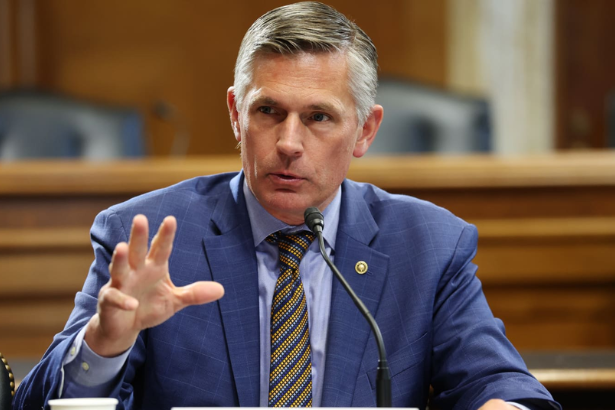
The Senate blocks data center bill story has become the latest flashpoint in Washington’s increasingly complicated debate over artificial intelligence infrastructure, electricity prices and who should pay for the power systems needed to support America’s rapidly expanding data-center industry.
On September 17, 2026, Sen. Martin Heinrich, Democrat of New Mexico, blocked an attempt to pass the House-approved Ratepayer Protection Act through unanimous consent. The legislation had cleared the House 417-3 the previous day. Heinrich argued that the measure did not go far enough in requiring data-center operators to cover infrastructure costs associated with their electricity demand.
The episode did not end with the Senate simply rejecting action on data centers. Heinrich proposed his own legislation, the GRID Savings Act, but Sen. Bernie Moreno, Republican of Ohio, objected to that measure as well.
Background and Context
The rapid construction of AI data centers is putting new pressure on electricity systems across the United States.
Modern AI facilities can require enormous amounts of electricity, creating questions about generation capacity, transmission infrastructure, utility rates and the allocation of costs between data-center operators and other electricity customers.
The House’s Ratepayer Protection Act emerged from that debate.
Under the House-passed legislation, state utility regulators would be directed to consider a standard under which utilities charge large data centers for the full cost of new power and transmission upgrades needed to serve them. The measure applies to large facilities and would not immediately impose a nationwide requirement that companies pay those costs.
The House passed the measure 417-3 on September 16.
That overwhelming vote set up the Senate confrontation one day later.
Latest Update: Senate Blocks Data Center Bill
Sen. Jon Husted, Republican of Ohio, sought unanimous consent to advance the Ratepayer Protection Act in the Senate.
Under unanimous consent, a single senator can prevent the measure from advancing through that procedure.
Heinrich objected.
The Washington Post reported that Heinrich said he agreed Congress needed to address electricity costs associated with data-center growth but argued that Husted’s legislation did not sufficiently require data centers to pay for grid upgrades or conserve water.
CBS News similarly reported that Heinrich characterized the Ratepayer Protection Act as insufficient and instead promoted his own GRID Savings Act.
The dispute therefore centers on how strongly federal law should require large data-center projects to absorb infrastructure costs, rather than whether the rapid expansion of AI infrastructure is affecting the energy-policy debate.
What the Ratepayer Protection Act Would Do
The House-passed legislation is narrower than some descriptions of it might suggest.
It would not simply set a national electricity price for data centers.
Instead, it would require state utility regulators to consider rules addressing the costs associated with large data centers’ electricity consumption and the infrastructure needed to serve those facilities. The Washington Post reported that the legislation would not take full effect for two years.
That distinction is important.
The measure is designed to influence how electricity costs associated with new data-center demand are allocated. It does not itself immediately rewrite every state’s utility-rate structure.
The House vote nonetheless represented one of Congress’s most significant recent attempts to address the energy consequences of AI infrastructure expansion.
Martin Heinrich’s Alternative Proposal
After objecting to the House-passed measure, Heinrich sought unanimous consent for the GRID Savings Act of 2026.
According to QZ, the proposal would give the Federal Energy Regulatory Commission authority over facilities drawing at least 150 megawatts from the grid and require such operations to absorb infrastructure costs created by their demand.
Moreno objected to Heinrich’s proposal, preventing that legislation from advancing through unanimous consent as well.
The result was that neither proposal advanced through the procedure used that day.
Why Data Center Electricity Costs Matter
The dispute reflects a much larger technological shift.
AI models require enormous computing resources, and those resources operate inside data centers that consume electricity around the clock.
As companies build increasingly large AI clusters, utilities and regulators have to determine how quickly new power generation and transmission capacity can be developed.
That creates several interconnected issues:
- Grid expansion: New facilities can require additional generation and transmission infrastructure.
- Utility rates: Regulators must determine how infrastructure costs are allocated.
- Local resources: Data centers can also create substantial water and land-use demands.
- Reliability: Large new loads can complicate planning for electricity systems.
- AI development: Restrictions or higher infrastructure costs could affect where companies build new computing capacity.
QZ recently reported that AI data-center growth is colliding with electricity infrastructure designed for a substantially different demand environment.
The Political Disagreement, Factually
The dispute involves competing approaches.
Supporters of the Ratepayer Protection Act argue that electricity customers should not be left responsible for infrastructure costs generated by large commercial data-center projects. Husted described the bill as a bipartisan measure intended to protect consumers from higher electricity prices.
Heinrich’s position, as reported by CBS News and The Washington Post, is that Congress needs stronger requirements that make data-center operators pay for infrastructure associated with their demand, while also addressing water use, air pollution and community involvement.
Moreno’s response was that blocking the House-passed legislation prevented what he characterized as immediate relief for consumers, while his objection to Heinrich’s alternative prevented that bill from advancing as well.
These are competing legislative approaches, not evidence that Congress has reached agreement on a single national policy for data-center energy costs.
The AI Infrastructure Connection
This debate matters to the technology industry because AI’s expansion increasingly depends on physical infrastructure.
The industry’s attention has traditionally focused on GPUs, AI models and software. But electricity has become an equally important constraint.
A large AI data center requires:
- Computing hardware
- High-capacity electrical connections
- Generation capacity
- Transmission infrastructure
- Cooling systems
- Water or alternative cooling resources
- Land and construction infrastructure
That means the next phase of the AI boom will depend not only on technological breakthroughs but also on whether physical infrastructure can keep pace.
For more coverage, an internal link to The Tech Marketer’s AI infrastructure and data-center coverage would fit naturally here.
Broader Implications
For AI Companies
The Senate dispute creates another policy variable for companies planning large AI infrastructure investments.
If federal or state regulators increasingly require data-center operators to absorb the costs of grid expansion, project economics could change.
Companies may respond by choosing locations with greater existing power capacity, developing their own generation resources or negotiating different arrangements with utilities.
For Utilities
Utilities face a difficult planning problem.
Large data centers can represent substantial new electricity demand, potentially creating opportunities for investment in generation and transmission.
At the same time, regulators have to determine who pays for the infrastructure required to serve that demand.
The outcome of that process can affect both utilities and other customers.
For Local Communities
The debate extends beyond electricity bills.
Heinrich specifically raised water conservation, air pollution and community engagement as issues that should be addressed alongside electricity costs.
That means future data-center policy could increasingly combine energy, environmental and land-use regulation.
For AI Infrastructure Investment
The legislative debate demonstrates that access to power is becoming a strategic consideration for AI companies.
A shortage of available electricity can delay data-center construction even when companies have sufficient capital and computing hardware.
That makes energy infrastructure one of the less visible constraints on the next phase of AI expansion.
Related History and Comparable Technologies
The relationship between technology growth and electricity infrastructure is not new.
Previous technology waves created their own infrastructure demands.
The expansion of personal computing drove semiconductor manufacturing and telecommunications investment. The smartphone era accelerated wireless-network construction. Cloud computing subsequently drove the development of enormous server campuses and fiber networks.
AI is extending that pattern.
The difference is the scale of computational demand associated with modern AI systems.
Data centers that once primarily supported web services and cloud applications are increasingly being designed around high-density computing clusters. That changes the electrical characteristics of facilities and increases the importance of grid planning.
The result is a growing connection between AI policy and traditional energy policy.
What Happens Next
The immediate legislative question is whether lawmakers can agree on a compromise that addresses the concerns raised on both sides.
The House has already demonstrated substantial bipartisan support for the Ratepayer Protection Act, passing it 417-3.
But the Senate’s unanimous-consent procedure did not produce the same result.
Heinrich’s alternative also failed to advance after Moreno objected.
The debate could therefore continue through other legislative procedures or return in a future Congress.
Meanwhile, state regulators and lawmakers are continuing to address the issue independently. QZ reported earlier in September that several states were reconsidering incentives and policies surrounding data-center development amid concerns about electricity costs and grid strain.
The technology industry’s infrastructure buildout is therefore continuing alongside a growing policy debate over its costs.
Conclusion
The Senate blocks data center bill episode illustrates how quickly AI infrastructure has moved from a technology-industry issue into a major energy-policy question.
The House’s Ratepayer Protection Act passed 417-3, but its Senate path was blocked when Martin Heinrich objected to unanimous consent. Heinrich then proposed the GRID Savings Act, which Bernie Moreno also blocked through the same procedure.
The central disagreement is now about how much responsibility data-center operators should bear for the electricity and infrastructure demands created by their facilities, and how federal and state regulators should enforce those responsibilities.
For the AI industry, the implications extend well beyond Washington.
As data centers become larger and more power-intensive, electricity availability, grid investment and infrastructure costs are becoming fundamental parts of the technology industry’s growth equation.
FAQ
What happened when the Senate blocked the data center bill?
Sen. Martin Heinrich objected to unanimous consent for the House-passed Ratepayer Protection Act on September 17, preventing it from advancing through that procedure.
What is the Ratepayer Protection Act?
The House-passed bill would require state utility regulators to consider rules addressing the cost of electricity and infrastructure associated with large data centers. It passed the House 417-3.
Why did Martin Heinrich oppose the bill?
Heinrich said the legislation did not go far enough in requiring data centers to pay for grid upgrades and address related issues such as water conservation.
What is the GRID Savings Act?
It is an alternative proposal from Heinrich that, according to QZ, would give the Federal Energy Regulatory Commission authority over certain large electricity-consuming facilities and require them to absorb infrastructure costs associated with their demand.
Did the Senate pass another data center bill?
No. Heinrich’s alternative proposal was also blocked after Sen. Bernie Moreno objected to its unanimous-consent request.
Why do AI data centers need so much electricity?
AI data centers contain large numbers of high-performance computing systems that require substantial electricity for computation and cooling. Their growth can therefore require additional generation and transmission infrastructure.
Could data-center policies affect AI development?
Potentially. Rules governing electricity costs, grid connections, environmental requirements and new construction could influence where and how quickly companies build AI infrastructure. The specific effect would depend on the policies ultimately adopted.
Google Trends Section
Trend topic: Senate blocks data center bill
The supplied Google Trends screenshot shows a sharp increase in searches for “senate blocks data center bill”, with related searches including “data center bill” and “data centers.”
Associated keywords:
- Senate blocks data center bill
- data center bill
- data centers
- data center electricity
- AI data center energy
- Ratepayer Protection Act
- Martin Heinrich
- data center utility costs
- electricity prices
- AI infrastructure
Google Trends image suggestion: Use the supplied screenshot showing the search-interest spike and the three news stories appearing beneath the trend chart.