


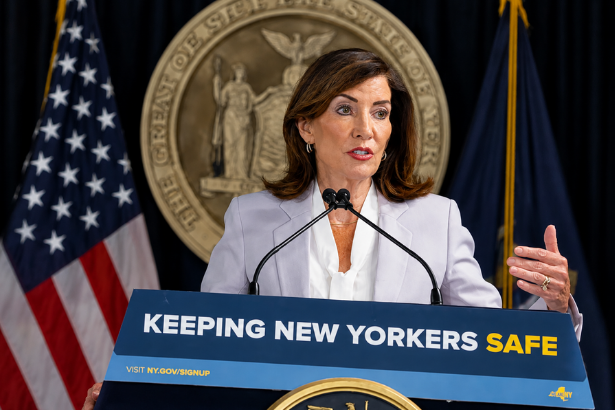
New York 3D printer gun law to block firearm production is facing its first public test. Months after Governor Kathy Hochul signed the measure, Defense Distributed founder Cody Wilson says he has built a tool intended to get around the law’s technical safeguards, and Hochul has responded publicly, signaling the state intends to keep adapting its approach.
What New York’s 3D Printer Law Requires
Hochul signed the law on May 27, 2026, after it passed as part of the Public Protection and General Government bill within the state’s budget package. The law requires all 3D printers sold in New York to include software, hardware, firmware, or other safeguards designed to block the manufacture of guns or gun parts. Violating the requirement can result in a $5,000 fine per product sold.
The measure builds on proposals Hochul first introduced in January 2026 as part of her State of the State agenda, which also included criminal penalties for manufacturing 3D-printed firearms, a ban on possessing or distributing the digital blueprints used to produce them without a license, a requirement that police departments report recovered 3D-printed guns to a state database, and a mandate that pistols sold in the state be designed so they can’t be easily converted into automatic weapons. Announcing the proposals, Hochul described the shift from traditional gun trafficking to home-based 3D printing as “the Plastic Pipeline,” building on the state’s existing efforts against the “Iron Pipeline” of trafficked firearms.
Enforcement details are still being worked out. Reporting from the Times Union noted that questions remain about how the statute will be implemented, with a state task force expected to help develop the specific technical standards printer manufacturers must meet.
Who Is Cody Wilson
Wilson is the founder of Defense Distributed, a Texas-based company that publishes open-source firearm designs for digital manufacturing through its DEFCAD platform. He first gained national attention in 2013 for building the world’s first working 3D-printed firearm and has spent much of the years since fighting legal battles over the right to distribute gun blueprints online, describing himself as a “crypto-anarchist” who believes governments “should live in fear of their citizenry.”
It’s worth noting that Wilson has a documented criminal history separate from his gun-related advocacy. In 2018, he pleaded guilty to injury to a child after paying an underage girl for sex, resulting in a sentence of seven years’ probation, mandatory sex offender registration, and a prohibition on owning firearms during that probationary period.
The Dispute Over Hochul’s Law
According to reporting from The Verge and Cybernews, Wilson has developed a tool he’s calling “Hochulization,” a direct reference to the governor, aimed at defeating one method printer-based safeguards can use to identify prohibited firearm files. Wilson has said he intends to apply the technique across his company’s repository of more than 200,000 gun design files and plans to make the method open-source.
Hochul addressed the development on a recent episode of the tech podcast Decoder, framing her response around public safety rather than the technical dispute itself. “You can tell Cody I will get ahead of him next,” she said. “I can’t always be on the forefront when I see someone intentionally thwarting a law. It is the law that you cannot have 3D-printed guns in the state of New York.” She went on to describe the stakes in stark terms, referencing concerns about unregulated firearm production by individuals with untreated mental health issues and the absence of background checks in home manufacturing.
Wilson isn’t the only voice pushing back on New York’s approach. The Electronic Frontier Foundation has separately raised concerns about digital surveillance implications and what it describes as mandated “censorware” being built into consumer 3D printers, a civil liberties argument distinct from Wilson’s own advocacy.
The Broader Legal and Enforcement Picture
Legal challenges to the law’s constitutionality are also part of the unfolding story. Critics have argued the law’s combination of criminal liability tied to digital design files, mandated detection software in commercial printers, and redesign requirements for handguns may run into tension with the framework the Supreme Court established in its 2022 Bruen decision on Second Amendment cases. Separately, law enforcement officials have acknowledged the practical difficulty of the effort. A firearms supervisor at the Monroe County Crime Lab told Spectrum News the state is essentially trying to ensure “the software on the systems can’t print any gun parts,” a technically difficult goal given how easily 3D printer software and file formats can be modified.
Broader Implications
This dispute is likely to become a test case for how effectively state governments can regulate digital manufacturing technology that’s fundamentally difficult to contain once files exist online, a challenge likely to recur as other states consider similar legislation. For more policy and technology regulation coverage, visit The Tech Marketer.
What Happens Next
New York’s task force is expected to continue developing specific technical standards for 3D printer manufacturers under the law, while Hochul has indicated the state will respond to circumvention efforts as they emerge. This article will be updated as enforcement details and any legal challenges develop.
Latest Updates
The Verge’s report on Hochul’s Decoder podcast response was published within the past day. Cybernews’ report on Wilson’s circumvention tool was published roughly a week prior, and coverage from the New York governor’s office and the Times Union has tracked the law’s legislative and implementation history since January 2026.
Note on sourcing: the submitted The Verge link was blocked on direct fetch. Its reported content, along with reporting from Cybernews, ABC News, and the Times Union, has been used to verify and provide additional context for this article.
Frequently Asked Questions
1. What does New York’s 3D printer gun law require?
It requires all 3D printers sold in New York to include safeguards, software, hardware, or firmware, designed to block the manufacture of guns or gun parts, with violations subject to a $5,000 fine per product sold.
2. Who is challenging New York’s 3D printer gun law?
Cody Wilson, founder of Defense Distributed, says he has developed a tool intended to circumvent the printer-based safeguards required under the law.
3. How did Governor Hochul respond to the challenge?
Hochul addressed the situation on the Decoder podcast, saying she intends to “get ahead” of efforts to thwart the law and defending the measure as necessary for public safety.
4. When did New York’s 3D printer gun law take effect?
Hochul signed the law on May 27, 2026, following legislative approval as part of the state’s budget package.
5. Is New York’s 3D printer gun law facing legal challenges?
Yes. Critics have raised constitutional concerns tied to the Supreme Court’s 2022 Bruen decision, and civil liberties groups including the Electronic Frontier Foundation have raised separate objections related to mandated detection software.
Sources and References
- “New York governor to 3D-printed gun leader: ‘tell Cody I will get ahead of him,'” The Verge (content verified via search due to a site-block error on direct fetch) — https://www.theverge.com/policy/986733/kathy-hochul-3d-printed-guns-cody-wilson-response
- Mayank Sharma, “This new tool could let 3D-printed guns slip past printer safeguards,” Cybernews — https://cybernews.com/news/bypass-3d-printed-guns/
- “New York Gov. Hochul proposes legislation to block 3D printing of guns,” ABC News, January 8, 2026 — https://abcnews.com/US/new-york-gov-hochul-proposes-legislation-block-3d/story?id=129014008