


SpaceX stock is having a moment on Wall Street, with Jefferies initiating coverage at a Buy rating and a $210 price target just days after the company pulled off a historic Starship milestone that analysts say fundamentally reshapes how the business should be valued. The timing is notable: the bullish call landed even as broader AI and semiconductor stocks were sliding through a steep correction.
Latest Update
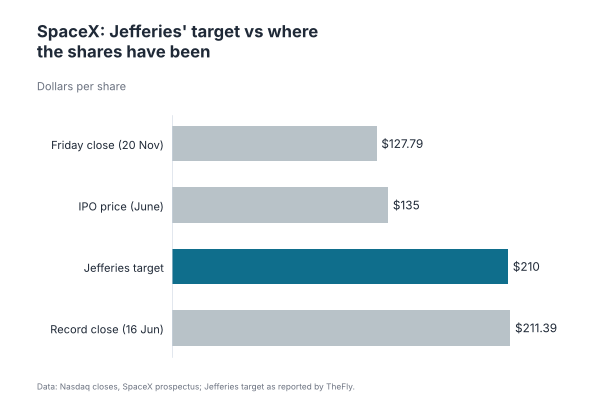
The headline number driving coverage this week is Jefferies’ new price target. Jefferies initiated coverage of SpaceX stock with a Buy rating and $210 price target, implying roughly 64% upside from the recent closing price of $127.79, a bullish call that stands out sharply as broader artificial intelligence and semiconductor equities sink into a steep correction. Rather than treating SpaceX as a pure rocket manufacturer, the firm is framing the company as emerging infrastructure for the broader AI economy. dailycoin
The reasoning behind that framing is specific. Jefferies cited the company’s exceptional engineering, which has allowed it to dominate mass-to-orbit launches, telling investors the firm sees this driving durable high growth in its space and connectivity segments and exponential growth in its super intelligence segment. The bank is not alone in that optimism. Bernstein reaffirmed its Outperform rating with a $268 price target, representing nearly 110% upside from Friday’s closing price, and the broader analyst consensus on TipRanks has reportedly reached Strong Buy status. tipranks
The growth numbers behind these targets are aggressive. Jefferies projects SpaceX’s connectivity segment revenue at $92 billion by 2029, implying a 70% compound annual growth rate, while also forecasting that available downlink capacity could expand fourteen times over the same period with margins sustained above 60%. That kind of growth assumption requires heavy spending to match it, with connectivity capital expenditure projected to increase sixfold to $30 billion annually by 2029.
The Starship Catch That Changed the Narrative
The catalyst behind this wave of bullish coverage was a weekend milestone that had been years in the making. SpaceX caught the upper stage of its Starship rocket with mechanical arms on its launch tower for the first time, a moment described as a major milestone that sets up the company’s future ambitions. The achievement landed at a moment when competitors were stumbling badly. Rival ULA, a Boeing and Lockheed Martin joint venture, had a Vulcan rocket failure that destroyed 40 Amazon Leo satellites, while Blue Origin’s New Glenn exploded on the ground in May, destroying its only launch pad, developments that one analyst argued widen SpaceX’s competitive lead. Yahoo Finance
The weekend was not without setbacks. SpaceX abandoned its attempt to catch the Super Heavy booster, which exploded before reaching the Gulf of Mexico, even though the booster represents roughly $63 million of a $90 million rocket and is normally the easier component to catch, something SpaceX has done multiple times before. Analysts framed this as a setback rather than a disqualifying failure, since the more technically difficult upper-stage catch succeeded. Yahoo Finance
Why does a single successful catch move price targets so much? Full reusability lets SpaceX spread a costly rocket across many launches, cutting costs and increasing launch frequency, potentially shifting its space segment from a low-margin launch business into a scalable logistics business where fuel and maintenance become the main costs. Taken to its logical conclusion, the bull case argues SpaceX could become a near-monopoly in orbital launch, pricing below rivals while keeping strong margins and building out Starlink or orbital data centers more cheaply than any competitor could match. Yahoo Finance
Not Every Analyst Is Fully Convinced
Not all recent coverage has turned fully bullish. One widely read upgrade moved the stock only from “strong sell” to “sell,” a shift the author himself described as modest. The upgrade cited rapid expansion strengthening the company’s prospects, with Starlink functioning as the current cash cow after subscribers nearly doubled to 13.6 million, even though international growth lowered average revenue per user from $83 to $69. Seeking Alpha
The same analysis flagged real risks sitting underneath the optimism. Management projects $33 billion to $37 billion in first-quarter 2027 revenue from AI as the growth engine, though it also expects heavy near-term capital spending, and the author kept a cautious stance because shares remain very expensive, company guidance is limited, and the stock carries exposure to a possible AI bubble. That caution matters given how much of the current bull case rests on execution of ambitious, multi-year infrastructure buildouts rather than revenue the company is generating today. Seeking Alpha
Remaining technical obstacles also stand between SpaceX and the more ambitious parts of its AI infrastructure thesis. Those include developing chips that can withstand cosmic radiation, a problem SpaceX is reportedly working on with Nvidia, along with cooling systems for data centers operating in space’s vacuum, and political hurdles around Earth-to-Earth cargo transport. None of these are solved problems, and each represents a multi-year engineering and regulatory challenge in its own right. Yahoo Finance
Broader Implications
The SpaceX story this week captures a broader theme playing out across AI-adjacent infrastructure stocks: investors are increasingly willing to pay premium valuations for companies that control physical infrastructure, whether that is launch capacity, satellite connectivity, or compute hardware, even when near-term earnings do not yet justify the price. Marketing and content teams covering enterprise technology should expect this framing, infrastructure as the real AI investment story, to keep showing up across earnings calls and analyst notes well into next year.
The Tech Marketer tracks how AI infrastructure narratives are reshaping valuations across the technology sector, because the companies winning analyst upgrades today are often the ones setting the pricing and capacity benchmarks competitors get measured against tomorrow. For ongoing coverage of AI infrastructure investment trends and enterprise technology valuations, more analysis is available at The Tech Marketer.
FAQ
1. What price target did Jefferies set for SpaceX stock?
Jefferies initiated coverage with a Buy rating and a $210 price target, implying roughly 64% upside from the recent closing price of $127.79.
2. What happened during SpaceX’s Starship catch?
SpaceX successfully caught the upper stage of its Starship rocket with mechanical arms on its launch tower for the first time, though it was unable to catch the Super Heavy booster, which exploded before reaching the Gulf of Mexico.
3. Why are analysts bullish on SpaceX as an AI company?
Analysts argue SpaceX’s reusable rocket technology could turn its space segment into a scalable logistics business, supporting cheaper Starlink expansion and potential orbital data center infrastructure tied to AI compute demand.
4. Are all analysts positive on SpaceX stock?
Not entirely. One recent analysis upgraded the stock only modestly, from “strong sell” to “sell,” citing concerns about high valuation, limited company guidance, and exposure to a possible AI bubble.
5. What technical challenges remain for SpaceX’s AI ambitions?
Remaining obstacles include developing radiation-resistant chips, building cooling systems for space-based data centers, and navigating political hurdles around Earth-to-Earth cargo transport.
Sources and References
- GuruFocus / Barron’s coverage — Jefferies Initiates Coverage on SpaceX (SPCX) with Buy Rating and $210 Price Target
- Yahoo Finance — Why Saturday’s Historic Starship Catch Changes the Bull Case for SpaceX Stock
- Seeking Alpha — SpaceX Is Far Better Than I Thought (Upgrade)