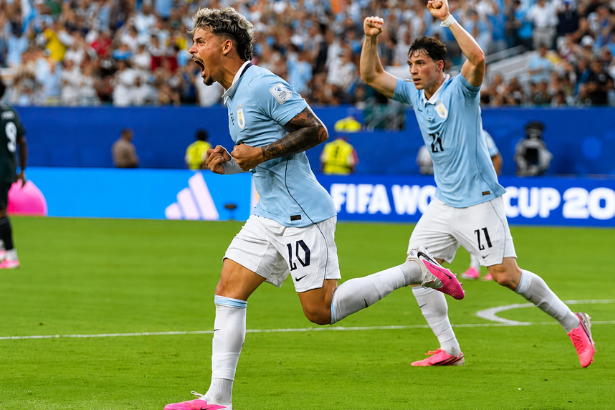
Saudi Arabia vs Uruguay delivered Miami’s first-ever FIFA World Cup match on June 15, 2026, and it produced a dramatic 1-1 draw at Hard Rock Stadium that left both sides with mixed emotions. Abdulelah Al Amri gave Saudi Arabia a half-time lead with a goal that ended a 42-game international scoring drought, only for Maxi Araujo to rescue a point for Uruguay with an 80th-minute equalizer after Marcelo Bielsa’s halftime tactical reshuffle transformed the match. Adding a unique visual element to the historic occasion, match officials wore special pink kits as a tribute to the host city.
Saudi Arabia vs Uruguay Final Score and Match Stats
Final Score: Saudi Arabia 1, Uruguay 1
Date: June 15, 2026 | Venue: Hard Rock Stadium, Miami Gardens, Florida
Competition: 2026 FIFA World Cup, Group H, Matchday 1
Goals:
- Abdulelah Al Amri (KSA) — first half, tap-in from Mohamed Kanno header rebound
- Maxi Araujo (URU) — 80th minute, follow-up after Federico Vinas header parried by Al Owais
Key Stats:
- Uruguay possession: 67% (their highest on record at a World Cup since 1966)
- Uruguay shots: 27 total, including 22 in the second half alone (equaling the most by any team in a World Cup half since East Germany’s 24 against Chile in 1974)
- CONMEBOL nations remain winless through 9 matches at the 2026 tournament (D6 L3), their worst start since 1974
Key Performers — Saudi Arabia:
- Abdulelah Al Amri: goal, ending a 42-game drought, second international goal of his career
- Mohammed Al Owais (GK): multiple key saves including denying Manuel Ugarte’s drive off the post
Key Performers — Uruguay:
- Maxi Araujo: equalizing goal, four goal involvements across his last two major tournaments
- Federico Valverde: moved into central role at halftime, denied by Al Owais from a free kick
- Fernando Muslera (GK): brilliant save denying Al Amri before conceding moments later
Abdulelah Al Amri’s Goal: Ending a 42-Game Drought
Saudi Arabia broke the deadlock through a player who had waited nearly five years for this moment.
Saudi Arabia gained momentum towards the end of the first half, with Al Amri forcing a good save from Fernando Muslera, though the goalkeeper could do nothing minutes later when Al Amri reacted quickest to a rebound from Mohamed Kanno’s header to tap in.
Abdulelah Al Amri scored his second goal for Saudi Arabia in this FIFA World Cup match, ending a 42-game goal drought for his national team. His only previous international goal came on his debut in a friendly against Kuwait in March 2021. The five-year wait between international goals makes the World Cup strike a deeply significant personal milestone, arriving on the largest possible stage.
Muslera had made a brilliant save to deny Al Amri just four minutes earlier, thrusting out a left hand to keep out his powerful shot, only for the rebound opportunity to present itself again moments later.
Maxi Araujo’s 80th-Minute Equalizer
Uruguay’s response, when it finally arrived, came from sustained second-half pressure that had been building for nearly 45 minutes.
He did well to parry Vinas’ header but could do little with Araujo’s follow-up. Maxi Araujo finally scored after Al-Owais could only push another Federico Vinas header into his path, with 10 minutes remaining in the match.
Maxi Araujo scored a late equalizer for Uruguay after Abdulelah Al Amri gave Saudi Arabia a half-time lead. The goal capped what had been an increasingly one-sided second half in terms of possession and chances, finally rewarding Uruguay’s pressure with the point their performance arguably deserved. That was to prove Araujo’s final kick of the game, as he was immediately substituted by Bielsa, with his replacement Brian Rodriguez nearly scoring a winner moments later.
Maxi Araujo has been directly involved in more goals than any other Uruguay player across their last two major tournaments, Copa América and the FIFA World Cup, recording four goal involvements, three goals and one assist, across that span.
Why Were the Referees Wearing Pink?
One of the most talked-about aspects of the match had nothing to do with the action on the pitch.
Italian referee Maurizio Mariani and his team will wear flamingo pink in Monday’s Group H game between Uruguay and Saudi Arabia in tribute to the city of Miami. Mariani is one of 170 match officials at the World Cup being staged across the United States, Canada, and Mexico.
FIFA’s Chief Refereeing Officer and Chairman of the FIFA Referees Committee Pierluigi Collina explained the decision: “Miami is our base camp so we thought it would be nice to show our appreciation to the city where we’ll live for about two months. We chose this ‘pink flamingo’ for the referees’ training material. It’s a sort of recognition. Also, the first match, which will be played in Miami, June 15, Uruguay v Saudi Arabia [Group H], the referee will wear the pink flamingo shirt.”
FIFA President Gianni Infantino added: “Pink is the colour of Miami, and we are all wearing this very nice pink dresses to give a little bit of a shout-out, to give a little bit of a smile to the city which is hosting us.” The Southern Florida city is associated with pink because of the flamingos once abundant in the region, its famous pink sunsets, and its iconic pink Art Deco architecture along Ocean Drive in South Beach.
Marcelo Bielsa’s Halftime Reshuffle That Changed the Game
Uruguay coach Marcelo Bielsa’s tactical decisions at the interval directly produced the second-half transformation that ultimately salvaged the point.
Uruguay coach Marcelo Bielsa made two changes at the break, with former Liverpool striker Darwin Nunez one of the players sacrificed, and moved captain and Real Madrid star Federico Valverde into a more central role, and the game was transformed.
Uruguay came close to a leveller within a minute of the restart, Vinas throwing himself at a cross from the right and forcing Al Owais into a fine stop. The pattern continued throughout the half: Uruguay substitute Agustin Canobbio headed wide from a corner, and Al Owais pulled off his best stop of the night, diving low to his right to tip Manuel Ugarte’s 20-yard drive onto the left-hand upright. Valverde himself was denied from a free kick before Araujo finally found the breakthrough.
The reshuffle’s effectiveness is reflected in the statistical gap between halves: Uruguay had 60% possession during the opening 35 minutes without a breakthrough, but generated 22 shots in the second half alone after the tactical changes.
Mohammed Al Owais: Saudi Arabia’s Goalkeeping Hero
Despite conceding the equalizer, the Saudi Arabia goalkeeper’s performance was widely regarded as the individual highlight of the match for either side.
The star of the show was Saudi goalkeeper Mohammed Al-Owais, who made a string of saves to ensure his side claimed a deserved point on their World Cup return. Uruguay, who had 27 shots in the game, were well worth their equalizer, and were close to a winner as Miami’s heat tired their opponents, but will feel they escaped given how late the equalizer came.
Al Owais’s saves against Ugarte’s drive off the post and Valverde’s free kick were the two most significant interventions of the second half, repeatedly denying Uruguay a goal that the underlying statistics suggested they deserved much earlier than the 80th minute.
Uruguay’s Historic Possession and Shot Numbers
The statistical record set by Uruguay during the match places it among the most extreme single-match performances in tournament history, even though the result was only a draw.
Uruguay had 67% possession against Saudi Arabia, their highest tally on record, since 1966, in a FIFA World Cup match. Their 22 shots in the second half equaled the most by any team in a FIFA World Cup half since East Germany attempted 24 shots in the first half against Chile in 1974.
These numbers reflect a match in which one team dominated territorial control and chance creation almost completely after halftime, yet still required a goalkeeping error in the 80th minute to convert that dominance into a single goal. The gap between underlying performance and the eventual 1-1 scoreline is exactly the kind of outcome that frustrates dominant teams and validates resilient, well-organized opponents.
Group H Standings After Matchday 1
The result, combined with the day’s earlier fixture, leaves Group H tightly contested heading into the second round of matches.
All four teams in Group H started with a draw following Spain’s earlier stalemate with Cape Verde. With Spain and Cape Verde drawing earlier in the day and now Saudi Arabia and Uruguay also splitting the points, every team in Group H sits level after Matchday 1.
For CONMEBOL nations more broadly, the tournament has opened poorly: South American teams are yet to win a game, drawing two and losing two, or even hold a lead in the 2026 competition, marking their worst start to a tournament since 1974, when CONMEBOL nations went nine matches without a win across that tournament’s opening stretch.
What’s Next for Saudi Arabia and Uruguay
Both teams will look to build on a result that, while not a win for either, avoided the worse outcome of an opening defeat.
Saudi Arabia, who memorably beat eventual champions Argentina in their opening game at Qatar 2022, were on course for a similar upset before Uruguay’s second-half transformation denied them. The Green Falcons will take confidence from Al Amri’s drought-ending goal and Al Owais’s goalkeeping performance into their remaining group matches.
For Uruguay, the dominant underlying numbers, particularly the 67% possession and 27 total shots, suggest the attacking quality is present even if the conversion rate against a well-organized Saudi defense was poor for long stretches. Bielsa’s halftime adjustments, removing Darwin Nunez and repositioning Valverde centrally, will likely be a tactical template the Uruguayan coach revisits if his side struggles to break down defensive opponents again in the group stage.
Latest Updates
The match was played on Monday, June 15, 2026 at Hard Rock Stadium in Miami Gardens, Florida, as Miami’s first-ever FIFA World Cup match. BBC Sport’s live coverage tracked the match minute by minute. NBC 6 South Florida confirmed the historic nature of the occasion as the first of seven World Cup matches scheduled for Miami. The Athletic and multiple outlets including ESPN and Yahoo Sports confirmed that referee Maurizio Mariani and his officiating team wore special “pink flamingo” kits as a tribute to Miami, a decision explained by FIFA President Gianni Infantino and Chief Refereeing Officer Pierluigi Collina. Sky Sports and Opta Analyst confirmed the full match statistics including Uruguay’s record 67% possession and Al Amri’s 42-game goal drought.
Full sources: BBC Sport | NBC 6 South Florida | The Athletic / NYT
Broader Implications
Saudi Arabia’s 1-1 draw with Uruguay in Miami’s first-ever World Cup match captured something distinctive about the tournament’s opening weeks: a host city tribute through referee kits, a near-record statistical performance from a team that still failed to win, and a goal-scoring milestone five years in the making for a player who had nearly given up hope of finding the net again for his country.
For the broader World Cup, the pink referee kits represent a small but symbolically significant gesture from FIFA toward the host cities of the expanded 48-team tournament being staged across three countries. As the World Cup moves through its various host markets over the coming weeks, similar localized tributes may follow, building a unique visual identity for each stage of the tournament distinct from previous editions held in single countries.
For CONMEBOL’s broader struggles through the tournament’s opening matches, Uruguay’s performance offers a complicated signal: the underlying numbers suggest genuine attacking quality, but the inability to convert dominant possession into more than a single goal against a well-drilled defense is the exact pattern that has produced South American football’s worst World Cup start since 1974.
For more World Cup coverage, visit The Tech Marketer.
Frequently Asked Questions
1. What was the final score of Saudi Arabia vs Uruguay at the 2026 World Cup?
Saudi Arabia and Uruguay drew 1-1 at Hard Rock Stadium in Miami Gardens, Florida on June 15, 2026. Abdulelah Al Amri gave Saudi Arabia a first-half lead, and Maxi Araujo equalized for Uruguay in the 80th minute. The match was Miami’s first-ever FIFA World Cup fixture.
2. Why were the referees wearing pink during Saudi Arabia vs Uruguay?
FIFA had match officials, led by Italian referee Maurizio Mariani, wear special “pink flamingo” kits as a tribute to the host city of Miami. FIFA President Gianni Infantino and Chief Refereeing Officer Pierluigi Collina explained the choice celebrates Miami’s pink flamingos, its famous sunsets, and its pink Art Deco architecture along Ocean Drive in South Beach.
3. What was significant about Abdulelah Al Amri’s goal for Saudi Arabia?
Al Amri’s goal ended a 42-game international goal drought for the Saudi Arabia national team. It was only his second international goal, with his first coming on his debut in a friendly against Kuwait in March 2021, meaning the World Cup strike came nearly five years after his only previous international goal.
4. How dominant was Uruguay’s possession against Saudi Arabia?
Uruguay had 67% possession against Saudi Arabia, their highest tally on record since 1966 in a FIFA World Cup match. They also recorded 27 total shots, including 22 in the second half alone, equaling the most by any team in a World Cup half since East Germany’s 24 shots against Chile in 1974.
5. What changes did Marcelo Bielsa make that turned the match around for Uruguay?
Uruguay coach Marcelo Bielsa made two halftime substitutions, removing former Liverpool striker Darwin Nunez among others, and repositioned captain Federico Valverde into a more central role. The changes immediately transformed Uruguay’s second-half performance, leading directly to the pressure that produced Araujo’s 80th-minute equalizer.
Sources and References
- BBC Sport: Saudi Arabia 1-1 Uruguay: Maxi Araujo Cancels Out Abdulelah Al Amri’s Opener
- NBC 6 South Florida: Live Updates: Saudi Arabia Takes on Uruguay at Miami Stadium
- The Athletic / New York Times: Why Are Referees Wearing Pink Shirts for Uruguay-Saudi Arabia at the World Cup?