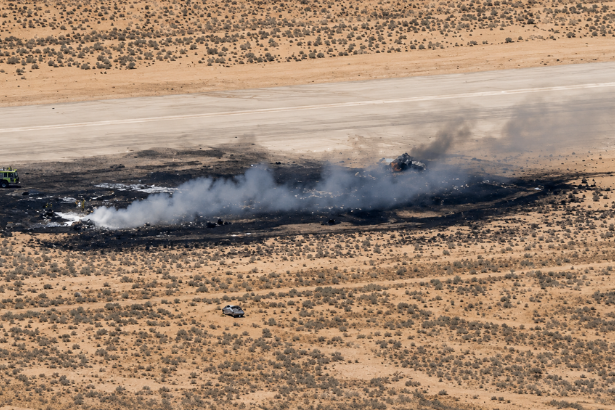
A B-52 bomber crash at Edwards Air Force Base in California’s Mojave Desert killed all eight people aboard on Monday, June 15, 2026, shortly after the aircraft took off for what officials described as a routine test mission. The crash occurred at approximately 11:20 a.m. PDT, with the aircraft bursting into flames upon impact. Colonel James Hayes, deputy commander for the 412th Test Wing at Edwards, confirmed at a press conference that initial indications showed the crash was not survivable. The victims included a mixed crew of uniformed military personnel, government civilians, and government contractors, including two Boeing employees.
What Happened: The B-52 Crash Timeline
A B-52 Stratofortress crashed shortly after takeoff Monday from Edwards Air Force Base in California’s Mojave Desert, according to the military base.
The base released a statement confirming the basic facts: “An Air Force B-52 Stratofortress carrying eight people on a routine test mission crashed today shortly after take-off at 11:20 a.m. (PDT). Initial indications are that the crash was not survivable. Emergency response personnel are on scene, and officials are working to account for all personnel. The crash is currently under investigation.”
The base is located in Kern County, in the Mojave Desert about 100 miles north of Los Angeles, near Lancaster, California. Aerial footage from news helicopters showed black smoke rising from a wide patch of charred desert near the base’s runway, with firefighters working to extinguish the blaze while other emergency vehicles stood by. There was nearly nothing left of the aircraft visible in the aftermath.
Who Were the Victims? Military, Civilians, and Boeing Contractors
The eight people killed represented a cross-section of the personnel who keep America’s bomber fleet operational, spanning active military service members, civilian government employees, and private contractors.
At a press conference Monday afternoon, officials confirmed that eight lives were lost. The victims were described as a mixed crew of uniformed military, government civilians, and government contractors. Their names were not immediately released as officials worked to notify next of kin.
Boeing confirmed that two of its employees were among those killed. In a statement, the company said: “We extend our deepest condolences to the loved ones of the eight crew members who lost their lives in the B-52 crash at Edwards Air Force Base, California. It is with great sadness that we confirm two Boeing employees were among those on board. We are in contact with their families and are offering support.”
The B-52 Stratofortress typically carries a crew of five, meaning Monday’s flight, with eight people aboard, carried additional personnel beyond a standard operational crew, consistent with a test mission involving government contractors and civilian specialists evaluating new equipment.
“Not Survivable”: What Officials Said at the Press Conference
Colonel James Hayes did not soften the severity of what investigators had already determined from reviewing footage of the crash.
“We lost eight great Americans. This crash is deemed to be unsurvivable, and right now, our thoughts and prayers are with the families of those who lost their loved ones,” Hayes said at the press conference.
Hayes explained that officials reviewed footage of the crash and deemed it unrecoverable and unsurvivable. Upon impact, the aircraft instantly burst into flames. First responders quickly took action to extinguish the blaze. Hayes noted that test missions take place every day, multiple times a day, at the Air Force Base, underscoring that Monday’s flight was not an unusual or high-risk undertaking by the standards of routine base operations.
“At this point, we don’t have any indication as to what the cause was of this. We won’t be able to release that information, and we don’t have an availability to get that anytime soon,” Hayes told reporters.
The Radar Modernization Program: Why the B-52 Was Flying
The specific purpose of Monday’s flight connects to one of the Air Force’s ongoing efforts to upgrade its aging bomber fleet with modern electronic systems.
Hayes said the B-52 bomber crashed shortly after takeoff for a mission supporting the “Radar Modernization Program,” which he described as a local test mission. This program involves fitting B-52 aircraft with new electronically scanned array radar systems built by Raytheon Technologies, replacing the mechanical radar systems that have been in use since the 1960s.
The radar upgrade is part of the broader B-52J modernization effort, which will also fit the aircraft with new Rolls-Royce F130 engines. The new radar system uses an “upside-down” display that beams toward the ground rather than up at the sky, a more powerful configuration than the legacy mechanical systems. It remains unclear whether the radar upgrade work is connected to the cause of Monday’s crash.
What Is the B-52 Stratofortress?
The B-52 Stratofortress, also known as the BUFF (big, ugly, fat fella), is one of the longest-serving bombers in U.S. military history, having been in operation since 1955.
The Boeing B-52 Stratofortress is a long-range bomber used for a variety of military missions. Capable of subsonic speeds and altitudes of 50,000 feet, the bomber was a workhorse of Operation Desert Storm in 1991 and has been the backbone of the United States’ bomber force for decades.
The aircraft can fly approximately 8,700 miles without refueling and can carry up to 70,550 pounds of weapons, making it capable of both conventional and nuclear missions. The B-52 is part of the backbone of the nuclear triad for the United States military, which includes submarine-launched missiles, intercontinental ballistic missiles, and the long-range bomber fleet of which the B-52 is a part, according to ABC News senior Pentagon reporter Luis Martinez.
By 2024, approximately 76 B-52s remained in active service. The bomber has flown missions in conflicts ranging from the Vietnam War to recent operations during the US-Israel war on Iran, and has more recently served as a launch platform for the D-21 Lockheed reconnaissance drone.
The Investigation: A Six-Month Process Ahead
The path from Monday’s crash to a public determination of cause is a lengthy, multi-stage military investigative process that will unfold over the coming months.
Investigators are now digging through the debris field for the aircraft’s black box and other equipment on board that could provide vital clues as to what went wrong. Officials said an interim safety board is doing an initial gathering of facts, which will then be handed to a safety investigation board that will look into the root causes of the crash. Hayes said that process will take about 30 days.
Following the safety investigation board’s findings, the matter moves to an accident investigation board, which will determine what information can be released to the public and to next of kin. Hayes said that process can take upwards of six months. The full public accounting of what caused Monday’s crash will therefore likely not be available until late 2026 or early 2027.
Edwards Air Force Base: Operations on Hold
The crash’s immediate operational impact has effectively paused activity at one of the Air Force’s most important test and evaluation facilities.
Operations at Edwards Air Force Base are on hold as the investigation continues on the runway. The Air Force and NASA regularly conduct test flights of new and developmental aircraft at Edwards Air Force Base, meaning the pause affects not only B-52 operations but the broader test flight schedule the base supports for multiple aircraft programs.
In an earlier update on social media, Edwards Air Force Base said the airfield was closed and all inbound aircraft were being diverted. Just a few hundred yards from the crash site, an intact B-52 bomber was visible in news helicopter footage, an indication of how close the disaster came to affecting additional aircraft and personnel on the ground.
California Governor Gavin Newsom Responds
California’s governor offered condolences and praised the emergency response in the hours following the crash.
California Governor Gavin Newsom said in a social media post that it was “a tragic incident.” He wrote: “My thoughts are with the victims, their families, and the entire Edwards Air Force Base community impacted by this tragic incident. Grateful to the first responders and emergency crew currently on the ground.”
The base’s location in Kern County, within the broader Antelope Valley region of Southern California, places it within a community with deep, multi-generational ties to military aviation and aerospace testing, given Edwards’ long history as a center for experimental flight research dating back to the earliest test flights of America’s most significant aircraft programs.
Latest Updates
The crash occurred Monday, June 15, 2026 at approximately 11:20 a.m. PDT at Edwards Air Force Base. NBC Los Angeles confirmed the initial crash report and location details shortly after the incident. ABC7 Los Angeles confirmed the full death toll of eight, Colonel James Hayes’ press conference statements, Boeing’s confirmation that two of its employees were among the victims, the Radar Modernization Program context for the test flight, and the multi-stage investigation timeline extending to approximately six months. Al Jazeera confirmed the international coverage of the incident, California Governor Gavin Newsom’s statement, and additional technical detail on the B-52J upgrade program and the aircraft’s broader military history and capabilities.
Full sources: NBC Los Angeles | Al Jazeera | ABC7 Los Angeles
Broader Implications
The loss of eight lives in Monday’s B-52 crash at Edwards Air Force Base is a tragedy that touches both the military community and the broader aerospace industry that supports America’s bomber fleet. The mixed crew composition, uniformed service members, government civilians, and Boeing contractors, reflects how deeply intertwined military test operations have become with private industry partnership, particularly for an aircraft program as old as the B-52 that continues to receive modern technology upgrades decades after its original design.
The Radar Modernization Program connection to Monday’s flight raises questions, not yet answered, about whether new technology integration played any role in the incident. The investigation process, which Hayes indicated will take up to six months to fully resolve, reflects the rigor the military applies to crash investigations involving an aircraft type that remains central to America’s nuclear deterrence posture and has flown in active combat operations as recently as the conflict with Iran.
For Edwards Air Force Base specifically, the pause in operations affects not just B-52 testing but the broader portfolio of experimental aircraft programs the base supports for both the Air Force and NASA. The base’s role as a premier flight test facility means the ripple effects of Monday’s tragedy will likely extend beyond the immediate B-52 program timeline.
For more breaking news and military aviation coverage, visit The Tech Marketer.
Frequently Asked Questions
1. How many people died in the B-52 bomber crash at Edwards Air Force Base?
Eight people died when the B-52 Stratofortress crashed shortly after takeoff at approximately 11:20 a.m. PDT on Monday, June 15, 2026. Officials confirmed the crash was not survivable. The victims included uniformed military personnel, government civilians, and government contractors, including two Boeing employees.
2. What caused the B-52 bomber crash?
The cause of the crash has not been determined. Officials said an investigation is underway and the cause cannot be released anytime soon. The aircraft was conducting a routine test mission supporting the Radar Modernization Program at the time of the crash. A safety investigation board will take approximately 30 days to gather initial facts, followed by an accident investigation board process that can take up to six months.
3. Where did the B-52 bomber crash happen?
The crash occurred at Edwards Air Force Base in Kern County, California, located in the Mojave Desert approximately 100 miles north of Los Angeles, near Lancaster. The aircraft crashed shortly after takeoff from the base’s runway.
4. What is the B-52 Stratofortress used for?
The B-52 Stratofortress is a long-range bomber that has been in service since 1955. It is capable of carrying both conventional and nuclear weapons, can fly approximately 8,700 miles without refueling, and can carry up to 70,550 pounds of payload. It is part of the backbone of the U.S. nuclear triad and has been used in conflicts from Vietnam to recent operations during the US-Israel war on Iran.
5. Did Boeing employees die in the crash?
Yes. Boeing confirmed in a statement that two of its employees were among the eight people killed in the crash. The company said it is in contact with their families and offering support, and extended condolences to the loved ones of all eight crew members who died.