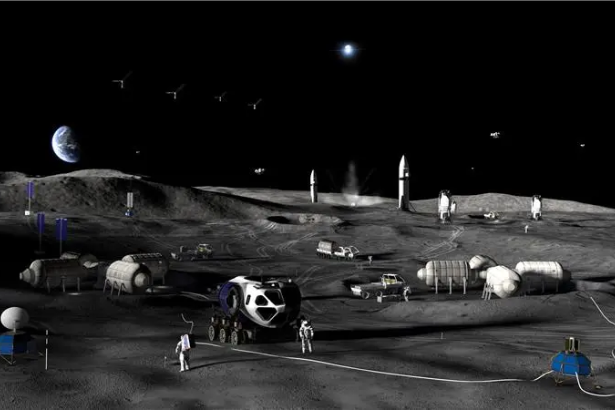
NASA’s lunar ambitions are shifting fast as a new $20 billion moon base plan signals a deeper, longer-term commitment to the Moon
Introduction
The NASA moon base plan is quickly becoming one of the most talked-about developments in space exploration, with reports pointing to a roughly $20 billion initiative focused on building a sustained human presence at the Moon’s south pole. The move marks a decisive shift from short-term missions toward permanent infrastructure, aligning with broader U.S. space policy goals.
Background and Context
For decades, NASA’s lunar ambitions have oscillated between exploration and retreat. The Apollo era proved humans could reach the Moon. The Artemis program aims to prove they can stay.
The lunar south pole has emerged as the focal point for this next phase. Scientists believe the region contains water ice trapped in permanently shadowed craters. That resource could be converted into drinking water, breathable oxygen, and even rocket fuel.
This changes everything. A moon base is no longer just symbolic. It becomes economically and strategically viable.
Latest Update or News Breakdown
The latest developments stem from NASA’s official policy rollout and supporting media coverage. According to NASA’s announcement, the agency is aligning its long-term exploration roadmap with national space policy goals, emphasizing sustained lunar presence and infrastructure development (NASA News Release).
Independent reporting adds more detail. Coverage from The Economist highlights that NASA’s evolving approach reflects a broader rethink of its future, shifting from mission-based exploration to ecosystem building (The Economist).
Meanwhile, CBS News reports that the agency is exploring a plan that could cost up to $20 billion to establish a functional base near the lunar south pole, designed to support astronauts for extended stays and enable scientific and industrial activity (CBS News).
This convergence of policy, funding signals, and infrastructure planning shows that the NASA moon base plan is no longer theoretical. It is entering early execution.
Expert Insights or Analysis
What stands out is the structural shift in NASA’s thinking.
Instead of treating the Moon as a destination, the agency is treating it as a platform.
That distinction matters. A platform implies:
- Continuous operations
- Logistics networks
- Partnerships with private companies
- Repeatable missions
Industry analysts see this as NASA borrowing a playbook from commercial space leaders. Build infrastructure first, then scale usage.
There is also geopolitical context. The United States is not alone in targeting the lunar south pole. China and its partners are pursuing similar ambitions. A permanent presence becomes both a scientific milestone and a strategic asset.
Broader Implications
The NASA moon base plan has ripple effects far beyond space exploration.
First, it accelerates the commercialization of space. Companies involved in lunar landers, habitats, robotics, and energy systems will see sustained demand. This aligns with broader trends covered in The Tech Marketer’s AI infrastructure and emerging tech analysis at https://thetechmarketer.com/.
Second, it reshapes supply chains. Transporting materials, building habitats, and maintaining systems on the Moon will require entirely new industrial frameworks.
Third, it redefines human spaceflight. Missions shift from brief visits to long-duration stays, which introduces challenges in health, sustainability, and autonomy.
Related History or Comparable Technologies
NASA has attempted long-term space habitation before.
The International Space Station proved humans can live in orbit for extended periods. But the Moon introduces new variables:
- Extreme temperature swings
- Dust that can damage equipment
- Communication delays
In some ways, this effort resembles early Antarctic bases. Remote, harsh, and dependent on logistics chains, yet essential for scientific advancement.
The difference is scale and distance. A lunar base operates far beyond Earth’s immediate reach.
What Happens Next
The next phase will likely unfold in stages:
- Robotic missions to prepare landing zones
- Deployment of power and communication systems
- Initial human missions with short stays
- Gradual expansion into a semi-permanent base
Key milestones will come from Artemis missions, particularly those focused on surface operations.
Funding approval and international partnerships will determine how quickly the NASA moon base plan moves from blueprint to reality.
Conclusion
The NASA moon base plan signals a turning point in space exploration. This is no longer about planting flags. It is about building footholds.
A $20 billion investment reflects confidence that the Moon can support sustained human activity and serve as a stepping stone to Mars and beyond.
If execution matches ambition, the next decade could redefine humanity’s relationship with space.
FAQ
What is the NASA moon base plan?
The NASA moon base plan refers to a proposed initiative to build a long-term human outpost on the Moon, likely near the south pole, with an estimated cost of around $20 billion.
Why is NASA focusing on the lunar south pole?
The south pole contains water ice in shadowed craters, which can be used for life support and fuel production, making it ideal for sustained missions.
How much will the NASA moon base plan cost?
Estimates suggest the project could cost up to $20 billion, depending on infrastructure scale and mission timelines.
When will NASA build a moon base?
Initial steps are already underway through Artemis missions, with incremental development expected over the next decade.
What is the goal of a lunar base?
The goal is to enable long-term human presence, support scientific research, test technologies for Mars missions, and develop a sustainable space economy.
Sources & References
- NASA: “NASA Unveils Initiatives to Achieve America’s National Space Policy” – https://www.nasa.gov/news-release/nasa-unveils-initiatives-to-achieve-americas-national-space-policy/
- The Economist: “NASA’s ambitious plans for a Moon base mark a rethinking of its future” – https://www.economist.com/science-and-technology/2026/03/25/nasas-ambitious-plans-for-a-moon-base-mark-a-rethinking-of-its-future
- CBS News: “NASA unveils ambitious $20 billion plan to build moon base near lunar south pole” – https://www.cbsnews.com/news/nasa-moon-base-plan-lunar-south-pole/