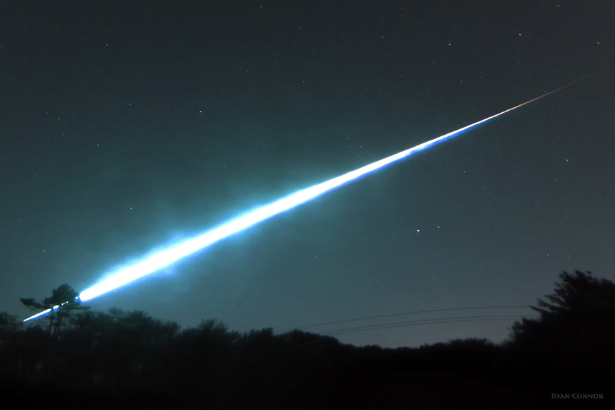
People from Elyria to Perry heard what sounded like an explosion on Tuesday morning. Some thought a transformer had blown. Others called 911. Within an hour, the National Weather Service had an answer from satellite imagery, and scientists were explaining why this particular fireball was genuinely extraordinary.
The meteor Cleveland Ohio residents woke up to on St. Patrick’s Day was not a rumble in the distance. Newsrooms across the region fielded calls all at once. Social media lit up with people asking the same question in different words: what was that? The answer, confirmed by the National Weather Service Cleveland before 9 a.m., was a meteor, and the satellite data that confirmed it told a story about how rare and how powerful the event actually was.
According to Cleveland19, reports of an explosion flooded in from as far west as Elyria and as far east as Perry, a geographic spread of more than 40 miles along the Lake Erie shoreline. NWS Cleveland posted on X that GLM imagery captured at 1301Z “does suggest that the boom was a result of a meteor,” pointing to data from the Geostationary Lightning Mapper, an optical sensor aboard NOAA’s geostationary satellite that operates continuously and picked up the bright atmospheric flash west of Cleveland, extending north over Lake Erie.
Why This Event Was Different From a Typical Fireball
Daytime fireballs are genuinely rare. To be visible against a sunlit sky rather than a dark one, an object has to be extraordinarily bright, which means it has to be extraordinarily large, moving extraordinarily fast, or both. Ryan Connor, an astronomy enthusiast and the only American Meteor Society station operator in Ohio, described it plainly after hearing the event on his outdoor microphone. “To see a fireball during the day, it has to be very, very, very bright, and that just almost never happens,” he said. “The fact that it actually created a sonic boom over our area, that’s probably a once-in-a-lifetime thing.”
The boom itself was different from what most people had heard before. Connor explained that a fighter jet produces a single sonic crack as it passes. This meteor generated a rolling series of successive booms as it punched through the atmosphere along its entire flight path. Anyone standing in a different location along that path heard the sound at a slightly different moment, which is why reports described it as an explosion in some neighborhoods, a distant rumble in others, and a low sustained thunder in places farther out.
Dr. Ralph Harvey of Case Western Reserve University described the object as somewhere in size between an engine block and a full-blown car, traveling from north to south at very high altitude. The physics were straightforward and also dramatic. “Rocks can’t handle that pressure very well,” Harvey told reporters, “so it blew up and made this beautiful fireball.”
What People Across Cleveland and Northeast Ohio Experienced
In Strongsville, a suburb southwest of Cleveland, at least one resident reported their entire house shaking, with picture frames and books knocked off walls and shelves. Others in northeast Ohio described vibrations that felt like a minor earthquake before they had any idea what had caused them.
Video captured at the Olmsted Falls City School District bus garage, west of Cleveland, showed the streak crossing the sky. A National Weather Service Pittsburgh employee driving toward northeast Ohio also caught the fireball on a dashcam. That footage, along with the GLM satellite confirmation, gave scientists enough data to start piecing together the object’s trajectory.
JonDarr Bradshaw, community engagement coordinator at the Great Lakes Science Center in Cleveland, explained the successive boom pattern to local reporters. As a supersonic object moves through air, pressure builds up in front of it. When it punches through that pressure wall, it creates a boom along every point of its entire flight path, not at one single moment. That is why people in Elyria and people in Perry both heard booms at slightly different times, and why the sound in some locations felt more like a rumble than a single explosion.
NWS forecaster Douglas Khan told Signal Cleveland that he personally heard and felt the boom that morning. The same event was visible from as far away as Indiana to the west, Virginia to the south, and Canada to the north. The American Meteor Society had more than 100 reports logged by mid-morning, with witnesses describing the streak as yellow, bright orange, and red.
No Ground Impact, But Fragments Remain Possible
No confirmed ground impact has been reported. Most of the object is believed to have disintegrated in the upper atmosphere before any fragments could reach the surface. Dr. Harvey said the high altitude at which the object broke apart made a surface strike unlikely, noting the chances of something hitting the ground were “pretty slim.” That said, he told residents in areas west of Cleveland to keep their eyes open. “I hope everybody that goes out on a dog walk or strolling through the fields or the parking lot, I hope they’re all keeping their eyes open for a rock that looks out of place,” he said.
The object’s trajectory, combined with the GLM flash position recorded west of Cleveland and extending north over Lake Erie, puts any surviving fragments, if they exist, in a zone that scientists will be able to narrow down as more video and sensor data is reviewed. Harvey and other scientists will analyze what is available in the coming days to refine estimates of the object’s size, speed, and exact path.
It is also worth noting that this fireball arrived in the context of an unusual stretch for northeast Ohio. A meteor was captured on a doorbell camera in mid-February, and another fireball was caught on camera just two days before this event on March 15. Tuesday’s event was not part of a pattern so much as a sharp departure from the scale of those earlier sightings.
For readers interested in space science, astronomy news, and the kind of stories that connect everyday life to the wider universe, The Tech Marketer covers science, technology, and the events that make headlines in both fields.
FAQ
Q1: What caused the loud boom heard across Cleveland and northeast Ohio on Tuesday? The boom was caused by a meteor entering Earth’s atmosphere on the morning of Tuesday, March 17, 2026, St. Patrick’s Day. The National Weather Service in Cleveland confirmed the event using Geostationary Lightning Mapper satellite imagery, which captured a bright atmospheric flash west of Cleveland extending north over Lake Erie at 1301Z. The object traveled from north to south at high altitude and produced successive sonic booms as it broke apart, heard and felt from Elyria to Perry, a geographic spread of more than 40 miles.
Q2: How far across Cleveland and the surrounding area was the meteor Cleveland Ohio event felt? Reports of the boom stretched from Elyria to the west and Perry to the east, covering more than 40 miles along the Lake Erie shoreline. The fireball itself was visible from Indiana to Virginia and as far north as Canada. The American Meteor Society received more than 100 reports from multiple states by mid-morning, with witnesses describing the streak as yellow, bright orange, and red. Homes in Strongsville had picture frames and books knocked off walls by the vibration.
Q3: Why did the meteor produce multiple booms rather than one explosion? As the meteor traveled through the atmosphere faster than the speed of sound, it created a sonic boom at every point along its flight path rather than at one single location. JonDarr Bradshaw of the Great Lakes Science Center in Cleveland explained that pressure builds up in front of a supersonic object, and each time the object punches through that wall of air, another boom is produced. People in different locations along the flight path heard the sound at slightly different times, which is why some described it as an explosion and others as a sustained rolling rumble.
Q4: Did the meteor Cleveland Ohio event result in any ground impact or damage? No confirmed ground impact has been reported. Dr. Ralph Harvey of Case Western Reserve University said the object was at very high altitude when it broke apart, making surface impact unlikely. Scientists believe most or all of the object disintegrated before reaching the ground. No injuries were reported. Harvey encouraged residents in areas west of Cleveland to watch for any rocks that look out of place in case small meteorite fragments survived the descent.
Q5: Why was this daytime fireball so unusual compared to normal meteor events? Most fireballs occur at night and are only visible against a dark sky. To be visible in full daylight, a meteor must be bright enough to compete with sunlight, which requires the object to be very large, very fast, or both. Ryan Connor, Ohio’s only American Meteor Society station operator, called it “probably a once-in-a-lifetime thing” to see a daytime fireball that also produced a sonic boom over a populated area. Dr. Harvey noted that while meteor sonic booms happen several times a day somewhere on Earth, the extraordinary factor here was that this one went directly over a densely populated major metropolitan area during morning hours.
Sources & References
- Cleveland 19 News, Julia Thyret, Multiple Reports of an Explosion in Northeast Ohio
- NWS Cleveland on X, GLM Imagery Confirmation at 1301Z, March 17, 2026
- Signal Cleveland, Franziska Wild, Michael Indriolo and Nick Castele, March 17, 2026
- News 5 Cleveland, Meteor Could Be Cause of Loud Boom in Northeast Ohio
- EarthSky, Sonic Boom From a Meteor Shakes Ohio and Pennsylvania
- ABC News, Emily Shapiro, Boom Heard in Ohio Appears to Have Been From a Meteor
- Fox 8 Cleveland
- BBC News Video, Fireball Streaks Across Sky
- Spectrum News 1, NWS Says Meteor Potentially Caused Loud Boom Throughout NE Ohio