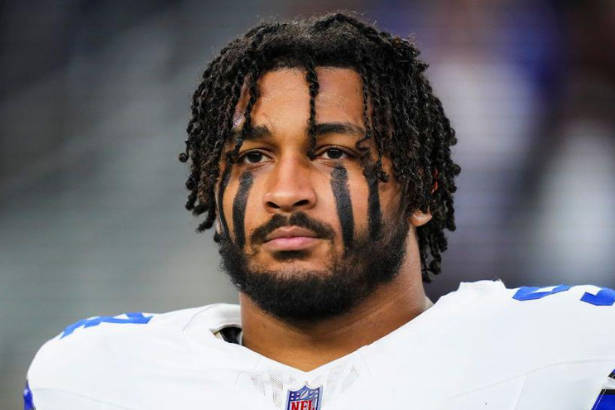
Marshawn Kneeland CTE diagnosis 2026 has brought a new and painful dimension to the story of the young Dallas Cowboys defensive end who died by suicide in November 2025 at the age of 24. Boston University’s CTE Center announced Tuesday that Kneeland was posthumously diagnosed with Stage 1 chronic traumatic encephalopathy after his family donated his brain for research following his death. His family, including his girlfriend Catalina Mancera, released a statement calling the diagnosis important context for understanding what NFL athletes and other high-contact sport participants may be struggling with. The BU CTE Center emphasized clearly that suicide is complex and multifactorial, and that a posthumous CTE diagnosis should not be considered the cause of a suicide.
Who Was Marshawn Kneeland
Before examining the CTE diagnosis, the person at the center of this story deserves to be understood on his own terms.
Marshawn Kneeland was a 24-year-old defensive end who played for the Dallas Cowboys. He had previously played college football at Western Michigan, where documented mental health concerns first surfaced as early as 2020. He was regarded by those who knew him as a person of genuine warmth and talent, and his family’s statement describes wanting people to remember him with compassion for the person he was rather than defining him by the final moments of his life.
The Cowboys selected Kneeland with the expectation that he would develop into a significant contributor on their defensive line. His career at the professional level was interrupted by his mental health struggles, and his death in November 2025 came as a profound shock to his teammates, coaches, and the broader NFL community.
What Boston University Found: Stage 1 CTE
The diagnosis itself requires context about what CTE is, what Stage 1 means, and what BU’s research has established about young athletes.
Boston University’s CTE Center made the diagnosis after Kneeland’s family donated his brain for research. There are four stages of CTE, with Stage 4 showing the most damage. Stage 1 represents the earliest detectable presence of the disease, characterized by focal areas of abnormal tau protein accumulation in the brain but without the widespread damage associated with later stages.
Dr. Ann McKee, director of the Boston University CTE Center and chief of neuropathology for the VA Boston Healthcare System, said she was not surprised by the finding. “We have found this progressive brain disease in nearly half of the athletes we’ve studied who have died before the age of 30,” she said in the family’s statement. “Thanks to the generosity of our brain donor families, we now better understand the earliest stages of CTE, and it is bringing us closer than ever to diagnosing it during life. My team and I are fully dedicated to finding effective treatments and a cure for CTE.”
The prevalence figure Dr. McKee cited, CTE in nearly half of athletes they have studied who died before age 30, is a research finding that carries significant implications for how the sports medicine and neuroscience communities think about the timeline of CTE onset in contact sport athletes.
The Family’s Statement: Context, Not Cause
The language the Kneeland family chose in their public statement reflects careful attention to the relationship between CTE and the circumstances of his death.
Kneeland’s family, including his girlfriend Catalina Mancera, released a statement Tuesday that read in full: “While this diagnosis does not change the tragedy of his passing, it provides important context about some of the struggles he may have been facing. We share this information to help people understand what NFL and other high contact sport athletes might be struggling with. Raising awareness is important to us. We continue to remember Marshawn with compassion for the person he was, rather than defining him by the final moments of his life. One Love.”
The BU CTE Center accompanied this with a direct and important clarification: suicide is “complex and multifactorial” and “a post-mortem CTE diagnosis should not be considered the cause of a suicide.” This framing reflects the scientific community’s understanding that CTE and suicide are related but not in a simple causal way. CTE may contribute to mood dysregulation, depression, impulsivity, and other symptoms that could increase risk, but each individual’s circumstances are unique and complex.
Mental Health Concerns That Predated the NFL
According to records obtained by ESPN, Kneeland’s mental health challenges were documented as far back as his college years at Western Michigan, years before any NFL contact.
In one documented incident at Western Michigan in 2020, Kneeland was required to turn in his firearm to police until he was cleared by a counselor following concerns about his mental health. In another incident, a friend called authorities with concern over his wellbeing. He was found on railroad tracks, saying he hoped a train would run him over. He was subsequently hospitalized.
These documented incidents, which occurred before Kneeland had experienced years of NFL-level contact, complicate any simple linear narrative connecting CTE to his struggles. They suggest a mental health history that predated his professional football career, while the CTE diagnosis adds the layer of physical brain pathology that may have compounded those existing challenges over time.
The Events of November 6, 2025
The circumstances of Kneeland’s death were detailed in a Texas Department of Public Safety report released Friday.
Texas police found Kneeland’s body in the early morning of November 6, 2025, after he had evaded officers during a traffic pursuit, crashed his car, and fled on foot. According to the DPS report, a trooper saw Kneeland’s car speeding down the highway, sometimes traveling at more than 145 mph and making several unsafe lane changes. The trooper ultimately lost sight of the vehicle. While officers searched for Kneeland, they received information that he had expressed suicidal ideations. His body was subsequently found in the early hours of November 6.
The DPS report provides the factual reconstruction of what happened that night. It does not, and cannot, explain the internal experience that led to it.
What CTE Research Tells Us About Young Athletes
The Kneeland diagnosis is significant within a broader body of research that has raised serious questions about the relationship between contact sport participation, especially football, and chronic brain disease.
Dr. McKee’s statement that CTE has been found in nearly half of athletes studied who died before age 30 is drawn from BU’s ongoing brain donation research program. Stage 1 CTE in a 24-year-old represents some of the earliest detectable pathology the center has documented, raising questions about the cumulative effect of repetitive head impacts even in players who have not experienced the decades of exposure associated with older cases in the study population.
The research community has been careful to note that the prevalence figures from brain donation programs represent a self-selected sample. Families who donate brains often do so because they suspect something may be wrong, which means the research population may not fully represent the broader population of contact sport athletes. That caveat has been consistently acknowledged by BU researchers while they continue to publish findings from the largest CTE brain bank in the world.
Latest Update: Cowboys and NFL Response
The Marshawn Kneeland CTE diagnosis 2026 announcement has prompted responses from the NFL and the Dallas Cowboys organization, though specific statements had not been published by ESPN as of publication.
The diagnosis adds Kneeland’s name to a list of former NFL players who have been posthumously diagnosed with CTE, a list that has grown substantially since Aaron Hernandez’s diagnosis in 2017 brought widespread public attention to the disease. The Cowboys organization had previously expressed support for his family following his death in November 2025. The NFL’s Head, Neck and Spine Committee continues its ongoing research partnership with BU and other institutions.
For full coverage, follow ESPN, BBC News, and People.
Broader Implications: What CTE at 24 Means for the NFL
The Marshawn Kneeland CTE diagnosis 2026 is a story about one person, one family’s grief, and one family’s decision to share painful information in hopes of helping others. It is also, unavoidably, a story about a systemic question that the NFL and the broader contact sport world has been confronting for more than a decade.
Stage 1 CTE in a 24-year-old who played football from youth level through the NFL is consistent with what BU researchers have been documenting, but it is not easier to absorb for being consistent. The disease was already present in a 24-year-old’s brain. The mental health struggles that predated his professional career existed alongside a developing brain that was absorbing repetitive impacts across years of organized football. The family’s decision to frame the diagnosis as context rather than cause is both scientifically appropriate and deeply human.
The research that Dr. McKee and her colleagues are conducting, working toward diagnosing CTE during life rather than posthumously, is the work that could change how contact sports manage player health in the decades ahead. Every brain donation, including Kneeland’s, moves that work forward.
For more sports and breaking news coverage, visit The Tech Marketer.
What Happens Next
The BU CTE Center will continue its research with Kneeland’s brain donation contributing to its ongoing database. The family has stated their intention to raise awareness about the struggles NFL athletes may face. No information about formal NFL or Cowboys institutional responses has been confirmed as of publication. Dr. McKee and her team continue to pursue diagnostic tools and treatment research that could identify CTE in living players.
FAQ
What is the Marshawn Kneeland CTE diagnosis 2026?
Boston University’s CTE Center posthumously diagnosed former Dallas Cowboys defensive end Marshawn Kneeland with Stage 1 chronic traumatic encephalopathy after his family donated his brain for research. Kneeland died by suicide on November 6, 2025, at the age of 24. The diagnosis was announced on July 7, 2026.
What does Stage 1 CTE mean?
CTE has four stages, with Stage 4 representing the most severe damage. Stage 1 represents the earliest detectable presence of the disease, characterized by focal abnormal tau protein accumulation in the brain. Dr. Ann McKee of BU’s CTE Center stated that her team has found CTE in nearly half of the athletes they have studied who died before age 30, making Stage 1 diagnoses in young athletes a documented finding in their research.
Did CTE cause Marshawn Kneeland’s death?
The BU CTE Center explicitly stated that suicide is “complex and multifactorial” and that “a post-mortem CTE diagnosis should not be considered the cause of a suicide.” ESPN records also document that Kneeland had documented mental health concerns dating to 2020 at Western Michigan, before his NFL career, including a hospitalization following an incident on railroad tracks. His family framed the diagnosis as providing important context for understanding his struggles rather than a simple explanation for his death.
What did Marshawn Kneeland’s family say about the CTE diagnosis?
Kneeland’s family, including his girlfriend Catalina Mancera, released a statement saying the diagnosis “does not change the tragedy of his passing” but “provides important context about some of the struggles he may have been facing.” They shared the information to help people understand what NFL and high-contact sport athletes might face, ending with: “We continue to remember Marshawn with compassion for the person he was, rather than defining him by the final moments of his life. One Love.”
What research does Boston University’s CTE Center conduct?
The Boston University CTE Center, directed by Dr. Ann McKee, operates the world’s largest CTE brain bank, studying donated brains from athletes and military veterans to understand the disease’s onset, progression, and effects. Their research has found CTE in nearly half of athletes studied who died before age 30. The center’s stated goal is to develop the ability to diagnose CTE in living patients and eventually to find treatments and a cure.
Sources and References
- ESPN (fully accessed): https://www.espn.com/nfl/story/_/id/49296262/late-cowboys-player-marshawn-kneeland-diagnosed-cte
- BBC News (original submission, blocked): https://www.bbc.com/news/articles/c5yz6kllg1jo
- People (original submission, blocked): https://people.com/marshawn-kneeland-cause-of-death-revealed-dallas-cowboys-player-was-24-11844906