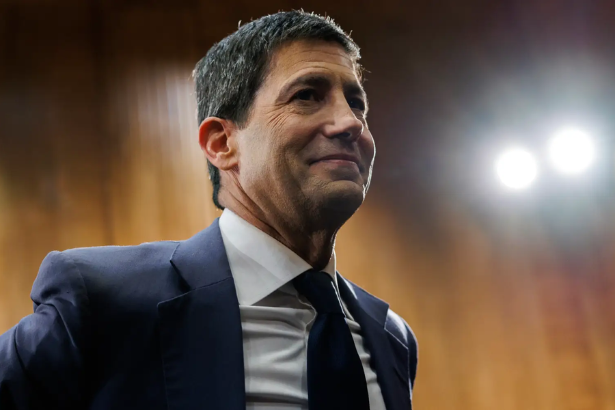
The Kevin Warsh Fed meeting on Wednesday, June 17, 2026, marked the new Federal Reserve chairman’s first time leading the central bank’s rate-setting committee, and it delivered a result that surprised few but unsettled markets significantly. The Federal Open Market Committee voted unanimously to hold interest rates steady, but updated projections released alongside the decision showed committee members now expect a quarter-point rate hike before the end of 2026, a sharp reversal from the rate cut they had projected in March. Stocks sold off sharply following Warsh’s press conference, with traders pricing in a better than 90% chance of a rate hike by October.
The Decision: Rates Held at 3.5% to 3.75%
The Federal Reserve kept interest rates unchanged Wednesday at Chairman Kevin Warsh’s first rate-setting meeting as the central bank’s leader, maintaining the federal funds rate in a range of 3.5% to 3.75%.
The vote on rates was unanimous, a contrast from the previous meeting, at which there were four dissents for various reasons. “Economic activity is expanding at a solid pace despite elevated uncertainty that owes, in part, to the conflict in the Middle East,” the Fed said in its policy statement. The committee also noted that “job gains have kept pace with the workforce,” a sign of labor market stability that gave policymakers room to hold steady rather than act immediately.
The decision matched what economists overwhelmingly expected heading into the meeting, with the Fed having kept its short-term rate steady throughout 2026 since its last cut in December 2025.
The Dot Plot Reversal: From Rate Cuts to a Rate Hike
The most consequential signal from Wednesday’s meeting was not the rate decision itself but the updated projections that accompanied it, revealing a dramatic shift in the committee’s collective outlook.
Updated forecasts from individual members of the rate-setting committee suggested they expect to raise interest rates by a quarter percentage point this year. That’s a turnaround from three months ago, when the average committee member was projecting a quarter-point cut in 2026. The median forecast now shows the federal funds rate ending 2026 at 3.8%, up from 3.4% in the Fed’s March projections, a quarter percentage point above the current range.
At least three of the FOMC’s 12 voting members had been expected to project rate hikes this year, but the actual dot plot revealed a more dramatic consensus: half of the committee members expect rate hikes as soon as this year. “Despite the recent pullback in oil, half of the members of the FOMC expect rate hikes as soon as this year, reflecting strong labor market and inflation data,” said Kay Haigh, global co-head and CIO of fixed income and liquidity solutions at Goldman Sachs Asset Management.
Warsh’s Hawkish Message: “We’re Going to Fix That”
In his first press conference as Fed chairman, Warsh delivered remarks that left little doubt about his priorities, even as he avoided committing to a specific policy path.
Warsh, in his first news conference as chair, underscored the Fed’s determination to bring inflation down to the central bank’s 2% target, suggesting he will take a hawkish approach as chair. “We’ve missed on inflation for five years and we’re going to fix that,” he said. “When we deliver on our price stability objectives, which we will, the American people will feel as though the hardships that they’ve been living through” will ease.
Warsh also acknowledged the burden current conditions are placing on households directly: “persistently high prices are a burden for the American people.” Consumer prices overall were up 4.2% in May from a year ago, the biggest annual increase since April 2023, giving Warsh’s comments immediate real-world weight.
Why Markets Sold Off: 90% Odds of an October Hike
The market reaction to Wednesday’s meeting was swift and significant, reflecting how directly investors interpreted Warsh’s tone as a signal of future tightening rather than reassurance.
After the news conference, stocks sold off as traders projected a better than 90% chance of a rate hike by October. The S&P 500 closed down 1.2%, the Nasdaq Composite fell 1.3%, and the Dow slid 506 points. The 10-year Treasury yield, which heavily influences consumer borrowing rates, shot up to nearly 4.5% by 4 p.m.
Warsh did not hint whether he was personally leaning toward hiking rates, but economists saw his message at the press conference as hawkish regardless. “The risk that they might need to raise rates has clearly risen given what we got today,” said Matthew Luzzetti, chief U.S. economist at Deutsche Bank. Financial markets agreed with that read, and bond yields rose alongside the equity sell-off.
Warsh’s Unusual Choice: No Personal Rate Projection
One of the more closely watched procedural details of the meeting involved Warsh’s decision not to participate in the projection exercise that all other committee members completed.
Kevin Warsh was the only committee member who didn’t submit an economic projection. “For me it’s not helpful,” he said. The Fed did not identify the participant by name in its release, though some Fed watchers had speculated in advance that Warsh would refrain from providing an individual rate projection, consistent with his long-standing public criticism of forward guidance as a policy tool.
We will hopefully get more clarity over time on the extent of Warsh’s aversion to forward guidance generally. He’s long criticized it but never defined how he would correct the practice. Forward guidance can take soft and hard forms, and the open question is whether Warsh wants to eliminate both, or simply reduce the Fed’s reliance on the harder, more specific commitments. Notably, the Fed also struck forward guidance language from its policy statement entirely at this meeting.
Five New Task Forces: Warsh’s “Regime Change” Begins
Beyond the immediate rate decision, Warsh used his first meeting to begin implementing structural changes he had signaled wanting to make to the Fed’s internal operations.
Warsh had suggested before he became chairman that the Fed needed “regime change.” At Wednesday’s news conference, he announced the creation of five task forces that would begin work in the next “couple of weeks,” reviewing the Fed’s communications, as well as critical areas of monetary policy, such as inflation, its sources of data, balance sheets, and productivity.
Asked whether the Fed’s long-standing 2% inflation target was on the table for the task forces to revisit, Warsh said he did not believe in revisiting that target until it had actually been reached. The announcement signals that Warsh intends to use his tenure to reshape how the Fed operates internally, not simply to set interest rates differently than his predecessor.
Powell Stays on the Board: An Unusual Arrangement
The presence of Warsh’s immediate predecessor at the same meeting, in a different capacity, added an unusual dimension to an already closely watched gathering.
In an unusual move, Warsh’s predecessor, Jerome Powell, elected to remain on the Fed’s governing board for a period of time after his term as chairman expired last month. Powell voted Wednesday in favor of keeping rates at about 3.6%, and has promised to keep a low profile and not compete with the new chairman.
President Trump had appointed Warsh after sharply criticizing Powell for not reducing rates deeply enough during his tenure. Those attacks largely backfired in one sense, as they prompted Powell to remain on the Fed’s governing board rather than departing entirely, where he continues to participate in committee votes even after handing over the chairmanship.
Trump’s Reaction: “All Right, Whatever”
President Trump, whose criticism of the Fed’s previous rate policy helped shape the path to Warsh’s appointment, offered a notably muted public reaction to Wednesday’s decision and projections.
Trump said the Fed’s decision Wednesday was “all right, whatever.” Asked about the potential for a rate hike specifically, Trump told reporters in Paris that it’s “hard to believe.” He added: “It’s so unusual, but we have a very good guy over there now, so I’m guided by what he wants.”
Warsh was also asked directly whether he had communicated with Trump since taking his new role. “I don’t have anything for you,” he responded, declining to elaborate on any contact between the new Fed chairman and the president who appointed him.
What This Means for Borrowers and Markets
The practical implications of Wednesday’s meeting extend beyond the immediate market reaction into the borrowing costs households and businesses will face for the remainder of 2026.
Warsh now faces a difficult choice. The Fed typically seeks to combat inflation by lifting interest rates to slow borrowing and spending and cool the economy. Yet taking such a step would likely attract the ire of the White House and could lift the cost of mortgages, auto loans, and other borrowing, just before the midterm elections.
If the Iran war’s resolution holds, gas prices will likely continue to decline and inflation may cool in the coming months. But prices of many goods and services, such as clothes, dental care, and child care, were rising before the Iran war began, and inflation has been above the Fed’s 2% target for five consecutive years, suggesting the inflation problem facing Warsh extends well beyond the immediate energy shock.
Latest Updates
The Federal Reserve’s policy meeting and Kevin Warsh’s first press conference as chair took place on Wednesday, June 17, 2026. CNBC confirmed the full meeting proceedings, the updated dot plot showing the median 2026 rate forecast at 3.8%, comments from Kay Haigh of Goldman Sachs Asset Management and Michael Feroli of JPMorgan, and the unusual nature of a new chair’s first meeting historically producing hawkish signals. PBS News and NPR confirmed Warsh’s direct quotes including “We’ve missed on inflation for five years and we’re going to fix that,” the unanimous rate vote, and the announcement of five new task forces. NBC News and CBS News confirmed the market reaction including the S&P 500’s 1.2% decline, the Dow’s 506-point drop, the 10-year Treasury yield rising to nearly 4.5%, and President Trump’s “all right, whatever” comment.
Full sources: CNN | Bloomberg | CNBC
Broader Implications
Kevin Warsh Fed Meeting as Federal Reserve chairman delivered a result that runs directly counter to the expectations that accompanied his appointment. President Trump nominated Warsh in hopes he would push for lower interest rates, and Warsh himself campaigned for the role partly by arguing that AI-driven productivity gains could allow rates to fall without reigniting inflation. Instead, his debut meeting produced a hawkish dot plot, a quarter-point rate hike now projected for 2026, and a press conference message centered on fixing a five-year inflation miss.
The historical pattern Citi identified, that meetings led by incoming Fed chairs tend to establish “hawkish bona fides” to reassure investors that inflation control remains the priority, appears to have played out exactly as that framework would predict. Whether Warsh maintains that posture once actual policy decisions are required, particularly given the political pressure from an administration that explicitly wanted lower rates, will be the central question for his tenure going forward.
For markets and households alike, the practical reality emerging from Wednesday’s meeting is that the rate cuts widely anticipated at the start of 2026 are now off the table, replaced by the live possibility of a hike before year’s end, driven primarily by inflation that has remained stubbornly above target even as the immediate Iran war energy shock begins to ease.
For more Federal Reserve, interest rate, and economic policy coverage, visit The Tech Marketer.
Frequently Asked Questions
1. Did the Federal Reserve raise interest rates at Kevin Warsh’s first meeting?
No. The Federal Reserve held interest rates steady at its June 17, 2026 meeting, keeping the federal funds rate in a range of 3.5% to 3.75%. The vote was unanimous. However, updated projections released at the same meeting showed committee members now expect a quarter-point rate hike before the end of 2026.
2. What did Kevin Warsh say at his first press conference as Fed chairman?
Warsh said: “We’ve missed on inflation for five years and we’re going to fix that.” He also acknowledged that “persistently high prices are a burden for the American people,” signaling a hawkish approach to fighting inflation despite having previously advocated for lower rates before becoming chairman.
3. Why did stocks fall after the Fed meeting?
Stocks fell because investors interpreted Warsh’s tone and the updated dot plot as more hawkish than expected. The S&P 500 closed down 1.2%, the Nasdaq fell 1.3%, and the Dow dropped 506 points. Traders priced in a better than 90% chance of a rate hike by October following the press conference.
4. Why didn’t Kevin Warsh submit his own interest rate projection?
Warsh was the only Federal Open Market Committee member who did not submit an individual economic projection at the June 2026 meeting, saying “For me it’s not helpful.” This aligns with his long-standing public criticism of forward guidance as a Fed communication tool, and the committee also removed forward guidance language from its policy statement at this meeting.
5. What task forces did Kevin Warsh announce at his first Fed meeting?
Warsh announced the creation of five task forces that will begin work reviewing the Fed’s communications and other critical areas including inflation, data sources, balance sheets, and productivity. He said he did not believe in revisiting the Fed’s 2% inflation target until it had actually been reached.