

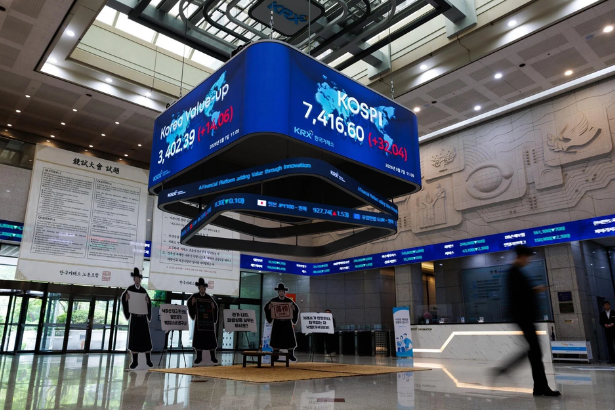
The KOSPI plunge on Tuesday, July 28, 2026, became one of the most severe single-session crashes in South Korean stock market history. The Korea Composite Stock Price Index fell 732.09 points, closing at 6,023.66, a decline of 10.84% that ranks as the fourth-largest percentage drop in the index’s history. At the session low the KOSPI fell as much as 11.3%, briefly dipping below 6,000 for the first time since April 14, before recovering a portion of the loss into the close. The Korea Exchange activated a market-wide circuit breaker after the index remained more than 8% below its previous close, halting all trading for 20 minutes in the eighth circuit-breaker activation of 2026. Samsung Electronics fell 12% and SK Hynix dropped as much as 13%, together wiping out hundreds of billions of dollars in market value in a single session driven by three converging catalysts: China’s mass production of domestic chip equipment, CXMT’s record-breaking Shanghai IPO, and renewed global fears about AI demand sustainability.
What Triggered the KOSPI Crash: Three Converging Catalysts
The July 28 selloff was not the result of a single event but the collision of three distinct developments that each individually would have pressured semiconductor stocks, and together produced a panic cascade through Asian markets.
The first and most significant catalyst was a report that China’s Shanghai Yuliangsheng had started mass production of deep ultraviolet lithography equipment, a core tool in semiconductor manufacturing that has historically been dominated by the Dutch company ASML. Reports that China has begun mass-producing its own deep ultraviolet DUV lithography equipment further dampened investor sentiment. This was interpreted as a signal that China is making progress toward technological self-reliance despite U.S. export controls on semiconductor equipment. If Chinese memory makers can source DUV equipment domestically, the procurement bottlenecks that have constrained Chinese semiconductor output begin to dissolve, potentially unleashing a wave of additional DRAM supply into an already competitive global memory market.
The second catalyst was the debut of CXMT on Shanghai’s STAR Market, where the Chinese memory chipmaker’s shares surged more than 400% on their first trading day. CXMT’s market capitalization briefly surpassed CNY 3 trillion, approximately $443.3 billion, on its first trading day, making it the largest mainland China-listed company. It was the largest A-share IPO in China since Agricultural Bank of China’s listing in 2010. A Chinese memory company achieving a market capitalization of $443 billion in a single trading session is a stark signal to global chip investors about where the next competitive threat to Korean semiconductor dominance is expected to originate.
The third factor was a continued selloff in Nvidia shares overnight in U.S. trading, driven by renewed concerns about AI capital expenditure sustainability and what analysts have been calling round-tripping concerns, the worry that AI infrastructure spending is generating revenues that do not yet justify the scale of investment being made.
Samsung and SK Hynix: The Specific Damage
The Kospi was down 10.5% at 6,051.19 by midday. Samsung’s shares tumbled 12% while those for SK Hynix were down 12.7%. Bloomberg’s final reporting placed both Samsung and SK Hynix declines at over 13% each by the session close, reflecting continued selling pressure through the afternoon after the 20-minute circuit breaker suspension.
Samsung Electronics is the world’s largest memory chip producer and the single largest component of the KOSPI index. SK Hynix is the world’s second-largest DRAM maker and the leading supplier of high-bandwidth memory to Nvidia for its AI accelerator chips. A simultaneous 12 to 13% decline in both stocks in a single session represents the market’s judgment that the Chinese competitive threat is real, imminent, and potentially structural rather than cyclical. The HBM supply chain that has generated extraordinary profits for SK Hynix in particular over the past two years depends critically on Nvidia’s continued AI chip demand and on the absence of a credible Chinese competitor in memory. Both of those assumptions came under pressure on July 28.
The Circuit Breaker: South Korea’s Eighth of 2026
The Korea Exchange activated a marketwide circuit breaker after the index remained more than 8% below its previous close. Trading was suspended for 20 minutes in the eighth circuit-breaker activation of 2026 and the 14th since the mechanism was introduced. The frequency of circuit breaker activations in 2026, eight in the first seven months of the year, reflects the extraordinary volatility that has characterized South Korean markets during a period defined by the AI chip boom, the subsequent correction, and repeated shocks from Chinese technology developments. BigGo Finance
Korea’s circuit breaker mechanism was designed to give markets time to process extreme dislocations and prevent panic selling from becoming a self-reinforcing collapse. The 20-minute trading pause on July 28 did not reverse the session’s direction, but the index did recover from its intraday low of below 6,000 to close at 6,023.66, suggesting the mechanism had some stabilizing effect.
July 2026: The KOSPI’s Worst Month in Nearly Three Decades
The July 28 crash does not exist in isolation. It is the culmination of a broader monthly collapse that has been running since the KOSPI peaked at a record closing high of 9,114.55 on June 22, 2026. The Kospi has now declined 29% during July, exceeding its previous record monthly fall of 27% during the Asian financial crisis in October 1997. The index is also 34% below its June 22 record closing level. BigGo Finance
That context transforms the July 28 session from a severe daily event into a historic monthly reckoning. The KOSPI’s 29% decline in a single month is its worst in nearly 30 years, surpassing even the carnage of the 1997 Asian financial crisis. The index had already entered a bear market earlier in July after falling more than 20% from its June peak, driven by chipmaker volatility, AI valuation concerns, and the growing use of leveraged investment products that amplify both gains and losses in South Korea’s retail-heavy investor market. Despite the reversal, the KOSPI remains 43% higher since the start of 2026, reflecting the scale of the AI-driven rally that preceded the decline. BigGo Finance
US Futures and Asian Market Ripple Effects
The Korean selloff did not remain contained within South Korean borders. Asian markets broadly declined on Tuesday, with Japanese, Taiwanese, and Hong Kong technology stocks all falling in sympathy as the China chip equipment news and the CXMT IPO reverberated across the region. Oil prices fell more than 1%, while U.S. futures were little changed. The relatively muted US futures reaction, compared to the violence of the Asian selloff, suggests that markets were pricing in the possibility that Alphabet’s strong Q2 results, reported Monday evening, might partially offset the chip sector pessimism when US cash markets opened Tuesday morning.
CNBC, Barron’s, and the Wall Street Journal all tracked the developing situation through live market coverage, with the Wall Street Journal noting that Nasdaq futures slipped as the depth of the Asian chip selloff became clear. The spread of the selling from Seoul to Tokyo and Hong Kong illustrated how interconnected the global semiconductor supply chain is and how quickly a development in Chinese chip manufacturing can transmit across the world’s technology stock markets.
What This Means for the Global AI Chip Landscape
The July 28 KOSPI crash is a market verdict on a specific thesis that has driven semiconductor stock valuations to record highs in the first half of 2026: that the US-led AI infrastructure boom would generate durable demand for high-end memory and logic chips that South Korean manufacturers supply, that Chinese competition would remain constrained by export controls, and that the AI spending cycle was sustainable at its current scale.
All three of those assumptions took direct hits on July 28. CXMT’s IPO demonstrated Chinese capital’s willingness to fund memory competition at a scale that exceeds most previous projections. The DUV lithography mass production report suggested that US export controls on equipment may be less durable than assumed. And the ongoing pressure on Nvidia shares reflected continuing uncertainty about whether the AI spending being made by hyperscalers is generating sufficient returns to justify continuation at current levels.
Latest Updates
The KOSPI closed at 6,023.66 on July 28, 2026, down 732.09 points or 10.84% on the session. CNBC confirmed the over-10% intraday decline, the circuit breaker activation, Samsung’s 12% decline, SK Hynix’s 12.7% decline, and the AI sustainability concerns driving the chip sector selloff. Barron’s confirmed the SK Hynix and Samsung declines as the primary drivers of the KOSPI drop and situated the selloff within the broader context of global chip stock volatility in July 2026. The Wall Street Journal confirmed that Nasdaq futures slipped as the chip selloff in Asia deepened, connecting the Korean market crash to US pre-market trading activity.
Sources: CNBC | Barron’s | Wall Street Journal
Broader Implications
The KOSPI’s July 2026 performance, a record-breaking 29% monthly decline following a record-setting first-half rally, is a compressed illustration of what happens when a market-wide narrative about transformative technology meets the reality of competitive disruption. South Korea built an extraordinary AI-era stock rally on the thesis that its two dominant chipmakers, Samsung and SK Hynix, were irreplaceable suppliers to a US-led AI infrastructure build-out that had no credible alternative supply chain. China is systematically building that alternative supply chain, one IPO and one equipment breakthrough at a time. The speed at which that thesis is being challenged, and the violence of the market’s reaction when each new data point arrives, suggests the correction in Korean semiconductor stocks may not be over even after a 34% decline from the June peak. For more global finance and technology coverage, visit thetechmarketer.com.
3. FREQUENTLY ASKED QUESTIONS
- Why did the KOSPI plunge on July 28, 2026?
The KOSPI fell nearly 11% on July 28, 2026, due to three converging factors: China’s Shanghai Yuliangsheng began mass production of deep ultraviolet lithography equipment, reducing South Korea’s competitive advantage in chip manufacturing; Chinese memory chipmaker CXMT debuted on Shanghai’s STAR Market with a 400% first-day surge and a market cap exceeding $443 billion; and continued selling pressure on Nvidia shares in the US reinforced concerns about AI demand sustainability.
- How much did Samsung and SK Hynix fall on July 28, 2026?
Samsung Electronics fell approximately 12% and SK Hynix dropped approximately 12.7% to 13% during the July 28, 2026 session, making them the primary drivers of the KOSPI’s 10.84% daily decline. Both companies are the world’s largest producers of memory chips and are heavily exposed to AI infrastructure demand through their HBM chip supply relationships with Nvidia.
- Did South Korea trigger a circuit breaker during the KOSPI crash?
Yes. The Korea Exchange activated a market-wide circuit breaker after the KOSPI remained more than 8% below its previous close, halting all trading for 20 minutes. It was the eighth circuit-breaker activation in South Korea in 2026 and the 14th since the mechanism was introduced.
- How does the July 28, 2026 KOSPI crash rank historically?
The KOSPI’s 10.84% single-day decline on July 28, 2026 was the fourth-largest percentage drop in the index’s history. The index also posted a 29% monthly decline in July 2026, exceeding its previous record monthly fall of 27% during the Asian financial crisis in October 1997. The KOSPI is 34% below its June 22, 2026 record closing high of 9,114.55.
- What is CXMT and why did its IPO affect South Korean stocks?
CXMT is a Chinese memory chipmaker that debuted on Shanghai’s STAR Market on July 28, 2026, with shares surging over 400% on the first day and a market capitalization briefly exceeding $443.3 billion, making it China’s largest listed company. Its record-breaking IPO signaled to global investors that China is building a serious competitive threat to South Korean memory chip dominance, accelerating selling in Samsung and SK Hynix shares.
4. SOURCES AND REFERENCES
- CNBC: U.S. Stock Futures Slip, South Korea’s KOSPI Plunges 10%: Live Updates
- Barron’s: SK Hynix, Samsung Drag Down KOSPI as China Chip Fears Spread
- Wall Street Journal: Stock Market Today: Nasdaq Futures Slip After Chip Selloff Deepens in Asia