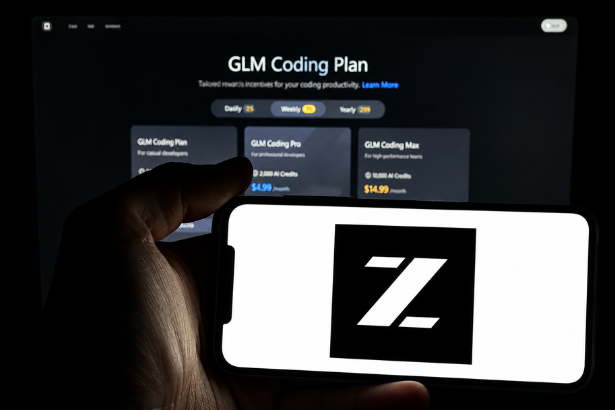
GLM-5.2, the newest model from Chinese AI lab Z.ai, formerly known as Zhipu AI, has beaten OpenAI’s GPT-5.5 on key long-horizon coding benchmarks while costing roughly one-sixth as much to run. The 753-billion parameter open-weights model was unveiled between June 13 and 16, 2026, released under a fully permissive MIT license, and arrived at a moment of unusual opportunity: the same week the US government ordered Anthropic to suspend access to its Fable and Mythos models for non-US nationals, a move Z.ai and other Chinese labs have seized on publicly.
What Is GLM-5.2? Z.ai’s New 753-Billion Parameter Model
Z.ai, the company formerly known as Zhipu AI, announced the immediate release of GLM-5.2, a 753-billion parameter open-weights large language model engineered specifically to dominate long-horizon autonomous coding and engineering tasks.
The model is available immediately on Hugging Face, the Z.ai API, and more than 20 third-party coding environments, and boasts a highly stable 1-million-token context window alongside enterprise subscription tiers starting at just $12.60 per month. Z.ai has released GLM-5.2’s core weights under an unrestricted MIT open-source license, allowing enterprises to download the model freely from Hugging Face, customize or fine-tune it to their liking, and run it locally or via virtual machines for only the cost of compute and electricity.
The full weights are live on Hugging Face under the handle zai-org/GLM-5.2. GLM-5.2 follows GLM-5 and GLM-5.1 in a rapid-fire release cadence that has characterized Z.ai’s product strategy throughout early 2026.
The Benchmarks: How GLM-5.2 Outperforms GPT-5.5
GLM-5.2 is designed for the kind of long, complex coding tasks that separate toy demos from production-ready tools. The model edges out GPT-5.5 by approximately 1% on FrontierSWE and ranks first among all open-source models on long-horizon coding benchmarks.
On industry-standard third-party benchmark tests, GLM-5.2 performs above most open-source flagship models, even DeepSeek V4, and scores near or above its closed-weights rivals, OpenAI’s GPT-5.5 and Anthropic’s Claude Opus 4.8. The model also posts strong numbers on PostTrainBench and SWE-Marathon, two benchmarks that test sustained, multi-step engineering performance rather than single-shot code generation.
On other benchmarks, GLM-5.2 demonstrated additional strength: it scored 77.0 on MCP-Atlas, a tool-usage benchmark, compared to GPT-5.5’s 75.3, and 54.7 on Humanity’s Last Exam with tools enabled, ahead of GPT-5.5’s 52.2. Developer reception was immediate: Cline IDE noted on social media that GLM-5.2 is the first open-weights model to cross 80% on Terminal-Bench, scoring 81.0, beating every other open model available.
One-Sixth the Cost: Why GLM-5.2’s Pricing Matters
The performance numbers alone would make GLM-5.2 a significant release, but the pricing structure is what transforms it into a genuine strategic threat to closed-source incumbents.
An open-weights AI model just beat GPT-5.5 on key coding benchmarks, and it costs roughly a sixth of what OpenAI charges. Z.ai launched the GLM Coding Plan to operationalize the model, with pricing tiers starting at $12.60 per month for the Lite plan, $50.40 for Pro, and $112.00 for Max, all billed annually.
GLM-5.2 will be available to all users of Zhipu’s new GLM Coding Plan subscription, which is priced at just a tenth of Anthropic’s premium Claude Code and Claude Max tiers. The plan offers out-of-the-box support for third-party coding harnesses including Claude Code, OpenClaw, Cline, and Kilo Code, meaning developers can substitute GLM-5.2 into existing coding workflows built around competitor tools with minimal friction.
The Anthropic Export Ban That Created an Opening
The timing of GLM-5.2’s release is inseparable from a major US policy decision that landed just days earlier and reshaped the competitive landscape for frontier AI access globally.
The U.S. government’s decision to stop Anthropic from offering its Mythos and Fable 5 models to non-US nationals may end up providing a big boost to the adoption of open-source models, including those from Chinese AI labs like DeepSeek and Moonshot AI. On Friday, Anthropic revealed that the US Department of Commerce had ordered it to stop providing access to its frontier models to anyone outside of the US.
The way US export rules are interpreted also means the company cannot offer the models to any foreign national inside the US, including its own employees. In response to the government order, Anthropic decided to suspend access to these models to all users. The release arrived amid this regulatory uncertainty for American proprietary models, following the directive that prohibited foreign nationals from using Anthropic’s Claude Fable 5 model.
Z.ai’s Pointed Message: “Should Not Be Subject to Withdrawal”
Z.ai did not let the timing of its release pass without directly referencing the Anthropic situation in its own public messaging, framing its open-source approach as a structural advantage rather than a coincidence.
“At a time when some frontier models can suddenly become unavailable, we choose to believe in a different path,” Knowledge Atlas, Z.ai’s parent company, posted on social media. In a clear reference to the Anthropic news, the company added that “frontier intelligence should not belong to only a few people, nor be subject to withdrawal by a handful of rules at any moment.”
The messaging strategy positions open-weights distribution as inherently more resilient than closed, cloud-hosted models that depend on a single company’s continued willingness and legal ability to provide access. Users can download open-source models and run them on their own computers or cloud networks, effectively sidestepping the ability of both AI developers and governments to control access.
Zhipu’s Stock Surge: Up Over 800% Since January IPO
The market reaction to GLM-5.2’s release, combined with the Anthropic export ban news, produced one of the most dramatic single-day stock moves in the AI sector this year.
Shares in Knowledge Atlas, a Chinese AI lab better known as z.ai, surged by over 30% in Hong Kong trading on Monday after it released the latest version of its open-source model, GLM-5.2. The Hong Kong-listed stock surged as much as 48% to HK$1,620 in morning trading and ended the day up 32.8% at HK$1,457, as the firm’s open-source roll-out coincided with Washington’s abrupt order to suspend top US models overseas.
Knowledge Atlas’s shares are up more than 800% since they debuted in January 2026, an extraordinary run that the GLM-5.2 release and accompanying Anthropic news appear to have meaningfully accelerated rather than initiated from scratch.
Sovereign AI: Why Governments Are Reconsidering US Models
Beyond the immediate market reaction, the Anthropic export ban has triggered a broader strategic reassessment among governments and enterprises about dependency on any single country’s AI infrastructure.
“It is the first time that a government has ordered a model developer to restrict access to a particular model based on nationality,” says Paul Triolo, a partner at DGA-Albright Stonebridge Group. “Companies and governments will start reconsidering how they are approaching application development based on a particular model, and for governments, which companies they will want to partner with for sovereign AI deployments.”
“Until there is further clarity about what criteria the U.S. government will use in assessing and approving frontier models, companies and governments will definitely be exploring options such as non-U.S. origin models,” such as those from Mistral, Cohere, and capable Chinese open-source models, Triolo adds. Asian governments in particular have made a public push for sovereign AI: South Korea launched a national state-backed competition to develop Korean-language AI models, and Sung Kim, founder of Korean AI startup Upstage, said at a press conference that AI was now a “strategic national asset” requiring rapid self-reliance.
Chinese Models Already Lead OpenRouter Usage
The shift toward Chinese open-source models was already underway before the Anthropic export controversy, with usage data showing a meaningful change in developer preferences over recent months.
Demand for Chinese models has already overtaken that for US models on OpenRouter, a popular platform for accessing different AI models. Last week, the top four most-used models came from Chinese companies: DeepSeek, MiniMax, Tencent, and Xiaomi. The Chinese open-source models have proved popular not just within China but also in many developing countries around the globe, where they are seen as a good trade-off between price and performance.
Chinese models still lag behind the absolute frontier: DeepSeek’s most recent model V4 performs at approximately the same level as Anthropic’s Claude Opus 4.6 and OpenAI’s GPT 5.4, both released in February and March 2026 respectively, with the Chinese startup estimating it was three to six months behind state-of-the-art frontier models. However, the price gap remains dramatic: DeepSeek’s V4 Pro costs $3.48 for 1 million tokens of output, compared to Anthropic’s Fable 5 at $50 for the same output.
What This Means for the Global AI Competition
The GLM-5.2 release and its convergence with the Anthropic export ban represents a meaningful inflection point in how the global AI competition is being framed and discussed across both industry and government circles.
The Anthropic order will “push scale for Chinese open-source models,” says Neil Shah, vice president of research at Counterpoint Research. “But we’ll also see lots of ambitious and self-sufficient economies, like in the Middle East, who will try to build their own indigenous software models.” Shah also characterized the broader policy shift as validating China’s tech self-sufficiency push, which accelerated in 2022 following Biden-era semiconductor export controls: “It’s a great move for China. Obviously they’re not on the cutting edge because of the export controls, but they have their own silicon and their own software.”
Japan, for its part, is exploring whether to turn to Anthropic’s rival OpenAI to bolster its cybersecurity defenses, suggesting the realignment triggered by the export ban is producing varied national responses rather than a single unified shift toward Chinese alternatives.
Latest Updates
GLM-5.2 was unveiled between June 13 and 16, 2026, with the Anthropic export ban news breaking on Friday, June 13. Fortune confirmed the full context of the US Department of Commerce order against Anthropic, Z.ai’s social media statement directly referencing the situation, comments from Paul Triolo and Neil Shah on sovereign AI implications, and the broader shift in OpenRouter usage toward Chinese models. VentureBeat confirmed the technical specifications of GLM-5.2, including its 753-billion parameters, 1-million-token context window, MIT license, and benchmark performance against GPT-5.5 and Claude Opus 4.8. Bloomberg and the South China Morning Post confirmed Knowledge Atlas’s stock surge of up to 48% intraday, closing up 32.8%, and the company’s more than 800% gain since its January 2026 IPO.
Full sources: Fortune | VentureBeat | Bloomberg
Broader Implications
The simultaneous arrival of Anthropic’s export ban and Z.ai’s GLM-5.2 release crystallizes a tension that has been building throughout the global AI race: the gap between frontier model capability and frontier model accessibility. A model that cannot be legally used by a foreign national anywhere, even one working at the developing company itself, creates exactly the kind of dependency risk that open-weights alternatives are designed to eliminate.
For Z.ai specifically, the timing was either remarkably fortunate or carefully calculated, but the effect is the same regardless: a benchmark-beating, dramatically cheaper, fully open model arrived in the exact week that the closed-source competitive narrative shifted most sharply in favor of open alternatives. The company’s direct social media reference to the Anthropic situation suggests at minimum an awareness of how to capitalize on the moment, even if the underlying model development timeline was independent of the export ban news.
For the broader AI industry, the sovereign AI conversations now underway in South Korea, Japan, the Middle East, and elsewhere suggest the Anthropic precedent, the first time a government has restricted model access based on user nationality, will have effects that extend well beyond Anthropic’s own business, reshaping how governments and enterprises think about AI infrastructure dependency for years to come.
For more AI industry, open-source models, and technology business coverage, visit The Tech Marketer.
Frequently Asked Questions
1. What is GLM-5.2 and who made it?
GLM-5.2 is a 753-billion parameter open-weights large language model released by Z.ai, the Chinese AI lab formerly known as Zhipu AI, between June 13 and 16, 2026. It is designed for long-horizon autonomous coding and engineering tasks and is released under a fully permissive MIT open-source license.
2. How does GLM-5.2 compare to GPT-5.5?
GLM-5.2 edges out OpenAI’s GPT-5.5 by approximately 1% on the FrontierSWE coding benchmark and ranks first among all open-source models on long-horizon coding tasks. It also scored higher than GPT-5.5 on MCP-Atlas (tool usage) and Humanity’s Last Exam with tools enabled, while costing roughly one-sixth as much to operate.
3. Why did Anthropic’s export ban help Chinese AI companies?
The US Department of Commerce ordered Anthropic to suspend access to its Fable and Mythos models for non-US nationals, including its own foreign employees inside the US. This created uncertainty for governments and companies relying on US-developed AI models, prompting some to consider Chinese open-source alternatives like GLM-5.2 as more resilient options not subject to similar export restrictions.
4. How much did Zhipu AI’s stock rise after the GLM-5.2 release?
Knowledge Atlas (Z.ai’s parent company, formerly Zhipu AI) saw its Hong Kong-listed stock surge as much as 48% intraday, closing up 32.8% at HK$1,457 on the day of the GLM-5.2 release. The stock is up more than 800% since its January 2026 IPO.
5. How much does GLM-5.2 cost compared to competitors?
Z.ai’s GLM Coding Plan starts at $12.60 per month for the Lite tier, $50.40 for Pro, and $112.00 for Max, all billed annually. This pricing is roughly a tenth of Anthropic’s premium Claude Code and Claude Max tiers, and approximately one-sixth the cost of equivalent GPT-5.5 usage on coding benchmarks.