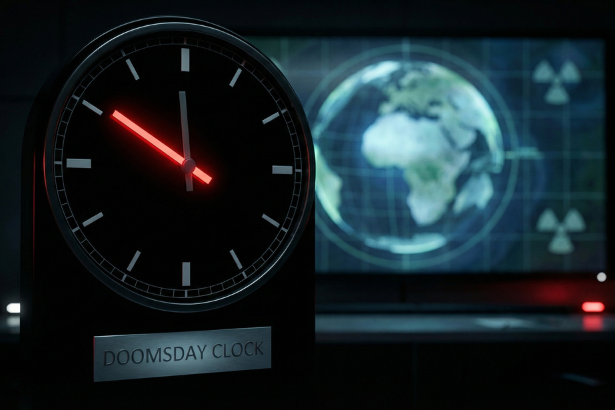
Scientists warn humanity is closer than ever to self-inflicted catastrophe as global risks accelerate in 2026.
Introduction
Doomsday Clock 2026 has been set at just 85 seconds to midnight, the closest the symbolic clock has ever come to representing global catastrophe, according to scientists from the Bulletin of the Atomic Scientists.
The decision reflects mounting concern that humanity is failing to manage escalating threats ranging from nuclear conflict and climate change to artificial intelligence and geopolitical instability.
What the Doomsday Clock Represents
The Doomsday Clock was created in 1947 by scientists involved in the Manhattan Project as a metaphor for how close humanity is to destroying itself. Midnight represents global catastrophe, originally nuclear annihilation but now expanded to include climate collapse, biological threats, and disruptive technologies.
Over the decades, the clock has moved forward and backward depending on world events. In recent years, however, it has consistently edged closer to midnight, reflecting compounding and interconnected risks rather than a single dominant threat.
Why Scientists Set It at 85 Seconds
For 2026, the Bulletin announced the clock would remain at 85 seconds to midnight, reinforcing the record-setting proximity first reached in 2025.
According to the official press release, scientists cited several accelerating dangers: ongoing nuclear tensions involving major powers, continued war-related escalation and erosion of arms-control frameworks, insufficient global response to climate change, rapid deployment of artificial intelligence without effective governance, and rising disinformation undermining democratic institutions.
CNN emphasized that the decision was not about a single event, but about the cumulative failure of global leadership to reduce existential risks. BBC reporting echoed this view, highlighting scientists’ warning that “every second counts” as global instability compounds.
What Scientists Are Warning About
Members of the Bulletin’s Science and Security Board argue that the world is now operating in a state of “persistent emergency.” Unlike earlier Cold War eras, today’s risks overlap and amplify one another.
Nuclear risk remains central. Arms-control agreements have weakened, communication channels between rival states are strained, and modernization of nuclear arsenals continues. Scientists warn that miscalculation, not intent, is now one of the greatest dangers.
At the same time, artificial intelligence has emerged as a new accelerant. AI systems are being integrated into military decision-making, cyber operations, and information warfare faster than international norms can keep up. The concern is not just misuse, but loss of human control in high-stakes environments.
What This Means for the World
For Global Security
The clock’s position signals that deterrence alone is no longer sufficient. Risk reduction now depends on cooperation, transparency, and rebuilding diplomatic trust.
For Technology Policy
AI governance has become an existential issue. Scientists stress the need for international guardrails similar to nuclear treaties, before competitive pressures make regulation impossible.
For Climate Action
Climate change remains a “threat multiplier.” Extreme weather, resource scarcity, and displacement increase the likelihood of conflict and political instability.
For the Public
The Doomsday Clock is not a prediction, but a warning. Its purpose is to provoke action, not fatalism.
How This Compares to Past Threats
The closest previous moments to midnight occurred during peak Cold War crises and again in the early 2020s as nuclear, climate, and technological threats converged.
What makes the current moment distinct is complexity. In earlier eras, leaders could focus on one dominant risk. Today, nuclear weapons, climate systems, biotechnology, and AI all interact in unpredictable ways.
This convergence mirrors other technological inflection points, such as the early internet era, when innovation outpaced governance. The difference is that failure now carries planetary consequences.
What Needs to Happen Next
The Bulletin will continue to reassess the clock annually, but scientists stress that waiting another year for movement is the wrong focus.
Instead, they call for immediate steps: renewed arms-control negotiations, binding climate commitments with enforcement mechanisms, international AI safety standards, and stronger global institutions to manage systemic risk.
Whether the clock moves backward in future years depends less on technological breakthroughs and more on political will.
Why This Matters
Doomsday Clock 2026 at 85 seconds to midnight is a stark signal that humanity is operating without sufficient margins for error.
The message from scientists is blunt but not hopeless. The same human systems that created these risks can still reduce them. The clock is a reminder that catastrophe is not inevitable, but avoiding it requires urgent, coordinated action.
FAQ
What does the Doomsday Clock represent?
It symbolizes how close humanity is to global catastrophe, with midnight representing disaster.
Why is the Doomsday Clock set at 85 seconds to midnight in 2026?
Scientists cite escalating nuclear risk, climate inaction, AI threats, and geopolitical instability.
Who sets the Doomsday Clock?
The clock is set by the Bulletin of the Atomic Scientists with input from global experts.
Has the clock ever been this close to midnight before?
No. 85 seconds is the closest it has ever been.
Is the Doomsday Clock a prediction?
No. It is a warning designed to spur policy change and risk reduction.