


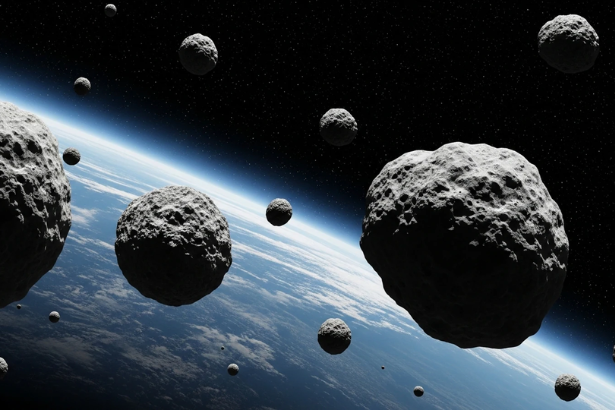
Search interest spikes after reports reveal Earth may be less protected than we think against thousands of near-Earth objects still hiding in space.
Introduction
Asteroid threat concerns are rising after new reporting highlights NASA’s acknowledgment that thousands of potentially dangerous “city-killer” asteroids remain undetected near Earth. Headlines from The Times, The Sun, and Moneycontrol have drawn fresh attention to gaps in global detection systems — gaps that came into sharp focus earlier in 2025, when asteroid 2024 YR4 briefly hit a 3.1 percent probability of striking Earth in 2032.
No imminent impact from any known object is predicted. Scientists are clear about that. But the detection problem is real, and the conversation around it is overdue.
Background and Context
Asteroids are rocky remnants left over from the early solar system. Most orbit safely in the asteroid belt between Mars and Jupiter, on stable paths that pose no threat to Earth. The concern centers on a different group entirely — Near-Earth Objects, or NEOs, whose orbits cross Earth’s own path around the Sun.
NASA classifies objects roughly 140 meters or larger as potentially hazardous if their trajectories bring them within 7.5 million kilometers of Earth. At that size, a direct strike on a major city would release the destructive energy of around 300 million tons of TNT — roughly six times the yield of the largest nuclear bomb ever detonated. That is why scientists and journalists have taken to calling them city-killers.
According to NASA’s own figures, astronomers have identified approximately 9,600 near-Earth asteroids in the 140-meter-and-up category. The estimated total is around 24,000. That means the planet has cataloged fewer than half of the objects large enough to destroy a major city.
Latest Update or News Breakdown
Recent coverage from The Times, The Sun, and Moneycontrol has spotlighted the scale of what remains unknown. Their reporting draws on longstanding NASA data and renewed public interest following the 2024 YR4 scare earlier this year. The key points covered:
- NASA’s Planetary Defense Coordination Office confirms fewer than half of all 140-meter-plus near-Earth asteroids have been identified
- Current ground-based surveys struggle to detect asteroids approaching from the direction of the Sun, or those with dark surfaces that absorb rather than reflect light
- The 2024 YR4 asteroid reached a peak impact probability of 3.1 percent in February 2025 before additional tracking data brought it back down to negligible levels — the highest such alert since the International Asteroid Warning Network was established
- No currently tracked asteroid poses a significant near-term threat to Earth
The surge in search interest reflects a familiar dynamic: when the language around space hazards turns concrete, public attention follows.
Expert Insights or Analysis
NASA’s Planetary Defense Coordination Office has made genuine progress since Congress first mandated the effort in 1998. The agency has located over 95 percent of kilometer-scale “planet-killer” asteroids — the kind capable of triggering global catastrophe. That job, for the most part, is done.
The harder task is the mid-sized category. These objects are smaller, darker, and often approach from angles that ground-based telescopes cannot easily cover. Paul Chodas, who oversees NASA’s Center for Near Earth Object Studies, has noted that finding the remaining population would require a fundamentally different approach to observation.
That approach is already being built. The Vera C. Rubin Observatory in Chile began science operations in 2025 and is expected to dramatically accelerate asteroid discovery rates. Further ahead, the NEO Surveyor — a dedicated infrared space telescope — is scheduled to launch in 2027. Observing in infrared from a vantage point closer to the Sun, it will be able to detect asteroids that current ground systems cannot see.
The DART mission, meanwhile, already proved that deflection works. In 2022, NASA deliberately crashed a spacecraft into Dimorphos, a moonlet orbiting the asteroid Didymos, and successfully altered its orbit. The technique requires years of lead time to be effective — which is precisely why finding these objects as early as possible matters so much.
Broader Implications
For Planetary Defense
The asteroid threat conversation consistently returns to the same point: early detection is everything. A space rock discovered a decade out can be nudged off course with a relatively modest mission. The same object found two years before impact becomes a far more complex — and potentially unsolvable — problem. Finding the remaining 14,000-plus undetected city-killers is not an academic exercise.
For Space Technology
The tools getting this done are advancing fast. Infrared detection, AI-assisted sky scanning, and globally networked telescope arrays are turning asteroid tracking from a manual, telescope-by-telescope effort into something approaching an automated planetary early-warning system. The Rubin Observatory alone is expected to discover more asteroids in its first few years than all previous surveys combined.
For Public Communication
Dramatic headlines reliably accompany asteroid stories, and they reliably overstate the immediate danger. NASA’s consistent position is that no known asteroid poses a significant threat to Earth in the foreseeable future. What the agency actually worries about — and what genuinely justifies continued investment — is the objects that haven’t been found yet. That is a meaningful distinction worth keeping.
Related History
The clearest modern reminder of what an undetected asteroid can do arrived on February 15, 2013, over Chelyabinsk, Russia. A 10,000-metric-ton space rock roughly 20 meters wide entered the atmosphere without warning, exploded with a force 30 to 40 times stronger than the Hiroshima atomic bomb, shattered windows across six cities, damaged 7,200 buildings, and injured more than 1,500 people. Nobody died, but only because the angle of entry caused it to detonate high in the atmosphere rather than at ground level.
That event prompted NASA to formally establish its Planetary Defense Coordination Office and accelerate its NEO catalog work. A decade later, the DART mission confirmed that the next step — deflection — is technically achievable. ESA’s Hera spacecraft is currently en route to study the aftermath of DART’s impact on Dimorphos, with arrival expected in late 2026. China has announced a similar kinetic impactor test, scheduled to launch in 2027.
The field has come a long way. The detection gap, however, remains.
What Happens Next
NASA continues expanding its NEO catalog through a global network of ground-based observatories and radar systems. The NEO Surveyor mission, on track for a 2027 launch, is designed specifically to find the dark, Sun-approaching asteroids that current surveys miss. Scientists expect it will identify the majority of remaining city-killer-class objects within a decade of operation.
Funding for planetary defense has held steady. The Trump administration’s 2025 budget proposal included $304 million for the effort — a slight increase — reflecting bipartisan recognition of the program’s value. A 2023 Pew Research poll found that 60 percent of Americans consider asteroid monitoring NASA’s top priority.
Public attention around the asteroid threat will likely fade until the next close-call headline arrives. Monitoring, however, continues every night.
Conclusion
Asteroid threat headlines tend to arrive in waves, and they tend to alarm more than the underlying science warrants. But beneath the dramatic framing lies a real and unfinished task: finding the thousands of city-killer asteroids that remain unknown, before one of them finds us first.
Detection is improving. Deflection has been demonstrated. International cooperation is expanding. The tools are getting better, and the catalog is growing.
The gap, though, is still there. That is what justifies the urgency — and the investment.
FAQ
Q1: Are thousands of asteroids about to hit Earth? No. NASA has not identified any known asteroid on an impact trajectory with Earth. The concern is about objects that have not yet been detected and cataloged.
Q2: What is a “city-killer” asteroid? An asteroid roughly 140 meters or more in diameter. A direct strike on a densely populated area would release energy equivalent to hundreds of millions of tons of TNT — enough to destroy a major city and surrounding region.
Q3: How many asteroids are still undetected? NASA estimates roughly 24,000 near-Earth asteroids exist in the 140-meter-plus category. Fewer than 10,000 have been found so far, leaving more than 14,000 undetected.
Q4: Can NASA stop an asteroid? Yes, under the right conditions. The 2022 DART mission successfully altered the orbit of Dimorphos, proving deflection is possible. Early detection is essential — the technique requires years of lead time to work effectively.
Q5: Should people be worried right now? There is no current asteroid posing an immediate threat to Earth. The real-world concern is about closing the detection gap before an unknown object moves into a threatening trajectory.
Sources and References
The Times: Asteroid Earth likelihood chance NASA
The Sun: NASA chiefs warn Earth is defenceless against city-killer asteroids
Moneycontrol: NASA says 15,000 city-killer asteroids still undetected in space