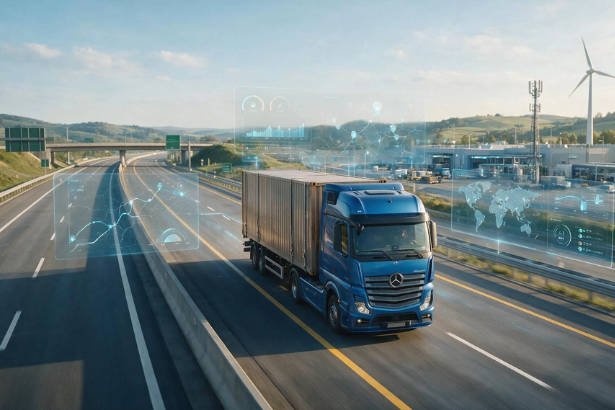
The logistics industry has always depended on timing, coordination and accurate information. A delayed shipment, an unexpected traffic jam or an unavailable delivery vehicle can affect an entire transportation network.
For years, logistics companies relied on traditional route planning software, GPS tracking and manual dispatch operations to manage these challenges. While these systems improved transportation visibility, they often struggled to respond quickly when real-world conditions changed.
That is where AI in logistics is beginning to make a significant difference.
Modern AI-powered transportation systems can analyze traffic conditions, historical delivery information, vehicle availability, shipment requirements and changing operational conditions. Instead of simply generating a route at the beginning of a journey, these systems can continuously evaluate whether the existing plan still makes sense.
The shift is becoming increasingly important across the US transportation industry.
According to Trimble’s Transportation Pulse Report 2026, 31% of surveyed carriers and logistics service providers already use AI for driver scheduling and route planning. Meanwhile, 54% prioritize real-time rerouting and 53% prioritize predictive route and load planning as valuable AI capabilities. Trimble+1
These findings suggest that logistics businesses are moving beyond basic digital tracking toward more intelligent transportation management.
For fleet operators, freight companies and third-party logistics providers, the opportunity is substantial.
The next generation of logistics operations will not simply follow predetermined routes. It will use connected data, predictive intelligence and human decision-making to respond to transportation challenges as they happen.
Background and Context: Why Logistics Companies Are Turning to AI
Amazon Freight Partner Program: What CDL Drivers Need to Know in 2026 | Oculus Reviews
Transportation networks are becoming increasingly complicated.
US logistics companies manage thousands of shipments across highways, warehouses, distribution centers, ports and customer locations.
Each shipment creates multiple operational decisions:
- Which vehicle should carry the shipment?
- Which route offers the best balance of time and cost?
- Is the driver likely to reach the destination on schedule?
- Will traffic or weather affect the delivery?
- Is there enough available capacity?
- Can another shipment be added without increasing unnecessary mileage?
Traditional transportation management systems help answer many of these questions.
However, conventional systems often depend on predefined rules and information that may become outdated as transportation conditions change.
For example, a truck might receive an efficient route in the morning. A highway accident could create congestion several hours later. The original route may no longer be the best option.
Without timely information, dispatchers must identify the problem, contact drivers and manually organize an alternative.
AI can help automate parts of this process.
By analyzing changing information, intelligent systems can identify potential disruptions, recommend alternative routes and help dispatchers make decisions more quickly.
The growing importance of transportation technology
The broader industry is also moving toward connected transportation management.
GPS tracking, electronic logging devices, fleet telematics, warehouse management systems and transportation management software generate information that can support more accurate operational decisions.
The challenge is making these systems communicate effectively.
Trimble’s 2026 Transportation Pulse Report identifies poor data quality and system gaps as major obstacles to successful AI adoption, with 57% of surveyed carriers and logistics service providers highlighting this challenge. News Releases+1
This means the future of logistics AI depends on more than sophisticated algorithms.
Companies also need reliable operational data, connected software platforms and employees who understand how to use AI recommendations.
Latest Update: AI Is Reshaping Logistics Route Optimization in 2026
How AI is Optimizing Logistics | Modulemint
One of the most important developments in logistics technology is the growing use of AI for route optimization.
ITSdigest explored this development in its July 15, 2026 article, Route Optimization Leverages AI: But Not How You Think, written by Pete Goldin.
The article discusses how carriers and fleets are increasingly using AI-powered tools to improve transportation planning.
It references findings from Trimble’s Transportation Pulse Report 2026, including the following statistics.
AI adoption in transportation: Important numbers
31%
AI adoption
Carriers and LSPs using AI for driver scheduling and route planning.
54%
Real-time rerouting
Prioritize rerouting based on changing conditions.
53%
Predictive planning
Prioritize predictive route and load planning.
57%
Data challenges
Identify poor data quality and system gaps as barriers.
Source: Trimble Transportation Pulse Report 2026. Figures relate to different survey questions and should not be interpreted as market-wide adoption rates.
These numbers reveal an important development.
Logistics companies are interested in AI not just because it can automate calculations, but because it can help them respond to transportation problems more intelligently.
For example, a fleet management platform may use real-time information to identify traffic delays, evaluate available alternatives and recommend a new route before a delivery becomes significantly late.
This changes route planning from a one-time activity into a continuous operational process.
Read the original coverage: ITSdigest: Route Optimization Leverages AI: But Not How You Think. ITSdigest+1
How AI-Powered Route Optimization Works in Modern Logistics
Wise Systems, Inc | AI-Driven Dispatch & Routing for SAP Software
Traditional route optimization focuses on finding an efficient path between multiple destinations.
AI-powered route optimization goes further.
It combines different types of operational information to evaluate routes, predict potential disruptions and recommend adjustments.
A typical system may consider:
- Traffic conditions: Current congestion, road closures and expected travel times.
- Vehicle availability: Which trucks are available and where they are located.
- Delivery schedules: Customer delivery windows and shipment priorities.
- Driver availability: Working hours, scheduling requirements and operational constraints.
- Fuel consumption: Expected fuel requirements based on distance and driving conditions.
- Shipment capacity: Vehicle space, cargo weight and load distribution.
- Weather conditions: Rain, snow, storms and other potential disruptions.
By combining these inputs, AI systems can help transportation teams make more informed decisions.
Example: How AI can change a delivery route
Imagine a logistics company operating a fleet of 50 delivery trucks across Texas.
One truck is scheduled to deliver products to several customers in Dallas.
The original route looks efficient, but an unexpected highway accident creates significant congestion.
A traditional system might continue displaying the original route until a dispatcher manually changes it.
An AI-enabled system could identify the delay, evaluate alternative roads, calculate the impact on delivery windows and recommend a revised route.
The dispatcher can review the recommendation and approve the change.
The result is a more responsive transportation operation.
The important distinction is that AI does not need to control every vehicle independently to create value. Even better recommendations and faster exception handling can improve day-to-day logistics performance.
Five Ways AI Is Transforming Logistics Operations
Novus Hi-Tech enhances Fleet Management System using Amazon Bedrock | Case Study | AWS
FedEx setzt auf Roboter „Scoop“ für automatische LKW-Entladung
13
1. Real-Time Route Optimization and Traffic Management
Traffic congestion is one of the most persistent challenges for transportation companies.
Unexpected road closures, accidents and construction work can affect delivery schedules and increase transportation costs.
AI-powered route optimization systems can analyze current traffic information and identify alternative routes.
They can also evaluate whether a route change is actually beneficial.
For example, a shorter road may have slower traffic or restrictions that make it less efficient for a commercial vehicle.
An intelligent system can evaluate multiple conditions rather than simply choosing the route with the fewest miles.
Business benefits:
- Better delivery planning.
- Faster responses to unexpected congestion.
- Improved vehicle utilization.
- Reduced unnecessary travel.
- More accurate estimated arrival times.
2. Predictive Fleet Management
Numeo One | AI-powered TMS for trucking carriers | Numeo
Fleet management involves coordinating vehicles, drivers, maintenance schedules and transportation requirements.
When these activities are managed separately, fleet operators can struggle to identify inefficiencies.
AI can help analyze vehicle performance data, maintenance records, fuel consumption and operational patterns.
For example, predictive maintenance systems can identify unusual engine temperatures, abnormal vibration patterns or other signals that may indicate developing mechanical problems.
Instead of waiting for a vehicle to break down, fleet managers can investigate potential issues earlier.
Predictive fleet management can help companies:
- Reduce unexpected vehicle downtime.
- Plan maintenance more effectively.
- Monitor fuel efficiency.
- Improve vehicle availability.
- Identify unusual operating patterns.
However, predictions depend on accurate sensor data and suitable maintenance processes. AI alerts should support, not replace, qualified vehicle inspections.
3. Predictive Load Planning and Freight Optimization
Distributionslogistik: Prozesse, Systeme & Strategien für effiziente Lieferketten
Empty miles represent a major operational challenge for freight carriers.
A truck that completes a delivery without securing another suitable shipment may travel significant distances without generating revenue.
AI-powered load planning can help carriers identify opportunities to match available vehicle capacity with nearby freight requirements.
These systems can consider:
- Pickup and delivery locations.
- Available vehicle capacity.
- Shipment deadlines.
- Driver schedules.
- Expected travel times.
- Freight rates and operating costs.
For example, a truck delivering cargo in Houston may have an opportunity to collect another shipment nearby rather than returning to its original location without freight.
AI can help identify that opportunity by analyzing shipment and vehicle availability.
This can improve fleet utilization while reducing unnecessary mileage.
4. Automated Shipment Tracking and Delivery Visibility
Customers increasingly expect accurate information about their deliveries.
For logistics companies, responding to shipment inquiries manually can consume considerable time.
AI-powered tracking systems can analyze GPS data, transportation schedules and historical delivery patterns to provide more useful estimated arrival times.
They can also identify shipments that may be delayed and alert the relevant teams.
For example, if a delivery is expected to arrive two hours later than planned, the system can notify the dispatcher and customer service team.
This gives businesses more time to communicate with customers and organize alternative arrangements.
The result is improved shipment visibility and more proactive customer service.
5. AI-Powered Transportation Management Systems
Best Transport Management System Dashboard of 2026 | QuantumByte Success Story
Transportation management systems, commonly known as TMS platforms, are becoming increasingly important in modern logistics.
They help companies manage transportation planning, freight procurement, carrier selection, shipment execution and reporting.
AI can enhance these platforms by automating repetitive tasks and identifying patterns that may be difficult to detect manually.
Examples include:
- Automated shipment scheduling.
- Predictive delivery estimates.
- Freight rate analysis.
- Carrier performance evaluation.
- Transportation exception management.
- Route and load optimization.
The integration of AI into TMS platforms can also connect transportation decisions with wider supply chain activities.
This is particularly useful for third-party logistics providers managing shipments across multiple customers, carriers and distribution networks.
The Role of Agentic AI in the Future of Logistics
Case Study: Linehaul AI Agent Orchestration Platform | ideyaLabs
The next stage of logistics automation involves agentic AI.
Traditional AI systems often analyze information and provide recommendations.
Agentic AI introduces systems that can pursue defined objectives, make decisions within permitted boundaries and execute certain workflows with limited human intervention.
In logistics, this could mean an AI agent monitoring shipment status, identifying a delay, evaluating available alternatives and preparing a revised delivery plan.
Consider a transportation company managing hundreds of daily shipments.
A logistics AI agent could:
- Monitor shipment locations and estimated arrival times.
- Identify deliveries at risk of missing their scheduled windows.
- Evaluate alternative routes and available carriers.
- Recommend a revised transportation plan.
- Notify dispatchers and relevant customer service teams.
- Execute preapproved actions within established operating limits.
This could reduce the time employees spend handling repetitive administrative tasks.
However, important decisions involving safety, regulatory compliance, contractual obligations and significant financial commitments should retain appropriate human oversight.
ITSdigest has also explored this subject in its earlier article, Agentic AI: The Next Frontier for Logistics. ITSdigest+1
Challenges Preventing Wider AI Adoption in Logistics
GTEMAS | Insights | Supply Chain Digital Twins: Visibility in Chaos
Despite its potential, implementing AI across transportation operations is not straightforward.
Many companies still operate with disconnected software platforms, inconsistent shipment information and manual processes.
These issues can limit the accuracy and usefulness of AI systems.
1. Poor data quality
AI depends on accurate and consistent information.
If GPS records are incomplete, delivery timestamps are incorrect or vehicle information is outdated, the system may produce unreliable recommendations.
Trimble’s 2026 Transportation Pulse Report identifies data quality as a major obstacle to successful AI adoption among carriers and logistics providers. News Releases
2. Integration with existing systems
Many transportation companies use separate platforms for fleet management, shipment tracking, warehouse operations and customer communication.
Connecting these systems can be complicated.
Businesses need reliable integrations so information can move between platforms without creating additional operational problems.
3. Implementation costs
AI implementation may require investment in software, cloud infrastructure, sensors, data integration and employee training.
Smaller logistics companies may find these costs difficult to justify without a clear financial benefit.
A phased implementation can help businesses measure results before expanding the technology across the organization.
4. Employee training and trust
AI recommendations are only useful when employees understand how to interpret them.
Dispatchers, fleet managers and transportation planners need appropriate training.
Companies should also explain when automated decisions can be trusted and when human review is necessary.
5. Data security and privacy
Transportation systems contain commercially sensitive information about shipments, customers, drivers and business operations.
Companies must establish appropriate cybersecurity controls, access permissions and data governance procedures.
AI adoption should strengthen operational efficiency without introducing unnecessary security risks.
How Logistics Companies Can Successfully Implement AI
Warehouse & Logistics Solutions — Witron AI
Companies do not need to automate their entire transportation network immediately.
A more practical approach is to identify a specific operational problem and introduce AI where measurable improvements are possible.
Step 1: Identify the biggest operational problem
Start by reviewing existing transportation processes.
Common opportunities include:
- High fuel expenditure.
- Frequent delivery delays.
- Excessive empty miles.
- Poor fleet utilization.
- Manual shipment tracking.
- Inefficient driver scheduling.
The objective is to identify where AI could make the greatest operational difference.
Step 2: Improve data quality
Before implementing advanced AI systems, businesses should evaluate the quality of their existing information.
This includes GPS data, vehicle records, shipment details, driver schedules and delivery timestamps.
Reliable information provides a stronger foundation for accurate predictions.
Step 3: Integrate transportation systems
Connect the systems that generate and use operational information.
For example, integrating a TMS with fleet telematics and shipment tracking platforms can improve visibility across transportation activities.
Step 4: Start with a pilot project
Rather than implementing AI across every fleet, begin with a limited number of vehicles or delivery routes.
Measure performance before and after implementation.
This helps determine whether the technology produces measurable business benefits.
Step 5: Monitor results and improve continuously
Track key performance indicators such as:
| KPI | What it measures |
|---|---|
| On-time delivery rate | Percentage of deliveries completed within the promised window |
| Cost per mile | Transportation cost relative to distance |
| Fuel consumption | Fuel used across fleet operations |
| Empty miles | Distance traveled without revenue-generating cargo |
| Vehicle utilization | How effectively available fleet capacity is used |
| Delivery accuracy | Difference between estimated and actual arrival times |
| Fleet downtime | Time vehicles remain unavailable for operations |
These measurements help companies determine whether AI is improving operational performance.
Expert Insights: What Industry Research Says About AI in Logistics
The growing interest in AI is supported by research from transportation technology providers and industry publications.
Three findings are particularly important.
First, transportation planning is becoming a major AI application.
Trimble’s Transportation Pulse Report 2026 found that 86% of surveyed shippers expect AI to have a significant impact on transportation planning and optimization over the next three to five years. Transportation Pulse Report 2026+1
Second, real-time operational intelligence is becoming a priority.
Carriers and logistics service providers are prioritizing real-time rerouting and predictive route and load planning. These capabilities can help transportation businesses respond to changing conditions instead of relying exclusively on static schedules. Trimble+1
Third, AI adoption still requires strong operational foundations.
The research identifies data quality, system integration and organizational readiness as important barriers.
The findings suggest that successful AI implementation is not simply about purchasing advanced software. It requires businesses to improve the quality of their information and the processes through which operational decisions are made.
These findings also support a broader industry shift: AI is increasingly being viewed as a decision-support capability rather than a complete replacement for transportation professionals.
Broader Implications: How AI in Logistics Is Changing the US Transportation Industry
How Inland Empire Freight Carriers Can Reduce Operating Costs Without Cutting Corners | Joel Ledesma
The growing adoption of AI in logistics has implications beyond individual transportation companies.
The US transportation network supports manufacturing, retail, agriculture, healthcare and international trade.
Improving the efficiency of freight movement can therefore influence businesses across multiple industries.
1. More efficient freight transportation
AI-powered route planning can help carriers use existing vehicles more effectively.
Better load matching, delivery scheduling and route adjustments may reduce unnecessary transportation activity.
2. Stronger supply chain visibility
Connected transportation systems can provide businesses with better information about shipment locations and expected delivery times.
This helps manufacturers, distributors and retailers coordinate inventory and customer commitments.
3. Changing logistics jobs
AI will change how dispatchers, fleet managers and transportation planners perform their work.
Employees may spend less time on repetitive scheduling activities and more time managing exceptions, reviewing recommendations and coordinating complex operations.
This makes technology training increasingly important.
4. Greater competition among logistics providers
Companies that use data effectively may gain advantages through improved service reliability, operational efficiency and customer communication.
However, technology alone will not guarantee success. Businesses also need effective management processes and reliable transportation networks.
5. More sustainable transportation operations
Reducing unnecessary mileage, improving load utilization and minimizing inefficient vehicle movements can support lower fuel consumption.
These improvements may contribute to reduced transportation emissions, although the actual environmental impact depends on vehicle types, route conditions and operational changes.
What Happens Next? Five Logistics Technology Trends to Watch
Thriving in the AI+Transportation World: Embracing the Opportunities and Challenges of 2024
The next phase of logistics technology will likely focus on connecting predictive intelligence with everyday transportation operations.
Here are five developments worth monitoring.
1. Agentic AI in transportation: AI agents will increasingly support shipment monitoring, scheduling and exception management within defined operational limits.
2. Predictive route optimization: Transportation platforms will place greater emphasis on anticipating traffic disruptions, delivery delays and changing freight demand.
3. Connected fleet management: More vehicles will communicate operational information through telematics and connected transportation platforms.
4. AI-powered freight matching: Intelligent systems will help carriers identify suitable loads and improve vehicle utilization.
5. Human-supervised automation: Logistics companies will increasingly combine automated recommendations with human approval for important operational decisions.
The wider direction is clear: transportation management is moving toward more connected, predictive and responsive operations.
Conclusion: AI Is Moving Logistics Beyond Traditional Route Planning
AI is changing how logistics companies manage transportation, coordinate fleets and deliver shipments.
The technology is helping businesses move beyond traditional route planning toward more responsive operational systems.
From real-time rerouting and predictive maintenance to automated shipment tracking and intelligent load planning, AI offers several opportunities to improve transportation performance.
The latest findings from Trimble’s Transportation Pulse Report 2026 demonstrate the growing interest in these capabilities among carriers, shippers and logistics service providers.
However, successful adoption requires more than advanced algorithms.
Companies need reliable data, connected software systems, employee training and clear operational controls.
The logistics businesses that approach AI strategically will be better positioned to improve efficiency, respond to disruptions and meet changing customer expectations.
The future of logistics will not simply be about finding the shortest route. It will be about making better transportation decisions, adapting faster to changing conditions and using intelligent technology to move goods more efficiently.
Frequently Asked Questions
1. What is AI in logistics?
AI in logistics refers to using artificial intelligence technologies to improve transportation planning, fleet management, shipment tracking, warehouse operations and supply chain decisions.
2. How does AI improve route optimization?
AI analyzes traffic conditions, delivery schedules, vehicle availability, road restrictions and other operational information to recommend efficient routes and alternative transportation plans.
3. What are the benefits of AI in logistics?
The main potential benefits include improved route planning, better fleet utilization, more accurate delivery estimates, reduced unnecessary mileage, predictive maintenance and faster operational decisions.
4. How is AI used in fleet management?
AI can analyze vehicle performance, fuel consumption, maintenance records, driver schedules and GPS information to help fleet managers improve vehicle availability and operational efficiency.
5. What is predictive logistics?
Predictive logistics uses historical and real-time information to anticipate transportation delays, demand changes, maintenance requirements and potential supply chain disruptions.
6. What is agentic AI in logistics?
Agentic AI refers to AI systems that can pursue defined objectives, make decisions and execute selected tasks with limited supervision. In logistics, this can include monitoring shipments, identifying delays and recommending alternative transportation arrangements.
7. Can AI reduce transportation costs?
AI can help reduce costs by improving route efficiency, optimizing vehicle utilization, reducing unnecessary mileage and identifying operational inefficiencies. Actual savings depend on implementation quality and operating conditions.
8. What is a transportation management system?
A transportation management system, or TMS, is software that helps businesses plan, execute and monitor freight transportation activities, including carrier selection, shipment scheduling and delivery tracking.
9. What are the biggest challenges of AI adoption in logistics?
Common challenges include poor data quality, disconnected software platforms, implementation costs, cybersecurity concerns and employee training requirements.
10. How will AI change the future of logistics?
AI is expected to support more predictive transportation planning, intelligent fleet management, automated workflows and connected freight networks. Human supervision will remain important for safety, compliance and complex operational decisions.
Sources & References
1. ITSdigest: Route Optimization Leverages AI: But Not How You Think, July 15, 2026. Original industry coverage by Pete Goldin.
2. Trimble: Transportation Pulse Report 2026: The AI Shift in Logistics. Research covering more than 230 shippers, carriers and logistics service providers in Europe and North America.
3. Trimble: Explore the AI Shift in Logistics in the Transportation Pulse Report 2026.
4. American Journal of Transportation: Route Optimization Leverages AI: But Not How You Think.
5. Descartes: 2026 Transportation Management Benchmark Survey.
6. ITSdigest: Agentic AI: The Next Frontier for Logistics.
7. McKinsey: Creating Value from AI and Digital Capabilities in Logistics Operations.