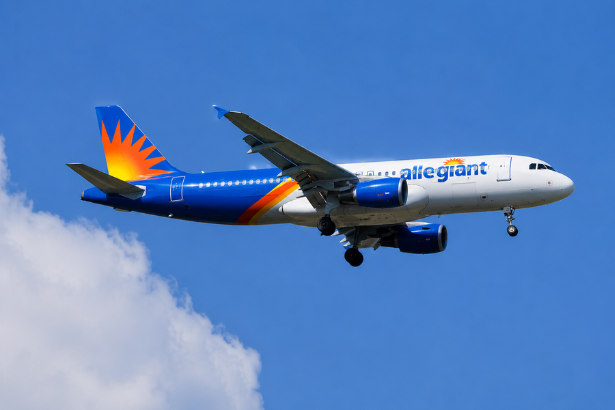
Allegiant Air route cuts 2026 have reshaped the ultra-low-cost carrier’s network significantly, with new OAG scheduling data showing 61 routes that operated in July 2025 are gone from the airline’s July 2026 schedule. While 61 routes have been removed, only 49 have been added, a net loss of 12 routes. The most significant driver of the cuts is Allegiant’s complete withdrawal from four airports: Los Angeles International Airport (LAX), Oakland International Airport (OAK), Minneapolis-St. Paul International Airport (MSP), and Norfolk International Airport (ORF), which together account for 43% of all eliminated routes.
What Changed: Allegiant’s July 2025 to July 2026 Network Comparison
The scope of the analysis, conducted using OAG data, compares Allegiant’s full network in July 2025 to what is available in July 2026, providing a clean year-over-year snapshot of the carrier’s network evolution.
All airlines cut routes, and Allegiant Air is no exception. 61 routes are no longer operating, many of which ended last year. While 61 have been removed, only 49 have been added. The gap between cuts and additions represents the most direct measure of Allegiant’s net network contraction over the twelve-month period.
In July 2025, OAG shows that Allegiant had scheduled service to 119 airports, all within the US. In contrast, 120 airports will see the carrier next month. Despite the route-level contraction, Allegiant will technically serve one more airport overall, reflecting how the carrier has reshuffled its geographic footprint even as its total city pair count has declined.
The Four Airports Allegiant Abandoned Entirely
The single largest driver of the 61 route eliminations is not gradual attrition across many markets but Allegiant’s complete exit from four specific airports.
Part of the reason is that Allegiant has pulled out entirely of Los Angeles International Airport (LAX), Oakland International Airport (OAK), Minneapolis-St. Paul International Airport (MSP), Norfolk International Airport (ORF), and more. Ceasing to fly to these four airports alone accounts for 43% of the cuts.
Seven airports have been removed from Allegiant’s map entirely: Columbia (South Carolina), Grand Forks, LAX, MSP, OAK, ORF, and San Diego (SAN). The MSP exit has a specific business explanation tied to Allegiant’s corporate ownership structure: the airline merged with Sun Country, whose hub is at MSP Terminal 2, and continuing service there would have meant Allegiant competing directly against its own sister carrier for the same fares.
LAX Takes the Biggest Hit: 14 Routes Gone
Los Angeles International Airport accounts for the largest single concentration of route eliminations in the entire dataset.
Due to no longer serving LAX, California’s busiest airport accounts for 14 of the 61 cuts. They are Bellingham, Cedar Rapids, Cincinnati, Spokane, Grand Rapids, Indianapolis, Little Rock, McAllen, Northwest Arkansas, Omaha, Sioux Falls, Springfield, Tulsa, and Wichita.
OAG indicates that eight of these are not served by another airline from LAX, meaning those specific city pairs lose Allegiant-provided air service entirely rather than simply losing a competitive option. However, Allegiant serves Bellingham, Cincinnati, Grand Rapids, Indianapolis, and Spokane from Burbank or Orange County, at least for now, providing displaced LAX travelers an alternative Southern California departure point for five of the fourteen markets.
Other airports with a notable number of eliminated links include Norfolk with six cuts, Fort Lauderdale-Hollywood International Airport with five, Oakland and Orlando Sanford International Airport with four each, and Las Vegas Harry Reid International Airport and Savannah Hilton Head International Airport with three each.
The Longest Cut: Cincinnati to LAX After Eight Years
Among the 61 eliminated routes, one stands out both for its distance and its longevity in Allegiant’s network.
At 1,651 nautical miles (3,058 km), Cincinnati to LAX was the longest of the 61 eliminated services. This route was part of Allegiant’s network between November 2017 and January 2026. In this period, the DOT shows that the carrier transported 272,000 round-trip passengers on its low-frequency service.
The route’s underlying economics were genuinely strong by Allegiant’s standards before the cut. Allegiant’s average base fare on the route, excluding taxes and add-ons, was $88 one-way, 60% higher than the carrier’s average fare across its entire network. This relatively low fare contributed to 91% of seats being filled, an exceptionally high load factor. For comparison, Delta’s base fare on competing service was $303, with a load factor of 77%. A route with that combination of strong load factor and above-average fare being eliminated underscores that the LAX exit was a strategic, airport-level decision rather than a market-by-market profitability judgment.
The average stage length of all 61 routes was 831 nautical miles, 10% longer than all of Allegiant’s planned routes in July 2026, suggesting the eliminated routes skewed toward longer, less typical Allegiant markets overall.
Florida’s 34 Route Cuts: A Closer Look
Florida represents the single largest state-level concentration of route cuts within the broader 61-route reduction, though the picture there is more nuanced than simple contraction.
Allegiant Air is cutting 34 Florida routes as the ultra-low-cost carrier reshapes its network to match changing travel demand and aircraft availability. The route reductions reflect a broader strategy airlines use to optimize capacity and profitability, with Allegiant replacing underperforming routes with markets showing stronger demand rather than abandoning Florida.
Despite the cuts, Allegiant is simultaneously expanding service to Florida. The airline announced in May 2026 that it will launch eight new nonstop routes to the state beginning in fall 2026, connecting Florida destinations including St. Pete-Clearwater International Airport and Punta Gorda Airport with cities such as Philadelphia, Pittsburgh, Omaha, Columbia, Missouri, and La Crosse, Wisconsin.
Florida continues to rank among Allegiant’s most important markets. The airline maintains major operations throughout the state, including airports in Sarasota Bradenton, St. Pete-Clearwater, Punta Gorda, Orlando Sanford, and Fort Lauderdale, which consistently rank among Allegiant’s busiest destinations nationwide.
New Routes Added: Philadelphia and Seven Other Airports
While the cuts dominate the headline numbers, Allegiant has simultaneously expanded into several new markets, including one notably large hub it had never previously served.
Eight airports have been added to Allegiant’s network, including Fort Myers, Huntsville, Atlantic City, La Crosse, Burbank, Trenton, Philadelphia International Airport (PHL), and Columbia, Missouri. Allegiant previously flew to Huntsville between 2007 and 2008 and to Trenton from 2016 to 2018, meaning both represent returns to previously served markets rather than entirely new territory.
Notice Philadelphia International Airport, which is the US’s 19th-busiest airport by departures. Allegiant’s flights mean that the airline now serves seven of the country’s 20 busiest airports, a meaningful credibility marker for an ultra-low-cost carrier that has historically built its identity around underserved secondary markets rather than major hubs.
Why Is Allegiant Cutting Routes? The Business Logic
The broader industry context behind Allegiant’s contraction reflects pressures affecting ultra-low-cost carriers across the sector, not a problem unique to Allegiant alone.
Route elimination has become routine across the airline industry, driven by fluctuating jet fuel prices, labor cost pressures, and shifting passenger demand patterns. Rising jet fuel costs, coupled with increased labor expenses following crew negotiations across the industry, have forced carriers to reassess unprofitable regional markets.
It would be easy to conclude that the ongoing war in Iran, with consequences on the price of jet fuel and more, contributed to the cuts. However, most of the longest markets among the 61 links, including Asheville to Phoenix Sky Harbor, Cedar Rapids to LAX, Cincinnati to LAX, Grand Rapids to LAX, and Indianapolis to LAX, all ended last year or at the start of 2026, before the war started in late February. The timing therefore points more toward structural network strategy than direct fuel cost response.
Allegiant, which built its business model on point-to-point leisure routes, faces particular pressure in secondary markets where load factors struggle to justify operational costs, even as the Cincinnati-LAX example demonstrates that strong-performing routes were also caught up in the broader airport-level exit decisions.
What This Means for Travelers in Affected Markets
For passengers in the affected cities, the practical impact varies significantly depending on whether alternative service exists.
The route eliminations will impact connectivity for passengers in smaller markets dependent on Allegiant’s affordable fares. Many communities that benefited from the carrier’s expansion during the post-pandemic travel boom now face reduced scheduling frequency or complete service withdrawal. For competing carriers, Allegiant’s contraction opens opportunities to capture underserved markets, though legacy carriers typically maintain higher baseline fares than ultra-low-cost alternatives.
For Florida travelers specifically, the changes are unlikely to have a major impact on most existing service, since Allegiant remains one of the largest carriers serving Florida leisure travelers, and key airports such as St. Pete-Clearwater, Punta Gorda, and Sarasota-Bradenton continue to benefit from the airline’s focus on affordable nonstop service to destinations larger carriers often skip.
For the eight LAX-area markets where Allegiant’s exit eliminates the only nonstop air service, the loss of connectivity is more significant. Travelers in Bellingham, Cedar Rapids, Little Rock, McAllen, Northwest Arkansas, Omaha, Sioux Falls, Springfield, Tulsa, and Wichita without alternative Allegiant service from Burbank or Orange County will need to connect through other carriers or airports to reach Los Angeles.
Latest Updates
The Allegiant route data was published on June 15-16, 2026 based on OAG scheduling comparisons between July 2025 and July 2026. Simple Flying confirmed the full 61-route elimination list, the four-airport exit accounting for 43% of cuts, the LAX-specific 14-route breakdown, the Cincinnati-LAX route’s eight-year history and strong 91% load factor, and the eight new airports being added including Philadelphia. ECIKS confirmed the Florida-specific 34-route cut, the eight new Florida routes launching fall 2026 connecting to Philadelphia, Pittsburgh, Omaha, Columbia, and La Crosse, and that Allegiant remains committed to its core Florida markets. Nomad Lawyer confirmed the industry-wide context of route consolidation driven by fuel and labor costs, and the broader implications for ultra-low-cost carrier business models facing margin pressure.
Full sources: Simple Flying | ECIKS.org | Nomad Lawyer
Broader Implications
Allegiant’s 61-route contraction, against only 49 additions, signals a meaningful shift in strategy for a carrier whose entire business model has historically depended on network density across secondary and tertiary leisure markets. The complete exit from LAX, a market where the carrier had a strong-performing, eight-year route history with a 91% load factor on at least one service, suggests the decision was driven by airport-level economics, gate availability, or strategic focus rather than individual route underperformance.
The Minneapolis exit’s connection to Allegiant’s Sun Country merger illustrates how corporate consolidation in the ultra-low-cost segment is reshaping network decisions beyond simple route profitability. As Allegiant and Sun Country integrate, eliminating internal competition for the same passenger base at shared hub airports becomes a logical efficiency move, even when it means withdrawing from a major metro market entirely.
For the broader ultra-low-cost carrier sector, Allegiant’s net contraction reflects pressures that have affected Spirit, Frontier, and other ULCCs throughout 2025 and 2026: rising fuel and labor costs compressing already-thin margins on routes that depend heavily on low fares to generate sufficient demand. The era of unconstrained network growth that characterized ULCCs through the 2010s appears to be giving way to a more selective, profitability-focused expansion model.
For more airline industry, travel, and consumer news, visit The Tech Marketer.
Frequently Asked Questions
1. How many routes is Allegiant Air cutting in 2026?
Allegiant Air is cutting 61 routes when comparing its July 2025 network to its July 2026 schedule, according to OAG data. Only 49 new routes have been added during the same period, representing a net loss of 12 routes overall.
2. Which airports is Allegiant Air leaving completely?
Allegiant has pulled out entirely of Los Angeles International Airport (LAX), Oakland International Airport (OAK), Minneapolis-St. Paul International Airport (MSP), Norfolk International Airport (ORF), Columbia (South Carolina), Grand Forks, and San Diego (SAN). The LAX, OAK, MSP, and ORF exits alone account for 43% of all eliminated routes.
3. Why is Allegiant Air leaving Minneapolis-St. Paul Airport?
Allegiant’s exit from MSP is connected to its merger with Sun Country Airlines, whose hub is at MSP Terminal 2. Continuing service there would have meant Allegiant competing directly with its own sister carrier for the same passenger base and fares.
4. How many Florida routes is Allegiant cutting?
Allegiant is cutting 34 Florida routes as part of the broader 61-route reduction. However, the airline is simultaneously adding eight new nonstop Florida routes beginning fall 2026, connecting destinations like St. Pete-Clearwater and Punta Gorda to cities including Philadelphia, Pittsburgh, and Omaha. Allegiant remains committed to Florida as a core market.
5. What new airports is Allegiant Air adding in 2026?
Allegiant has added eight new airports: Fort Myers, Huntsville, Atlantic City, La Crosse, Burbank, Trenton, Philadelphia International Airport (PHL), and Columbia, Missouri. Philadelphia is notable as the US’s 19th-busiest airport by departures, meaning Allegiant now serves seven of the country’s 20 busiest airports.