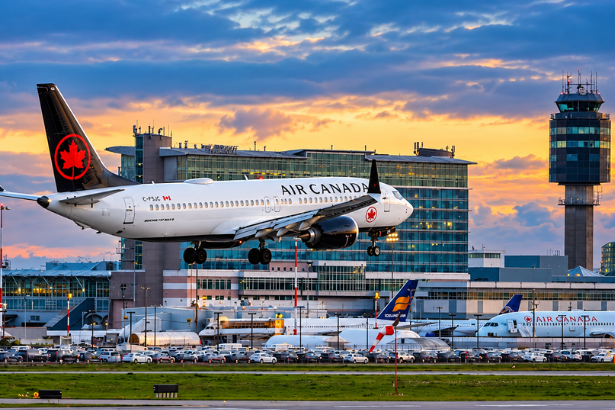
Air Canada flights to two U.S. destinations are being cut from future schedules, affecting travelers who rely on seasonal nonstop connections between Canada and smaller American markets. The airline has decided not to bring back its seasonal Toronto-to-Charleston route for summer 2027, while its nonstop Raleigh-Durham to Vancouver service has also been discontinued after the seasonal operation ended early in 2026. The changes reflect an airline adjusting capacity to match demand, rather than a nationwide shutdown of Air Canada service to the United States. (TheStreet report republished by eReadIT, Triangle Business Journal)
The Toronto-Charleston decision means Air Canada will no longer operate its seasonal direct service to Charleston International Airport in South Carolina in summer 2027. In North Carolina, Raleigh-Durham International Airport loses a nonstop route to Vancouver, a connection that also offered onward access to destinations across Asia.
For passengers, the practical consequences are straightforward: some trips may now require a connection, a different departure airport or another airline. For the aviation industry, the cuts are another example of how carriers adjust route networks when demand and operating economics change.
Background and Context: Why Air Canada Flights Are Being Cut
Airlines do not maintain routes simply because they connect two popular cities. They have to consider passenger demand, ticket revenue, aircraft availability, fuel prices, airport costs and whether an aircraft can earn more money on another route.
Seasonal flights can be particularly vulnerable. A route may perform well during a summer travel period but struggle to support service for a longer season. Airlines regularly revise their schedules when bookings and broader travel patterns fail to support the planned capacity.
Air Canada has said it regularly reviews its network to ensure capacity aligns with customer demand and travel patterns. That principle is central to both route decisions covered in the recent reporting. (Triangle Business Journal)
The backdrop is a period of uneven Canada-U.S. travel demand. Reporting by TheStreet, republished by eReadIT, cited Canadian government statistics showing that Canadian trips to the United States in September 2026 were down 29% compared with September 2024. Air travel was down 19% over the same comparison, while car crossings fell 31%. Those figures provide context for the market, but they do not establish that lower demand alone caused every route cancellation. (eReadIT/TheStreet)
Latest Update: Two Routes, Two Different Impacts
1. Toronto to Charleston will not return for summer 2027
Air Canada has decided to discontinue its seasonal Toronto Pearson International Airport to Charleston International Airport route for summer 2027. The decision ends a connection that had linked the Canadian city with South Carolina’s coastal tourism and business market.
According to TheStreet’s report, the route originally launched in 2001. It was later retired during the COVID-19 pandemic and returned for summer 2024. Toronto was Air Canada’s only route into Charleston, so the decision leaves the airline without that direct connection to the city. (TheStreet report republished by eReadIT)
Air Canada told Charleston’s The Post and Courier that it had made a commercial decision not to operate the seasonal route in summer 2027. Its stated approach was to align capacity with customer demand and travel patterns.
The loss matters for both directions of travel. Canadians heading to Charleston may need to connect through another city, while travelers in South Carolina lose a nonstop option to Toronto on Air Canada.
It does not mean every airline has abandoned Charleston, or that all flights between Canada and South Carolina have stopped. The reported decision concerns Air Canada’s Toronto-Charleston service.
2. Raleigh-Durham loses its nonstop Vancouver connection
Air Canada has also ended its seasonal nonstop service between Raleigh-Durham International Airport (RDU) and Vancouver International Airport (YVR). The route launched in 2025 and was suspended roughly two months earlier than originally planned during summer 2026. The airline has said it does not plan to operate the route next summer, although it regularly reviews future opportunities. (Triangle Business Journal)
This cut has a different effect from the Charleston decision. Vancouver was not only a destination for leisure travelers and business visitors. It also provided connections to other destinations, including parts of Asia.
The Triangle Business Journal reported that Air Canada continues to serve Raleigh-Durham with flights to Toronto and Montreal. So the airport is losing one international route, not all Air Canada service.
The decision also comes after WestJet ended its Raleigh-Durham service to Calgary, citing a notable decline in transborder travel demand, according to the same report. Together, the changes reduce direct connections between the Raleigh-Durham region and western Canada.
Quick comparison of the route changes
| Route | Latest reported decision | What it means for travelers |
|---|---|---|
| Toronto (YYZ) to Charleston (CHS) | Air Canada will not resume the seasonal route for summer 2027 | Travelers may need another airline or a connecting itinerary |
| Raleigh-Durham (RDU) to Vancouver (YVR) | Seasonal nonstop route ended, with no return planned for summer 2027 | Passengers lose a direct connection to Vancouver and its onward network |
| Raleigh-Durham to Toronto and Montreal | Air Canada service continues, according to local reporting | Travelers still have Air Canada connections to these Canadian hubs |
These are route-specific changes. Passengers should check their own booking details and the airline’s current schedule before making travel plans.
Expert Insights and Analysis: What the Route Cuts Tell Us
Route planning is about profitability, not just popularity
A destination may attract tourists and business travelers but still fail to generate enough revenue to support a particular nonstop service. Airlines must fill seats at fares that cover the cost of operating a route, while also considering whether aircraft and crews could be deployed more profitably elsewhere.
Air Canada’s stated position is that it reviews its schedules against demand and travel patterns. The route cancellations are consistent with that practice, although the available reporting does not provide a full financial breakdown for either route.
Smaller airports can feel network changes more sharply
Large international hubs generally offer travelers multiple airlines and connecting options. Smaller airports often depend on a handful of nonstop routes to provide convenient access to international markets.
When a route disappears, the alternative may involve a longer journey, a different connecting airport or an additional ticket. For businesses, that can add friction to meetings and travel budgets. For tourism operators, it may make a destination less convenient for visitors from a specific market.
The travel-demand picture is not uniform
A decline in some Canada-U.S. travel measures does not mean every route or destination is experiencing the same trend. Demand can vary by season, city pair, traveler purpose and fare level.
Air Canada is also continuing to adjust and expand parts of its network. Reuters reported on October 16 that Air Canada and United Airlines planned new transborder routes for summer 2027, including Toronto to Louisville, Montreal to Indianapolis and Edmonton to Newark. That illustrates how airlines can cut some services while adding others where they see a stronger commercial opportunity. (Reuters)
Broader Implications: What Travelers and Regional Businesses Should Know
The Air Canada route changes highlight the link between airline scheduling and local economic connections.
For travelers, nonstop service is about more than saving time. Direct routes can reduce the risk of missed connections, simplify itineraries and make short business trips more practical. When service disappears, passengers may need to build extra time into their plans or compare alternative airports.
For tourism businesses, fewer direct flights can reduce convenience for visitors from affected markets. Charleston’s tourism and hospitality sectors lose one seasonal connection to Toronto, while the Raleigh-Durham region loses a direct link to Vancouver and its connecting network.
Airlines, however, must balance regional connectivity with financial sustainability. Keeping a route that consistently underperforms can divert resources from other services. Route decisions therefore involve a trade-off between maintaining convenient connections and deploying aircraft where demand can support them.
For The Tech Marketer’s readers interested in how changing travel networks affect business, an internal companion article on airline route optimization and travel technology could provide useful context. Suggested internal link: The Tech Marketer. Replace this homepage link with a relevant published article URL before publication.
Related History: Airlines Have Long Adjusted Routes to Demand
Route cancellations are a normal part of commercial aviation, although the reasons differ from one case to another. Airlines change schedules in response to seasonal demand, operating costs, fleet availability, competition and shifting travel patterns.
The COVID-19 pandemic caused an extraordinary disruption to global aviation, leading airlines to suspend many routes and rebuild networks as restrictions and passenger demand changed. Since then, carriers have continued to reassess which routes justify year-round or seasonal service.
Air Canada has also been making broader network changes in response to costs. In an April 2026 update, the airline said higher jet fuel prices had affected the economics of some lower-profitability routes and that it was making schedule adjustments. It also said the total impact of those listed changes on planned annual capacity was approximately 1%. (Air Canada)
That earlier announcement is relevant background, but it should not be treated as proof that fuel costs were the direct cause of the Charleston or Vancouver decisions. The more recent reports emphasize route economics, customer demand and schedule planning.
What Happens Next?
Travelers and regional businesses should watch four developments:
- Summer 2027 schedules: Check Air Canada’s official booking system for the latest availability, since seasonal route plans can change.
- Alternative connections: Travelers from Charleston and Raleigh-Durham may need to compare connections through other Canadian or U.S. hubs.
- Other airlines’ schedules: The withdrawal of one carrier does not necessarily mean a route or destination has no alternatives. Availability depends on dates and current airline timetables.
- Cross-border demand: Further airline announcements and official travel statistics may help clarify whether these cuts are isolated commercial decisions or part of a wider network shift.
Anyone holding a ticket for an affected itinerary should contact the airline or booking provider directly. The reports establish that the routes are being discontinued or not returning as planned, but individual passengers’ options depend on their booking, dates and ticket terms.
Conclusion
Air Canada’s latest route changes affect two different travel markets: Toronto to Charleston and Raleigh-Durham to Vancouver. The Toronto-Charleston seasonal service will not return for summer 2027, while the RDU-Vancouver nonstop has been discontinued after its seasonal operation ended early in 2026.
The changes underscore how airlines continually weigh passenger demand against the cost and commercial value of individual routes. They also show how losing a single nonstop flight can affect a region’s access to international destinations and connecting networks.
For travelers, the immediate step is to verify schedules and compare alternatives before booking. For regional businesses, the longer-term question is whether other carriers or future schedule changes will restore some of the lost connectivity.
The broader story is not that Air Canada has stopped flying to the United States. It is that its network is being reshaped route by route, with some services ending while others continue or expand.
FAQ: Air Canada Flights and Route Cancellations
1. Which Air Canada flights are being cut?
The recent reports cover the seasonal Toronto-to-Charleston route, which will not return for summer 2027, and the Raleigh-Durham-to-Vancouver nonstop, which has been discontinued after the 2026 seasonal service ended early.
2. Is Air Canada ending all flights to South Carolina?
The reported change concerns Air Canada’s seasonal Toronto-to-Charleston service. It does not mean that all airlines have stopped flying to South Carolina or that all air travel to the state has ended.
3. Why is Air Canada canceling these routes?
Air Canada says it regularly reviews its network to align capacity with customer demand and travel patterns. Reporting also describes broader weakness in some Canada-U.S. travel markets. The available sources do not establish one single cause for both route decisions.
4. Will Air Canada still fly from Raleigh-Durham?
Yes. The Triangle Business Journal reports that Air Canada continues to serve Raleigh-Durham with flights to Toronto and Montreal. The seasonal nonstop route to Vancouver is the service being discontinued.
5. What can travelers do if their nonstop route is no longer available?
Compare connecting itineraries, other airlines and alternative departure airports. Passengers with existing bookings should check directly with the airline or travel provider to understand any rebooking or refund options that apply to their ticket.
6. Does the loss of these flights mean Canada-U.S. travel is collapsing?
No. The reported route cuts show that some services are being withdrawn, while other routes are being added or expanded. Travel demand varies by destination, season and traveler type, so individual route changes should not be treated as a complete picture of the market.
7. Could Air Canada restore these routes later?
Air Canada has said it reviews route opportunities regularly. That leaves open the possibility of future changes, but the available reports do not confirm a restart date for either service.
Sources & References
1. Veronika Bondarenko, TheStreet, republished by eReadIT. “Air Canada cancels all flights to U.S. state due to low demand.” October 21, 2026. https://www.ereadit.com/air-canada-cancels-all-flights-to-u-s-state-due-to-low-demand/
2. Lauren Ohnesorge, Triangle Business Journal. “Air Canada ends nonstop RDU-Vancouver flight.” October 20, 2026. https://www.bizjournals.com/triangle/news/2026/10/20/air-canada-ends-rdu-vancouver-flight.html
3. The News & Observer. “RDU loses another nonstop flight to Canada amid pullback in cross-border travel.” October 20, 2026. https://www.newsobserver.com/news/business/article317696507.html
4. Reuters. “Air Canada, United Airlines to expand Canada-US network with new summer routes.” October 16, 2026. https://www.reuters.com/business/air-canada-united-airlines-expand-canada-us-network-with-new-summer-routes-2026-10-16/
5. Air Canada. “Cost of fuel and the impact to Air Canada’s schedule.” April 23, 2026. https://www.aircanada.com/media/cost-of-fuel-and-the-impact-to-air-canadas-schedule/