AI infrastructure manufacturing is emerging as an important growth opportunity for U.S. industry in 2026. As technology companies expand their data center capacity to train and run artificial intelligence models, demand is spreading into sectors that have traditionally operated far from Silicon Valley. Factories producing electrical equipment, industrial generators, turbines and specialized components are increasingly connected to the AI investment cycle.
A recent report from The Washington Post, published October 7, describes how data center construction is supporting manufacturing jobs and demand for industrial equipment, including gas turbines, wiring and electrical switchboards. It also highlights a less comfortable reality: the boom could create new economic vulnerabilities if investment slows or expected AI returns fail to materialize. Read the Washington Post report. <Cite refs={[“turn248243search0”]}/>
For U.S. manufacturers, the opportunity is bigger than selling components to technology companies. It includes expanding production capacity, modernizing factories, developing specialized supplier relationships and investing in the skilled workforce needed to build increasingly complex industrial systems.
But demand alone does not guarantee lasting growth. Manufacturers must balance new orders against long equipment lead times, energy constraints, supply-chain exposure and the possibility that data center spending could eventually cool.
Background and Context: Why AI Is Becoming a Manufacturing Story
Artificial intelligence depends on physical infrastructure. Behind every AI service is a network of computing equipment, data centers, cooling systems, electrical distribution equipment and power sources. These facilities require large amounts of specialized hardware, much of which must be manufactured, transported, installed and maintained.
That creates opportunities for manufacturers outside the traditional technology supply chain. Electrical switchboards distribute power. Transformers and related equipment help connect facilities to electrical networks. Generators provide backup or dedicated power. Turbines can be used in gas-fired generation, while wiring, control systems and cooling equipment help keep data centers operating.
The Washington Post reports that employment in manufacturing categories connected to data center equipment, including gas turbines and electrical components, has been among the more resilient areas of manufacturing employment in recent years. It also describes rising wages for some specialized electrical-component jobs. <Cite refs={[“turn248243search0”]}/>
This demand is arriving as the United States faces a broader industrial challenge: expanding domestic production while managing costs, labor availability and competition from overseas suppliers.
The AI buildout gives some manufacturers a new source of orders. It does not, however, mean that every U.S. factory will benefit equally. Companies positioned to make high-demand components, meet demanding technical standards and deliver on time are likely to be better placed than suppliers without the required capacity or certifications.
Latest Update: Five Ways AI Infrastructure Is Creating Manufacturing Opportunities
1. Electrical equipment manufacturers are gaining new demand
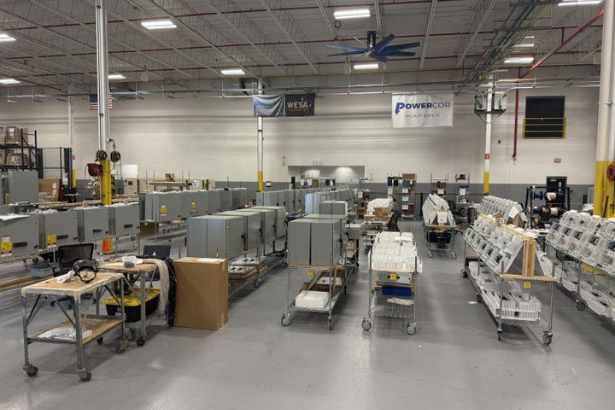
AI data centers require dependable electricity and complex distribution systems. That creates demand for equipment used to control, protect and distribute power, including switchboards, electrical assemblies, wiring and related components.
For manufacturers, this demand can support production expansion, investment in automated assembly and deeper relationships with engineering and construction firms working on data center projects.
The opportunity is particularly relevant to companies that already serve industrial, commercial or utility customers. They may be able to adapt existing products and manufacturing capabilities for data center projects, although customer specifications, safety standards and qualification requirements still apply.
The challenge is timing. Manufacturers may need to invest in labor, tooling and additional production space before they can fulfill a large order. Businesses should therefore evaluate customer commitments and the cost of expansion rather than assuming that the current pace of demand will continue indefinitely.
2. Industrial generators and gas turbines are becoming strategically important
One of the clearest examples of AI infrastructure spilling into traditional manufacturing is the renewed interest in power-generation equipment.
The Washington Post reports that some data center developers are building on-site power generation to secure electricity more quickly or reduce dependence on constrained grid connections. The article describes industrial gas turbines and generators as increasingly important equipment, with long waiting times for popular models. <Cite refs={[“turn248243search0”]}/>
This can create opportunities for turbine manufacturers, generator producers, component suppliers, precision-machining businesses and companies that provide maintenance services.
However, the demand also highlights a bottleneck. If equipment takes years to arrive, data center projects can face delays even when financing and construction plans are ready. Manufacturers capable of delivering reliable equipment and servicing it over its operating life may be well positioned, provided they can scale without compromising quality.
3. Data center construction is creating a wider industrial supply chain
The manufacturing impact does not end at the equipment manufacturer. Data center projects require materials, electrical systems, structural components, cooling equipment, backup power and controls. Those needs connect a technology investment to a much broader network of industrial suppliers.
Potential beneficiaries include:
- Electrical component and switchgear manufacturers.
- Industrial generator and turbine suppliers.
- Metal fabricators and precision-machining companies.
- Cooling and thermal-management equipment makers.
- Industrial controls and power-management suppliers.
- Maintenance, testing and equipment-service providers.
The actual opportunity depends on the supplier’s product range and qualifications. A manufacturer that serves a neighboring industrial market may be able to enter the data center supply chain, but it will need to meet the customer’s technical, reliability and delivery requirements.
For smaller U.S. manufacturers, working through established equipment makers, engineering contractors and approved supplier programs may be a more practical route than pursuing large data center operators directly.
4. Rising electricity demand creates both orders and constraints
The AI boom is also changing the energy outlook. The U.S. Energy Information Administration expects U.S. electricity consumption to set new records in 2026 and 2027, with data centers among the factors driving higher demand. Reuters reported on the EIA outlook on October 6. Read the Reuters report. <Cite refs={[“turn248243news51”]}/>
For manufacturers, greater power demand can generate business for electrical equipment, generation systems, grid components and industrial energy-management solutions. It can also create a more difficult operating environment.
Factories need electricity too. Higher energy prices, grid constraints or delays in connecting new facilities can increase operating costs and slow expansion. Manufacturers considering new production lines should assess power availability, connection timelines and energy costs as part of their investment decisions.
The companies best placed to benefit may be those that help solve the infrastructure problem itself, particularly manufacturers supplying equipment that improves power distribution, reliability and efficiency.
5. Domestic manufacturing opportunities come with global dependencies
The U.S. AI infrastructure buildout can support domestic factories, but the equipment supply chain remains international. Advanced semiconductors, servers, networking hardware and other components may come from overseas suppliers.
Reuters commentary published October 13 argues that substantial AI-related investment is flowing into imported hardware, which can limit how much of the spending translates into domestic economic output. Read the Reuters analysis. <Cite refs={[“turn248243news47”]}/>
That distinction matters for manufacturers and policymakers. A data center built in the United States does not automatically mean that all of its equipment was made domestically. The strongest domestic opportunities may be in products where U.S. suppliers can compete on lead time, service, customization, technical requirements and total delivered cost.
For manufacturers, the strategic goal should be to identify the parts of the value chain where they have a defensible advantage, not to assume that every dollar invested in AI will become a U.S. factory order.
Expert Insights and Analysis: Turning AI Demand Into Sustainable Factory Growth
The central question for manufacturers is whether the current wave of AI infrastructure investment can become a durable source of business rather than a short-lived surge.
Three considerations should guide investment decisions.
First, separate committed demand from forecasts. Announced data center projects and industry spending plans can signal opportunities, but manufacturers should distinguish binding orders from preliminary discussions and long-range estimates. Production expansion is expensive, and capacity built around overly optimistic assumptions can become a burden if projects are delayed.
Second, invest in bottlenecks, not just output. Additional manufacturing space will not solve every constraint. Skilled labor, specialized tooling, quality testing, component availability and electricity can all limit production. A focused investment in the hardest-to-source component or a process that improves throughput may deliver more value than a broad factory expansion.
Third, plan for customers’ operating requirements. Data center equipment must often meet strict requirements for reliability, safety and service. Manufacturers that can document quality, provide traceability, maintain consistent lead times and support equipment after installation can build stronger supplier relationships.
The opportunity is real, but it is not automatic. The manufacturers most likely to benefit are those that connect capacity investments to credible customer demand and build capabilities that remain useful beyond the current AI spending cycle.
Broader Implications: AI Could Reshape the U.S. Industrial Economy
The AI investment cycle is changing the relationship between the technology sector and traditional industry. Data center developers may be technology companies, but their projects create demand for factory equipment, construction services, energy infrastructure and skilled trades.
That can support employment in industrial regions and provide manufacturers with new markets. It can also encourage investment in automation, digital monitoring and more sophisticated production processes as companies work to increase output and meet tighter specifications.
There are important risks. If AI infrastructure spending slows sharply, suppliers that expanded too aggressively could be left with excess capacity. Regions dependent on data center construction could feel the impact, while manufacturers may struggle to redirect specialized equipment to other markets.
Electricity demand is another broader concern. New industrial activity can create jobs and investment, but power constraints and rising costs may affect other businesses and households. Policymakers and utilities will need to balance new demand with reliability, affordability and long-term infrastructure planning.
Internal link suggestion: Link the phrase “AI in smart manufacturing” to a related industrial automation, predictive maintenance or manufacturing technology article on The Tech Marketer. Replace the homepage URL with the exact published article link before publication.
Related History: From Semiconductor Manufacturing to the Data Center Supply Chain
Previous technology investment waves have also created demand beyond the companies selling the end product. The expansion of computing, telecommunications and internet infrastructure supported manufacturers of networking equipment, power systems, electronic components and industrial hardware.
The AI buildout follows a similar pattern, but its energy needs make the infrastructure dimension particularly visible. Data centers need computing equipment, but they also require dependable electricity, cooling, monitoring and physical facilities. That creates a wider industrial footprint than a software-only investment might suggest.
There is an important difference between building a domestic manufacturing base and simply building infrastructure domestically. A data center can be located in the United States while relying on imported servers, chips and specialized equipment. The long-term industrial benefit depends on which parts of the supply chain domestic manufacturers can competitively supply.
For manufacturers, the lesson is to look for durable capabilities rather than chase a single technology trend. Electrical engineering, precision production, quality assurance, industrial controls and equipment servicing can support multiple markets even if AI-related spending eventually normalizes.
What Happens Next?
Over the coming months, manufacturers should watch whether announced AI infrastructure projects turn into purchase orders, factory output and sustained supplier revenue.
Several indicators are worth tracking:
- New data center projects: Monitor which projects are funded, permitted and moving into construction rather than relying solely on announcements.
- Equipment lead times: Track availability for generators, turbines, switchgear, transformers and other critical components.
- Manufacturing orders: Review official U.S. data on new orders for manufactured goods and electrical equipment.
- Electricity supply: Follow grid-connection timelines, utility investment and regional power costs.
- Labor availability: Assess whether qualified technicians, electricians and manufacturing workers are available to support expansion.
- Customer concentration: Evaluate how much revenue depends on a small number of AI infrastructure customers.
- Domestic sourcing: Identify where U.S. production can compete on lead time, service, customization and cost.
The key test is whether demand becomes a stable industrial market. If manufacturers can secure repeat orders, manage investment risk and develop capabilities that serve multiple customers, AI infrastructure could become a meaningful growth channel. If projects are delayed or investment pulls back, companies with concentrated exposure could face a difficult adjustment.
Conclusion
AI infrastructure is creating new opportunities for U.S. manufacturers by increasing demand for electrical equipment, industrial generators, turbines, wiring and specialized components. The benefits are spreading beyond the technology sector into factories, industrial suppliers and skilled trades.
But the boom comes with real constraints. Electricity availability, long equipment lead times, labor shortages, imported components and the possibility of an AI investment slowdown all affect how much value U.S. manufacturers can capture.
The strongest strategy is not to bet blindly on endless data center expansion. It is to identify products with credible demand, invest in the capabilities that customers need, and build supplier relationships that can endure beyond one investment cycle. AI may be a software revolution, but its industrial future will depend on the factories, equipment and infrastructure that make it possible.
FAQ
How is AI infrastructure creating opportunities for U.S. manufacturers?
AI data centers need electrical equipment, generators, turbines, wiring, cooling systems and other industrial components. Manufacturers that can meet technical requirements and deliver reliably may gain new customers and opportunities to expand production.
Which manufacturing sectors could benefit most from AI data center investment?
Electrical equipment, power-generation systems, industrial controls, precision machining, metal fabrication, cooling equipment and component servicing are among the areas with potential opportunities. Actual demand varies by project and supplier qualification requirements.
Why are gas turbines and industrial generators important to AI infrastructure?
Data centers need dependable electricity. Some developers are pursuing on-site power generation to address grid constraints or project timelines, increasing interest in generators and gas turbines. The economics and environmental effects depend on the technology and how it is used.
Does AI infrastructure investment automatically create U.S. manufacturing jobs?
No. Domestic construction can support U.S. manufacturing and skilled trades, but some equipment and components are imported. The domestic employment impact depends on which parts are produced in the United States and how much local supplier capacity is used.
What risks should manufacturers consider before expanding for AI demand?
Risks include project delays, overcapacity, customer concentration, long equipment lead times, energy constraints, labor shortages and a potential slowdown in AI infrastructure spending. Manufacturers should distinguish confirmed orders from speculative forecasts.
How can small manufacturers enter the AI data center supply chain?
They can identify components they already produce that meet data center requirements, seek relationships with established equipment makers and contractors, and invest in quality systems, traceability and delivery reliability. Technical certification and supplier approval may be necessary.
Will the AI manufacturing boom continue through 2027?
The outlook depends on continued investment, the availability of power and equipment, and whether data center operators can generate returns from their spending. Current demand creates opportunities, but it does not guarantee that growth will continue at the same pace.
Sources & References
- Shira Ovide, “The unexpected ways that AI is reshaping the U.S. economy.” The Washington Post, October 7, 2026. Read the article.
- Reuters, “US power use to beat record highs in 2026 and 2027 as AI use surges, EIA says.” October 6, 2026. Read the report.
- Reuters, “AI may be rocket fuel for US stocks, less so for GDP.” October 13, 2026. Read the analysis.
- U.S. Census Bureau, “Economic Indicators: Industrial Production and Manufacturing.” View current manufacturing indicators.
- U.S. Energy Information Administration, “Short-Term Energy Outlook.” Review U.S. energy forecasts.